Energy Shots: Middle Distillates and the Middle East
August 21, 2026 • 9:30 – 10:00 am EDT

Photo: Antoine Boureau/Hans Lucas/AFP/Getty Images
Rice is Japan’s staple food, and it reaches nearly every dinner table in the country. In early 2024, a five-kilogram bag of rice cost the average Japanese household about ¥2,000 ($13). A year later the price had nearly doubled, reaching its highest level in decades (see Figure 1). The political reaction came quickly. In May 2025, the agriculture minister resigned after saying he had never bought rice with his own money, a remark widely seen as out of touch. Rice prices became a national issue and a factor in that year’s elections. Since then, prices have peaked and eased somewhat, though they remain much higher than before the surge. Continued high rice prices have also added to the recent rise in the cost of living, pushing the government to cut the consumption tax on food despite fiscal concerns.
The surge exposed an issue that Japan had mostly overlooked. For decades, its food security debate centered on a single fear: that the country’s heavy dependence on imports would leave it vulnerable if supply were ever cut off. The current rice crisis raises a different question: Can an ordinary household reliably afford its daily food? Japan must address two different problems: how to guarantee national self-sufficiency during a crisis and how to ensure household food security in everyday life. To effectively balance these goals, the Japanese government should focus on strengthening agricultural production capacity through policies that promote the effective use of different types of farmland, create safety nets for farmers during price downturns, and support the adoption of technologies that lower production costs.
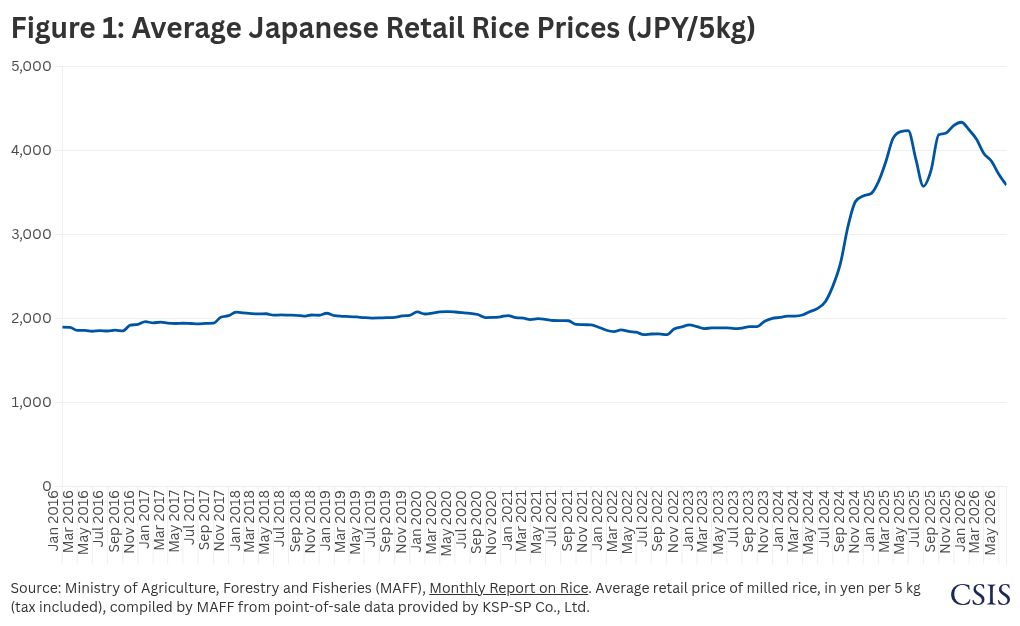
According to a report by the Japanese Ministry of Agriculture, Forestry and Fisheries (MAFF), several forces working simultaneously pushed rice demand above supply. The government’s demand forecasts had assumed a continued decline in line with a shrinking population, but consumption instead rose, driven by inbound tourism and higher household purchases. On the supply side, extreme summer heat lowered milling yields, so more brown rice was needed to produce the same amount of table rice. Production fell short of demand, and private stocks had to be drawn down to make up the gap.
This gap in supply and demand was not large, but the change in price was, partly due to how staple crops behave. In general, demand for rice has low price elasticity: When the price rises, households cut back only a little rather than sharply, because rice is not something easily dropped from the daily diet. Because demand barely falls, a small gap between supply and demand can move prices sharply.
Long-standing Japanese government rice policy may also have played a part. For decades, Japan has managed rice supply to match projected demand, holding output down so that prices would not collapse. The government stopped assigning production targets to each region and farmers in 2018, but it still pays them to shift paddy fields from rice to other crops such as wheat, soybeans, and feed grains. Due to these constraints, supply remained tight and could not easily absorb an unexpected jump in demand.
As a short-term measure, the Japanese government released rice from its emergency reserves, beginning in March 2025. But prices did not fall right away: The released rice was slow to reach store shelves, and much of the effect took months to show up in what shoppers actually paid.
The long-term question for the government was whether Japan should produce more rice overall. In August 2025, the Ishiba administration announced a shift toward higher production to bring prices down. However, two months later, under the Takaichi administration, Agriculture Minister Norikazu Suzuki pulled back, framing the goal as production aligned with demand rather than expansion. Both positions have a logic to them. Growing more rice lowers prices and helps households, but it also drives farmers out of business and therefore takes paddies out of use. Growing less protects farmers but pushes prices back up, causing hardship for consumers.
One option the government did not take was to allow more foreign rice into the Japanese market. Normally, imports would fill the gap and cap a price spike. But Japanese rice imports are restricted by a World Trade Organization (WTO) import quota; any imports above this quota are subject to a tariff of ¥341 per kilogram, which mostly keeps foreign rice out. The quota allows about 770,000 tons a year, and even the 2025 U.S.-Japan trade deal only raised the U.S. share within that quota rather than opening the market. Of that amount, at most 100,000 tons are sold as staple rice, while the rest is directed to processing, feed, and other uses. A finance ministry panel has suggested making greater use of imported rice when supply is at risk. Since the 100,000-ton limit is set domestically, Japan could in principle allocate more of the quota to staple rice without renegotiating its WTO commitments. However, the government has stayed cautious overall, apparently concerned about the impact on domestic production.
The issue is complicated because rice plays two roles at once. Paddy fields and rice farms are the core of Japan’s domestic food supply: More than half of Japan’s farmland is paddy and more than half of its farms primarily grow rice. At the same time, rice is what households eat every day. Price ties the two together. A high price keeps farmers on the land but strains households; a low price relieves households but drives farmers off their land. Steering the price cannot serve both, so the real question for the government is not how to set the price, but what else policy can do for food security.
Japan’s food security has usually been measured by one number: the self-sufficiency rate, the share of calories the country produces for itself. At about 38 percent, Japan’s is the lowest in the G7, and it is often treated as a warning. However, self-sufficiency is an imperfect measure of food security. Researchers have long noted that a country can score high on the ratio and still not be food secure. Self-sufficiency and food security are not the same thing.
In normal times, indeed, imports are what keep food affordable. Japan was the fourth-largest market for U.S. agricultural exports in 2025, buying about $13 billion in farm goods such as corn, beef, pork, and soybeans, with Australia and Canada supplying much of the rest. Export restrictions among such trusted suppliers are rare. Japan can rely on them in normal times and need not emphasize self-sufficiency at the expense of households.
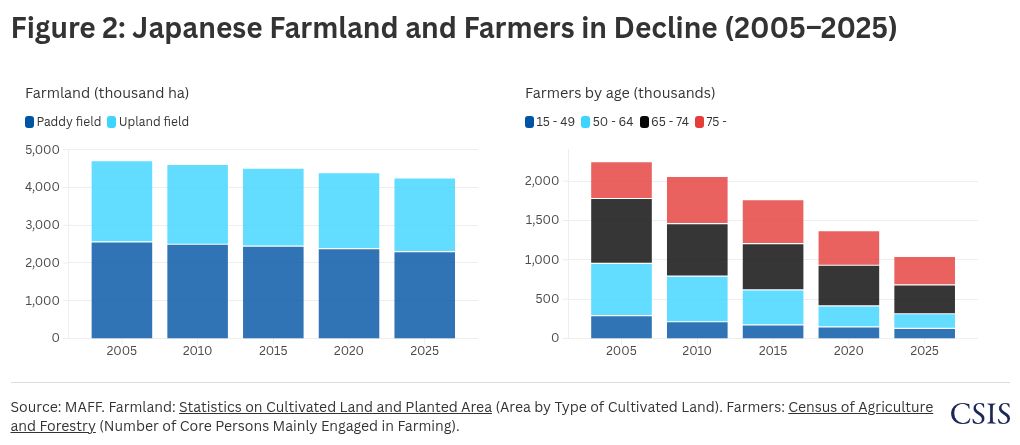
What matters instead is production capacity for a crisis. If imports were ever cut off, whether by a regional conflict, a blocked shipping lane, or a pandemic, the country would have to feed itself. That capacity rests on farmland, farmers, and technology, and it can only be built in advance. MAFF’s own estimate is alarming: With today’s production capacity, a complete cutoff of imports would leave Japan unable to meet its people’s daily calorie needs, unless farmland were shifted to potatoes and other high-calorie crops on a national scale. However, the capacity upon which Japan would rely in a crisis is quietly eroding in peacetime: Farmland is decreasing, and the farming population is shrinking and growing older (see Figure 2).
Strengthening agricultural production capacity could help on the household side as well. A stronger production base would allow steadier output at lower cost, easing prices in normal times and proactively preparing for times of crisis. Protecting production capacity may thus serve both ends at once, while price is left to the market.
To protect agricultural production capacity, the Japanese government must engage directly with the three foundations on which it rests: farmland, farmers, and technology.
Farmland: Protect the Right Land, for the Right Reason
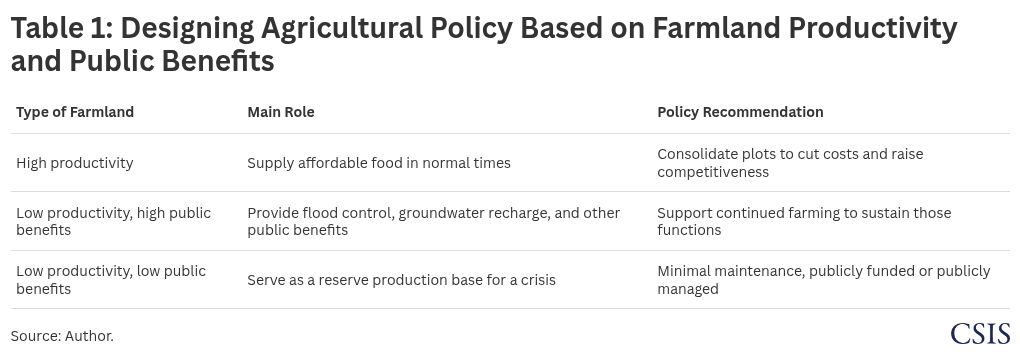
All farmland contributes to production capacity, but not all of it should be treated the same way in government policy (see Table 1). For example, productive flatland is easier to keep in use, as successors are more readily found and the risk of abandonment is relatively low. In this case, the government should focus on consolidating plots into larger, lower-cost operations. Lower costs raise competitiveness and keep food affordable.
In contrast, less productive land is more likely to fall out of use, yet it can still deliver great public benefits—known as multifunctionality—such as flood control, groundwater recharge, scenic landscapes, and biodiversity. Therefore, this land deserves support from the government to keep it farmed and preserve those functions. Some of this support already exists: Direct payments for hilly and mountainous areas have been in place since 2000, and evidence suggests they have slowed the abandonment of farmland. Another payment scheme supports the multifunctionality of farming more broadly. Ideally, such payments would be tied more closely to the specific benefits each type of land provides, measured and supported accordingly.
In the case of land that is neither productive nor rich in public benefits, government policy should focus on maintenance, so the land is ready as a reserve in a crisis. Since farmland is hard to restore, it should not be abandoned. Even basic maintenance is a challenge, however. MAFF’s survey found that over 30 percent of farmland has no identified successor a decade from now.
Farmers: A Safety Net that Switches On Only in Downturns
Japan’s farmers are aging fast. The average farmer is now in their late sixties, and the farming population has roughly halved in two decades (see Figure 2). Some further decline is unavoidable, and consolidation into larger operations is part of the answer. But scale alone will not keep committed farmers in business or bring new entrants in. That requires income stability.
One option is a safety net that activates only when prices fall below a set floor that covers production costs to a reasonable degree without overly distorting the market. This safety net would cushion farmers in downturns and make farming a safer career to enter, while leaving the market alone when prices remain above the support floor, so households are not overcharged in normal times. The U.S. Price Loss Coverage program offers a useful model. Although setting the appropriate floor is difficult, Japan may be able to use a recently established reference point as a basis: In April 2026, a government-authorized body published a national cost indicator for rice, putting total costs from production through retail at ¥2,816 ($18) per five kilograms of milled rice.
Technology: Cooperate with the United States to Cut Costs
Lower production costs are the one path that serves both goals at once: cheaper food for households and more viable farms. Japan can learn from the United States. For example, precision agriculture is widely used in the United States but is only beginning to spread in Japan. Similarly, direct seeding is standard in the United States and helps cut costs, while in Japan nearly all rice is still transplanted. Both techniques can reduce operational costs, and deeper cooperation with the United States on farm technology would give Japan a way to keep rice affordable without squeezing its farmers.
The rice price shock should be a wake-up call for Japan to rethink its approach to food security. Japan should invest in the farmland, farmers, and technology needed to maintain its production capacity for a crisis. A stronger production base would make Japan more resilient in emergencies while also helping keep food affordable in normal times.
Ryosuke Inoue is a visiting fellow from Mitsubishi UFJ Research and Consulting Co., Ltd., with the Japan Chair at the Center for Strategic and International Studies in Washington, D.C.

Commentary by Kristi Govella — September 9, 2025

Commentary by Taisuke Kassai — January 27, 2026

Commentary by Makoto Tsujiguchi — January 13, 2026