Energy Shots | Cold Front Incoming: Can Energy Markets Weather Russia-Iran Sanctions?
September 18, 2026 • 10:00 – 10:30 am EDT
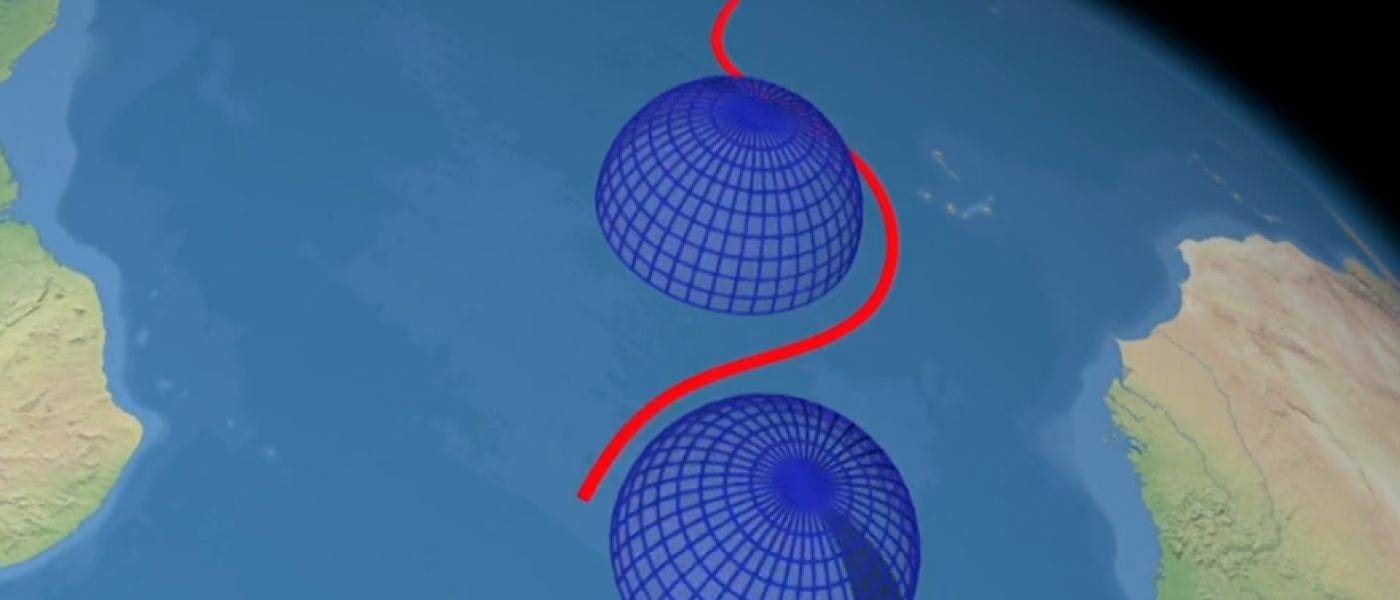
Screenshot from Vladimir Putin's 2018 presentation unveiling the Burevestnik, illustrating its ability to evade maritime missile defenses.
Photo: Russian State Media
Vladimir Putin claimed that Russia recently completed the successful test of a new nuclear-powered and nuclear-armed missile, Burevestnik (which translates as “Storm Petrel”), calling it “a unique weapon that no other country possesses.” Because of its onboard nuclear power, the weapon has, in principle, a nearly unlimited range. Putin alleged that the test lasted around 15 hours, with the missile traveling more than 14,000 kilometers. The Norwegian government confirmed that the test flight launched out of Novaya Zemlya, an archipelago off the northern coast of Russia.
The development of such a capability has implications for U.S. strategy to deter Russian aggression and missile defense. In response to the test, President Trump announced the resumption of U.S. nuclear weapons testing. Is the Burevestnik a new and significant threat, or is it merely autocratic saber-rattling?
Q1: What is the operational status of the Burevestnik?
A1: The Burevestnik has not yet been fielded, but Putin called for the armed forces to move from development toward an operationalization phase, instructing them to “determine which class of weapons this new system belongs to, identify possible modes of employment, and begin preparing the infrastructure to base it in our Armed Forces.”
This will not happen overnight. As Putin added, “substantial work has to be done in order to place this weapon on combat duty.” To do so, however, Russian forces will not be starting from scratch. Russian state media has since reported that the missile can, with modifications, be integrated into existing launchers for the Iskander and Oreshnik missiles. Those two missiles have been operational since 2006 and 2024, respectively.
Q2: Why does Russia claim it needs this type of weapon?
A2: Russian advances in offensive nuclear capabilities have often been justified as necessary to maintain the ability to strike the U.S. homeland following American investments in missile defense. Most recently, the announcement of the Golden Dome missile defense initiative, which intends to refocus U.S. homeland defenses on great-power competitors, was greeted with condemnation from the Kremlin.
This argument is central in the case of the Burevestnik. Just weeks before the recent test, on September 22, Putin invoked Golden Dome—specifically the pursuit of space-based interceptors—to say that it “could nullify our efforts to maintain the status quo in the field of strategic offensive arms,” adding that Russia “will respond appropriately in this case.” While he did not explicitly reference Golden Dome in his announcement of the Burevestnik test, Putin touted the new missile’s ability to evade missile defenses.
Putin’s concern about U.S. missile defense did not begin with Golden Dome. In 2018, Putin stated that the Burevestnik and several other new strategic weapons were necessary to preserve strategic stability, citing the 2002 withdrawal from the Anti-Ballistic Missile (ABM) Treaty as destabilizing, a claim he has used repeatedly.
Putin’s invocation of the threat from missile defense advancements is at odds with his own remarks from 2001. At that time, he stated that the U.S. departure from the ABM treaty would not disrupt mutually assured destruction between the two states, saying, “As is known, Russia, like the United States and unlike other nuclear powers, has long possessed an effective system to overcome anti-missile defense. So, I can say with full confidence that the decision made by the President of the United States does not pose a threat to the national security of the Russian Federation.”
Q3: What does the Burevestnik have to do with missile defense?
A3: Russia is incentivized to loudly decry U.S. missile defense efforts as destabilizing. Nevertheless, it is difficult to accept the narrative that U.S. missile defense investments are the root cause of the Russian decision to expand their offensive capabilities, especially when the United States has repeatedly attempted to accommodate Russian concerns.
The intended effect of the U.S. departure from the ABM treaty was not the defeat of Russian capabilities—the departure enabled the United States to pursue homeland missile defense capabilities to protect against threats from rogue states. U.S. leaders pursued a number of confidence-building measures in parallel, including continued dialogue to bilaterally reduce offensive forces, increase transparency, and cooperate on joint missile defense exercises and development programs.
The United States further accommodated Russian concerns in the New Strategic Arms Reduction Treaty (New START) in 2010. Article V of the treaty bans the conversion of offensive launchers for missile defense interceptors, a response to Russian concerns about the U.S. ability to reconvert silos to house missile defense interceptors, thereby reducing the time it would take to deploy additional offensive intercontinental ballistic missiles (ICBMs) beyond the number allowed under New START.
The international environment has fundamentally changed since 2010, and not as a result of U.S. behavior, but of Russian aggression. The past 15 years have been rife with examples of Russian and Chinese nuclear modernization and force expansion, Russian aggression in Ukraine and elsewhere along its borders, and Russian nuclear saber-rattling to influence Western decisionmaking. A new era of great-power competition has begun, and the United States is adapting to an evolving threat environment. Adapting U.S. missile defense to deal with missile threats from across the spectrum is a reactive measure necessary to contend with Russian aggression.
While it is true that the focus on missile defense will enhance the security of the U.S. homeland, it is unreasonable to assert that it would eliminate Russia’s second-strike capability, with or without nuclear modernization and expansion. To be sure, Golden Dome will protect selected assets in the United States. It will not, however, be an impenetrable shield rendering the entire United States invulnerable.
The Golden Dome and other missile defense efforts contribute to de-escalation and stability, not the opposite. The strategic logic of the case is demonstrated by how the Russian military views its own investments in air and missile defense. In a 2025 Valdai Discussion Club meeting, President Putin stated that Russian air defenses have continuously adapted to Western missile threats, including the (very short range) ATACMS missile, and signaled his commitment to strengthen the Russian air defenses against weapons like the Tomahawk cruise missile.
By no means will Golden Dome render nuclear weapons impotent and obsolete or disrupt strategic stability. On the contrary, a limited measure of air and missile defenses for the U.S. homeland—like Russian and Chinese air and missile defenses—contributes to deterrence by raising the threshold for attacks. Russia retains the ability to attack the United States with a significant number of its strategic forces, with or without these novel delivery systems.
Q4: Is this technology new?
A4: While the Burevestnik concept is relatively new to Russia, with reports of initial testing taking place around 2016, nuclear-powered cruise missiles are far from a novel concept. The United States pursued nuclear-powered ramjet technology between 1957 and 1964 through Project Pluto, a Cold War–era program aimed at developing a supersonic nuclear-powered cruise missile capable of striking deep into Soviet territory. The program achieved significant technical milestones, including successful ground tests of the nuclear-powered ramjet engine.
There are good reasons why nuclear-powered cruise missiles or aircraft have not been pursued much since then. Despite its theoretical promise, Project Pluto was ultimately canceled due to a myriad of unresolved environmental and safety concerns. Testing the system posed risks, including the accidental irradiation of populated areas and uncontrolled release of radioactive material into the atmosphere, among other environmental factors.
While the Burevestnik shares the technological legacy of Project Pluto, the two systems are not directly analogous. Project Pluto was particularly dangerous due to its unshielded reactor, which led to significant radiological leakage; advancements in the scientific understanding of radiation’s effects on the environment have evolved. However, these concerns persist with the testing of the Burevestnik missile: A 2019 test of the weapon likely resulted in the deaths of several Russian scientists.
Q5: Why are cruise missiles difficult to intercept?
A5: Unlike ballistic missiles, which follow high-altitude, predictable trajectories, cruise missiles travel at lower altitudes, closely following the contours of Earth’s terrain. This terrain-hugging flight profile allows them to remain under the radar horizon, reducing the defender’s reaction time to detect, track, and intercept the threat.
Radar search horizons are limited by the curvature of the Earth. A typical surface-based radar has a search horizon of around 40 kilometers for a target at typical cruise missile altitudes. A subsonic cruise missile first detected at the horizon could reach the radar site in just over two minutes. In contrast, in an intercontinental ballistic missile attack, decisionmakers have up to 30 minutes before the interceptor reaches its target to react.
These detection challenges span sensor phenomenologies. Cruise missiles do not have high thermal signatures. Space-based infrared sensors struggle to distinguish their low thermal signature against the Earth’s surface.
Cruise missiles are by no means unstoppable. Great numbers of cruise missiles have been intercepted, including in recent conflicts in Ukraine, Israel, and the Red Sea. Ordinarily, flying at lower altitudes, where the air is more dense, increases drag and the amount of fuel expended. There is also a higher risk of crashes into the terrain without sophisticated guidance technologies.
Nuclear propulsion solves one of these challenges because it reduces fuel limitations, enabling virtually unlimited range and sustained low-altitude flight without concern for efficiency. However, the challenge of navigating varied terrain persists—the risk of crashing a missile powered by a nuclear reactor before its intended target should raise concerns for both safety and collateral damage.
Q6: How does the Burevestnik compare to U.S. nuclear delivery systems?
A6: While Russia’s nuclear-powered, nuclear-capable cruise missile is grabbing headlines, the concept of deep, precision nuclear strike capability is not new. The foundational principle of the U.S. nuclear triad is to ensure a credible second-strike capability against nuclear-armed adversaries.
Nuclear submarines provide the advantage of survivability, as they are difficult to track and target. Intercontinental ballistic missiles present a targeting dilemma: They number in the hundreds, are dispersed, and can be launched within minutes, making a successful preemptive strike nearly impossible. The bomber leg of the nuclear triad leverages both stealth and range. Platforms like the B-2 Spirit stealth bomber can execute missions lasting up to 40 hours with aerial refueling and evade detection by adversary air defense systems, enabling them to deliver precision strikes deep into Russian territory.
The Burevestnik introduces a nuclear delivery system that combines the stealth and range of strategic bombers with the mobility and survivability of road-mobile platforms. Fundamentally, the weapon does not change the balance between the two states, nor does it affect Russia’s ability to hold the U.S. homeland at risk—the same mission can be effectively carried out using intercontinental ballistic missiles and other traditional nuclear weapons delivery systems.
Q7: What does Putin hope to gain from this test?
A7: The Burevestnik may still be a long way from operationalization; this test does not indicate that Russia intends to use the capability on the battlefield in Ukraine anytime soon. The repeated emphasis on the long range of the weapon and ability to overcome any missile defense system also indicates that the intended target would be the United States, not a regional adversary that Russia could strike with much cheaper shorter-range systems.
Putin is using this test to create fear in the United States to discourage U.S. decisionmakers from pursuing policies that threaten Russian interests. It could contribute to the pattern of nuclear saber-rattling to influence U.S. decisionmaking in one or more areas, including influencing U.S. weapons transfers and policies in negotiations for a peace deal in Ukraine and encouraging the United States to agree to a one-year informal agreement to follow New START numerical limits—without inspections.
Putin has demonstrated concern about long-range strikes into Russia since the full-scale invasion of Ukraine and before in 2019 and 2016. His outcry about Tomahawk missiles specifically and their destabilizing effects increased in early October 2025 after reports that the United States was considering sending a number of these missiles to Ukraine, which would allow the state to strike targets deeper in Russian territory. He called the move “a totally new stage in this escalation.”
Advocates for the transfer of Tomahawks to Ukraine argue that increasing Kyiv’s ability to strike new targets could be a game changer in the conflict. After a two-and-a-half-hour phone call on October 16 between Trump and Putin, the Trump administration reversed course on the proposition. However, the possibility of backtracking remains on the table for the United States.
Enter the Burevestnik. By testing a nuclear-armed cruise missile that could reach the U.S. homeland, Putin blurs the line between conventional and nuclear escalation to send a message about the potential response to a U.S. transfer of conventional Tomahawks or other long-range strike weapons to Ukraine.
The message Putin hopes to send to the United States with this test likely extends to bilateral nuclear arms control efforts as well. On September 22, Putin proposed that both sides unilaterally observe the New START agreement for an additional year after its expiration on February 5, 2026—but without the verification or inspection from the original agreement.
The Trump administration should examine the offer with caution. U.S. decisionmakers must ask what incentives are driving the Russian proposal. It is likely that Russia is facing a number of constraints limiting its ability to modernize and expand its nuclear forces in the absence of an agreement.
The New START treaty sets quantitative limits on three categories of strategic offensive forces: launchers, deployed delivery vehicles (exclusively of ICBMs, submarine-launched ballistic missiles [SLBMs], and deployed heavy bombers), and deployed warheads. The cruise missile would not be subject to the treaty because it does not meet the definition of a strategic offensive weapon, regardless of whether it is nuclear powered or nuclear armed.
With the Burevestnik, Putin could be looking to influence U.S. thinking about the state of Russian nuclear capabilities and its modernization efforts, making it appear that Russia could realistically modernize, diversify, and expand the numbers of its nuclear forces in the absence of a bilateral arms control agreement. The United States should be wary of Russia’s likely intent to use these kinds of tests and demonstrations to create fear among U.S. decisionmakers.
Patrycja Bazylczyk is a program manager and research associate with the Missile Defense Project at the Center for Strategic and International Studies (CSIS) in Washington, D.C. Hannah Freeman is a program coordinator and research assistant with the Missile Defense Project at CSIS.