Securing U.S. Interests in the 2026 USMCA Review: Building a Fortress North America
Photo: Jabin Botsford/The Washington Post via Getty Images
Available Downloads
Below please find public comments prepared by Diego Marroquin Bitar, Ryan C. Berg, and Christopher Hernandez-Roy, submitted to the Office of the U.S. Trade Representative (USTR) as part of the consultation process for the upcoming 2026 review of the USMCA.
The submission, “Securing U.S. Interests in the 2026 USMCA Review: Building a Fortress North America,” outlines concrete recommendations to ensure the agreement continues to deliver for American workers, strengthen supply chain security, and maintain North America’s position as the most competitive region in the global economy. The commentary puts forward concrete recommendations to deepen cooperation on critical minerals, investment screening, digital trade, and energy integration, translating this vision into actionable policy outcomes.
1. The Strategic Stakes
The 2026 USMCA review is a defining test of whether the United States can preserve jobs, strengthen technological leadership, and cement energy dominance in a volatile world. By enforcing commitments and targeting modernization, the U.S. can ensure North America delivers for American workers, secures supply chains, and remains the most competitive region in the global economy. In doing so, Washington can build a true Fortress North America that withstands external shocks and unfair competition from China.
Failure to modernize and preserve the USMCA would risk millions of American jobs, fractured supply chains, and weakened investment confidence. By leading a cooperative agenda with Mexico and Canada, the U.S. can demonstrate that North America is not only stronger together but also aligned behind U.S. leadership in a new era of global competition.
2. Key Metrics
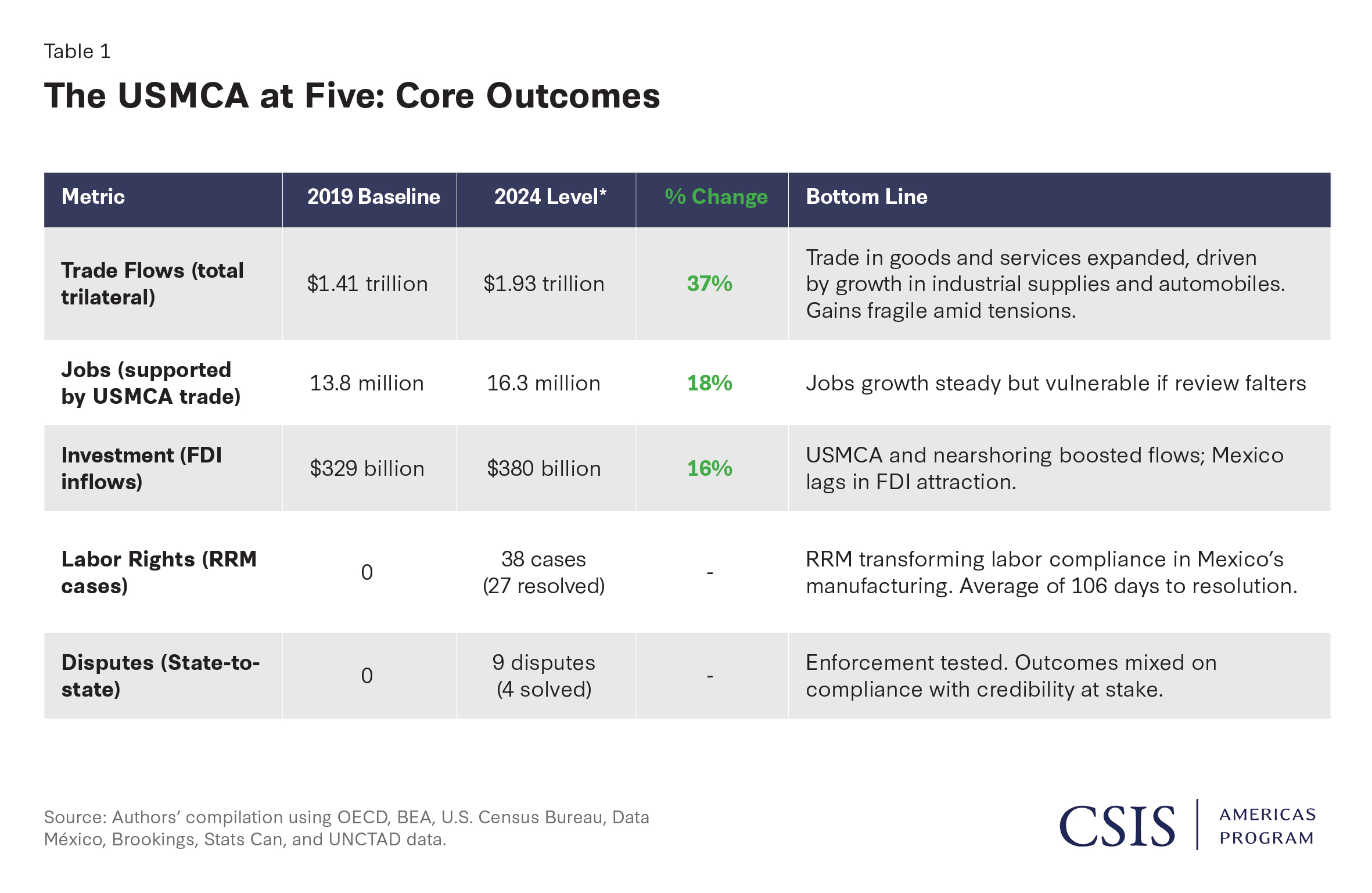
Five years on, the USMCA has delivered measurable results while exposing areas of fragility.
Trade and Investment Flows Supporting U.S. Workers and Small Businesses
- Since the USMCA took effect, intra-regional trade in goods and services has grown by 37 percent, driven largely by industrial supplies and the automotive sector and supporting millions of U.S. workers. In that time, Mexico has remained the United States’ fastest-growing, most stable export destination, closely followed by Canada
- Foreign direct investment (FDI) across the region rose by 16 percent (UNCTAD), with the United States remaining the world’s top FDI destination, attracting $278 billion in 2024.
Dispute Settlement Performance that Guarantees U.S. Exporters a Level-playing Field
- In its first five years, four state-to-state disputes advanced through panel proceedings with final rulings issued. This reflects a stronger commitment to enforceable rules. However, the United States has yet to comply with the automotive rules of origin ruling, and cases involving Mexico’s energy policy remain in consultations. These examples illustrate how political calculations continue to outweigh investor certainty.
Labor Rights Enforcement to Prevent Unfair Competition from Low-wage Practices
- The USMCA transformed Mexico’s labor compliance landscape through its Rapid Response Labor Mechanism (RRM). Between May 2021 and June 2025, the United States initiated 37 cases and Canada one. Twenty-seven were resolved successfully, producing a 71 percent resolution rate. While transformative in parts of the manufacturing sector, the USMCA falls short as a broader policy solution to Mexico’s structural productivity and formal employment challenges.
If the agreement were to weaken or lapse, North American manufacturing, especially in the automotive, aerospace and agricultural sectors, would suffer from higher costs and reduced efficiencies. Without preferential market access through USMCA, goods would face trade and regulatory barriers, making them more expensive for American consumers and less competitive in global markets. This would give an opening to rivals like China, which already competes aggressively in key sectors. Current economic emergency and sectoral tariffs limit consumer options and risk fueling inflation.
3. Keeping Sights High: Options to Deepen Cooperation
The 2026 USMCA review must be seized as an opportunity to modernize and strengthen the agreement and the United States’ leadership, not feared as a threat to job creation and regional competitiveness.
To secure the region’s economic and strategic interests, the three countries should focus on cooperative solutions that reinforce U.S. leadership and deepen North America’s competitiveness, resilience, and cohesion. To advance U.S. interests, the following priorities should guide the review:
- Secure critical minerals for U.S. industries. Negotiate a USMCA chapter, or side letter, to eliminate tariffs and align rules for mining and processing. Speeding up permitting will be key. Guarantee supply in times of crisis and streamline visas for specialized engineers.
Why it matters: U.S. manufacturing, from autos to defense, depends on reliable access to critical minerals. Recent Chinese export restrictions on rare earths and magnets underscore the need for secure regional supply chains. - Protect U.S. security through investment screening. The three countries should jointly monitor and manage national security risks from foreign investment. Mexico’s absence of an institutional screening mechanism makes regional coordination essential. Institutionalize investment coordination through a North American Economic Security Committee under UMSCA.
Why it matters: Protecting U.S. technology and infrastructure requires consistent rules across North America. - Build transparent and resilient U.S. supply chains. Launch a permanent regional dialogue for supply chain transparency. A digital “North American product passport” would track inputs in real time, protecting U.S. industries from unfair trade practices and forced labor. Together, these measures form the backbone of a Fortress North America that is resistant to external manipulation and coercion.
Why it matters: resilient and transparent supply chains protect U.S. jobs and reduce reliance on adversaries. - Cement U.S. energy dominance. Use the review to institutionalize energy cooperation through a North American Energy Business Council and by integrating energy into the USMCA Competitiveness Committee. Aligning infrastructure and regulatory priorities will sustain U.S. energy exports and innovation as key drivers of growth.
Why it matters: Energy security and export leadership are central to U.S. competitiveness and influence. - Lead in global digital economy. Modernize Chapter 19 or create a new chapter to cover artificial intelligence, data flows, and emerging technologies. Promote U.S. standards while tapping Mexico’s growing digital ecosystem.
Why it matters: U.S. leadership in technology ensures that American companies and workers set the rules rather than competitors abroad. - Deepen North American financial integration. Expand cross-border banking options, ensuring more seamless operation in the three countries and adhering to a common regulatory framework which would facilitate anti-money-laundering efforts.
Why it matters: Stronger financial integration reduces costs for U.S. businesses, expands access to capital, and strengthens defenses against illicit flows.
The 2026 review is an opportunity for the United States to lock in job creation, secure technological leadership, and cement energy dominance while maintaining fair and reciprocal trade with Canada and Mexico.
Each day of uncertainty leading up to the agreement’s review and after July 1, 2025, acts as a silent tax on competitiveness, job creation, and trust in the region’s economic governance. If approached strategically, the review can transform the USMCA into the cornerstone of a Fortress North America: a secure, resilient, and competitive region that advances U.S. leadership in an increasingly fragmented world.
Diego Marroquín Bitar is a fellow with the Americas Program at the Center for Strategic and International Studies (CSIS) in Washington, D.C. Ryan C. Berg is director of the Americas Program and head of the Future of Venezuela Initiative at CSIS. Christopher Hernandez-Roy is a senior fellow and deputy director of the Americas Program at CSIS.