All About the Base | AATB on Location: Conversations from AUSA
November 2, 2026 • 9:00 – 9:30 am EST
Hosted by All About the Base

Photo: John Lamparski/Bloomberg via Getty Images
Early in October, over 4,000 delegates from more than 100 countries gathered in Nadi, Fiji, for this year’s pre–Conference of the Parties (COP) meeting in advance of November’s COP 31 in Antalya, Turkey. For many Pacific nations, this event marked a key opportunity to engage in climate diplomacy and hopefully shape the agenda of COP 31, even as the COP construct has failed to deliver real progress in recent years to mitigate the threat climate change poses to these islands.
Countries with small populations and limited diplomatic resources often view international institutions and multilateral forums as critical platforms to amplify their collective voices and advance common interests on a global stage. This approach has at times produced meaningful change by shaping international negotiations and increasing access to international legal and financial mechanisms. At the same time, complex bureaucracies, slow-moving funding procedures, and uninterested larger countries can constrain the extent to which small nations are able to realize tangible outcomes. Real progress demands sustained support from an international system that has so far proven unreliable.
This analysis examines how Pacific Island Countries (PICs) have leveraged international institutions to promote core interests such as climate change and discusses some of the benefits and limitations of this approach. To fully meet the Pacific’s climate challenge, this approach of working collectively on the international stage must be broadened to include global partner countries, foundations, and institutions, all of which have a stake in the future of the Pacific. Supporting Pacific priorities on the global stage benefits more than just climate-vulnerable nations. A sovereign, secure Pacific Islands region also serves partners such as the United States, which sees a stable Pacific as critical to its own national security.
PICs have a long history of engaging collectively through regional organizations such as the Pacific Islands Forum and through broader international coalitions such as the Pacific Small Island Developing States (PSIDS) at the United Nations to advance their common interests. For example, in 2008, then–Naoero Permanent Representative to the United Nations Marlene Moses introduced a draft resolution titled “Climate change and its possible security implications” on behalf of the PSIDS at the General Assembly’s 63rd session, which was adopted the following year.
The ability to leverage these multilateral institutions is especially critical to combat challenges such as climate change that disproportionally threaten smaller island states and yet require action by larger emitters such as the United States and China. As climate change has emerged as the Pacific region’s top national security threat, PICs have increasingly used multilateral institutions to elevate their concerns and advocate for stronger international action, such as in 2013 when the Pacific drove the creation of the Warsaw International Mechanism, the primary policy body within the United Nations Framework Convention on Climate Change (UNFCCC) to address loss and damage from the adverse effects of climate change.
For some PICs, climate change is truly existential. Studies predict that low-lying countries such as Tuvalu could be largely submerged by the end of the century. For most PICs, sea level rise is already causing devastating effects on local agriculture and forcing population movement as well as raising questions of maritime territorial sovereignty as exclusive economic zones shrink. And this is on top of the increasing occurrence of natural disasters, such as tsunamis, cyclones, and floods, which disproportionately affect island nations and cause annual economic losses of 3 to 5 percent of GDP in countries that are often already economically vulnerable. In extreme cases, this percentage can skyrocket: The 2022 Hunga Tonga-Hunga Ha’apai eruption wiped out 18 percent of Tonga’s GDP that year.
As the largest international body, the United Nations provides an essential platform for Pacific nations to push for resolutions, elevate regional issues on the global stage, and conduct active climate diplomacy. While most PICs have only limited diplomatic presence abroad, 12 of the 14 PICs have diplomatic missions in New York at UN headquarters (the other two, Niue and the Cook Islands, do not have seats in the United Nations). All 14 PICs are signatories to the UNFCCC, which hosts COP, the largest annual climate summit in the world. During previous COPs, Pacific nations have regularly advocated progress on issues such as climate finance, loss and damage, and adaptation, among others. This advocacy helped build international support for loss and damage finance, including through a proposal drafted by a Pacific negotiator that contributed to the Loss and Damage Fund.
To maximize their power on the global stage, PICs have often joined coalitions of like-minded countries well beyond the Pacific. Most Pacific nations are classified as Small Island Developing States (SIDS), a UN-recognized classification comprising 39 states and 18 territories facing unique development challenges due to their size, geographic location, limited economies, and vulnerability to climate change. There have been four international SIDS conferences to date: 1994 in Barbados, 2005 in Mauritius, 2014 in Samoa, and 2024 in Antigua and Barbuda. Another interregional organization, the Alliance of Small Island States (AOSIS), is a voluntary intergovernmental group of small island and low-lying atoll countries that works to address climate change impacts.
In theory, institutions such as the United Nations provide equal footing to countries regardless of size or geopolitical power—Palau, a country of roughly 17,000 people, and India, with almost 1.5 billion people, each get one vote at the General Assembly. These multilateral institutions not only provide a platform for raising critical issues on a global stage but are also an important avenue for Pacific nations to advance national development priorities. The United Nations, World Bank, and Asian Development Bank, among others, provide technical support and development finance to Pacific nations to tackle a range of issues, including resilient infrastructure, food security, and climate adaptation—all of which are essential to meet the Pacific’s sustainable development goals.
Residing in one of the most vulnerable regions in the world to climate change, Pacific Islands have had a disproportionate influence in global climate discussions and have achieved some tangible wins. For example, AOSIS entered the 1992 Rio Earth Summit with 12 goals and achieved 10 of them, including a provision in the UN climate convention recognizing the vulnerabilities of small islands and low-lying coastal nations. And in May this year, the UN General Assembly adopted the Vanuatu-led resolution stating that combating climate change is a “legal duty,” not just a political choice—although the United States was one of eight members to vote against the resolution. Yet having a platform to speak does not always translate into action, and Pacific climate objectives are often limited by bureaucratic realities and the attention span of larger nations.
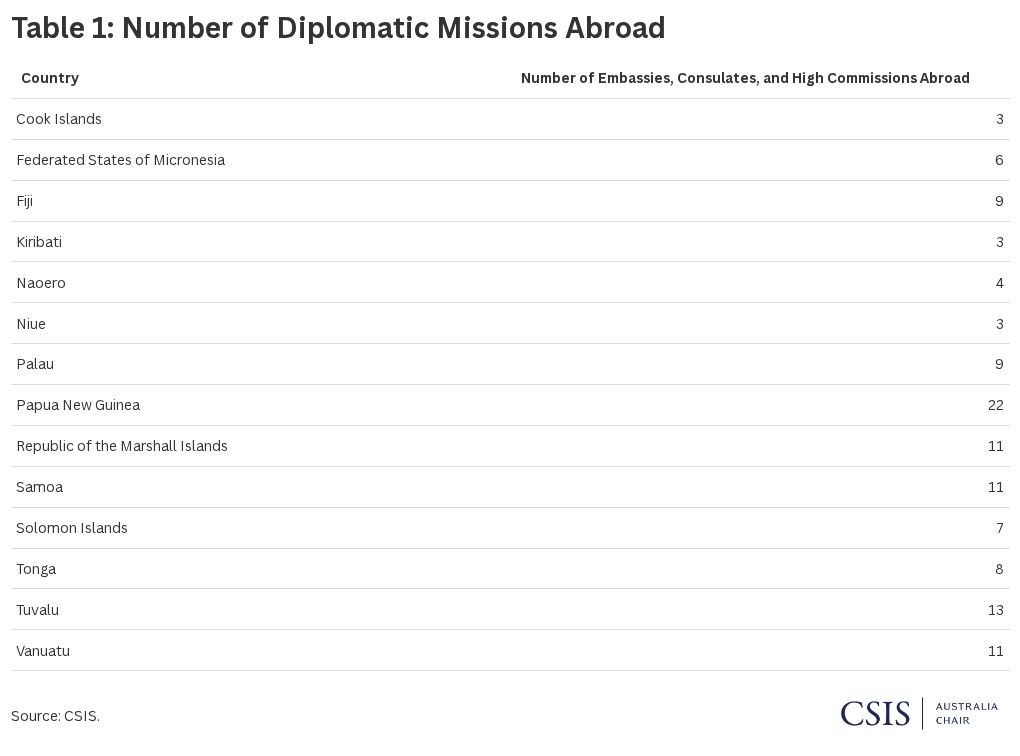
Working through multilateral institutions also presents logistical challenges for Pacific nations. Participation in international institutions requires allocating often limited diplomatic and technical resources across regional organizations, UN negotiations, international financial institutions, and other multilateral processes. The size of PIC diplomatic networks provides one indication of these constraints. These countries have only a handful of overseas diplomatic missions, and those that do exist often have small numbers of staff to cover all bilateral and multilateral efforts across economic, diplomatic, political, and defense sectors. For example, the Federated States of Micronesia only has five staff at its embassy in the United States and Fiji only has three staff at its high commission in New Zealand.
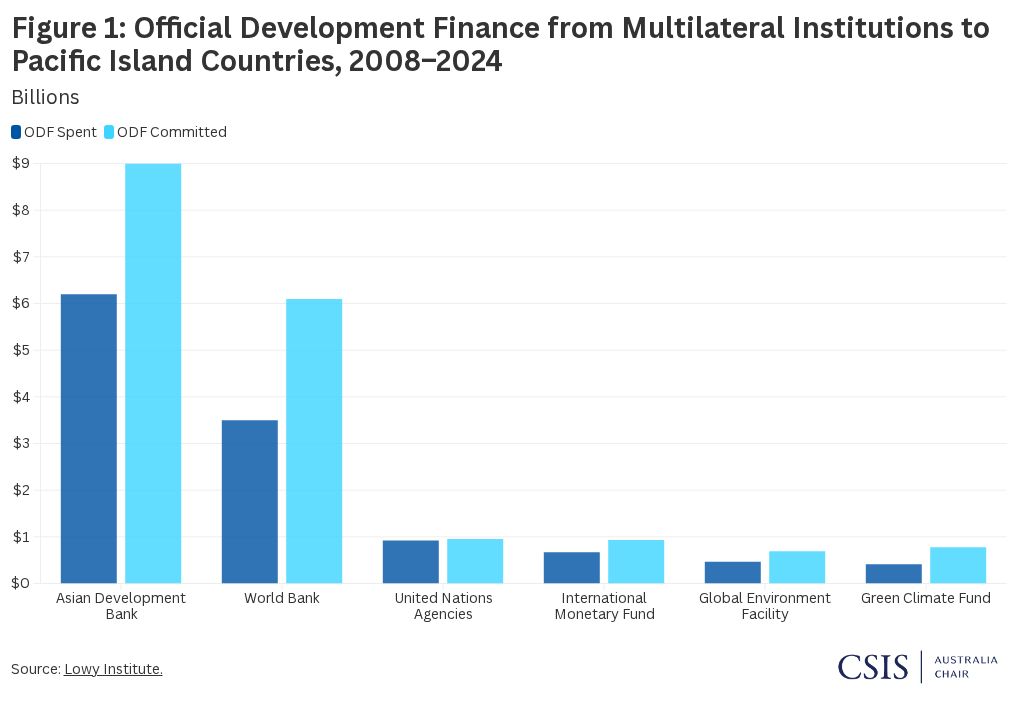
Another limitation is the often lengthy and complex process to secure funding from multilateral institutions. Despite massive levels of climate financing available in recent years—annual climate finance reached $1.9 trillion in 2023—securing climate financing remains challenging for PICs. On average, the climate financing process takes roughly three years from project development to final approval. As of December 2024, the Pacific has only accessed 0.22 percent of global climate funds. For PICs on the front lines of climate change, these lengthy timelines can delay action on urgent needs. Earlier this year, Fiji’s Minister for Information, Environment, and Climate Change Lynda Tabuya noted that although the region receives between $200 and $600 million per year for climate action from both partner nations and international organizations, the Pacific currently has a climate financing shortfall of almost $1 billion annually.
Some institutions are implementing changes to rectify this shortfall. For example, the international Green Climate Fund will be opening a regional office in Suva, Fiji, in 2027 as part of ongoing efforts to accelerate the delivery of funds to the Pacific. Frustrations over accessing sufficient climate financing also prompted the Pacific Islands Forum to launch in 2023 the Pacific Resilience Facility (PRF), the first Pacific-led financing vehicle for addressing the bespoke development finance needs of the Pacific region. At only roughly $200 million raised thus far, however, the fund risks falling far short of its goal of $500 million by the end of 2026.
Despite some limited success in leveraging their collective weight to meet critical climate needs, Pacific nations are unlikely to fully meet the climate change threat without greater support from the broader global community. Given the Pacific’s key strategic location and emergence as an arena of great power competition, external partner support is not purely philanthropic. As the effects of climate change erode economies and infrastructure, they also negatively affect regional security and stability and weaken national and regional governance.
Countries such as the United States, Australia, and Japan—as well as partners farther abroad such as the European Union and Canada—are eager to see the Pacific remain independent, secure, and free from Chinese influence. The United States depends upon the Pacific as its connection to allies Australia, Japan, and the Philippines, to which the United States must have unhindered access in the case of a conflict with China. Even for an administration that has de-emphasized climate action, there is national interest in ensuring that PICs remain secure and maintain sovereignty over their vast maritime territories.
The following are some ways that outside powers—including countries, climate foundations, and multilateral institutions—can more effectively support Pacific climate objectives.
As host of pre-COP, Fiji promoted three main themes: (1) keeping the 1.5-degree target within reach, (2) making climate finance more accessible, and (3) elevating ocean health in the climate regime. Yet despite these aspirations and broad consensus among Pacific nations and other SIDS as to the urgency of this threat, it is unclear what, if any, Pacific priorities will make it through to the final COP 31 outcome.
The ability of Pacific nations to form broad coalitions and move global policy with a heft far above their relative size is admirable and has achieved critical wins in the international battle against the effects of climate change. To truly halt the tide of increasing climate destruction on these island nations, however, this collective must expand further. To protect Pacific sovereignty and ensure that these island nations—protectors of much of the world’s vast ocean resources—are secure well into the future requires sustained and sincere commitment from larger powers and international foundations alike. For the United States, that commitment is not charity but strategy: A stable, sovereign Pacific is vital to U.S. interests now and into the future.
John Augé is program manager for the Australia Chair at the Center for Strategic and International Studies (CSIS) in Washington, D.C. Kathryn Paik is deputy director and senior fellow in the Australia Chair at CSIS.