Capital, Consolidation, and Leadership in the New Minerals Era
October 7, 2026 • 10:00 – 10:30 am EDT
Hosted by Critical Minerals Security Program

Photo: MARK FELIX / Contributor via Getty Images
Terrorism aimed directly at U.S. elections is rare, and recent attacks have failed to kill their intended victims. But terrorists have targeted U.S. elections in each of the past several cycles, suggesting that similar violence around the 2026 midterm elections is possible. Perpetrators targeting elections have come from across the political spectrum, seeking to overturn results they believed were fraudulent, kill candidates they opposed, or exploit the attention surrounding an election for causes unrelated to electoral politics. The challenge for the 2026 midterms is to take the threat seriously enough to protect candidates, election officials, and voters without letting fear and overreaching security discourage the very participation that protection is meant to preserve.
Terrorists have attacked or plotted against candidates, the people who run and certify the vote, or the crowds an election draws in each of the past several election cycles in the United States. As the 2026 midterm elections approach, those same targets are again at risk.
This brief answers a series of related questions: Why do terrorists target elections? When and how do these terrorists strike? What could the threat look like around the 2026 midterms? And what consequences could such violence have for elections and U.S. politics?
To answer these questions, this study primarily draws on the CSIS U.S. Terrorism Incidents Dataset.1 The analysis first identifies terrorist attacks and plots directly connected to U.S. elections over the past decade and examines patterns in their frequency, motives, timing, targets, weapons, and disruption. It then analyzes the major ideological drivers of recent terrorism incidents in the United States and assesses how each could plausibly intersect with the 2026 midterm elections. Finally, the study considers the broader consequences that election-related terrorism could have for political participation, polarization, security, and civil liberties.
The analysis finds that election-related terrorism is rare but potentially consequential. Perpetrators have emerged from across the political spectrum and targeted elections for different reasons, including efforts to overturn results, hostility toward particular candidates, and attempts to exploit the attention surrounding an election for other extremist causes. Incidents occurred throughout the election cycle, not just on Election Day. Operationally, the incidents resembled U.S. terrorism more broadly, usually involving lone actors or small groups using readily available weapons, especially firearms. Although most incidents reached the attack stage, none killed their intended victims, reflecting the effectiveness of protective security, perpetrators’ limited operational capabilities and skill, the fact that most attacks targeted only one or a few people rather than killing indiscriminately, and good luck. The historical record suggests that it is hard to completely disrupt simple, targeted violence against candidates and officials in accessible locations, which can require little preparation and provide authorities with few opportunities to intervene.
A successful attack could affect policy by altering who holds office, while the threat of violence alone can discourage candidates and voters from participating in politics. Election-related terrorism can also deepen political polarization, encourage additional violence, and prompt security responses that burden civil liberties or democratic participation. The challenge is therefore to take the threat seriously without overstating it. Election-related terrorism remains rare, but dismissing the risk could leave real vulnerabilities unaddressed, while exaggerating it could heighten fear, distort political debate, and provoke unnecessary security measures.
This section analyzes terrorist attacks and plots in the United States that were directly connected to an election between January 1, 2015, and June 30, 2026. Terrorism is defined here as violence carried out by a nonstate actor with the intent to kill and to advance a political objective through the intimidation or coercion of a wider audience. This study defines a terrorism incident as related to an election when a specific election or election process shaped the perpetrator’s motive, target selection, timing, or intended political effect. Eleven incidents in the past decade in the CSIS U.S. Terrorism Incidents Dataset meet these criteria (see the appendix), and they suggest several patterns in when, why, and how terrorism has intersected with U.S. elections. Because the overall number of incidents is small, however, these findings should be considered suggestive rather than definitive.
The 11 incidents from the past decade used in this analysis capture only violence that meets the definition of election-related terrorism described above, not political violence that, if its effects are considered broadly, might affect an election. Terrorism is an important but incomplete measure of the climate of political violence and intimidation that surrounds U.S. elections. Threats that never progressed into operational planning are excluded, including online harassment directed at election officials, poll workers, political candidates and staff, and other common targets of abuse.2 In the CSIS terrorism dataset, which tracks more than election-related violence, property and other attacks not intended to be lethal are also excluded—such as night-time arsons of unoccupied campaign offices—because lethal intent is part of what separates terrorism, as defined here, from vandalism and other crimes. In addition, policy and public concerns about terrorism focus on the lethality risk, but there are some causes (for example, white supremacy or extreme environmentalism) that at different historical periods have had large numbers of attacks leading to low-level property damage that, while an important matter for law enforcement, do not suggest the same risk as an attack intended to kill and thus are not at the same level of concern for leaders and the public. Violence against political figures when there is no evidence of a political motive is also excluded. The 2024 assassination attempt against Donald Trump in Butler, Pennsylvania, for example, is excluded because investigators found no political or ideological motive, while the 2024 attempt by Ryan Wesley Routh and the 2016 attempt by Michael Steven Sandford are included because evidence established a political motive in each.3
Some attacks meet this definition of terrorism but are still excluded because they were not directly connected to an election. The 2025 assassination of Minnesota State Representative and former Speaker of the House Melissa Hortman, for example, was politically motivated, but the perpetrator’s motive was not connected to an election.4 Such attacks can nevertheless indirectly affect elections. Hortman was considered a plausible future candidate for governor of Minnesota.5 Finally, this analysis does not cover other major threats to elections, such as foreign influence operations and cyberattacks against campaigns or election infrastructure. These exclusions do not mean such activity is unimportant. Rather, terrorism represents only one part of the broader threat landscape surrounding an election.
Analysis of the 11 incidents of election-related terrorism over the past decade yields six main findings:
Finding 1: Election-related terrorism is rare, but it has occurred in each of the past several election cycles.
Only 11 of hundreds of terrorist attacks and plots in the United States over the past decade were election related. The incidents have become more concentrated in recent years: 10 of the 11 incidents occurred in 2021 or later, including during the 2020, 2022, and 2024 federal election cycles. This suggests that election-related terrorism may be becoming more frequent, though the small number of incidents makes it difficult to determine whether this increase represents a real trend. Although election-related terrorism around the 2026 midterm elections is a possibility given the recent record, such incidents remain a tiny portion of overall terrorism in the United States.
Finding 2: Terrorists have targeted elections for three main reasons.
The motives of the perpetrators of the 11 election-related terrorism incidents in the past decade fall into three broad categories.
First, six incidents involved violence intended to overturn or reject an election result that the perpetrators regarded as fraudulent. Four were shootings orchestrated by Solomon Peña after he lost a 2022 New Mexico legislative race and falsely claimed the election was rigged. Peña orchestrated shootings at the homes of four Democratic officials.6 The January 6, 2021, attack on the Capitol was similarly motivated by election denialism. (The CSIS dataset does not classify the January 6 riot as a whole as terrorism but does include the premeditated actions of individuals who entered the Capitol carrying weapons, tactical gear, zip ties, radios, and chemical sprays and sought out specific lawmakers as Congress met to certify the electoral vote.7) In a separate incident the night before, Brian Cole Jr. placed pipe bombs outside the Democratic and Republican national headquarters after becoming convinced that the 2020 election had been tampered with.8
For the 2026 midterm elections, claims of election fraud, disputes over election administration, and concerns about political interference remain prominent, while election officials continue to report threats and concerns for their physical safety.9 Such claims risk inciting attacks against candidates, election administrators, and certifying institutions perceived as participants in an illegitimate result.
Second, three incidents in the past decade involved attempts to assassinate political candidates based on hostility to that candidate’s actions and policies. In 2024, Ryan Wesley Routh positioned himself with a semiautomatic rifle in the brush at the Trump International Golf Club in West Palm Beach, waiting for the then-presidential candidate to come into his line of fire. Routh’s writings indicate that his attempt was politically motivated by hostility to Trump, including anger over his foreign policy and regret over his election.10 Eight years earlier, Michael Steven Sandford tried to grab a police officer’s firearm at a Las Vegas rally to kill Trump, then the presumptive Republican presidential nominee, telling police that he viewed Trump as racist and believed he needed to die.11 In 2022, Quintez Brown fired six shots at Democratic Louisville mayoral candidate Craig Greenberg inside his campaign office after criticizing Greenberg over gentrification and development policy.12
For the 2026 midterm elections, candidates remain potential targets for terrorists, creating a threat throughout the campaign at rallies, offices, public appearances, residences, and other locations.
Third, two incidents were disrupted mass-shooting plots in which the election shaped when the perpetrators intended to act rather than why they wanted to commit violence. In 2024, Nasir Ahmad Tawhedi and Abdullah Haji Zada plotted an ISIS–inspired attack on crowds of people on Election Day.13 In a separate plot, Mark Adams Prieto planned to kill Black concertgoers at an Atlanta concert, believing the attack could help trigger a race war. Prieto wanted to act before the 2024 presidential election because he believed martial law would be imposed afterward.14 Both plots were disrupted in FBI sting operations.
The 2026 midterm elections could attract terrorists whose underlying grievances have little to do with electoral politics, whether because Election Day offers large crowds and heightened public attention or because perpetrators attach broader political or symbolic significance to the election period.
Finding 3: Election-related terrorism has emerged from across the political spectrum.
Election-related terrorism has not been confined to one side of the political spectrum: 6 of the 11 incidents were associated with right-wing ideologies (although 4 were part of Peña’s campaign, so by another measure it would be 3 of 8 episodes), 3 with left-wing ideologies, and 1 with jihadism. The remaining incident—Brian Cole Jr.’s pipe-bomb attack—targeted the national headquarters of both the Republican and Democratic parties and so did not fall clearly on either side of the left-right spectrum.
Election-related terrorism has emerged from several ideological directions rather than from a single movement or political constituency.
For the 2026 midterm elections, the conclusion is that election-related terrorism has emerged from several ideological directions rather than from a single movement or political constituency.
Finding 4: The threat extends across the election cycle, not just Election Day.
Only 1 of the 11 election-related incidents—the Tawhedi and Zada ISIS-inspired plot—was deliberately planned for Election Day itself. None are confirmed to have targeted a polling place, ballot-counting facility, or election workers, although threats to all of these are common.15 Instead, election-related terrorism has most commonly occurred at several other points in the political process. Routh, Sandford, and Brown targeted candidates during campaigns; the premeditated acts of violence that occurred on January 6 were an attempt to interfere with the certification of the results of an election after voting was complete; and Cole Jr.’s pipe-bomb attack and Peña’s shooting campaign were attempts to exact revenge against targets perceived as corrupting the election after the fact.
For the 2026 midterm elections, security concerns extend beyond Election Day itself to candidates during the campaign and to officials involved in the political process afterward.
Finding 5: Most incidents reached the attack stage, but none killed a victim.
Only 2 of the 11 election-related incidents were disrupted in the plotting stage, while the other 9 progressed to attacks. However, that distribution should be interpreted cautiously. Attacks typically garner greater attention and are therefore easier to identify retrospectively than disrupted plots (especially those disrupted early in the plotting process), so the data likely captures attacks more completely than plots. The two identified plots—the Tawhedi-Zada and Prieto mass-shooting plots—both involved extended preparation that exposed the perpetrators to law enforcement before they reached the attack stage. Indeed, U.S. law enforcement has a strong interdiction record. A RAND study found that the rate at which U.S. authorities disrupted terrorist plots in the United States surged after 9/11: In the six years before 9/11, authorities foiled 31.9 percent of plots, while in the decade after 9/11, they foiled 80.6 percent.16
Three incidents reached the attack stage but were disrupted before the perpetrators achieved the full extent of their intended violence. Sandford was stopped while trying to seize an officer’s gun, Routh was discovered by the Secret Service before he could fire, and various security measures during the January 6 attack disrupted the ability of the perpetrators included in this analysis to reach their intended targets. All three occurred in settings where protective security was already present, demonstrating its potential to interrupt an attack even after it has begun.
For the 2026 midterm elections, political campaigns and officials at the federal, state, and local levels have taken steps to increase physical protection of potential targets. Such measures include more training on emergency response procedures and de-escalation techniques, increased law enforcement presence, wider security perimeters, more tightly controlled entrances to sensitive areas, greater surveillance, and more bulletproof glass.17 These steps are a continuation of a trend in recent years to increase the protective security measures for elected officials, candidates, political party officials, political staff, election workers, judges, and other targets of political violence.18
The remaining incidents—Peña’s four shootings, Brown’s shooting, and Cole Jr.’s pipe-bomb attack—were carried out without disruption. Peña and Brown conducted firearm attacks at relatively accessible locations with little or no protective security measures. Cole Jr. successfully planted two viable pipe bombs, but their mechanical timers failed to initiate the devices; they were not discovered until roughly 15 hours later.19
None of the 11 incidents succeeded in killing their intended victims. That reflects several factors: Protective security prevented some perpetrators from reaching or attacking their targets, most perpetrators had limited operational capabilities and skills, and most sought to kill one or a small number of specific targets rather than inflict mass casualties. Good luck was also important.20
For the 2026 midterm elections, the record suggests that prominent political targets with substantial security may be comparatively difficult to attack successfully, while simpler attacks in more accessible spaces may be harder to prevent or disrupt.
Finding 6: Election terrorism operationally resembles U.S. terrorism more broadly.
Like most terrorism incidents in the United States, the election-related incidents were almost all planned or carried out by lone actors or small groups with no communications, training, or support from formal terrorist organizations. Historically, these individuals tend to lack advanced weapons and tactical training as well as the resources to conduct sophisticated attacks. At the same time, lone actors emerge less predictably from a decentralized extremist ecosystem and therefore can be more difficult to detect and disrupt. The perpetrators of election-related terrorism were overwhelmingly male and primarily U.S. citizens, consistent with perpetrators of most terrorism in the United States. Firearms were also the most common weapon used in the election-related incidents, mirroring their prominence in U.S. terrorism more broadly. They were used in the Peña shootings, all three candidate-assassination attempts, and both disrupted mass-shooting plots, while Cole Jr.’s pipe bombs and the variety of weapons carried on January 6 show that other readily accessible weapons also remain relevant.
For the 2026 midterm elections, the principal terrorism threat is likely to resemble the operational profile of the broader terrorism threat in the United States: decentralized individuals or small groups using easily available weapons against a wide array of targets.
For the 2026 midterm elections, the principal terrorism threat is likely to resemble the operational profile of the broader terrorism threat in the United States: decentralized individuals or small groups using easily available weapons against a wide array of targets.
As demonstrated above, election-related terrorism can emerge from a wide range of grievances and almost always involves individuals or small groups of decentralized actors with easy access to weapons. These features make predicting future attacks difficult. This section therefore looks beyond the 11 election-related incidents to terrorism in the United States generally (see Table 1) and considers how the prevailing ideological drivers over the past several years could plausibly motivate an attack around the 2026 midterm elections.
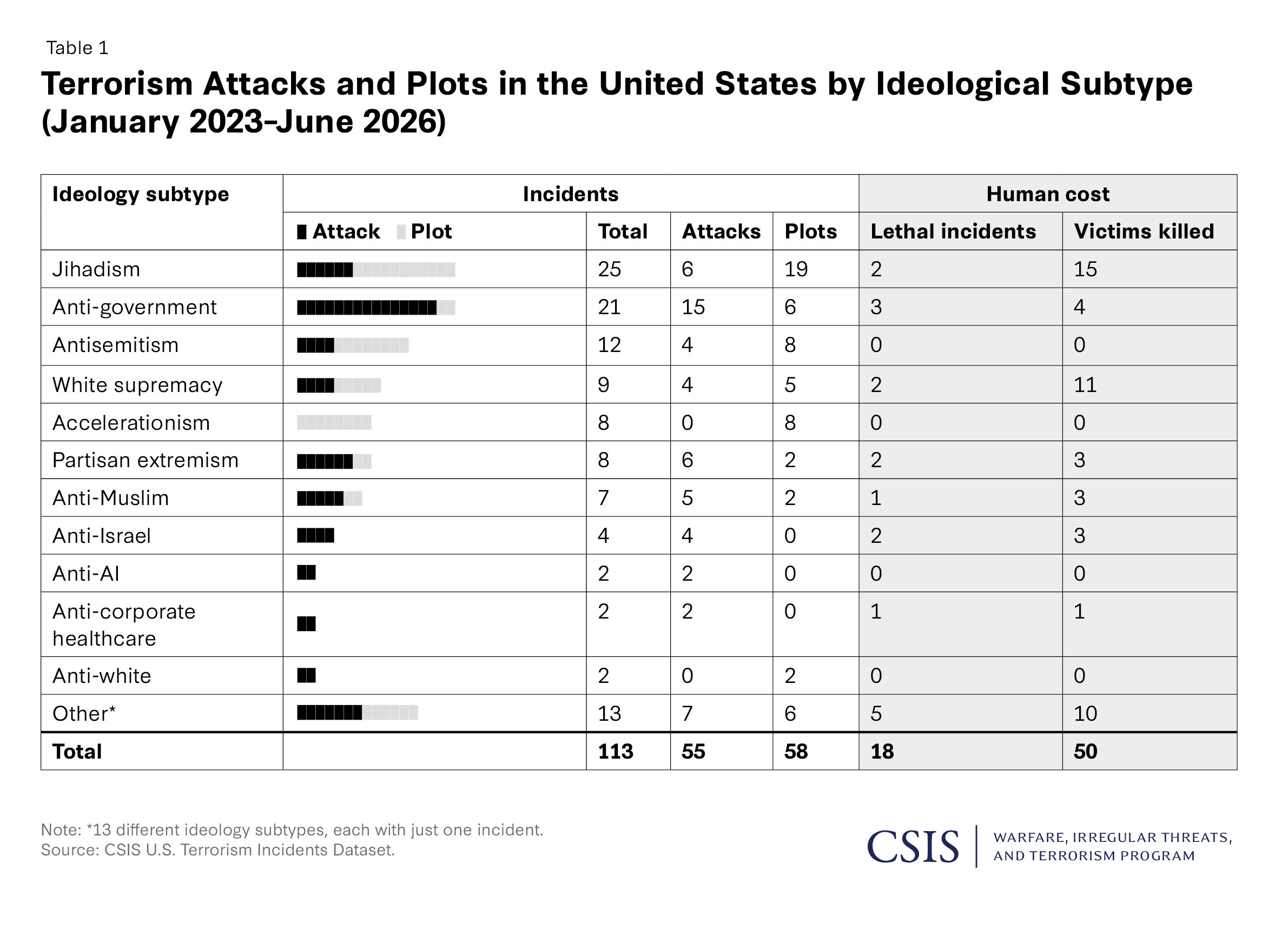
Jihadism was the most common ideological driver of U.S. terrorism from January 2023 through June 2026, accounting for 25 incidents, although 19 were plots and only 6 were attacks. Two of those attacks were lethal and killed 15 victims combined, more than any other ideological subtype. However, this death toll is almost entirely the result of one incident, the car ramming attack on New Year’s Day 2025 on Bourbon Street in New Orleans, making it a mistake to generalize from it more broadly. Jihadists reject the legitimacy of the U.S. political system, but most of their grievances have nothing to do with electoral politics. Elections may be attractive to jihadist attackers simply because of the crowds and publicity associated with them. The Tawhedi-Zada plot is an example of this dynamic. Other recent jihadist incidents show a broader attraction to prominent dates and gatherings, including Christian Sturdivant’s plot to conduct a mass-casualty attack on New Year’s Eve 2025 and an ISIS-inspired group in Michigan that plotted attacks around Halloween in 2025.21
The 2026 midterm elections could create similar opportunities through campaign rallies, election-night gatherings, polling locations, and other events that combine concentrated crowds with significant national and international attention. However, as the above examples suggest, there are numerous events in the United States that involve crowds and publicity that have nothing to do with elections.
Anti-government extremism was the second most common ideological driver of U.S. terrorism from January 2023 through June 2026, accounting for 21 incidents and four deaths, while partisan extremism accounted for 8 incidents and three deaths. Elections are particularly salient for anti-government and partisan extremists because they can focus anti-government hostility on political institutions and state authority or intensify partisan hostility toward the opposing political side.
Accordingly, in the eyes of potential terrorists, the midterm elections justify attacks on candidates, election workers, party offices, courts, and institutions because they are participants in an illegitimate outcome or otherwise broken system. Both pathways are amplified by the broader political climate in 2026, with public concerns about election integrity, political fundraising, voter intimidation, gerrymandering, and other political issues running high.22
One potentially mitigating factor is that Trump himself is not on the ballot this election cycle. Because he has been a focal point for election-related terrorism both supporting and opposing him, Trump’s absence may reduce some grievances, even as he remains central to the broader political environment.
Misperceptions that one’s political opponents are far more violent or supportive of violence than they actually are create an environment where extremists can more easily rationalize attacks of their own.
Although the majority of Americans—even those who hold extreme anti-government or partisan beliefs—would never commit violence, and generally oppose it, the growth of such grievances can expand the pool of extremists from which a much smaller number of violent actors may emerge.23 At the same time, misperceptions that one’s political opponents are far more violent or supportive of violence than they actually are create an environment where extremists can more easily rationalize attacks of their own.24
White supremacist terrorism accounted for nine incidents and 11 deaths from January 2023 through June 2026, while accelerationist extremism accounted for another eight incidents but no deaths. Elections may offer these types of extremists a moment when they perceive that violence has an unusually good chance of producing broader social or political disruption. Prieto’s 2024 plot reflected this logic directly—he sought to massacre Black concertgoers to provoke a race war before the presidential election.25 Recent accelerationist activity has likewise included efforts to assassinate public officials and attack critical infrastructure specifically to foment political upheaval or accelerate societal collapse. In 2025, Nikita Casap planned to assassinate President Trump to help trigger a political revolution, while separate 2024 plots by Skyler Philippi and Andrew Takhistov targeted electrical substations as part of broader efforts to destabilize society.26
The 2026 midterm elections could therefore provide an accelerationist with a particularly attractive backdrop for attacks intended to deepen societal instability and mistrust. For a white supremacist, some campaigns could also elevate racial or religious minorities, minority candidates, or constituencies into highly visible symbolic targets.
Antisemitic extremism accounted for 12 incidents from January 2023 through June 2026, while anti-Muslim and anti-Israel extremism accounted for 7 and 4 incidents, respectively. None of the antisemitic incidents were lethal, while anti-Muslim and anti-Israel attacks killed three people each in total. None of these incidents were election related.
The 2026 midterm elections are unfolding amid intense political conflict over Israel, Gaza, Iran, and U.S. Middle East policy. Involvement by the American Israel Public Affairs Committee (AIPAC) in some congressional races has also made pro-Israel political influence itself a prominent campaign issue.27 In this environment, violent extremists could direct broader grievances toward particular candidates, campaigns, advocacy organizations, or constituencies. Antisemitic extremists may fold electoral politics into long-standing conspiracy theories about Jewish influence or control, anti-Israel extremists could target candidates or organizations viewed as enabling Israeli military actions, and anti-Muslim extremists could focus on Muslim candidates, several of whom have increased prominence in the 2026 election, or constituencies amid heightened political hostility toward Islam.28 The 2026 midterm elections therefore provide a highly visible arena in which already intense identity and foreign-policy grievances could select specific political targets.
Any assessment of additional issue-specific categories beyond the ones above is especially speculative. Anti-AI, anti–corporate healthcare, anti-white, and many other ideological subtypes are represented by only a handful—and in some cases a single—recent terrorism incident. Still, they suggest several ways narrower grievances could intersect with an election. Anti-AI and anti–corporate healthcare extremists have targeted individuals viewed as representatives of industries or policies they oppose, suggesting that candidates or elected officials could become targets when their positions make them prominent symbols of those or similar grievances. The two recent anti-white plots similarly suggest that racial grievances could be directed toward political figures, constituencies, or events identified with white political power. These incidents are too few to establish any patterns, but they illustrate the variety of grievances that could plausibly inform pathways to selecting a political target around the midterm elections.
In addition to the tragedy of any deaths or injuries resulting from election-related terrorism, such violence can have a range of negative consequences for democracy and society.
The assassination of a political candidate changes the democratic choice itself by removing one of the options available to voters. Candidates are not interchangeable, even when they belong to the same political party. They differ in their policy positions and leadership qualities, and those differences can affect how voters choose among them.29 Removing a candidate can therefore change who voters are able to support, who ultimately wins the election, and the policies pursued afterward.
The very threat of terrorism may also deter some individuals from participating in politics, including running for office or voting. One study of politicians in Sweden found that even politicians who were not directly exposed to violence were more likely to consider leaving politics after attacks and threats.30 Another study found that over 40 percent of U.S. politicians “said they were less willing to run for reelection or higher office” because of threats.31 Studies of countries in the developing world show that violence can decrease voting and depress participation in key pre-electoral processes such as attending rallies.32
Election-related terrorism can also deepen political polarization when an attack is used as evidence in a broader argument about the political movement or ideology from which the perpetrator emerged.33 Popular grievances can shape the beliefs of violent extremists, as many of the incidents examined in this report demonstrate. But attributing an individual’s violence to the much larger population that shares some of those beliefs greatly exaggerates the extent of support for violence and reinforces antidemocratic perceptions that the opposing political side is dangerous and illegitimate. This dynamic was visible after Routh’s attempt to assassinate Trump and Peña’s attacks on Democratic officials, as well as after the non-election-related killings of Charlie Kirk and Hortman, when each attack became part of a broader argument about support for violence on the opposing political side.34 Indeed, there is a risk that terrorism may fuel further violence, creating a dangerous cycle. Although only small numbers of individuals perpetrate terrorism in the United States, the perception that one’s political opponents support violence can increase hostility and provide a powerful justification for retaliation. This can be out of a desire for revenge or because individuals are more likely to see their own use of violence as necessary defense.35
Finally, the threat of election-related terrorism creates a difficult trade-off around security. Candidates, election workers, polling places, and other potential targets need security, but some measures intended to provide protection can themselves affect democratic participation. In March 2026, before election season began in earnest, polls indicated that many Americans (but not a majority) favored having the National Guard monitor polling places to ensure security.36 The presence of police and soldiers, however, can intimidate voters, creating the perception that violence may be more likely than it is or fears that minority voters may be susceptible to harassment or arrest.
The demand for security can also be used to justify government activity that goes beyond physical protection. Efforts to identify potential threats could expand into monitoring civil society organizations or peaceful political movements, burdening civil liberties even when those groups are not engaged in violence.37
The potential consequences are serious and warrant protection, but that response must remain proportionate to the threat.
Some scholars have warned that terrorism threats could be used by political actors to undermine the legitimacy or conduct of elections.38 In an unlikely but grave scenario, officials or their allies could deliberately exploit violence or the fear of violence to justify measures that interfere with, delay, or discredit an election.
Taken together, these risks argue for a calibrated response. Election-related terrorism remains rare, and recent attacks have fortunately failed to kill their intended victims. At the same time, the 2026 midterms are taking place in a period of heightened concern over political violence, and there are several plausible ways extremists could direct their grievances toward candidates, officials, institutions, or events surrounding the 2026 midterm elections. The potential consequences are serious and warrant protection, but that response must remain proportionate to the threat and avoid unnecessarily burdening civil liberties and democratic participation.
Please see the PDF for references and the appendix.
Daniel Byman is the director of the Warfare, Irregular Threats, and Terrorism (WITT) Program at the Center for Strategic and International Studies (CSIS) in Washington, D.C. Riley McCabe is an associate fellow with the WITT Program at CSIS.
This report is made possible by general support to CSIS. No direct sponsorship contributed to this report.

Report by CSIS Scholars — May 26, 2026

Brief by Riley McCabe — October 21, 2024

Commentary by Riley McCabe — September 10, 2026

Brief by Daniel Byman and Riley McCabe — September 25, 2025

