The Return of the Nuclear Sea-Launched Cruise Missile (SLCM-N) | HTK
November 4, 2026 • 1:00 – 2:00 pm EST
Hosted by HTK Series

Photo: MOHD RASFAN/AFP/Getty Images
U.S.-China trade relations continue to enjoy a fragile détente, but recent dialogues between Washington and Beijing have not resolved underlying tensions. One point of friction is the White House’s condemnation of Chinese “transshipment” of trade goods, articulated most clearly in its August 2026 report The Great Transshipment Scam. The report critiques a wide range of trade practices that it argues constitute a coordinated strategy to illegally avoid U.S. tariffs imposed on Chinese goods. In doing so, it sets the stage for future actions toward China and other commercial partners.
The “transshipment scam” report reflects the Trump administration’s continued dissatisfaction with the United States’ and China’s respective roles in the global trade landscape. Despite the flurry of U.S. actions against China since early 2025, Beijing’s export-oriented economic growth model continues to perpetuate global trade imbalances, stoking political backlash in Washington, Brussels, and other capitals around the world. Moreover, the overarching U.S. trade balance has not durably shrunk, and concerns of threatened U.S. industrial competitiveness vis-à-vis China remain as strong as ever. U.S.-China relations are likely to remain strained as long as these factors persist.
The White House muddies the policy debates surrounding these issues, however, by blaming them all on transshipment. The most novel contribution made by the report is an attempt to stretch the definition of transshipment beyond its traditional definition—i.e., the rerouting of unmodified goods through intermediate countries—to include substantive overseas manufacturing using Chinese-origin inputs. The analysis below examines the extent to which transshipment is taking place, both in the traditional sense and under the White House’s expanded definition, and unpacks potential policy options for addressing these respective phenomena.
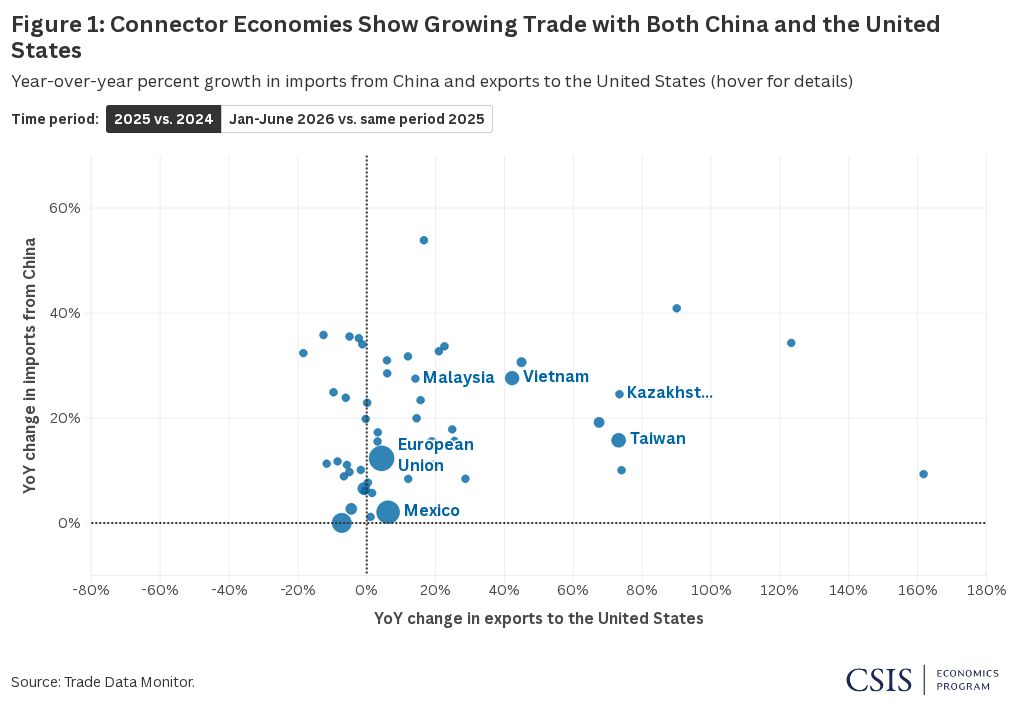
A core aspect of the White House report’s argument is that Chinese-origin products are continuing to flow into the United States even though direct bilateral trade has shrunk. This allegedly takes place through more than 40 economies that reroute intermediate or final Chinese goods from China to the United States to benefit from lower tariff rates. CSIS’s own analysis shows that some of these economies have indeed experienced disproportionate growth in imports from China and in exports to the United States since 2024, a signal that these countries may be serving as “connectors” of U.S. and Chinese economic activity (see Figure 1). These countries, which fall into the top-right quadrant of Figure 1 below, are thus sometimes referred to as connector economies.
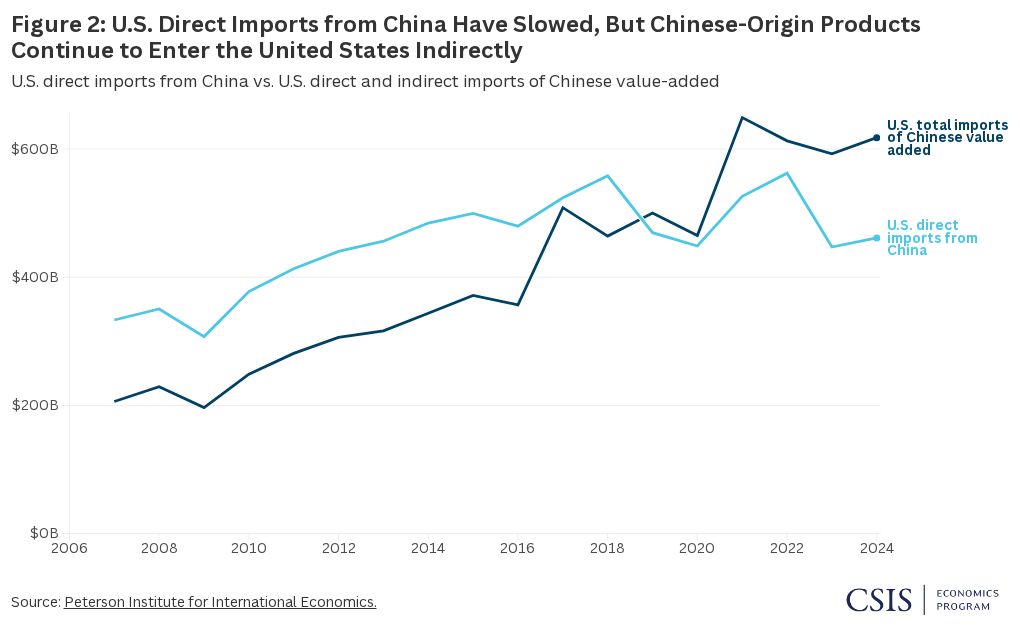
The first part of the White House’s claim has strong empirical support. A 2026 Peterson Institute for International Economics policy brief examines the share of U.S. import value that originated in China, either through direct imports from China or from Chinese upstream inputs embedded in products imported from elsewhere—a measure known as “value added.” It finds that Chinese value added flowing into the United States has grown since 2018 even as U.S. direct imports from China have fallen (see Figure 2), meaning that Chinese value added increasingly enters the United States via third countries. The Peterson paper and other analyses identify Mexico and Vietnam as two prominent conduits linking U.S. and Chinese supply chains, providing a pathway for 23 percent and 15 percent of indirect Chinese value added entering the United States in 2024, respectively.
The key question is how this value added reaches the United States. A factory in Mexico exporting specialized products using Chinese inputs may simply reflect an efficient supply chain responding to comparative advantages. This is a wholly different phenomenon than a logistics company importing products from China and directly re-exporting them without modification (i.e., the traditional definition of transshipment). Legal and policy implications are determined by how Chinese goods pass through connector economies, and specifically whether or not they have been substantially transformed along the way.
One way to assess the predominance of rerouting versus substantial transformation is investigating whether the six-digit Harmonized System (HS-6) code—the international standard taxonomy for classifying traded goods—changes for a certain good between its import from China and its export to the United States. If a country’s imports from China and exports to the United States are both growing, and a growing share of its U.S.-bound exports match its Chinese imports, transshipment may be occurring. On the other hand, a flat or declining share of overlapping trade suggests transshipment is not growing as a share of that country’s total trade activity.
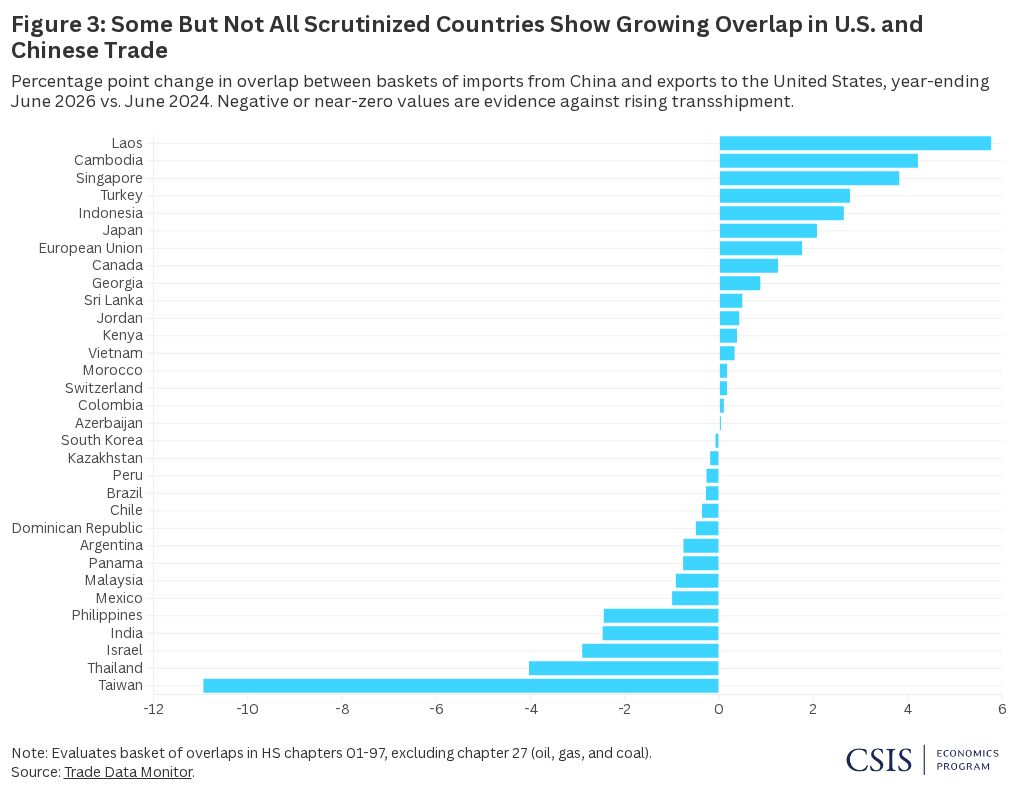
Building on prior research, CSIS analysis shows that for many economies singled out in the White House report, the overlap in imports from China and exports to the United States has not meaningfully grown. Figure 3 shows the percentage-point difference in overlapping Chinese imports and U.S.-bound exports by identical HS-6 product code from 2024 to 2026, measured with the Finger-Kreinin Export Similarity Index. This analysis challenges the view that transshipment is the dominant way that Chinese-origin products end up in the United States. Some economies, such as Laos and Cambodia, do show a growing trade overlap, but several other economies show the opposite trend.
Mexico, Canada, and several Southeast Asian economies have particular scrutiny for their potential role in transshipment networks, and it is worth examining them more closely to assess these critiques. Of this group, U.S.-bound exports from Cambodia and Laos, and to a lesser extent from Singapore and Indonesia, increasingly overlap with the product categories these countries import from China (see Figure 4). Particular areas of overlapping growth in these countries include photovoltaic cells and steel products—both of which have been identified by Commerce Department duty circumvention investigations.
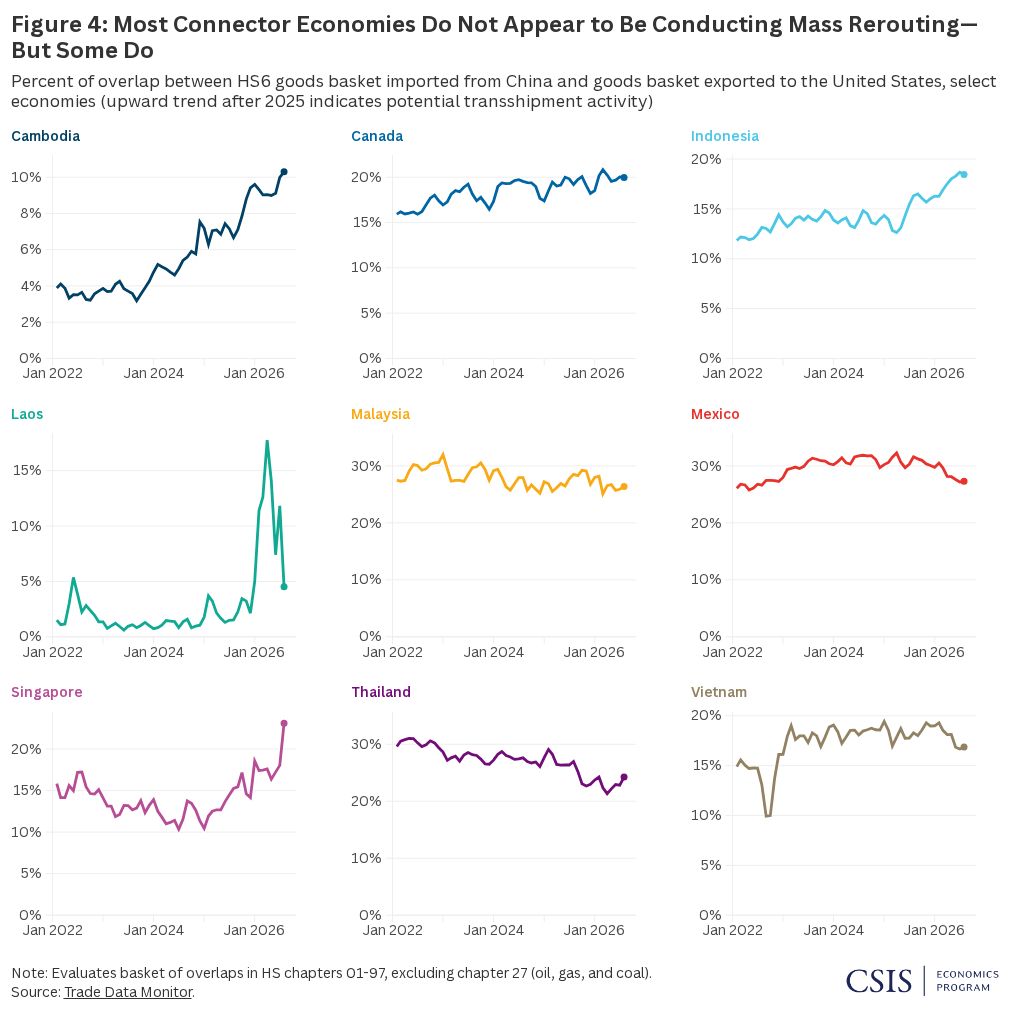
More surprising, Malaysia, Mexico, Thailand, and Vietnam show no overall rise in their share of overlapping U.S. and Chinese trade; Malaysia and Thailand even show a decline. The divergence appears to be driven largely by specialization within electronics supply chains, in which these countries import simple electronics components from China and export advanced electronics to the United States (see Table 1). Some transshipment is still occurring in these economies—as illustrated by the investigations cited above—but it does not appear to be growing as a share of these countries’ trade.
Overlapping HS-6 baskets provide clues to where transshipment might be occurring, but identifying illegal or problematic activity requires more granular analysis. Many HS-6 codes cover broad baskets of goods, and products can often be substantially transformed without changing HS-6 codes. Conversely, different HS-6 codes might be used for the same product in different contexts or by different countries. Also, analysis of government-reported trade statistics cannot account for instances of misreported value, classification, or origin—which recent research suggests have spiked since new tariffs were levied on China in early 2025. Products as diverse as tungsten carbide, quartz, plastic bags, and batteries have all been found by investigations to have been involved in illicit rerouting schemes.
These examples are plainly fraudulent, but transshipment itself is not inherently illegal or undesirable from a policy perspective. Companies route goods through third countries for several legitimate reasons, including port access, logistics synergies, and inventory storage. Problematic behavior, by contrast, involves concealing or misrepresenting a product’s true origin to evade regulation or obtain a lower tariff rate. Even then, trade practices may be undesirable from a policy perspective without necessarily being prohibited under current trade law. By branding all such undesirable activity as illegal, the White House report conflates entirely legitimate business actions with criminal behavior.
The evidence above suggests that transshipment activity as conventionally defined explains only a subset of Chinese-origin value added flowing into the United States. The remainder is likely explained by routing through more substantial transformation steps in a multistage supply chain. International Monetary Fund research illustrates how such trade reallocation can be driven by Chinese businesses investing abroad, foreign firms relocating from China overseas, and local firms in connector economies turning Chinese inputs into products for the U.S. market. Other research reinforces this finding. A 2026 Federal Reserve study, for instance, found that Chinese production in Mexico accounted for about 14 points of Mexico’s export gains after the 2018–19 tariffs, while direct transshipment accounted for less than 1 point.
U.S. tariffs and trade actions from 2025 onward have shifted supply chain contours but have not reduced underlying U.S.-Chinese trade imbalances. Transshipment fraud explains part of this phenomenon but overlooks more fundamental macroeconomic determinants of the lopsided trade relationship.
China’s economic model accounts for much of the macroeconomic situation. As China’s domestic economic performance continues to underwhelm, its leaders have remained committed to an export-oriented growth strategy that props up supply-side economic activity. An undervalued real exchange rate, tepid consumer spending, and entrenched state support for key technology sectors all contribute to China’s widening trade surplus. Given these factors, blocked exports to the United States are unsurprisingly being diverted to other markets rather than absorbed domestically or curtailed by contracted production. Data from 2025 shows that China’s total exports rose 5.5 percent even as its exports to the United States fell about 20 percent, with many displaced exports shifting to the European Union.
Inverse factors contribute to the persistent U.S. trade deficit. U.S. domestic investment has risen on the back of a surge in AI infrastructure spending even as U.S. household savings remain low and the public-sector fiscal deficit widens. This mismatch pulls capital in from overseas to finance the investment, widening net capital inflows and conversely depressing the trade balance. AI spending in particular has pushed imports higher, both from China directly—which dominates global manufacturing of key inputs such as electrical transformers and optical transceivers—and from connector economies that rely on Chinese supply chains for high-tech goods.
These macroeconomic fundamentals force the United States into the position of net importer and China into the position of net exporter, fueling imbalances in their bilateral relations. Such factors have not changed since Washington hiked trade barriers against Beijing in 2025. What has changed is the emergence of sizable tariff differentials—in other words, differences between U.S. tariffs on Chinese products and those applied to other countries.
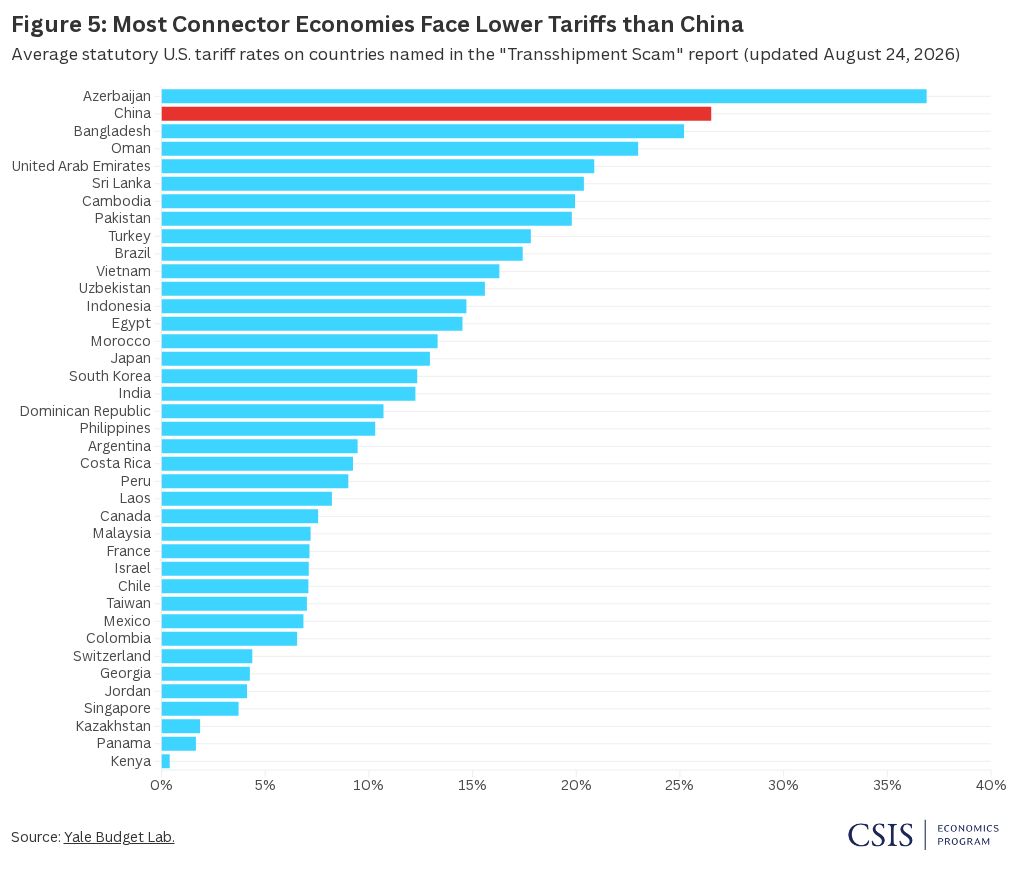
Historically, World Trade Organization most-favored-nation rates provided a broad ceiling to tariff rates that prevented the emergence of major tariff differentials. Now, many connector economies enjoy an average statutory tariff rate 10 to 20 percentage points lower than China’s or more, as shown in Figure 5. This creates a powerful incentive for companies to relocate operations to lower-rate jurisdictions, even in instances when such shifts may not make much economic sense otherwise. Operating footprint changes in response to tariff differentials do not imply the existence of any central plan from the Chinese government to circumvent tariffs; such outcomes arise through decentralized profit-maximizing market logic, as several economistspredicted shortly after earlier tariff announcements.
Curtailing the supply chain shifts described above puts the White House in the unenviable position of steering commercial activity against market incentives. The White House report concludes that countervailing market forces necessitate stronger statist intervention and a more extensive apparatus for policing trade activity, which it conceives of as an “AI Detective Border.” The exact mechanisms of this new system remain unclear, but it will necessitate more government spending on customs enforcement, higher compliance costs for companies, and stronger demands for monitoring and policing from Washington’s trading partners.
Yet this emphasis on compliance elides the more fundamental policy question of what should qualify as legitimate manufacturing operations in connector countries. Much of the White House’s critique falls on supply chain behavior that is permissible under current trade agreements—e.g., “component integration,” which U.S. Customs and Border Protection (CBP) hasoftenruled constitutes substantial transformation. Moreover, the standards the White House report uses to critique alleged transshipment activity, including share of Chinese value in inputs and the presence of Chinese ownership or financing, have not historically been used to determine origin under substantial transformation rules. Enforcement action alone will have a limited effect on shaping supply chain behavior unless these policy questions are resolved.
Because rules of origin chiefly govern tariff applicability under trade agreements, changing them will likely involve trade talks with U.S. commercial partners. This is no small feat. Rules of origin are complex legal standards that often are painstakingly negotiated product by product within a given trade agreement. The White House evidently anticipated such an undertaking when it included placeholder clauses in all 10 of the agreements on reciprocal trade finalized so far, which state that “if benefits of this Agreement are accruing substantially to third countries or third-country nationals, a Party may establish rules of origin necessary to achieve the Parties’ intention for this Agreement” (or some variant of that language). As of early October 2026, there has been little motion on revisiting these clauses, but history suggests that the product of ongoing U.S.-Mexico-Canada Agreement negotiations may provide a template for updated rules of origin that can be applied to certain goods under other trade agreements.
New demands on connector economies may not be limited to updated rules of origin. One way Washington could advance its CBP upgrading efforts is to call for its trading partners to collect and share more customs data. CBP has already taken steps to require more data sharing from companies themselves, per an advance notice of proposed rulemaking to implement Executive Order 14411, and government-to-government sharing would be an obvious extension of this approach. Washington may also push its trading partners to increase enforcement of transshipment fraud laws. Such efforts are already underway in manyconnectoreconomies, but more state capacity could be warranted—particularly if new rules of origin require greater on-site scrutiny of manufacturing operations. Both measures would be costly to governments and industry actors in connector economies, and both may face political headwinds. Washington should be sensitive to these constraints when considering how to incentivize cooperation.
Though connector economies are the most likely target for U.S. pressure to stop transshipment activity, the White House may also engage Beijing directly. China’s own economic imbalances incentivize transshipment by pressuring Chinese exporters with thin profit margins to eke out overseas sales wherever possible—even when such activity may require falsifying customs information. One concrete measure to curb transshipment incentives would be to reduce refunds for China’s value-added tax (VAT) on exported goods. Earlier in 2026, China’s State Taxation Administration moved to reduce the previous 9 percent VAT refund offered on exported goods, particularly batteries and solar panels. This action could be expanded to other goods that are aggravating U.S. transshipment concerns.
Agreeing with trade partners on substantive policy changes is challenging. Yet without these changes, efforts to achieve a more balanced economic relationship with China will fall short of their goals. The White House report misdiagnoses the challenges plaguing the U.S.-China trade relationship, and its recommended enforcement actions are misaligned to resolve unintended consequences of U.S. tariff differentials. A sustainable path forward involves more rigorous analysis of global trade patterns, reappraisal of the market-distorting effects of U.S. tariff differentials, and frank dialogue with trade partners and industry leaders about the utility and feasibility of new trade rules.
Hugh Grant-Chapman is a fellow with the Economics Program and Scholl Chair in International Business at the Center for Strategic and International Studies in Washington, D.C.


Commentary by Diego Marroquín Bitar — August 4, 2026
