The Hormuz Implications for Energy Policymaking: Japan and South Korea
August 18, 2026 • 8:00 – 9:00 am EDT

Photo: VCG/VCG/Getty Images
The United States must pursue an invigorated hybrid warfare campaign that capitalizes on the Chinese Communist Party’s (CCP) enduring vulnerabilities. The CCP prioritizes narratives over facts, is built on endemic corruption, suffers excessive strongman rule, is paranoid about U.S. intentions, and has few friends to help reduce its dependence on the United States and allies. A U.S. hybrid warfare campaign built on exploiting endemic CCP frailties will provide the United States more flexible policy options against China with the added benefit of anticipating predictable CCP responses. As the United States formulates this campaign against the CCP, it must avoid sunk cost fallacy, be risk tolerant, coordinate appropriately to achieve scale, and scope objectives to achieve clear, measurable outcomes.
The United States must wage a more offensive and entrepreneurial campaign to compete with China. Crucially, this campaign must exploit the increasingly detrimental means by which China’s President Xi Jinping and the CCP control China.1 This campaign can capitalize on CCP vulnerabilities, anticipate predictable reactions, and position the United States to successfully advance its national security priorities.
The CCP is vulnerable because it prioritizes narratives over facts, is built on endemic corruption, suffers excessive strongman rule, is paranoid about U.S. intentions, and has few friends to help reduce its dependence on the United States and allies. The United States should shape its political, economic, military, and intelligence operations to exploit these weaknesses in ways that embarrass the CCP and ensure China remains too weak, distracted, or insecure to dominate East Asia. U.S. operations should include exposing CCP hypocrisy, extracting and releasing factual data, conducting sabotage operations to hinder China’s illicit activities, and pursuing more aggressive intelligence operations in instances where CCP officials are particularly incentivized to hide bad news.2
This article explains the stakes underlying the U.S.-China contest and articulates a foundation for a U.S. campaign based on the CCP’s core vulnerabilities. It determines that China’s responses to U.S. hybrid warfare activities are fundamentally predictable and therefore exploitable.3 It concludes with key principles that U.S. policymakers should adhere to if they carry out this campaign. Other work on U.S.-China relations and gray zone activities largely focus on means by which the United States can defend against China’s operations.4 China exploits tensions inherent to the open, democratic society of the United States; the United States’ approach should likewise exploit China’s Communist dictatorship. This piece offers ways to take the fight to the CCP.5
The United States is taking competition with China seriously. It has—in a largely bipartisan manner—bolstered its military presence and capabilities in East Asia, pursued an oscillating trade war, sanctioned Chinese technology companies, and increased its support to partners and allies in the region.6 China is not going down without a fight, either.7 Beijing has pursued an expansive export control scheme for rare earth elements, attempted to harden its economy to weather Washington’s sanctions, dug in on key trade imbalance issues, rapidly accelerated its military modernization, bolstered its relationship with Moscow, and provided military support to Tehran to bring about a U.S. military defeat.8 China has also aggressively ramped up its offensive irregular warfare activities against the United States, including disturbing intelligence and cyber operations, disinformation campaigns, economic coercion, and military cognitive domain operations.9 Some of these activities are likely wartime preparations, but often, they are about economic and industrial espionage intended to position China to leapfrog the United States.10
Though existing U.S. policies are meaningful steps toward achieving national security objectives, they are ultimately insufficient to ensure China remains too weak, distracted, or insecure to dominate East Asia. The United States should pursue a more deliberate, entrepreneurial, protracted strategy to compete with China.11 Hybrid warfare campaigns—if done correctly—provide the United States the flexibility to conduct timely, appropriately scoped, and (if necessary) obfuscated operations to maintain technological advantage, degrade the CCP’s confidence in its military, and corrode global sentiment toward China. Critically, the United States must also pursue these activities without disqualifying opportunities for engagement and cooperation.12
Several converging geopolitical factors suggest that now is the right time for the United States to pursue an invigorated offensive campaign against China. First, the United States is stretched thin on conventional power projections resources.13 Hybrid warfare operations will bolster hard power deterrence, shape perceptions, and provide policymakers with more flexible courses of action below the threshold of outright conflict. Second, recent intelligence assessments have clarified China’s ambitious mid-century goals.14 The United States requires an approach that looks past 2027 and beyond Taiwan as the epicenter of U.S-China competition.15 Taiwan should remain an important component of a strategy but should not be the prism through which the United States measures its success. Third, U.S.-China technology, energy, and supply chain contests are gaining prominence and require a more thorough integration into U.S. gray zone activities.16 China appreciates the stakes of this technological competition and is relatively unrestrained in finding solutions, including through subversive tactics.17 Last, Xi Jinping increasingly perceives the United States is pursuing a coordinated campaign to contain, encircle, and suppress China’s “inevitable” rise, including undermining Beijing’s partners in Caracas and Tehran.18 His worldview suggests Beijing will carry out activities designed to harm U.S. interests and ensure China dictates the terms in East Asia.19 U.S. operations can reduce the CCP’s confidence that its own activities are effective.
What should this campaign look like? To start, the United States’ strategy must begin with a clear-eyed view of China’s vulnerabilities. The CCP has several weaknesses that the United States can capitalize on.
The CCP is built on endemic corruption. The CCP is tainted by pervasive corruption because of poor transparency, a CCP-centric concept of rule of law, and a lack of independent checks on public officials.24 Xi, and previous CCP leaders, have consistently pursued anti-corruption efforts—Xi himself has likely investigated over 5 million government officials since 2012.25 Xi’s motivations for addressing corruption are likely threefold: to root out corruption that undermines the regime’s legitimacy, to target his political rivals, and to eliminate growing power centers within the party.26 CCP corruption also extends itself to China’s illegal operations, including intellectual property theft, technology smuggling, and harassing dissidents abroad.27 Endemic corruption incentivizes CCP officials to hide unlawful activities and prevent information from moving up the chain of command.28
China’s recent military anti-corruption campaign is especially illustrative. CSIS data indicates Xi has potentially purged at least 100 senior PLA officers since 2022.29 Xi’s anti-corruption efforts may have reduced the likelihood that a rival faction can grow out of the military and may have also helped him whittle away any resistance PLA officials may have had for Xi’s military reform and modernization goals.30 Xi now has the daunting task of rebuilding China’s military leadership.31 This presents a window for the United States to capitalize on historic levels of insecurity, paranoia, and empty leadership at the top of the PLA. Xi is clearly dissatisfied with his military; U.S. operations can exploit that.
Xi’s personalist rule creates more problems than it solves. Xi Jinping’s unprecedented steps to consolidate his rule over the CCP comes at a cost to the country. Xi abolished term limits, has not identified a successor, stacked loyalists into top leadership positions, and took more direct oversight of the military and security forces.32 His rule erodes institutional checks to the CCP, discourages dissenting views, and likely foments a succession crisis upon Xi’s departure.
Xi’s success bending the CCP to his will has downstream effects that erode the party’s effectiveness and legitimacy. CCP officials are incentivized to obfuscate rather than admit mistakes, paralyzing bureaucrats and hindering grassroots reform efforts at lower levels of party governance.33 Expert Jonathan Czin rightly notes Xi’s choices are probably calculated decisions aimed at routing out China’s most pressing vulnerabilities—internal corruption and dependence on the United States for economic growth—but that does not alleviate the inevitable downsides of excessive strongman rule.34
The CCP is paranoid the United States and partners seek war. CCP officials are deeply insecure about China’s military capabilities vis-à-vis the United States and are prone to view everything the United States does as a coordinated campaign to contain and dominate China militarily, economically, and politically.35 In 2024, Xi Jinping went as far to say the United States was trying to “trick” China into invading Taiwan after then-President Biden declared several times the United States would defend the island.36 Beijing is well aware of the potentially disastrous outcomes of a failed Taiwan assault and likely views a military invasion as an unattractive policy outcome.37 Efforts by the second Trump administration to tamper tensions via softened rhetoric do not appear to have eased China’s concerns, as they have noted a divergence between executive rhetoric and entrenched bipartisan policy campaigns to contain China, as evidenced by almost every U.S. National Security Strategy this decade.38
Similarly, U.S. military operations under the Trump administration in Venezuela and Iran probably play into Xi’s worst fears—overwhelming U.S. military force to conduct rapid, shocking exfiltration (in the Venezuela case) and counterforce strikes (in the Iran case) against an adversary’s leadership. These U.S. military operations, plus pressure operations against Panama and Cuba, likely underscore for Xi that even if he wanted the PLA to protect China’s interests in the Middle East or the Western Hemisphere, his forces are not up for the challenge.39 Before conflict broke out in Iran in February 2026, China consistently rotated a PLA Navy Task Group to the Middle East, yet China’s blue-water navy is nowhere to be seen as China’s energy supply chain is threatened by the ongoing situation in the Strait of Hormuz.40 Xi has seemingly decided to avoid direct intervention in the conflict; however, if he decided to task his military to secure China’s oil, it is not obvious the PLA could do so.41 These situations reinforce for Xi that his military does not have the power projection capabilities to protect China’s interests abroad, which is why China is so aggressively pursuing unrestricted hybrid warfare activities of its own to make up for the gap.42 China’s paranoia regarding U.S. intentions and inability to sufficiently project conventional military power are exploitable vulnerabilities.
The CCP has few friends and depends on the United States and its allies. The CCP has made insufficient progress shoring up the partners and allies it needs to reduce its dependence on the United States as a key importer of Chinese goods and as a key goods and technologies provider.43 China’s only formal ally is North Korea, while it is strategically aligned with Russia (currently bogged down in Ukraine), Pakistan, and Iran (currently reeling from the ongoing conflict).44 Economic diplomacy efforts to strengthen ties have also fallen by the wayside; many of China’s Belt-and-Road agreements resulted in predatory lending practices and likely harmed China’s reputation in those countries.45 CCP officials must balance their disdain toward the United States with the inconvenient reality that China’s economy will struggle to grow absent cooperative economic policies with the United States.46
The CCP’s bullying tactics in the region, including against Australia, Japan, the Philippines, South Korea, and Taiwan, have pushed most of China’s strategically significant neighbors to look for closer ties to the United States.47 The CCP relies on stale diplomatic narratives and is often too slow to adjust failing tactics. More than three years of wolf warrior diplomacy—in which China’s diplomats paired confrontational and insulting language with an aggressive online presence to defend against foreign criticism—did lasting damage to China’s international image and hardened the U.S. public’s views toward China. This wayward diplomatic effort was, predictably, only reversed following a Xi-chaired Politburo gathering.48 The CCP has not figured out how to balance its narratives to earn more partners because their hypocritical actions—unlike within China—are more easily exposed on the international stage.
A U.S. hybrid warfare campaign built on exploiting endemic CCP frailties will provide the United States more flexible policy options against China with the added benefit of anticipating predictable CCP responses. China exploits tensions inherent to the open, democratic society in the United States; the United States’ strategy should likewise exploit China’s Communist dictatorship.49 Table 1 provides a range of possible U.S. actions against China.
CCP responses to U.S. offensive operations will be predictable and exploitable. First, CCP responses are predictable because they are guided by a primary principle: Avoid embarrassing Xi Jinping and ensure the party can save face.50 This tenet provides a general blueprint to determine the likelihood and severity of CCP response to a given U.S activity. The CCP’s centralized decisionmaking combined with risk-averse attitudes at lower levels of the party reduce the chances U.S. operations are even reported up the chain in the first place. In other words, subtle messages are unlikely to register.
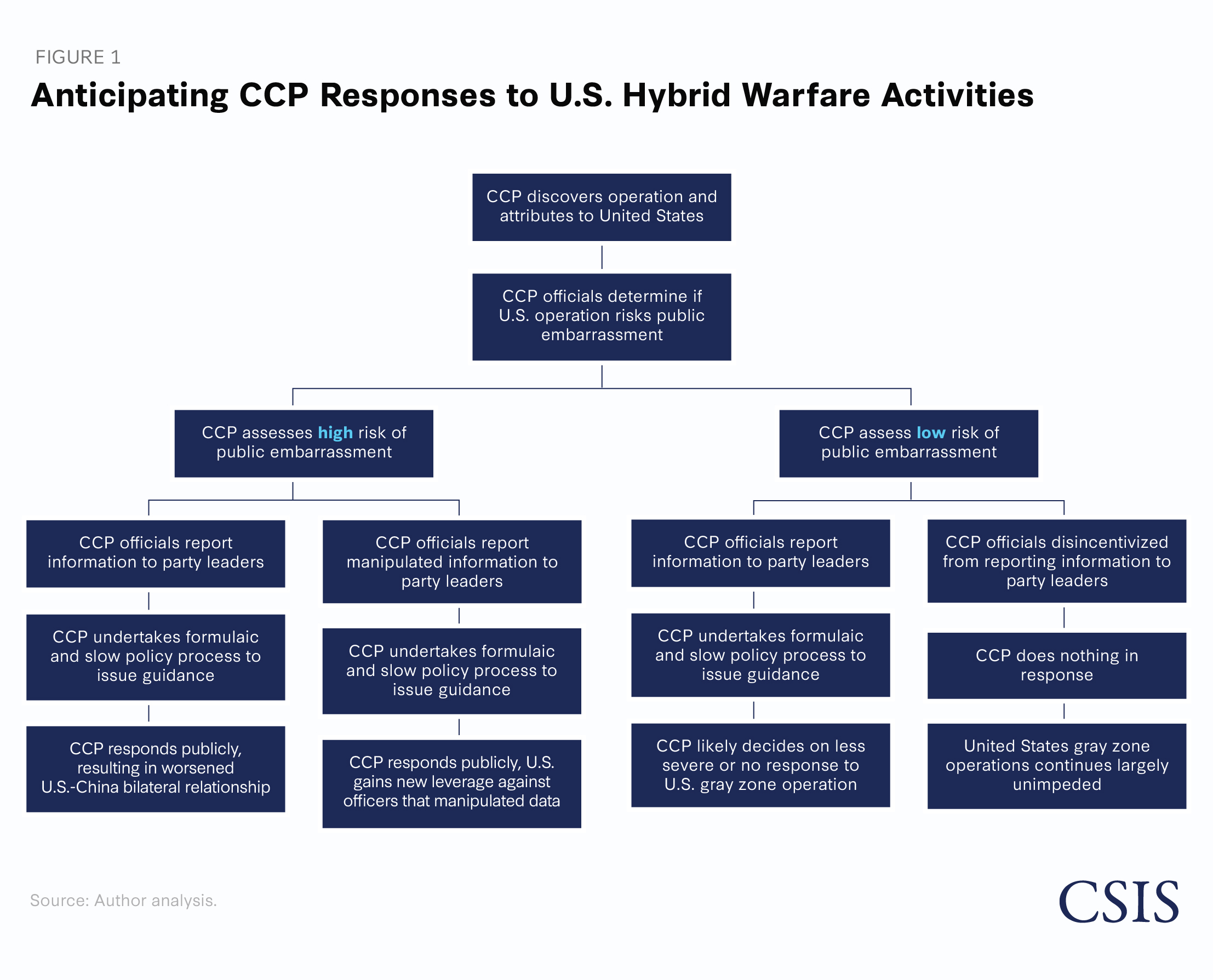
These hypothetical CCP responses should only serve as notional guideposts to anticipate outcomes. The United States will need to assess all the possible opportunities, risks, and outcomes of a given potential operation.
Take, for example, a notional U.S. effort to seed defunct technology into the CCP’s research and development for fronter AI capabilities, akin to U.S. operations during the Cold War.51 The United States’ approach should exploit corrupt patronage networks between personnel running smuggling networks (to get advanced chips into China) and CCP officials.52 Though these efforts are likely CCP-directed, they probably involve under-the-table payouts that unduly benefit CCP members.53 Directing U.S. sabotage campaigns through these channels will be more successful because—even if discovered—CCP officials will seek to avoid invasive anti-corruption committee investigations into their network and will perceive their activities pose low risk of public embarrassment for the party. If forced, they may skew the information reported up the chain, which provides the United States further opportunities to tailor its activity. Alternatively, CCP officials may do nothing at all, and U.S. operations will persist long enough to have the intended strategic effect.
Ascribing this blueprint to a more aggressive notional U.S. effort to sabotage PLA units abroad—which may be harder to hide—proves illustrative. In March 2025, a PLA Navy Task Group circumvented Australia for this first time.68 Imagine the United States conducted a sabotage operation against that Task Group. A successful U.S. operation would have been highly embarrassing for the PLA (e.g., one of its warships requiring assistance from Australia to stay afloat, or being towed by another Task Group vessel). The CCP would probably not hesitate to blame the United States (no matter how capably our operators conducted the operation), U.S.-China relations would sour, and Beijing would aim to respond accordingly.
A more productive sabotage operation would focus on PLA units trying to hide the extent of their activities abroad.69 China has relatively little experience supporting expeditionary units; thus U.S. operations could capitalize on the CCP’s slow processes to support or replenish these PLA units asking for help.70 In this case, U.S. operations could exercise more agility than formulaic CCP policy processes allow. China would likely view responding to these U.S. sabotage operations as unattractive because an exchange risks revealing China’s activities to the host nation and embarrassing the CCP. In this instance, the CCP would probably settle on a diluted response to the United States’ operations.
U.S. operations will need to balance attributability and success if they are to achieve a level of scale required against the CCP. The CCP applies the thinnest layers of plausible deniability to their unlawful campaigns, including using maritime militia to harass fishermen and front companies to steal technology, and pushing out state propaganda through foreign media Beijing has acquired.71 The United States should mimic the CCP’s tenacity and not shy away from being seen as willing to get into the trenches with China. Nonattributable operations are important in a few discrete areas, such as actions within mainland China or targeting CCP officials individually, but embarrassing the CCP should be a feature—not a bug—of U.S. operations.
A U.S campaign against China built on the CCP’s weaknesses will unlock new opportunities for policymakers to advance U.S. national security interests. Critically, the campaign must align itself to the correct capabilities, appropriate authorities, robust staffing, and general agreement on how to assess risk in these spaces. U.S. efforts will likely fail if policymakers do not understand where current U.S. policy is lacking or if they are not provided a clear plan for how the government will execute these gray zone operations effectively.
As the United States formulates the specifics of its campaign to contest China, Washington should adhere to the following principles:
U.S. hybrid warfare operations will help shape the landscape across which the United States and China will compete intensely for economic prosperity, technological dominance, military superiority, and ideological alignment. Right now, China is fighting the United States across all domains, while the United States is not doing enough. A hybrid warfare campaign, however, can put China on its back foot and help ensure China never sees the day it perceives it has surpassed the United States.
Nick Harrington is a senior associate (non-resident) for the Warfare, Irregular Threats, and Terrorism Program at the Center for Strategic and International Studies (CSIS) in Washington, D.C.
All statements of fact, opinion, or analysis expressed are those of the author and do not reflect the official positions or views of the US Government. Nothing in the contents should be construed as asserting or implying US Government authentication of information or endorsement of the author’s views.
This report is made possible by general support to CSIS. No direct sponsorship contributed to this report.
Please consult the PDF for references.