All About the Base | AATB on Location: Conversations from AUSA
November 2, 2026 • 9:00 – 9:30 am EST
Hosted by All About the Base
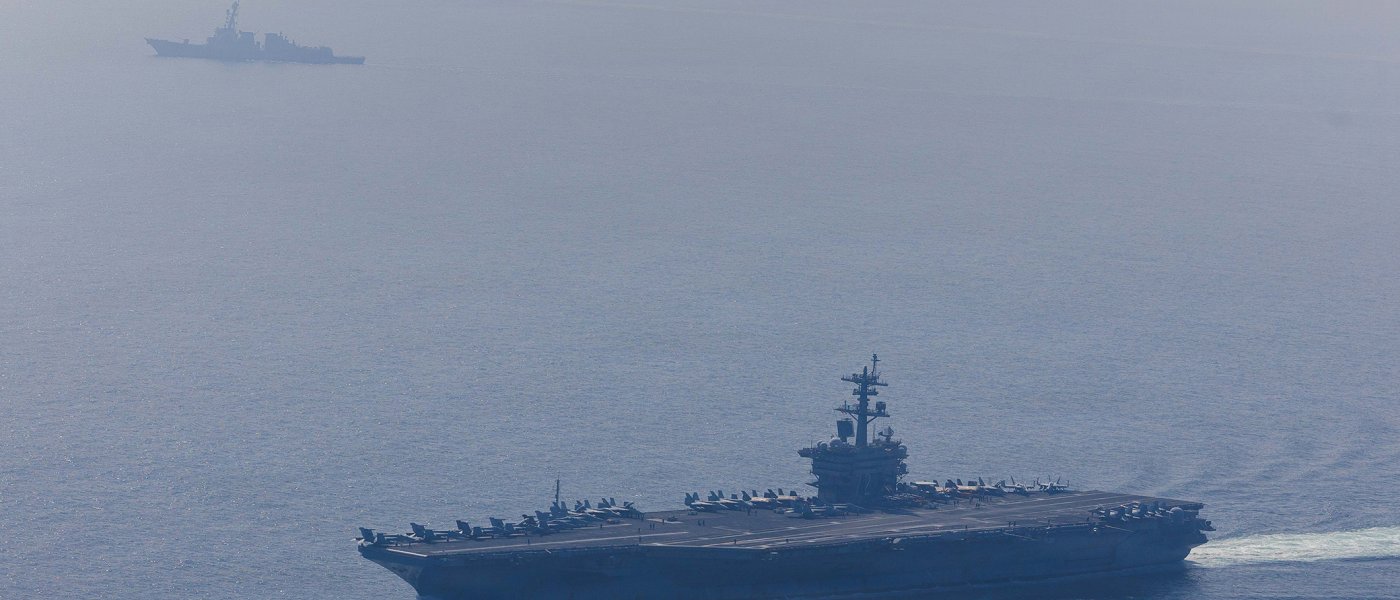
Photo: Mass Communication Specialist 1st Class Jesse Monford/U.S. Navy via Getty Images
The United States finds itself again in a Middle Eastern quagmire. The Trump administration is negotiating with a regime unlikely to make concessions easily and whose very appeal to authority is predicated upon resistance to the United States and death to the state of Israel. As a result, to bolster its potential next move, the United States has been deploying additional military assets to the region as it weighs military options. Below are six options likely under discussion based on a mix of military history and recent campaigns. Every option assumes that the United States keeps its existing economic warfare campaign, which includes a mix of sanctions and the ongoing blockade, in place. Each option also has clear trade-offs, including the potential to escalate into a larger war. As a result, it is crucial that everyone from concerned citizens to Congress reflect on these options and voice their concerns to shape a more productive policy dialogue.
First, the United States could continue to build up forces in the region while negotiating with Iran. The end state would be a pressure campaign to get Iran to the negotiation table on more favorable terms. The primary mechanism would be coercive diplomacy, combining military displays to signal the future costs of resistance with near-term benefits to persuade Tehran. The United States would move additional assets, including another carrier strike group, into the region while continuing to push enablers such as aerial refuelers and use a mix of strategic communication and inform and influence activities to send a message to officials in Tehran.
There are clear trade-offs to coercive diplomacy. The approach would be the most likely to maintain integration with Gulf state allies, who are leery of a return to large-scale hostilities. Yet it runs the largest risk of being disrupted by Israeli planning and campaign designs that are almost certain to be more aggressive. The approach also risks emboldening Iran, which has already tested the U.S. blockade with intermittent strikes against commercial shipping and threats to attack critical infrastructure in the region.
Second, the United States could use a series of limited strikes on key military assets such as coastal and air defense radar sites to alter the military balance and signal its ability to impose costs at a time and place of its choosing. The end state would be limited attacks that degrade key capabilities, support follow-on strike campaigns, and based on an altered correlation of forces change Iran’s nuclear calculus in the short term. The primary mechanism would be a mix of airpower supported by joint all-domain operations including space, electronic warfare, and cyber effects that set conditions for the attack. The best parallel is the April 2024 Israeli limited strike on the S-300 radar complex defending the Isfahan nuclear site.
The primary trade-off is escalation risk relative to the value of the objective. A limited strike is meant to signal costs and risks of resistance in support of negotiations. If Iran launches an overwhelming response as threatened, the return on investment for a limited strike is low. Therefore, limited strikes support negotiations but risk changing the risk calculus for Tehran and encouraging the regime to expand the conflict.
Third, another variant of a limited strike campaign is to shift the objective from key radar sites to a critical node in Iran’s nuclear program. The end state would be to alter the regime’s calculus about the prospects of holding onto a nuclear program during negotiations. The mechanism relies on long-range penetrating strikes capable of precision targeting of key sites across the country. Here, Operation Midnight Hammer is the template. The June 2025 strikes showcased the mix of stealth, long-range strike, and joint coordination required for this option to succeed.
The trade-off is similar to the limited strikes on military targets such as radar sites discussed previously. While the attacks would almost certainly frustrate Iranian nuclear ambitions, they risk an escalating spiral of counterattacks and further locking Tehran into rebuilding its program as the ultimate shield for its sovereignty.
Fourth, and more audacious, would be a large-scale special forces raid built around the concept of relative force superiority. As seen in Ukraine’s Operation Spider Web and the U.S. capture of Maduro, special forces raids can create dramatic, though often transitory, effects. The end state is similar to strikes on nuclear facilities with the assumption that removing enriched uranium makes it harder for Tehran to sprint toward a weapon, thus altering the regime’s approach to negotiations.
The raid would need to target the underground network of complexes where Iran likely stores enriched uranium. The most recent parallel is the September 2024 Israeli commando raid on an underground missile production facility in Syria, also known as Operation Many Ways. That operation involved multiple Israeli units, including Unit 669 and Shaldag, which specializes in long-range penetration raids. Yet, targeting multiple underground complexes inside Iran would require a significantly larger force, including conventional forces securing the outer cordon and constant airstrikes to limit Iran’s ability to retaliate over the course of the operation, which would likely take days, not hours.
The sheer complexity and time involved demonstrate the trade-off. The United States showed its ability to conduct complex, special forces–led missions inside Iran during the rescue of two downed pilots in April 2025, but also the costs. Iran could even use ballistic missiles to target its own sites where U.S. special forces teams were extracting uranium, creating significant risk to force and mission.
Fifth, the United States could opt for a prolonged sea control campaign designed to limit Iran’s ability to hold sea lines of communication at risk. The end state would be a near- to medium-term reduction in the ability of the regime to target shipping lanes, essentially adopting the Sun Tzu stratagem that “attacking the enemy’s strategy is the highest and most effective form of generalship.” This approach would take longer and require a larger expenditure of munitions, which are already running low, than the previous options. U.S. aircraft would need to roll back Iranian defenses and hit its ballistic missile sites to reduce the costs and risks of retaliation. With these conditions set, aircraft could hunt hard-to-find fast attack craft, drones, and anti-ship cruise missiles that Iran relies on alongside mines to threaten shipping lanes.
The campaign would embody challenges long discussed in military circles associated with the hider-finder competition. Iran has built its sea denial capabilities to hide inside urban areas and the countryside, thus increasing the resources and time associated with finding them.
The trade-off is time and risk to deterrence. The longer the United States conducts sustained military operations over Iran, the more likely it is to face diplomatic blowback alongside economic costs associated with higher oil prices and shipping insurance premiums. Furthermore, no campaign will stop 100 percent of Iran’s ballistic missiles, drones, cyber operations, covert action teams, or proxies from retaliating, creating a potential escalation trap. Last, every munition expended against Iran is one fewer warhead able to deter China, Russia, and North Korea.
Sixth, the United States could expand the scope and scale of strikes to threaten the security of the Iranian regime. The end state would be that Tehran’s fears of regime survival lead to a dramatic change in its negotiation process, if not a catastrophic collapse. The best parallel in military history is Operation Allied Force, the Kosovo air campaign that combined airpower with other coercive instruments to pressure the Serbian regime. Unlike that campaign, which had broad international support, this option would likely need to involve significant covert action and even special forces teams working alongside separatist and dissident groups inside Iran. That fact diminishes the prospects given the time and infrastructure required to, using an old Green Beret phrase, generate indigenous mass. Standing up guerrilla units across Iran while using airstrikes to weaken the regime and encourage a resumption of protests is a high-risk, high-reward gambit.
A counterfactual reading of Kosovo shows the risks. If Serbia, which also was experiencing large-scale civil unrest and protests, had not backed down and the United States had been forced to introduce ground forces, it could have led to a longer, protracted campaign. Iran is 151 times larger than Kosovo and has a population of over 90 million with a large military. Any option that risks turning into a protracted ground campaign is a gamble almost certain to be unpopular at home and abroad.
Fighting while negotiating has been a constant in diplomacy and military history. The situation in Iran is no different. The lowest-risk option is to continue a sustained pressure campaign, but Tehran could call Washington’s bluff and use the time to rearm, drive a wedge between allies, and even launch spoiling attacks. At the same time, there is no guarantee that past military success demonstrated in the campaign against Iran can be translated into larger, sustained political gains, even if the United States expands the scope and scale of its attacks. That is why a clear-eyed review of options is central to grand strategy in a democracy.
Benjamin Jensen is director of the Futures Lab and a senior fellow in the Defense and Security Department at the Center for Strategic and International Studies in Washington, D.C.

Commentary by Benjamin Jensen — March 12, 2026

Commentary by Benjamin Jensen — March 23, 2026

Critical Questions by Benjamin Jensen — February 26, 2026