All About the Base | AATB on Location: Conversations from AUSA
November 2, 2026 • 9:00 – 9:30 am EST
Hosted by All About the Base

Photo: RAUL ARBOLEDA/AFP/Getty Images
Threats to the U.S. homeland continue to proliferate at a concerning rate. The protection once afforded by oceans and friendly neighbors is eroding as new weapons systems increase the ability of adversaries to hold at risk critical civilian and military infrastructure. In particular, the threat of small uncrewed aerial systems (UASs), often referred to as drones, has attracted significant attention from homeland defense planners. Indeed, the 2026 U.S. National Defense Strategy highlights the need to “develop and deploy capabilities and systems to counter unmanned aerial systems” in its first line of effort.
However, the drone threats the United States is seeking to prepare for have already arrived in Latin America. According to recent data from the Armed Conflict Location and Event Data Project, approximately 480 weaponized drone attacks took place in the region between January 2025 and August 2026. These attacks have been highly concentrated in Mexico and Colombia, but the threat is metastasizing throughout the region. In Brazil, the Comando Vermelho gang, recently designated as a foreign terrorist organization, uses drones to strike at police forces as well as provide overhead surveillance in dense urban confines. In Ecuador, drones are used to smuggle weapons, explosives, and other contraband into the country’s prisons, fueling deadly massacres. Still, Colombia stands out as a particularly dire warning of how cheap commercial drones can be leveraged by malign actors to gain an asymmetric advantage against state forces.
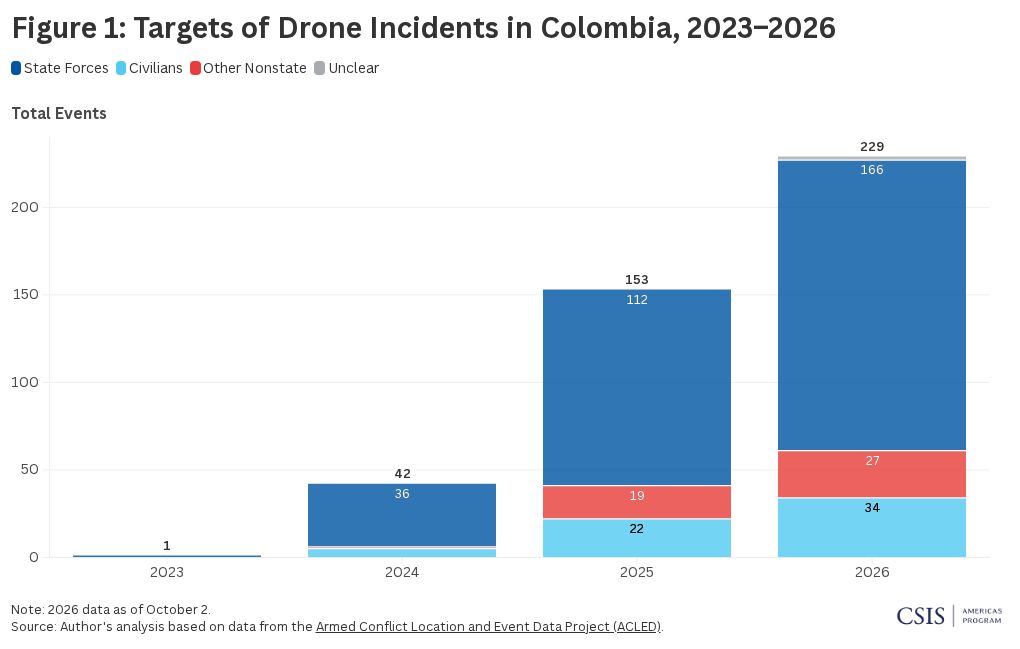
Colombia’s armed forces remain some of the best-trained in the region, and they are key security partners for the United States. However, the rapid adoption of UASs has thus far outpaced the Colombian government’s ability to respond, especially in rural areas where state presence was already weak. Drones allow nonstate armed groups to strike without exposing their fighters to direct retaliation, gather intelligence on military and police movements, and even threaten Colombia’s ability to move forces by air.
The United States cannot stand by as its allies suffer the depredations of a criminal air force. Not only do nonstate drone attacks undermine the security and stability of partner governments in the Americas, but they also reveal similar vulnerabilities that adversaries could use to strike the U.S. homeland in the near future. Confronting the drone threat is accordingly a hemispheric challenge, and an area where the United States can play a leading role. More specifically, the United States should look to fortify cooperation between Joint Interagency Task Force-401 (JIATF-401), the Pentagon’s dedicated counter-drone organization, and U.S. Southern Command’s newly established Joint Task Force Western Hemisphere. In addition, the United States could consider piloting a “lend-lease” program in which it provides partner governments in the Americas with counter-UAS (cUAS) technology and training in exchange for data and operational insights that will allow it to further refine its own drone defenses.
More concerning than the mere rate of drone attacks is the sophistication of nonstate drone tactics in the Americas. For example, in February, Colombian authorities confirmed the first instance of an attack using a fiber-optic cable connected to a drone to render it immune to radio-frequency jamming. In October 2026, Mexico seized a cache of drones that included at least 15 fiber-optic spools. The adoption at scale of fiber-optic drones could leave regional governments further behind in the innovation battle. Indeed, at least in the case of Mexico, it seems likely that interest in fiber-optic technology is being driven by advances in rival cartels’ cUAS capabilities, while the Mexican state’s drone defenses are of even lesser concern.
Increasingly, criminal groups are recruiting from the ranks of foreign fighters serving in Ukrainian drone units. Mexico’s Jalisco New Generation Cartel has reportedly been one of the most active in this regard, sending members to the front to learn drone tactics firsthand. Recent reporting from the Financial Times documented the emergence of an organized recruiting effort seeking to funnel Latin American foreign fighters from Ukraine into Colombian and Mexican criminal outfits. These individuals tend to be sought after for their knowledge of how to modify drones to make them more resilient to jamming, or their tactical expertise as pilots. In Colombia, for instance, recent attacks have employed “swarm” tactics, whereby multiple drones strike at the same targets near-simultaneously to overwhelm defenses. Such operations require close coordination among multiple pilots, expertise that can be difficult to acquire without the kind of instruction that service in Ukraine provides. However, this pipeline is hardly the only means for diffusing drone expertise and tactics, and as UASs are adopted by criminal and nonstate groups in the Americas, it seems likely that more regionally tailored expertise will emerge.
There is every reason to expect that the scale, sophistication, and geographic coverage of nonstate drone tactics in the Americas will continue to increase. Regional governments face steep learning curves, resource constraints, and bureaucratic hurdles that complicate the rollout of drone countermeasures at scale. All the while, criminals and insurgents are innovating at a rapid pace. Two especially concerning developments to watch for include the design and manufacturing of original drone models by criminal groups, as well as the diversification of drones away from UASs to ground and maritime platforms. There are already troubling signs that nonstate groups have begun experimentation in both areas.
While most criminal groups purchase commercial drones that are then modified to incorporate weapons, advances in 3D-printed firearms show that these groups could begin to manufacture their own custom platforms in the future. Many groups already make use of rudimentary 3D printing for certain components such as winglets for drone-dropped munitions, while a raid by the Venezuelan armed forces in September 2025 reportedly recovered eight printers used for manufacturing drones. In Colombia, the seizure of a remotely piloted semisubmersible “narcosub” in July 2025 also points to criminal innovation in the design of uncrewed surface vessels (USVs). USVs offer a number of advantages for drug traffickers, including reduced heat signatures, the ability to loiter off the coast for extended periods, and reduced overhead personnel costs for traffickers. To date, no groups in the region have sought to employ weaponized USVs; however, the lessons from Ukraine’s campaign against the Russian Black Sea Fleet illustrate the threat such platforms pose for Latin American navies and coast guards.
Governments throughout the Western Hemisphere have been slow to react to the drone threat, but not stagnant. Under former president Gustavo Petro, Colombia announced a $1.68 billion “drone shield” program aimed at procuring additional sensors and countermeasures to defeat UAS threats. While the program continues to advance, Colombian security forces have targeted drone operators in recent operations in a bid to sever the pipeline funneling drone expertise to nonstate armed groups. Colombia’s National Directorate of Taxes and Customs has also implemented new guidance for screening imports of drones and drone parts through the Bogotá airport and port of Cartagena in an effort to clamp down on the criminal UAS supply chain. Nevertheless, Colombian armed groups have seemingly accelerated their deployment of weaponized UASs in response to President Abelardo de la Espriella’s intensified security campaign. The drone threat in Colombia will likely continue to worsen before it has a chance to get better.
The United States itself has not been spared from such challenges. Cartel drone incursions along the U.S.-Mexico land border illustrate one vector for future adversaries to strike the U.S. homeland. Unauthorized drone incursions at military bases, particularly in the wake of the start of hostilities in Iran, reveal that even static defense of strategic bases represents a challenge. Despite these challenges, the United States continues to make strides in the counter-UAS domain. JIATF-401 has played an especially important role integrating perspectives across the government as well as testing and scaling cUAS options. JIATF-401 also operates a digital cUAS marketplace, where law enforcement, military, and partner-nation actors can interface directly with vendors to quickly procure new sensors and countermeasures.
The United States has also had success recently along the southwest land border following a series of embarrassing false positives and interagency coordination failures earlier this year. The Federal Aviation Administration and the Pentagon inked a safety agreement in April for the use of directed-energy cUAS platforms along the border. In August, Joint Task Force–Southern Border announced it had successfully interdicted three drones using a high-energy laser, the first publicly acknowledged use of such a system in a real-world counter-drone context. Since then, drone activity along the Rio Grande Valley has reportedly fallen by 75 percent. U.S.-Mexico cooperation has also been moving in a positive direction on the counter-drone front, with the two countries recently signing a letter of intent to grant Mexico access to the United States’ digital marketplace for drone and counter-drone equipment. In September, the two countries launched the joint Operation Águila Alta (High Eagle) near the Tijuana–San Diego border to monitor and interdict illicit drone activity.
Although these recent moves are welcome developments, the threat profile of drones along the border differs substantially from that found elsewhere in Mexico, let alone the rest of the Americas. Drones are primarily used by nonstate actors to monitor the movements of border patrols to identify new smuggling routes, or, in some cases, to move contraband via air into the United States. By contrast, in Mexican states such as Michoacán and Jalisco, drones are used to directly attack rival cartels, state forces, and civilians, at times in conjunction with ground offensives and assaults by improvised armored fighting vehicles (often referred to as “narco tanks”). These areas represent the true front line of illicit drone innovation, and a more pressing threat from the Mexican government’s perspective. Combating such a threat requires a layered approach that includes sensing, hard- and soft-kill countermeasures, and regulatory alignment across military and civilian institutions.
By helping its partners in Latin America defeat their own drone threats, the United States can gain valuable insights into how it can better protect its own homeland from future attacks. To do so, the United States must confront two interlocking challenges: the pace of criminal UAS innovation and the constraints partner governments face in defense procurement and adoption. Even in the face of growing drone threats, Latin American militaries face significant budget constraints that could make them reluctant to expend resources on technologies that may not have a significant operational track record and could even be rendered obsolete by the latest nonstate innovation. On top of this, simply pushing capabilities into the hands of regional armed forces will do little to curb the drone threat if they are not accompanied by new tactics, techniques, and procedures to make the most of these systems.
To rectify this, the United States should consider lending cUAS equipment to partner governments in the Americas free of charge for a trial period. In return, these governments would allow U.S. personnel to embed with their forces and access operational data that could be fed back into planning for homeland counter-drone force design. At the conclusion of the trial, governments could have the option of buying the equipment directly, potentially at a discounted rate to reflect asset depreciation during the testing period, or returning it in the event that it did not meet expectations or operational realities. This model would not only allow Latin American governments to start reclaiming the initiative in the innovation battle by rapidly unrolling a range of new cUAS capabilities for relatively low cost, but would also grant the United States access to a wealth of real-world intelligence on the performance of different drone countermeasures.
From a defense-industrial standpoint, the value of real-world testing cannot be overstated in helping planners make better decisions on what kinds of equipment to procure for the future U.S. force. So far, Ukraine has proved the gold standard for such tests, but Latin America can reveal important new insights such as the performance of systems in jungle, riverine, and irregular warfare conditions. This model could also be rolled out using existing cooperation mechanisms, potentially through JIATF-401’s cUAS marketplace, which Argentina, Mexico, and Panama have reportedly either expressed interest in or joined. The United States can also leverage the Americas Counter Cartel Coalition and ongoing security cooperation with Colombia and Ecuador as another channel.
To be sure, this approach is only one of a range of actions the United States should take to harden regional capabilities against the illicit drone threat. Washington should always seek to ensure new equipment is accompanied by robust technical assistance. To this end, JIATF-401 and U.S. Southern Command should explore options for deepening cooperation with regional militaries on counter-drone best practices. Beyond strengthening military-to-military ties, the United States should also encourage exchanges between law enforcement and private-sector actors to help build out whole-of-government and whole-of-society strategies for combating the drone threat. The United States should also take care to learn the right lessons from its Latin American partners: The tactics and equipment that may work along the southwest land border may not be suitable for base defense, just as the squad-level tactics used to fend off cartel UAS attacks may not necessarily be indicative of how a peer competitor would employ uncrewed systems in a future high-intensity conflict. Nevertheless, by joining its southern neighbors in their fight against illicit drones, the United States can reap a wealth of vital information for protecting its own homeland, infrastructure, and people.
Henry Ziemer is a fellow with the Americas Program at the Center for Strategic and International Studies in Washington, D.C.

Commentary by Henry Ziemer — June 11, 2025
