The Implications of the Hormuz Energy Crisis on South Asia
September 21, 2026 • 8:30 – 9:30 am EDT

Photo: Hector Vivas/FIFA/Getty Images
On July 1, 2026, the White House let the clock start on the United States-Mexico-Canada Agreement (USMCA) by declining to renew the deal for another 16 years. The agreement did not expire; instead, it entered a phase of annual reviews that could run until 2036, when the agreement would lapse for good if the three governments never agree to extend it. With U.S.-Canada trade talks now in collapse, Mexico is the only USMCA track still moving. What Mexico concedes for tariff relief in a stopgap deal could become the baseline for Canada, and for the harder USMCA fight still to come.
Three weeks after the July 1 deadline, U.S. Trade Representative Jamieson Greer laid out the administration’s two-stage plan for the USMCA before the Senate Finance Committee. The first step is reaching separate interim “deals” with Mexico and Canada to clear several trade and nontrade barriers before year’s end, as well as reducing each country’s exposure to U.S. tariffs. Then, the three countries would turn to the harder files: China, rules of origin, labor, and environmental provisions. Those issues that will ultimately decide whether the USMCA survives.
The United States and Canada were close to reaching an agreement in August, but negotiations collapsed, with both sides blaming the other. Canadian Prime Minister Mark Carney argued that some of the U.S. demands would have compromised Canada’s control over its own policies, while President Trump accused Canada of having taken advantage of the United States and insisted that such a relationship would no longer continue. On August 22, the United States imposed a 50 percent tariff on $20 billion worth of Canadian products; Canada launched retaliatory tariffs on September 8. While regrettable, the collapse in U.S.-Canada negotiations does not decide Mexico’s outcome. Mexico and the United States have continued their bilateral discussions since March 2026, and Mexican officials have publicly expressed optimism that an agreement can still be reached before the U.S. midterm elections of November. The United States’ bilateral relations with its two USMCA partners are different enough economically, politically, and strategically that it could land in a different place with each, although neither of these agreements would amount to the renewal of the USMCA.
Recent U.S. deals with other partners, together with Ambassador Greer’s own testimony, give a reasonably clear picture of what the United States will likely ask of Mexico, and what Mexico would look to secure in return. The administration offered few details, but it has signed enough agreements elsewhere to set precedent. These include agreements on reciprocal trade (ARTs) with countries such as Argentina, South Korea, and Japan. ARTs are not submitted to Congress as traditional free trade agreements; they largely rely on authority to the president claims t and are implemented through executive action. While the legality and scope of some of those authorities remain contested among members of Congress and other actors, these arrangements still indicate the type of concessions that Washington seeks from trading partners.
Their substance varies widely. Argentina’s ART opened agricultural markets and tightened intellectual property enforcement. South Korea’s committed $150 billion to U.S. shipbuilding and another $200 billion in broader investment. Japan’s accepted a capped tariff rate in exchange for its own investment pledges. An important issue to keep in mind with respect ARTs is that implementation has been uneven, with commitments from U.S. partners being slow-rolled or quietly set aside.
Mexico is a different case. Unlike most countries signing ARTs, Mexico already has a comprehensive free trade agreement with the United States and sits inside deeply integrated North American production networks. Whatever emerges from these talks should be understood strictly as temporary tariff relief, not a substitute for the USMCA.
Even so, it is difficult to picture the White House cutting existing Section 232 and Section 301 tariffs without asking Mexico for something in return. The results of negotiations with other countries suggest that tariff relief under this administration comes with a price. When the first International Emergency Economic Powers Act tariffs were announced, the United States had already presented Mexico a lengthy list of tariff and nontariff concerns that it wanted to address, reportedly more than 50 items. By the third U.S.-Mexico negotiation round this July, that list had shrunk to 14 issues. What closes the remaining gap, and what Mexico gets in exchange, is the decisive question now, especially with Canada having already rejected the United States’ terms.
Potential U.S. demands fall along two dimensions. The first is speed: how quickly Mexico can implement them. The second, and more consequential, is depth: how far they reach into Mexico’s control over its domestic policies and its access to the U.S. market.
The first dimension includes short-term demands, which Mexico could address relatively quickly, and medium- or longer-term demands, which would require commitments that extend beyond an interim agreement. The second includes structural and nonstructural demands. This is perhaps more important. Some U.S. requests could be relatively easy for Mexico to implement without fundamentally changing its policies; others could have much deeper consequences by limiting Mexico’s access to the U.S. market or its ability to conduct trade relations with other countries.
Crossing the two dimensions produces four types of demands:
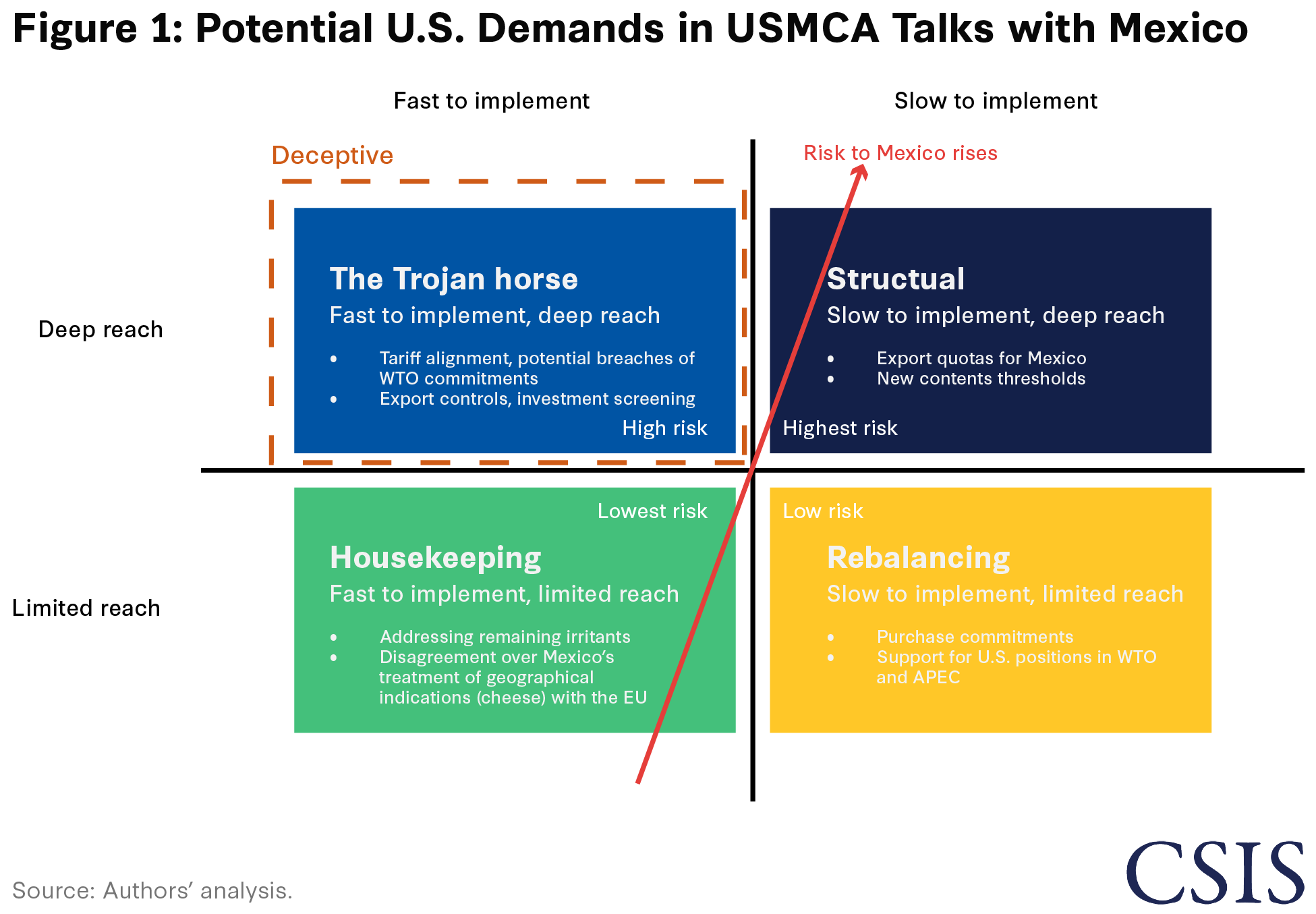
Mexican President Claudia Sheinbaum’s ability to move quickly is not in doubt. Article 131 of Mexico’s Constitution provides the executive with the power to increase, reduce, or eliminate import and export tariffs and to establish restrictions on imports, exports, and transit when necessary to regulate foreign trade. This authority is further reinforced in Mexico’s Foreign Trade Law, which provides the president and the economy ministry with important instruments to establish or modify tariff and nontariff measures. Consequently, some potentially significant commitments could be implemented without lengthy legislative processes. But if the result is to limit Mexico’s ability to determine its own trade policy toward China or another country, the implications are clearly much more significant. Prime Minister Carney considered structural demands as red lines and claims they caused the collapse of the U.S.-Canada interim deal.
How easily Mexico can grant concessions should not be confused with their significance or cost. Mexico’s potential for compromise will depend on what the United States offers in exchange.
Mexico’s main objective in an interim agreement is tariff relief, particularly applied to Section 232 duties on steel, aluminum, automobiles, and related products. A second priority is resolving existing Section 301 tariff actions that apply to Mexico, one on forced labor and one on excess manufacturing capacity. A third is protection against future U.S. tariff actions. An interim deal that delivers duty relief on today’s tariffs while leaving the door open for tomorrow’s would give Mexico the illusion of protection while exposing the country to additional duties on the very products it is negotiating relief for right now.
The governing principle should be proportionality. If the United States requests relatively simple, reversible concessions, Mexico may be able to accept them in exchange for specific tariff relief. However, if the United States expects Mexico to make deeper and permanent structural changes to its policies, Mexico should receive a stronger guarantee in return. Mexico should not accept permanent limitations on its trade policy in exchange for the temporary suspension of tariffs that can be imposed again a few months later under Section 232, Section 301, or another legal authority. The recurring flaw of ARTs with other countries is that the United States has been unwilling to commit against reimposing tariffs it has agreed to lift.
This does not mean that Mexico should refuse to make important concessions. There may be areas where greater alignment with the United States serves Mexico’s own interest—particularly if the objective is to strengthen North American production and secure supply chains—but the exchange needs to be balanced. The deeper and more lasting the demand, the stronger the guarantee that would be needed to justify it.
The failure of the U.S.-Canada negotiations makes this balance even more important for Mexico. Mexico may decide that some of the concessions rejected by Canada are acceptable if the benefits obtained from the United States justify them, but Canada’s decision creates an unavoidable point of comparison. If Mexico accepts significant or structural concessions that Canada rejected but obtains only limited or temporary tariff relief in return, it could end up with the worst of both worlds: bound by restrictions that Canada was unwilling to accept while still remaining exposed to the next wave of U.S. tariffs. Similarly, if trade with Mexico and Canada ends up governed by two different sets of rules, each product of a separate bilateral bargain, the trilateral nature of USMCA would survive only on paper. An agreement built on common rules does not hold when the parties operate under divergent terms.
Mexico should approach an interim deal pragmatically, with a clear hierarchy of what matters. Resolving individual irritants, facilitating additional U.S. investment, and accepting deeper North American economic security cooperation are reasonable pieces of a broader bargain. What Mexico cannot afford to do is treat any such deal as final. President Trump is a permanent negotiator and will reopen trade files as economic or political circumstances shift. If an interim deal is reached, Mexico should assume that the United States can return with new demands next year regardless of what was signed and negotiate accordingly.
The value of an interim agreement lies precisely in the fact that it does not have to resolve everything. Mexico should use that to buy certainty where certainty is available, settle what can reasonably be settled now, and preserve enough leverage for the harder USMCA conversations that will resume in 2027. But the risk runs the other way, too: Mexico could burn through its negotiating capital in the early rounds and arrive at the decisive ones with nothing left to trade. The benchmark for a good interim deal is not just tariff reduction today; it also needs to be proportional, provide stable market access to the United States, and leave cards for Mexico to negotiate in the future.
Diego Marroquín Bitar is a fellow in the Americas Program at the Center for Strategic and International Studies in Washington, D.C. Juan Carlos Baker Pineda is resident fellow with the Georgetown Americas Institute and one of the architects of the original USMCA.

Brief by Diego Marroquín Bitar, Christopher Hernandez-Roy, and Earl Anthony Wayne — August 18, 2025

Commentary by Diego Marroquín Bitar and William Alan Reinsch — March 27, 2026