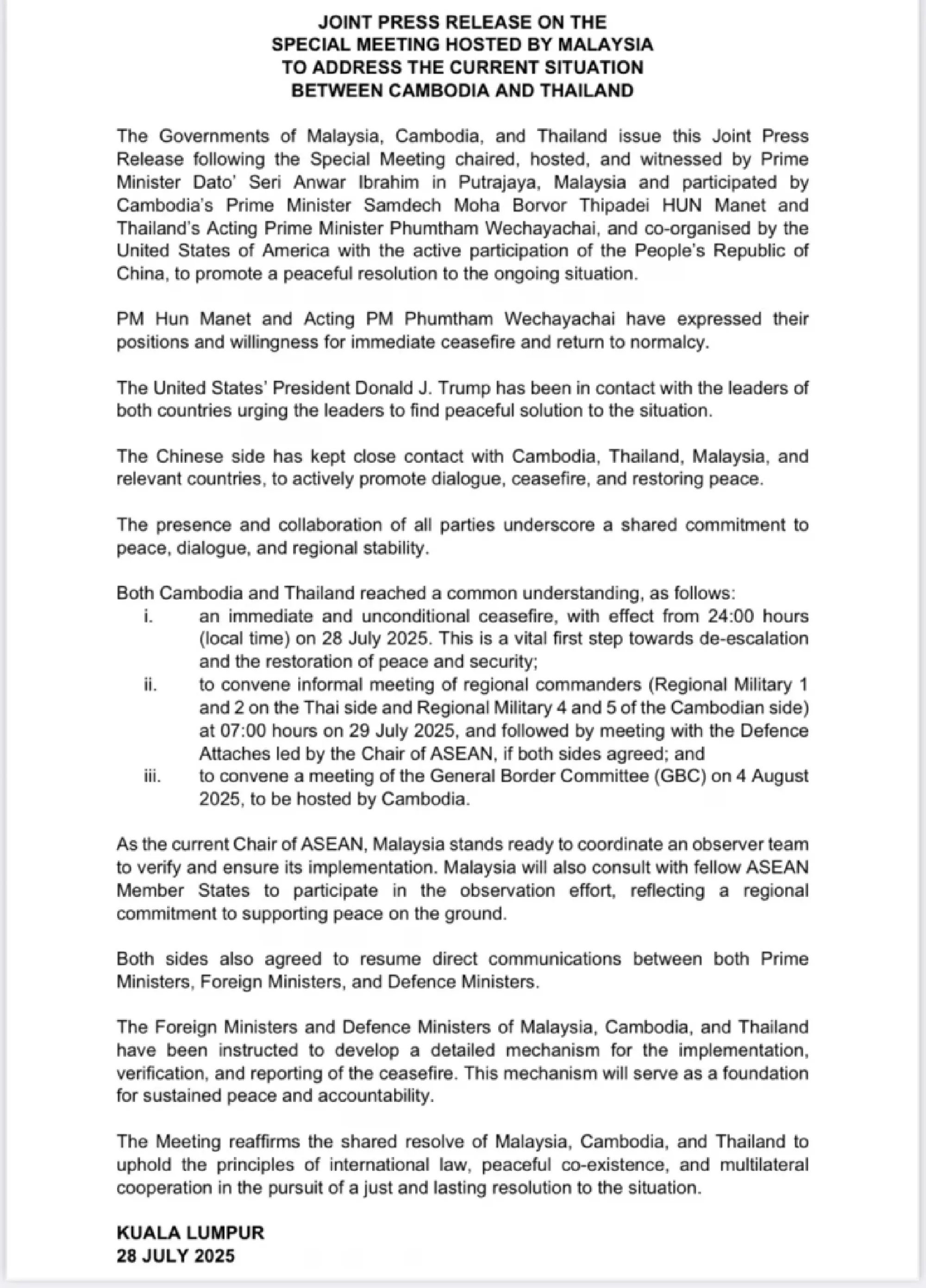
Cambodia and Thailand agreed to an unconditional ceasefire on July 28 after five days of border conflict that killed at least 38 people and displaced more than 300,000. Cambodian prime minister Hun Manet and Thai acting prime minister Phumtham Wechayachai met in Putrajaya at the invitation of Malaysian prime minister and ASEAN chair Anwar Ibrahim. The joint press release for the meeting stressed the three countries’ resolve to adhere to international law and pursue peaceful coexistence for a lasting resolution to the conflict. Watching closely on the sidelines were China and the United States. In a rare moment of consensus, both countries sent their ambassadors as observers after encouraging dialogue.
Cambodia and Thailand’s unconditional ceasefire took effect at midnight on July 29, though Thailand claimed Cambodian troops were responsible for isolated skirmishes well into the morning. Cambodia denied these allegations, and so far the ceasefire has held. Thailand, however, did file complaints to Malaysia, the United States, and China about Cambodia’s alleged breaches.
Despite a shaky start, the two countries’ regional military commanders met on July 29 and agreed to maintain the ceasefire, facilitate the return of the wounded and dead, and stop troop movements. As a next step, the defense attachés from both countries will meet in Malaysia, with the Malaysian government serving as mediator. The bilateral General Border Committee will then host a meeting on August 4 in Cambodia, with both parties agreeing to reestablish direct lines of communication. Displaced civilians have begun returning to their homes.
The United States was initially slow to address the conflict but took on a larger role with the direct intervention of President Donald Trump. Soon after the conflict began on July 24, the U.S. embassies in Cambodia and Thailand issued travel advisories for American citizens. Hours later, the State Department called for a cessation of hostilities during a regular press briefing. U.S. president Donald Trump became directly involved two days later, calling both countries’ leaders. In a series of posts on Truth Social, Trump threatened to cancel trade talks with the two countries if they did not reach an agreement to end the conflict.
President Trump’s threat posed serious economic consequences to both countries and may have played a role in bringing them to the negotiating table. He claimed credit for the ceasefire reached on July 28, though other U.S. officials have acknowledged that Malaysia’s Prime Minister Anwar was the lead mediator. In any case, Trump seems to have followed through on his promise to negotiate a trade deal in exchange for peace. On July 31, just hours before the United States’ threatened deadline to impose worldwide “reciprocal” tariffs, Commerce Secretary Howard Lutnick announced that trade deals had been reached with both Cambodia and Thailand to reduce the 36 percent proposed tariff rates on their goods. The United States has not yet announced what the new tariff rates will be, nor have the Cambodian and Thai governments provided details.
Japhet Quitzon is an Associate Fellow for the Southeast Asia Program at the Center for Strategic and International Studies (CSIS) in Washington, D.C. Gregory B. Poling is a senior fellow and director for the Southeast Asia Program and the Asia Maritime Transparency Initiative at CSIS.
For more political, economic, and security analysis on the region, check out our blog series, The Latest on Southeast Asia. To hear the latest news on the region and hear from Southeast Asia experts, listen and subscribe to the Southeast Asia Radio podcast on any streaming platform.