Powering America: The Grid, Affordability, and Energy Dominance
September 15, 2026 • 9:00 – 9:30 am EDT

Photo: Martin Leissl/Bloomberg via Getty Images
On August 6th, President Trump invoked Section 232 of the Trade Expansion Act of 1962 to impose minimum import prices (MIPs) on imports of foreign-produced polysilicon and polysilicon derivative products, as well as tariffs on polysilicon derivative products. The proclamation notes that these actions are necessary to increase domestic manufacturing capacity of polysilicon for semiconductors and solar panels, given that the United States has seen its share of global polysilicon production capacity fall from 50 percent in 2005 to under 2 percent today, and blames the actions of foreign governments for this decline.
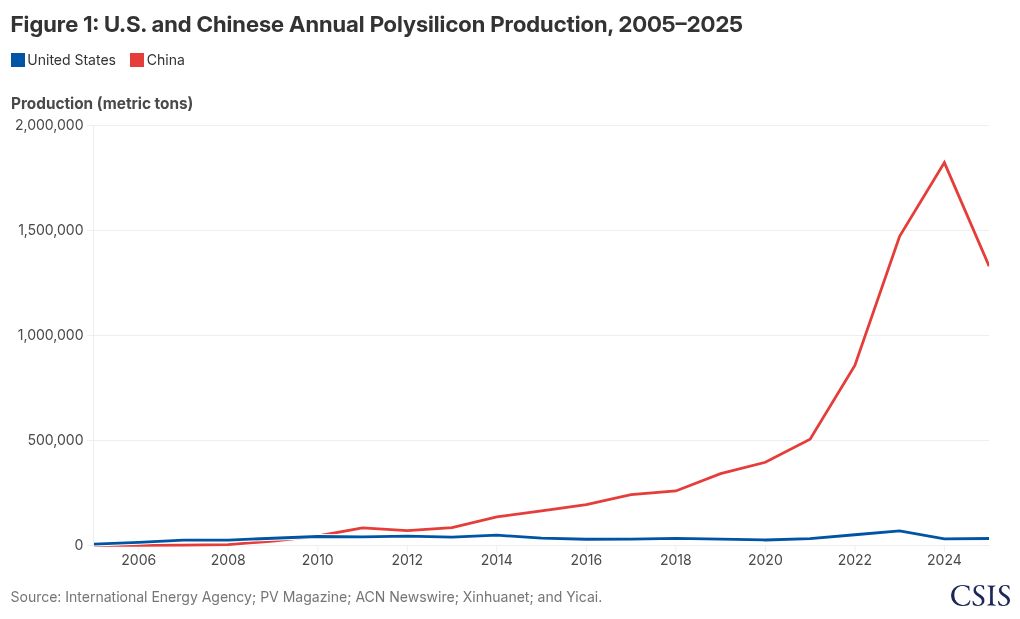
The proclamation deploys a broad range of trade policy tools in service of industrial goals, including price floors, market access advantages for trading partners that match them, and tariff waivers for companies that invest in U.S. capacity. However, prior attempts to protect the U.S. polysilicon industry through trade measures alone have been largely unsuccessful, and this attempt is also unlikely to succeed without additional domestic incentives or concerted action to build an ex-China global market for polysilicon.
Q1: What is the context of U.S. actions on foreign polysilicon and solar imports?
A1: The proclamation marks the latest step in more than a decade of escalating U.S. trade actions against foreign polysilicon and solar imports. The United States first imposed anti-dumping and countervailing duties (AD/CVDs) on Chinese solar imports in 2012, with rates reaching as high as 250 percent. China responded with its own anti-dumping investigation and tariffs of up to 57 percent on U.S. polysilicon imports, effectively shutting out then-dominant U.S. producers—just as Chinese policy support and industry investment were beginning to translate into rapid domestic capacity expansion. The loss of access to what was becoming the world’s largest solar market—combined with increasingly cheap and abundant Chinese alternatives—significantly weakened the commercial prospects of U.S. polysilicon manufacturers and contributed to an erosion of domestic investment, manufacturing capacity, and innovation.
Washington continued to broaden its trade restrictions over the subsequent years: AD/CVD measures were extended to Taiwanese imports in 2014; Section 201 safeguards and Section 301 tariffs were imposed on global and Chinese solar imports, respectively, in 2018; the Uyghur Forced Labor Prevention Act, which functioned as a de facto trade barrier on products including solar, came into effect in 2022; Section 201 measures were extended and certain Section 301 tariffs raised in 2024; and new AD/CVD orders were imposed on solar imports from Cambodia, Malaysia, Thailand, and Vietnam in 2025. The latest Section 232 action adds to an increasingly expansive and complex U.S. solar trade regime, in which successive measures have variously extended or replaced earlier restrictions rather than simply accumulating over time.
Q2: How will the proclamation affect the U.S. solar industry?
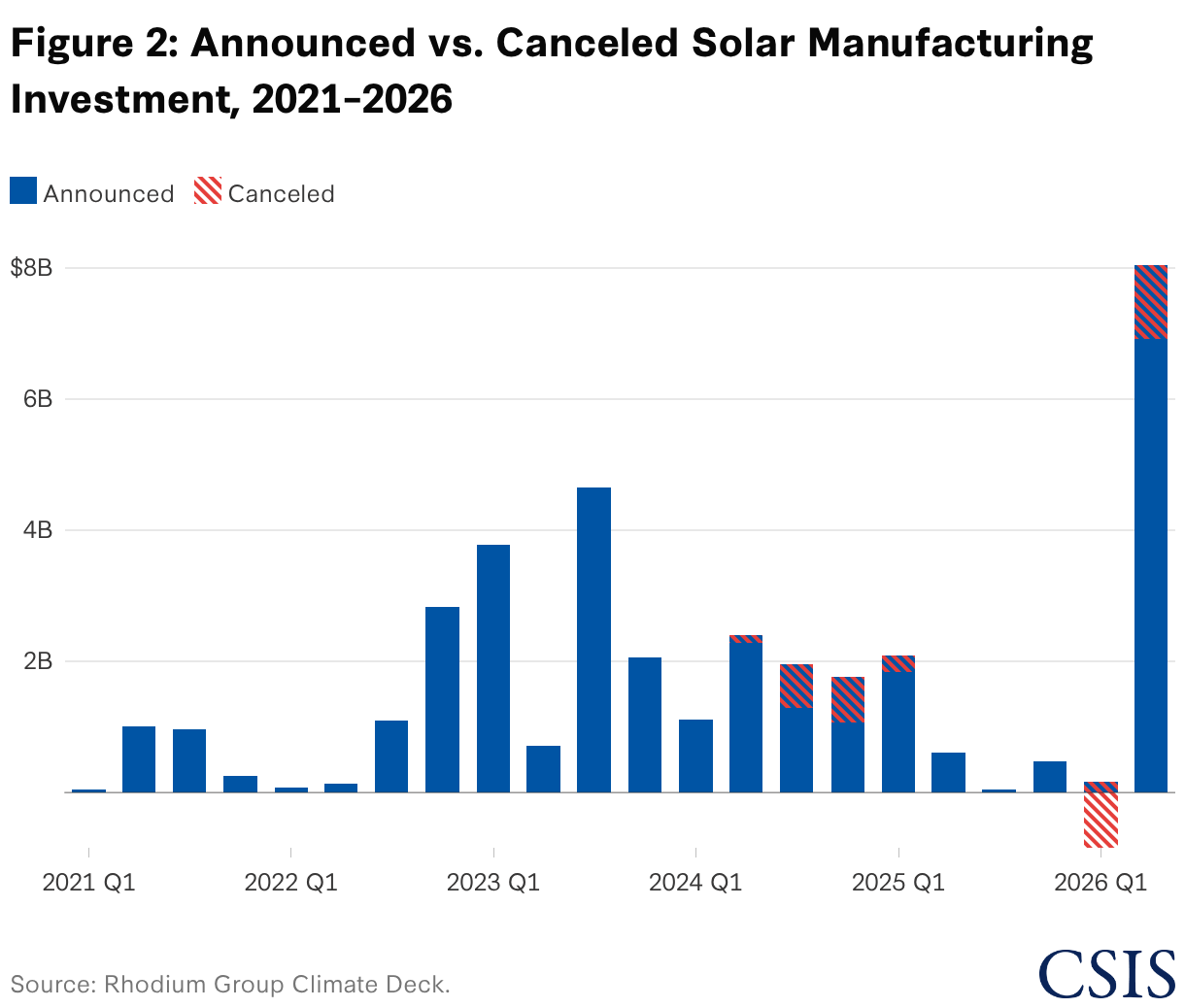
A2: Despite more than a decade of trade protection, U.S. solar manufacturing remains far from competitive: As of February 2026, domestic production costs were nearly five times those in China. Policy incentives, most notably those provided by the Inflation Reduction Act (IRA), have helped fuel an investment boom in solar manufacturing in recent years, but the buildout has been uneven across the supply chain. U.S.-produced solar modules supplied roughly 70 percent of the country’s installations in 2025, but capacity remained far more limited in midstream and upstream segments, with only about 3 GW for cells and roughly 5 GW each for wafers and ingots. Similar imbalances have emerged in the battery industry, where investment has concentrated in cell manufacturing and pack assembly while continuing to lag in midstream electrode components and upstream materials. The pace of investment also underscores the industry’s continued sensitivity to policy shifts and broader market conditions, as solar manufacturing investment fell to a three-year low in Q1 2026 and, despite rebounding 30 percent the following quarter, remained 19 percent below Q2 2025 levels.
The proclamation therefore affects a larger, though still incomplete, U.S. solar manufacturing base that remains heavily reliant on imported inputs across critical segments of the supply chain. Crucially, tariffs and tighter sourcing restrictions are now coinciding with the phaseout of demand-side IRA incentives and uncertainty surrounding remaining manufacturing credits, creating volatility on both supply and demand sides of the market. The key question is, consequently, whether the added cost of the tariffs will push input costs for U.S. midstream and downstream producers to unsustainable levels—and, in turn, whether higher prices materially weaken demand.

So far, industry analysts expect underlying solar demand to remain relatively inelastic. U.S. electricity load growth is projected to continue, while solar and storage remain among the lowest-cost and fastest-to-deploy sources of new generation. Solar power contracting has also proved resilient despite years of tariff uncertainty, with power purchase agreement volumes roughly doubling since 2022. Underlying demand, however, may not translate to actual deployment. For now, installations are set to be buoyed by roughly 200 GW of “safe-harbored” solar capacity shielded from the phaseout of tax incentives and prohibited foreign entity provisions under the One Big Beautiful Bill Act. But continued trade uncertainty, interconnection queues, permitting bottlenecks, and equipment backlogs could all temper deployment beyond this near-term pipeline.
The supply-side picture is less clear. Even accounting for potential offsets, analysts expect the combination of new and existing tariffs to contribute to a substantial supply gap, with imported cells as the cheapest pathway for domestic procurement. Notably absent from the proclamation’s advantaged country list are major suppliers of cells and upstream components—including India and Southeast Asian countries—that accounted for nearly 80 percent of U.S. cell imports in 2025. As such, the measures’ effects are likely to vary considerably across the value chain: They should provide additional protection and tailwinds for domestic upstream producers, but the outlook is much less favorable for midstream manufacturers and downstream developers that remain reliant on imported inputs and must absorb higher costs. Similarly, while these measures may create a comparative pricing and cost advantage for a handful of vertically integrated U.S. solar companies domestically, they are nonetheless still likely to raise costs for the U.S. solar manufacturing industry as a whole against foreign competitors. Policymakers will also need to account for second-order effects on related industrial segments: U.S. manufacturers of ultra-pure semiconductor-grade polysilicon, for instance, depend on the significantly higher demand volume of the broader solar-grade polysilicon market to sustain the necessary economies of scale and capacity utilization. Measures that suppress domestic demand for solar-grade polysilicon, as a result, may also harm U.S. semiconductor-grade polysilicon manufacturing.
Q3: Could the proclamation lead to an international price floor regime?
A3: The MIPs included in the proclamation establish price floors that are substantially above global prices. The International Renewable Energy Agency finds the average global polysilicon price in January 2026 to be $5.27/kg, compared to the $21/kg price listed in the proclamation. The report finds a similarly dramatic difference between solar cells ($0.058/W versus $0.22/W) and solar modules ($0.07–$0.25/W versus $0.38/W). As previously mentioned, U.S. polysilicon and solar production costs are significantly higher than those abroad. The presence of the price floors should guarantee a market that U.S. producers can compete in while reducing pricing pressures from international competitors beyond that provided by already-existing safeguards (though China has overcome solar price floor efforts before in Europe).
President Trump’s proclamation broadly blames foreign governments for implementing policies that led to the decrease of U.S. polysilicon manufacturing, even though China’s policy interventions have had the most pronounced effects. Crucially, however, the proclamation also states that countries that have entered into trade deals with the Trump administration and have established “substantially equivalent import-adjusting action modeled after our MIP” may receive increased access to the U.S. market (though the proclamation is vague on how; it says that the secretary of commerce and U.S. trade representative can “alter” the applicability of the MIP and tariffs regarding polysilicon and derivative products).
Put another way, the United States is attempting to use the lure of its domestic market to unilaterally create a multilateral price floor with trading partners. In theory, this is an interesting idea. The last several administrations have successfully wagered that foreign economies would be willing to make concessions in order to maintain access to the lucrative U.S. market. Now, the Trump administration is asking trading partners to establish domestic price floors for polysilicon and its derivative products well above prevailing market levels in order to maintain access. The trade-off, however, is more acute as higher prices would further raise costs for those countries’ solar developers and semiconductor manufacturers at a time of high energy prices. U.S. trading partners will therefore have to decide if the market access advantages being offered by the United States are worth charging a higher price at home when cheap Chinese imports are available.
Q4: Who might join such a coalition?
A4: The countries most likely to agree to such a price floor are those that have domestic polysilicon and polysilicon derivative producers featuring non-Chinese supply chains that are at risk from Chinese overcapacity. Outside of the United States, other non-Chinese polysilicon-producing countries include Germany and South Korea. Other possibilities for partnership include Japan, the United Kingdom, and Malaysia. The reasons for these last three are varied: Hemlock Semiconductor, one of the two primary U.S. polysilicon producers, is a joint venture between Corning and Japanese firm Shin-Etsu Handotai, and the United Kingdom enjoys a preferential trade relationship with Trump. Malaysia is one of the largest non-Chinese producers of polysilicon, though bilateral trade tensions could make striking a polysilicon agreement difficult. Germany (as part of the European Union), South Korea, Japan, the United Kingdom, and Malaysia have all struck trade deals or frameworks with the Trump administration and all except Malaysia received preferential tariff rates in the proclamation. Theoretically, these countries could all be eligible for whatever benefits the United States is offering should they implement a substantially equivalent MIP. Additionally, the United States has existing agreements or ongoing talks regarding critical minerals with almost all of these countries.
Q5: Are the MIPs and tariffs enough?
A5: While the price floors likely guarantee a market for U.S. producers, and the U.S. market is large enough for polysilicon producers to achieve economies of scale, the proclamation as structured is still unlikely to achieve a sector that can compete globally without government support. Creating internationally competitive firms often requires exposing them to foreign competition, as South Korea did when it conditioned state support for its chaebols on hitting international export targets. Tariffs and protectionism are seldom enough to ensure competitiveness, as Brazil’s auto industry can testify to. By sheltering U.S. firms from price competition, the proclamation risks making U.S. polysilicon firms uncompetitive elsewhere over the long term.
An international ex-Chinese price floor for polysilicon and derivatives could mitigate this concern. If other countries establish equivalent price floors, U.S. producers would be competitive in those markets as well. However, it is unclear exactly what the United States is offering, as the wording of the proclamation suggests that both reductions to the 15 percent tariffs and the MIPs themselves are possible. Clarity on what’s on offer will be important when asking trading partners to raise the prices their own companies need to pay.
Over the long term, if the administration wants to create a truly resilient, self-sustaining ex-China international market for polysilicon, many more rules would need to be agreed to. Among others, these would cover demand-side concerns (including long-term offtake agreements, who gets priority in case of shortages, and acceptable national preference programs), supply-side concerns (including acceptable use of Chinese inputs, government stakes, and financial assistance), and the creation of a price index system. Negotiators would also need to ensure such a market was immunized against the strategies employed by China to undermine Europe’s solar price undertaking regime.
Domestically, the administration will also have to grapple with how to direct capital to strengthen the U.S. buildout in ingots, wafers, and cells, the true bottleneck in the solar ecosystem. Before the IRA, the United States had virtually no domestic capacity in these segments despite strong protective tariffs. IRA incentives strengthened U.S. production of these products to an extent, but their partial repeal, coupled with the administration’s hostility to renewables, has dampened investment. The fact that trade barriers alone were insufficient to develop capacity of those products indicates that other forms of support will also be needed to accomplish the proclamation’s goals. Beyond that, companies will likely need long-term assurances in order to invest the hundreds of millions of dollars necessary to stand up factories, or risk seeing their investments stranded if the MIP or tariffs on non-trade-agreement partners are removed.
Q6: So, will the proclamation work?
A6: It will be impossible to separate the impact this proclamation has on polysilicon and polysilicon derivative production from the broader policy environment. Several previous Trump administration priorities have limited the growth of the domestic U.S. solar industry, capping the market potential for domestic polysilicon and polysilicon derivative producers. Guaranteeing the U.S. market is available for U.S. producers is an important first step toward strengthening U.S. domestic manufacturing capacity; providing additional domestic incentives and creating a global market that excludes unfair Chinese competition are vital next steps to ensure long-term success of the sectors the administration is seeking to strengthen. For polysilicon and its derivative products, as well as other critical minerals, getting the right mix of domestic incentives, trade measures, and international alignment is necessary to build both a competitive domestic industry and meaningful ex-China capacity.
Christopher Gundermann is a fellow with the Economics Program and Scholl Chair in International Business at the Center for Strategic and International Studies (CSIS). Ray Cai is an associate fellow in the Energy Security and Climate Change Program at CSIS.

Report by Ray Cai and Jane Nakano — April 27, 2026

Critical Questions by Leslie Abrahams — April 10, 2025