AI Has a Memory Problem
Photo: Gorodenkoff/Adobe Stock
As memory manufacturers shift production toward AI-oriented products, a growing share of global memory capacity is being directed toward data center applications. Policymakers and industry leaders have devoted significant attention to advanced logic chips, but recent developments suggest that memory availability may become an equally important determinant of AI deployment and broader industrial competitiveness. While advanced logic processors, particularly AI accelerators such as Graphic Processing Units that perform the computations required to train and run AI models, often receive the most attention, AI systems also depend heavily on memory chips to move, store, and process huge volume of data, making memory availability a critical constraint on future AI deployment.
In June 2026, a coalition of U.S. trade associations representing telecommunications providers, automakers, medical device manufacturers, retailers, and other industries urged the Trump administration to address emerging shortages in the memory chip market. The groups argued that rapidly growing demand from AI data centers is tightening memory supplies and increasing costs for a range of downstream industries that depend on these components.
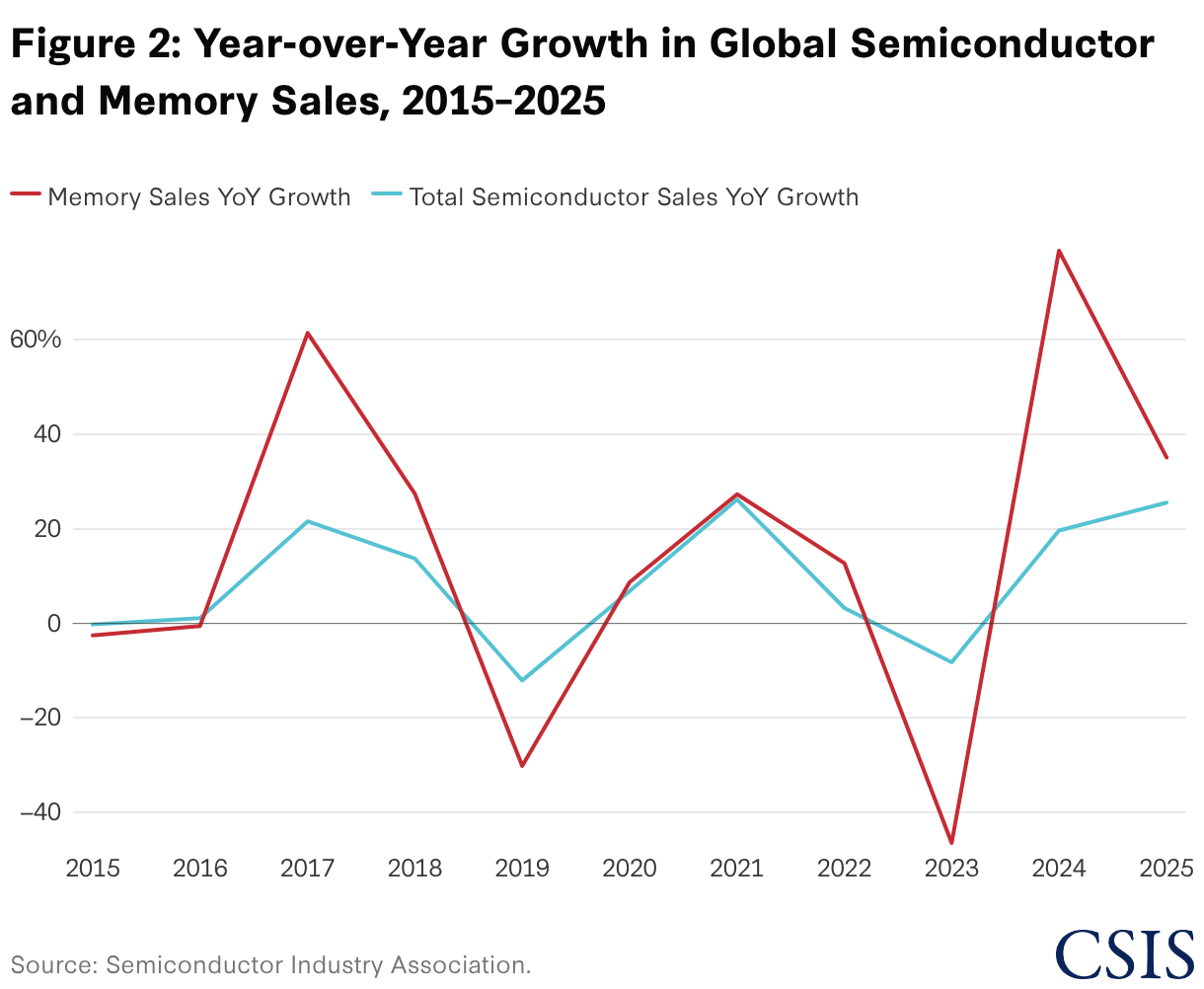
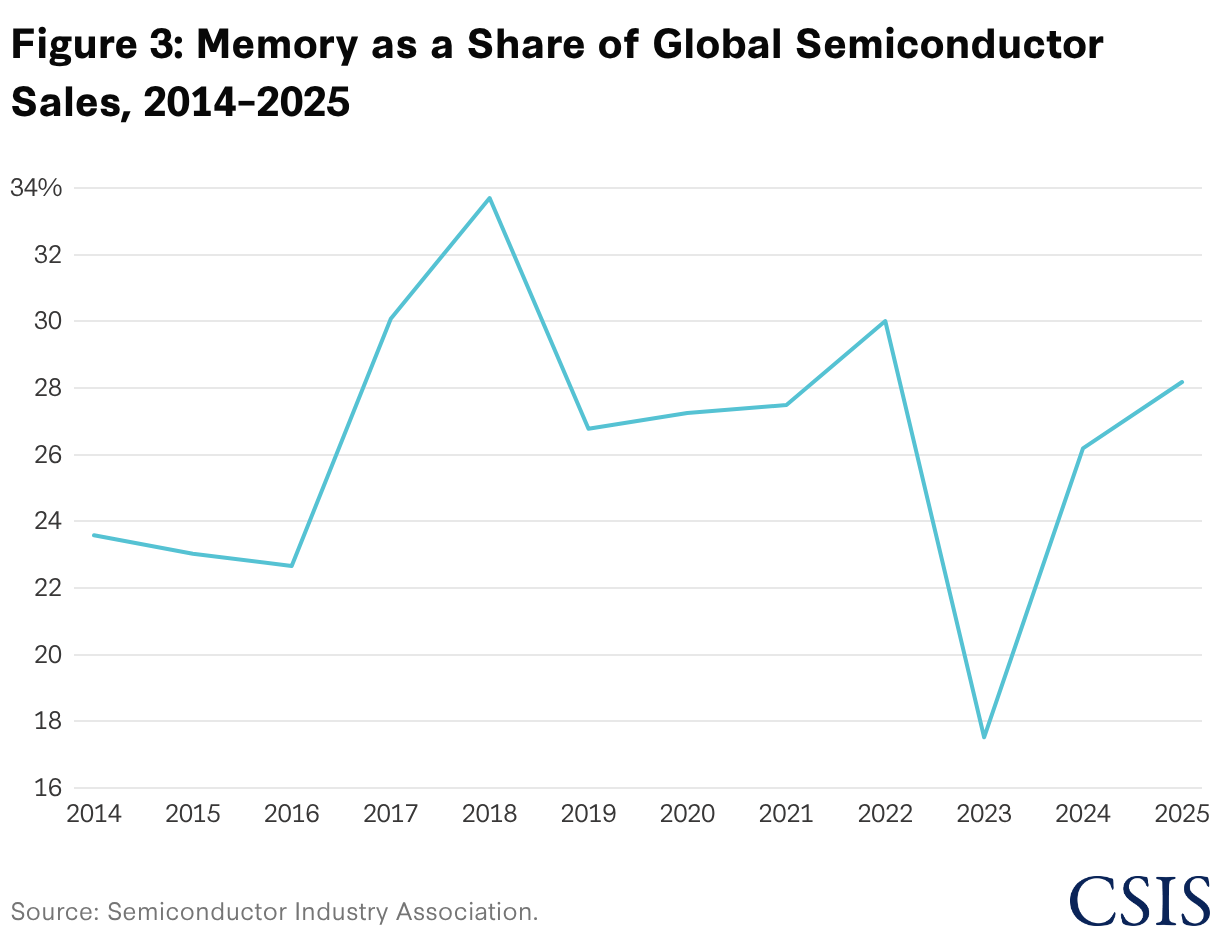
The concerns come amid a period of rapid growth in the memory market. Global memory sales increased nearly 79 percent in 2024 to $165 billion and are projected to exceed $223 billion in 2025, driven by rising demand from data centers and advanced computing applications. Available evidence suggests the current market dynamics are being driven by both rising demand and constrained supply. While memory revenues have increased sharply, there are also signs that physical demand for advanced memory is outpacing production capacity. For example, SK Hynix—the leading producer of high-bandwidth memory (HBM)—reportedly sold out its entire 2026 production slate and is no longer accepting new orders for major memory products. This suggests that the issue is not simply rising prices, but that manufacturers are struggling to expand output quickly enough to meet growing demand from AI infrastructure projects.
Much of this growth has been driven by demand for HBM, a type of advanced memory designed to improve data transfer speeds and support the computational requirements of AI workloads. As investment in AI infrastructure has accelerated, major technology firms have significantly increased spending on data centers and computing capacity. Between 2024 and 2026, Meta, Microsoft, Amazon, and Alphabet are projected to increase annual spending on AI-capable data centers from $217 billion to roughly $650 billion. OpenAI reportedly secured agreements in 2025 for up to 900,000 DRAM wafers per month for its Stargate project, equivalent to roughly 40 percent of global DRAM output.
As demand for AI infrastructure has increased, memory manufacturers have adjusted production strategies to meet changing market requirements. Samsung, SK Hynix, and Micron—which account for more than 90 percent of global DRAM production—have expanded HBM output in response to growing demand from hyperscalers and AI firms. As a result, a larger share of global memory capacity is being directed toward data center applications, which are projected to consume roughly 70 percent of worldwide memory output in 2026.
What makes the current situation particularly significant is that it may not be resolved quickly. New memory fabrication facilities require investments of $15–20 billion and typically take several years to become operational. Although Samsung, SK Hynix, Micron, and emerging Chinese producers are investing heavily in new capacity, industry forecasts suggest shortages could persist through at least 2027 and potentially beyond.
The implications extend beyond near-term price increases. As demand for advanced memory continues to grow, access to memory components may become an increasingly important determinant of both industrial competitiveness and AI deployment. Industries that rely on memory-intensive technologies are facing higher costs and greater supply uncertainty, while firms developing AI infrastructure are likely to encounter longer lead times and increased competition for critical inputs. In this environment, memory capacity is becoming an increasingly strategic component of the broader semiconductor ecosystem.
As AI infrastructure expands, competition for memory is likely to intensify. Meeting future demand will require continued investment in both memory manufacturing and advanced packaging capacity, which is essential for producing HBM used in AI systems. Strengthening supply chain resilience, expanding domestic capacity, and working with trusted partners can help alleviate emerging bottlenecks and ensure that growth in AI infrastructure does not create constraints for other industries that rely on memory-intensive technologies.
Data visualization by Kharle Wu