Launching the International Call to Action for 6G Leadership and Security
July 29, 2026 • 9:30 am – 12:00 pm EDT
Hosted by Strategic Technologies Program

Photo: iLab/CSIS
The opening weeks of 2026 have offered little respite from policy uncertainty emanating from Washington. The negative impact on its traditional trading partners and allies is deepening and will likely be long lasting. They are no longer just reacting—they are responding to a world in which U.S. commitments to underwrite the global economic system now appear to be revocable. They are seeking to hedge their U.S. exposure by crafting new trade and technology deals with each other and rethinking their China stance in pursuit of perceived stability. The question is what comes next.
At Davos, Carney and Trump offered dueling visions for what may be coming—both rooted in less-than-generous critiques of the post-WWII order. Yet neither delivered a compelling alternative that promotes growth and security for free peoples. Prime Minister Carney's call to middle powers may create margins for maneuver, as Canada's China deal suggests. But it is hard to see how his formula will avoid the downsides of Chinese mercantilism, malign action, and economic coercion. Meanwhile, President Trump’s assertions of shared sovereignty with Venezuela, tariff threats over Greenland, and the creation of a "Board of Peace" with its hefty membership fee only serve to remind us that coercion without shared goals does not deliver buy-in or stability.
It is worth considering the U.S. administration’s goals. To date, the tariff gambit has had myriad, at times competing goals: stopping fentanyl flows, raising revenues, reducing bilateral goods trade deficits, acquiring territory, securing energy access, and extracting defense spending commitments. Absent clarity on the goals, it is hard to see how the United States can play the economic and technology long game. While we may debate the strengths and weaknesses of the post-WWII economic order, at least the architects of Bretton Woods were clear on their goals—ensuring exchange rate stability, preventing competitive devaluations, and promoting reconstruction and growth.
Clarifying America’s long-term goals was one of the motivators for our flagship Tech Edge Report. The report lays out a playbook for America’s technology long game—one centered around building dexterity across technologies that matter most, achieving speed and scale, and defending networks of innovators and trading partners. The Tech Edge Report is the commencement, not the culmination, of our multi-year effort that will cover a number of technology deep dives, from robotics to batteries, from life sciences to digital payment systems.
As I've argued in Foreign Affairs, this will require not only productive and technological capabilities in the private sector, but new economic management and economic security capabilities in government. Absent these capabilities, the United States could continue to improvise, while China
operates with long-term vision, institutional coordination, and shrewd diplomatic outreach to traditional allies. It is time to develop the next generation of economic warriors.

Photo: Siarhei/Adobe Stock
Tech Edge: A Living Playbook for America’s Technology Long Game
January 20, 2026
Winning the tech race is not about any single breakthrough. Leadership requires competing across the full menu of technologies, developing the dexterity to build at speed and scale, and defending our domestic markets from nonmarket competition.
America Needs Economic Warriors
December 30, 2025
"Building an economic warrior class should be a national priority among government, business, universities, think tanks, and philanthropies," warns CSIS’s Navin Girishankar in Foreign Affairs.
Is a Weakened CS3D Still Too Much?
January 5, 2026
Bill Reinsch and Michael Gary unpack the critical questions around the European Union's Corporate Sustainability Due Diligence Directive (CS3D).
Building a True Trusted Trade Partnership with the United Kingdom
January 22, 2026
Meredith Broadbent unpacks the recent agreement between the United States and United Kingdom to cooperate on pharmaceuticals and medical technology.
Japanese Energy Companies Step Up U.S. Investments
January 23, 2026
The series of major Japanese investments in U.S. gas assets since last year is driven by commercial, policy, and geopolitical factors. Ben Cahill and Jane Nakano explore the Japanese investments in U.S. oil and gas assets.
U.S.-India Insight: Beyond Optics: India’s New Strategic-Commercial Linkages
January 8, 2026
As global alignments shift, India is quietly deepening trade and security ties with U.S. allies—even as high-profile engagements with rivals grab headlines. A closer look shows substance, not symbolism, is shaping India’s strategic direction.
Securing the Future of the U.S. Biopharmaceutical Industry: The Most-Favored-Nation Paradox
January 13, 2026
The administration’s success in securing massive investment pledges from the industry to reshore manufacturing needs to be reinforced. Its positive impact will be undermined if the long-term consequence of its most-favored-nation pricing policy weakens the foundations of U.S. innovation.
Canada and the European Union: Two New Wins for Chinese Exports in the West
January 22, 2026
Canada and the European Union appear to have reached agreements allowing more EVs made in China to enter their markets. These deals suggest that these close allies are considering increasing their technological cooperation with China in some sectors.
Unstable Coins: Stablecoin Regulation, Market Structure Legislation, and U.S. Security Risks
January 12, 2026
If policymakers do not urgently refine and implement cryptocurrency regulation, existing stablecoin and market-structure frameworks risk embedding systemic financial and national security vulnerabilities.

Photo: iLab/CSIS
New Pathways to Prosperity ft. Paul Ryan, fmr Speaker of the U.S. House of Reps
January 7, 2026
Betting on America welcomes Paul Ryan, former Speaker of the U.S. House of Representatives, for a wide-ranging conversation on the big forces shaping politics and policy—competing populisms, U.S. trade policy and its discontents, out-of-control fiscal deficits, the future of the U.S. dollar, and the tech race with China.
The Trade Guys
January 26, 2026
On this episode of the Trade Guys, Bill and Scott discuss President Trump's tariff threats surrounding Greenland and the outcomes of the World Economic Forum in Davos.
The AI Policy Podcast
January 22, 2026
In this episode, Greg Allen discusses and evaluates the BIS' new export policy for Nvidia's H200 chips before turning to Beijing's decision to block H200 imports and the Pentagon's recent AI strategy.
Cache Me If You Can
January 21, 2026
In this episode, James A. Lewis joins Matt Pearl to discuss the geopolitics of quantum tech, as Congress reintroduces the National Quantum Initiative Reauthorization Act to expand U.S. quantum leadership in research, workforce, and global cooperation.
China Field Notes
December 11, 2025
In this episode of China Field Notes, Scott Kennedy speaks with historian Michael Szonyi about why fieldwork matters to social historians and trends in U.S.-China relations.
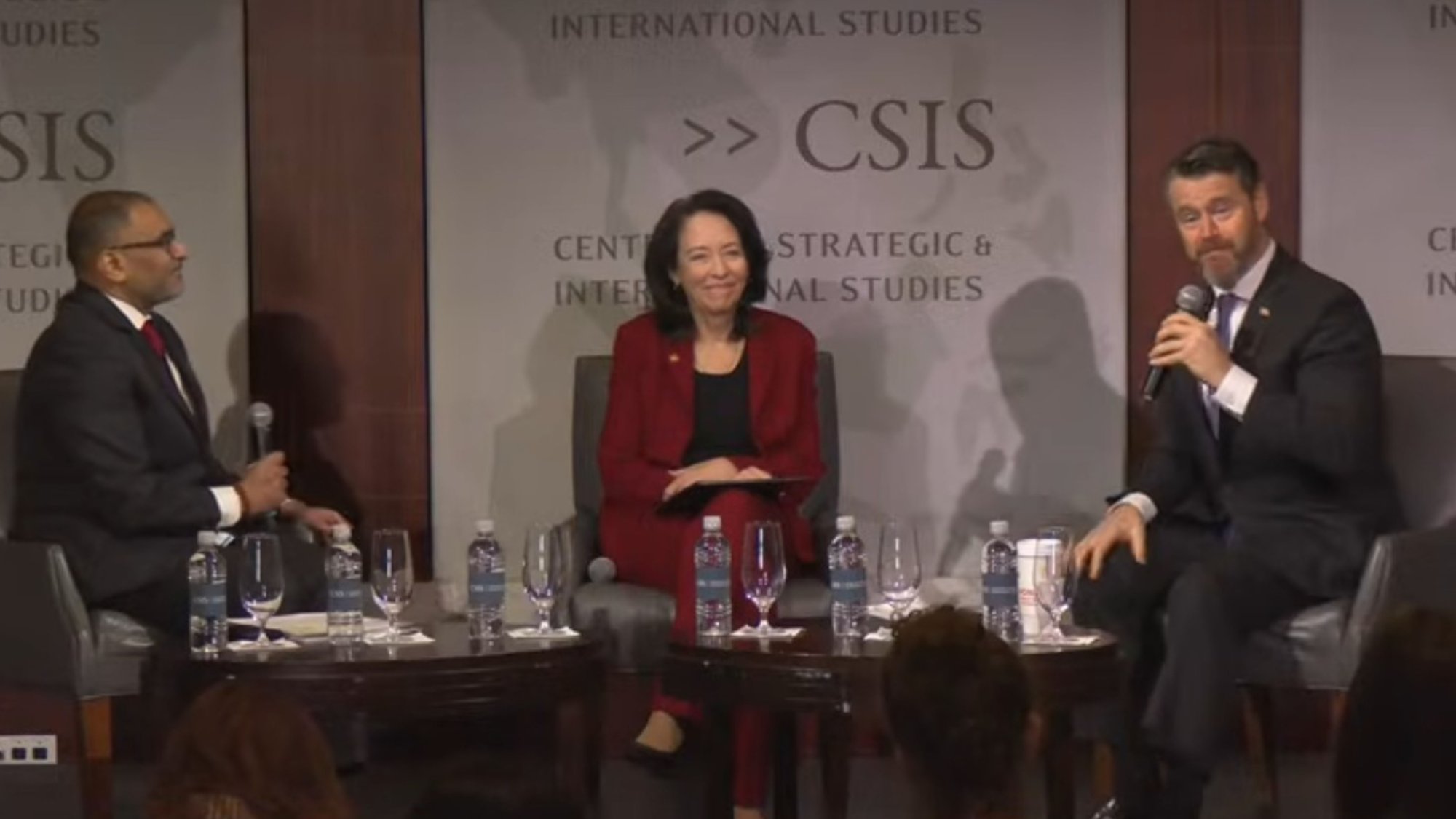
Photo: CSIS
Securing the Edge: America's Technology Long Game for Competing with China
January 28, 2026
Catch the Recap: The CSIS EST department is hosting an event with Senators Maria Cantwell (D-WA) and Todd Young (R-IN) for a fireside conversation on the future of U.S. technology leadership. The discussion explored bipartisan priorities for securing critical supply chains, accelerating both R&D and technology commercialization, and modernizing America’s industrial base.
Global Oil Markets Outlook: Key Takeaways from EIA’s January 2026 STEO
January 20, 2026
Catch The Recap: The CSIS Energy Security and Climate Change Program hosted a discussion and presentation on the U.S. Energy Information Administration’s January 2026 Short-Term Energy Outlook.
Energy Trends Across APEC: Insights from APERC’s 9th Energy Outlook
January 8, 2026
Catch The Recap: The CSIS Energy Security and Climate Change Program hosted a discussion and presentation on the APEC Energy Demand and Supply Outlook, 9th Edition, with Glen Sweetnam, Senior Vice President, Asia Pacific Energy Research Centre (APERC).
Strengthening the U.S.-India Partnership: A Fireside Chat with Reps. Rich McCormick and Ami Bera
January 12, 2026
Catch The Recap: A bipartisan fireside chat with U.S. House of Representatives Rich McCormick and Ami Bera examining how Congress is shaping the future of the U.S.–India partnership across security, economic ties, technology, and people-to-people engagement.
Exploring Global AI Policy Priorities Ahead of the India AI Impact Summit
January 30, 2026
RSVP: CSIS Wadhwani AI Center and CSIS Chair on India and Emerging Asia Economics are hosting a conference previewing the India AI Impact Summit. The conference will convene leading voices in AI to explore India’s goals for the upcoming AI Impact Summit and expert perspectives on the future of global AI policy.
