Assessing the Impact of China-Russia Security Coordination in Latin America and the Caribbean

Tabletop Exercise Summary

Available Downloads

Executive Summary

The United States is currently engaged in a dramatic reprioritization of the Western Hemisphere in its national security policy. Documents like the 2025 National Security Strategy and 2026 National Defense Strategy make clear that Washington cannot readily project power abroad without security and stability at home. Although the ongoing war with Iran has undoubtedly challenged the prioritization laid out in these documents, it has not shaken the broader pivot to the Americas. While U.S. and Iranian missiles and drones were trading blows across the Strait of Hormuz, a dozen leaders from Latin America and the Caribbean (LAC) gathered in Doral, Florida, for the inaugural Shield of the Americas Summit. At the gathering, the United States launched the Americas Counter Cartel Coalition, a group of like-minded countries pursuing security cooperation. Subsequently, U.S. forces joined their Ecuadorian counterparts in a renewed offensive against transnational organized crime, while the United States continues to probe next steps in Venezuela following the capture of dictator Nicolás Maduro by U.S. forces on January 3, 2026.

But the United States is not the only actor seeking to make inroads in LAC’s security and defense space. Russia has long viewed provocation in the Western Hemisphere as a means of retaliating against perceived interference in its own “near abroad.” China has been more cautious, but the country has still attempted to forge partnerships through arms exports and military diplomacy with the region. Although the so-called no-limits partnership professed by the two has been revealed to be increasingly hollow over the past year, it remains worthwhile for policymakers to question whether closer Russia-China coordination might be able to challenge U.S. security interests in LAC.

For this reason, the CSIS Americas Program designed a novel tabletop exercise to better understand the consequences of Russia-China cooperation in the security and defense space in LAC. The findings from this exercise suggest that the United States remains the security partner of choice for most of the region, and that Moscow and Beijing struggle to achieve tight coordination even when allowed to communicate freely with one another. Nevertheless, the exercise revealed structural factors that could produce runaway escalation dynamics and destabilization that could hurt the U.S. strategic position in a world of more sharp-edged geopolitical competition.

To address these challenges, the United States should take action to disrupt alliances between Russia, China, and anti-U.S. authoritarian regimes in the Western Hemisphere. The United States should also seek to shore up its position as the security partner of choice for its allies in LAC, leveraging initiatives like the Americas Counter Cartel Coalition as well as increasing funding for defense modernization throughout the region.

Introduction

On February 4, 2022, a mere three weeks before Russia’s unprovoked full-scale invasion of Ukraine, Russian President Vladimir Putin and Chinese President Xi Jinping met in Beijing where they declared a partnership both leaders described as greater than a traditional alliance. In the joint statement released by their respective governments, this would be a “no-limits” partnership. At a follow-up meeting a little over a year later, Xi told Putin: “There are changes happening, the likes of which we haven’t seen for 100 years. Let’s drive those changes together.” Putin nodded in agreement. But Xi’s comment was more than a parting platitude. The notion of “changes unseen in a century” has been identified by scholars as foundational to China’s view of itself as an inexorably rising power set to overtake the United States as the world undergoes unprecedented changes that will catapult China into the driver’s seat of history. The brief exchange is illustrative because it indicates that the People’s Republic of China (PRC) views Russia as a key partner in its mission to overtake the United States.

Beijing sees Moscow as its most important collaborator in its wider project of altering the current international order and replacing it with something more favorable, while Iran occasionally plays a role as one of the most important middle-sized powers that has found convergence in China’s and Russia’s pursuit of a less Western-centric world. While cooperation and coordination between China and Russia have centered on Europe and Eurasia, the CSIS Americas Program set out to examine the extent of their purportedly infinite friendship in LAC. If China and Russia’s no-limits partnership were to extend into true cooperation in the LAC defense and security space, both countries would already have sizable bases to build upon. In the short-to-medium term, this cooperation could have deleterious effects on U.S. economic, political, and even physical security within the Western Hemisphere. In the event of a crisis or conflict with either Moscow or Beijing, such efforts would likely accelerate into overdrive to create a hostile operating environment for the United States close to home and defang Washington’s longstanding policy of strategic denial within the hemisphere.

Even as the no-limits partnership has come under strain during the Trump administration’s multiple military operations—with neither China nor Russia intervening to rescue the Venezuelan or Iranian regimes—events of the last four years, and especially more recently, have provided ample evidence of the challenge posed by China-Russia coordination on security and defense issues. Principally, China has supported Russia’s defense industrial base throughout its full-scale invasion of Ukraine, while Russia bombards Ukrainian cities with its own version of Iran’s Shahed drone. More recently, both China and Russia have reportedly been sharing satellite imagery and drone technology with Iran, making the latter’s retaliatory targeting against U.S. allies in the Gulf more effective and lethal. While China-Russia coordination did not transpire during Operation Absolute Resolve to remove dictator Nicolás Maduro, cooperation in the defense and security space in other theaters makes it more than possible the two countries will eventually do so in LAC. Nevertheless, recent trends underscore why coordination demands closer analysis. While not necessarily alliance-like, China-Russia defense and security cooperation, especially when aimed at helping a fellow authoritarian regime weather a storm, fits under the umbrella of the no-limits partnership.

Remote Visualization

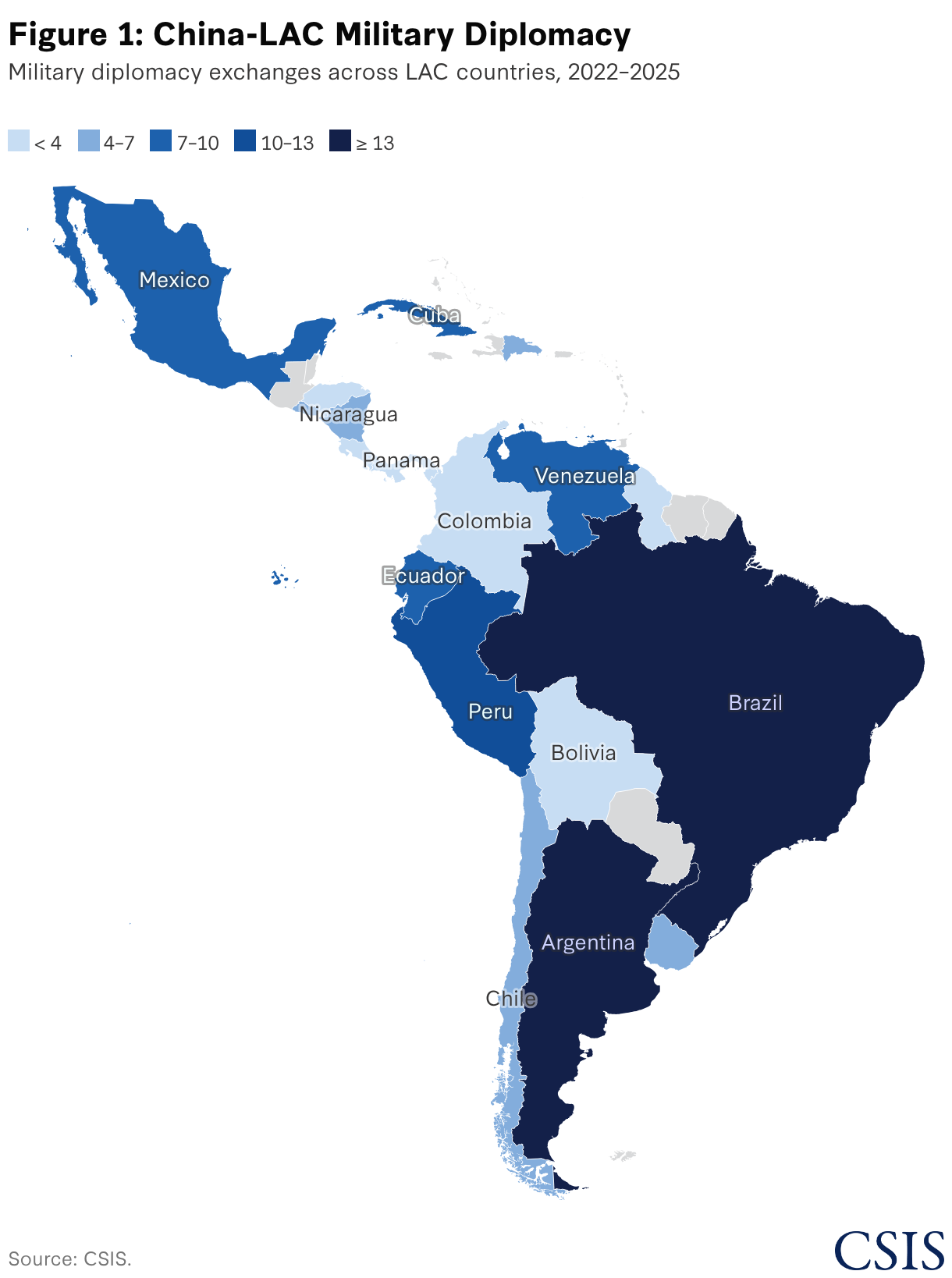
In the Western Hemisphere, China-Russia defense and security coordination would risk compounding pressure on U.S. interests, even more so if paired with diplomatic and economic tools. In recent years, China and Russia have conducted joint bomber patrols, including near U.S. airspace in the Arctic off the coast of Alaska. The North American Aerospace Defense Command conducted a successful intercept to deter this incursion into Alaska’s Air Defense Identification Zone. Both China and Russia have expanded their military diplomacy in LAC, endeavoring to train a larger percentage of LAC’s flag officers in their military academies. These exchanges build influence networks and provide opportunities for information exchange on training and doctrine. And China has expanded its engagement in defense-adjacent areas such as dual-use technologies, training, and security assistance. This includes donating military and police equipment and focusing on security at a local level as opposed to the national level, where the United States is typically the partner of choice with the region’s armed forces. China also has more space infrastructure in LAC than anywhere else in the world outside of mainland China. Security and defense cooperation is a high-stakes domain. Often these relationships are harder to reverse than, say, trade flows or media influence. Weapons sales, doctrine exchange and training, space facilities—these activities are “stickier,” creating long-term dependencies that are not easily undone.

The potential for a China-Russia alliance directed against the United States in the Western Hemisphere presents a tangible security threat to the region if the malign influence of Beijing and Moscow is not sufficiently deterred.

It is therefore of vital importance for the United States to assess the degree to which China and Russia are cooperating in LAC in the defense and security space. It may well be the case that the two do not have a formal policy to synchronize efforts in the hemisphere but are instead simply pursuing convergent strategic objectives that aim for the same ends, including sowing chaos and diminishing U.S. standing in the region. The United States would do well to recall that it nearly came to blows with the Soviet Union in LAC throughout the Cold War as both powers clashed in proxy conflicts in El Salvador, Guatemala, and Nicaragua, with devastating consequences for the region’s inhabitants. The potential for a China-Russia alliance directed against the United States in the Western Hemisphere presents a tangible security threat to the region if the malign influence of Beijing and Moscow is not sufficiently deterred. Looking back further to World War II, historians have observed that the Axis powers, far from being a cohesive alliance, were far more uncoordinated than the Allies, yet nevertheless posed a global threat due to their shared revisionist and expansionist goals.

Remote Visualization

The CSIS Americas Program exercise featured a hypothetical Colombia-Venezuela border escalation provoked by the presence of designated terrorist groups, and in the subsequent maneuvering, China, Russia, and the United States all rush to provide assistance to their preferred party, each endeavoring to become the security partner of choice. The Colombia-Venezuela border is a highly volatile area characterized by little to no state presence and myriad criminal and terrorist actors. Dissidents of the Revolutionary Armed Forces of Colombia (FARC-D) and the National Liberation Army (ELN) control large swathes of territory. While Colombia has generally taken a firm stance against the presence of these groups and the destabilizing attacks they often carry out, the Venezuelan regime has maintained close working relationships with many of these groups, often providing safe haven and weapons for their operations and turning a blind eye to their role in drug trafficking and illegal gold mining. In the past, Colombia and Venezuela experienced several fraught episodes on their shared border. In the tabletop scenario, competing external actors simultaneously sought to provide support, influence outcomes, provide protection, and pursue their own strategic interests.

Regional context is important. Colombia must live with persistent security threats from the FARC-D, ELN, Tren de Aragua, and sundry other designated criminal groups that find safe haven in neighboring Venezuela. In recent years, some of these groups have taken to deploying sophisticated unmanned aerial vehicles and drone technology to threaten troops and undermine Colombian public security strategy. The Colombian state has failed to catch up to these innovations, which are sometimes aided by the return of Colombian mercenaries from the frontlines in Ukraine. Budgetary constraints and reduced external assistance to the Gustavo Petro administration have compounded the challenges.

Meanwhile, in neighboring Venezuela, the Maduro regime relied heavily on Russian defense equipment, including sophisticated air defense systems (e.g., the S-300), which, though not Russia’s latest versions, are more advanced than systems possessed by many countries in the region. In recent years, the Maduro regime expanded security engagement with China, including digital surveillance capabilities, space infrastructure, and radar systems. The regime also uses designated terrorist organizations as power projection tools and mechanisms of destabilization against neighbors like Colombia.

The United States’ core interests in LAC include regional stability and preventing narcotics from reaching the homeland. As part of these efforts, it has historically pursued a policy of strategic denial against extra-hemispheric competitors. In the Trump administration’s 2025 National Security Strategy, which led with the idea of implementing a “Trump Corollary to the Monroe Doctrine,” a form of strategic denial of adversaries is on full display, with the strategy explicitly mentioning a concern for adversary control over strategic infrastructure and strategic geographies. Moreover, in its prioritization of LAC, the Trump administration has leaned heavily on the region’s desire to bolster security as a way of deepening partnerships and attempting to remain the partner of choice. Recent summits such as the Shield of the Americas gathering in Miami serve to bolster that reality. Nevertheless, the United States often struggles to handle tensions between response to acute security threats in LAC and long-term influence preservation.
 

The Tabletop Exercise

To test the implications of China-Russia collaboration in the security and defense environment in LAC, the CSIS research team developed a unique tabletop exercise. The exercise was conducted over the course of two iterations and featured a total of 16 participants, representing former government officials, think tank experts, and academics. As previously discussed, the scenario centered on border tensions leading to potential conflict between Colombia and Venezuela. Both iterations of the exercise were identical, with one exception: In the first iteration, the teams representing China and Russia were not allowed to speak to one another at any point during the exercise. In the second iteration, they were permitted (though not required) to communicate and coordinate their activities.

The scenario begins in January 2027 following a strike by the Colombian air force against an ELN insurgent camp near the border with Venezuela. According to Venezuela, the strike targeted Venezuelan territory, and the jets entered Venezuelan airspace to carry out the strike. Colombia responded by claiming that the ELN was operating at the behest of the Venezuelan government in an effort to destabilize northern Colombia. In turn, Caracas condemned these allegations as efforts by “imperialists” in Bogotá to seize Venezuelan territory and ordered forces in the Andes Integral Strategic Defense Region to mobilize along the border. Faced with this fraught situation, both Colombia and Venezuela are seeking to shore up their defenses and leverage international partnerships to resolve tensions on favorable terms. Meanwhile, the United States, Russia, and China each perceive an opportunity to strengthen security cooperation, though each country has different risk tolerances with respect to escalation—Russia being the most willing to stoke the flames of war.

Each iteration of the exercise was played in two turns, following a discussion-negotiation-adjudication framework. Turns began with teams convening to review their goals and prepare strategies. Each team received a menu of actions reflecting specific policies and modalities of security cooperation they could pursue, with different actions costing varying amounts of points based on how resource intensive it would be to implement them. The menus for the United States, Russia, and China teams were further split into security cooperation and unilateral activities. Security cooperation activities represent policies that help build up partner capacity and could be offered to either Colombia or Venezuela. Both Colombia and Venezuela, however, could only choose to accept security cooperation from one other team and were constrained by their absorptive capacities in the amount of assistance they could take in. Each turn, the United States, China, and Russia teams would have an opportunity to send representatives to meet with the Colombia and Venezuela teams to discuss what types of security cooperation they would be interested in (if at all) in order to inform their final cooperation offers. This dynamic aimed to model how Washington, Moscow, and Beijing vie to be the preferred security partner in the region. During the first iteration of the exercise, the assumption upon entering the exercise was that the United States would seek to remain partners with Colombia and Russia with Venezuela, while China would seek to opportunistically displace either in an effort to increase its own regional clout.

Remote Visualization

In addition to security cooperation activities, all five teams also had unilateral actions they could spend points on to undertake without consulting another team. This reflected the autonomy of all countries involved in the crisis and offered a way for Colombia and Venezuela to influence the scenario in the event that no country put forward a compelling security cooperation package. Not revealed to the participants was the fact that each action also had an impact on escalation dynamics. Based on the sum of these actions at the end of the first turn, the conflict evolved into one of four options: conflict, proxy war, status quo, or de-escalation. Conflict indicated that overt hostilities had begun along the Colombia-Venezuela border, with the potential to spiral into a full-scale war. Proxy war indicated an intensification in cross-border operations by both sides, but without formal acknowledgment by either government. Status quo indicated that the situation remained largely unchanged from the one described in the background. Finally, de-escalation indicated that Colombia and Venezuela had begun to take steps toward defusing the situation. 

The second turn played out identically to the first, and each team’s respective budgets and absorptive capacities reset. Some additional contextual information was also provided based on which of the four scenarios had been triggered. Colombia and Venezuela had the option to either stick with their partners from the first turn or see if they could receive a better security cooperation offer from a different team.

After players completed both turns of the first iteration, they restarted the exercise using the same teams. The gameplay was identical, except that in the second iteration, the China and Russia teams were allowed (though not required) to coordinate their decisionmaking.
 

Limitations and Caveats

Notably, this tabletop exercise was conducted in the fall of 2025, when the outcome of the U.S. military buildup in the Caribbean and its position with respect to dictator Nicolás Maduro was still taking shape. As such, the exercise assumed that Maduro, and Venezuela as a whole, would adopt an antagonistic posture toward the United States and pursue closer alliances with Russia and China. Following Operation Absolute Resolve on January 3, 2026, and the current thawing of U.S.-Venezuela tensions under Delcy Rodríguez, the exact scenario is less imaginable.

The recent diplomatic row between Colombia and Ecuador over the latter’s bombing campaign against alleged drug traffickers in border regions underscores how border disputes can still bubble up despite the traditionally pacific geopolitical character of the region.

Nevertheless, the thematic contours of the exercise remain relevant for understanding how the United States, China, and Russia might react to heightened military tensions in LAC. The recent diplomatic row between Colombia and Ecuador over the latter’s bombing campaign against alleged drug traffickers in border regions underscores how border disputes can still bubble up despite the traditionally pacific geopolitical character of the region. Future iterations of this exercise could consider other sources of interstate tensions that could implicate Chinese or Russian interests. Russian state media, for instance, have sought to magnify the newly signed U.S.-Paraguay Status of Forces Agreement to stoke fears that the United States is seeking to encircle Brazil with a ring of client states. Coupled with China’s commercial interests in Brazil and Paraguay’s status as Taiwan’s only diplomatic ally in South America, a dispute between Brazil and Paraguay could draw interest from Beijing, Moscow, and Washington alike.

Another challenge to the game design raised by participants following the exercise’s completion was the fact that Colombia and Venezuela were not allowed to meet with one another, although both teams did speak with the United States, Russia, and China. Although this was judged to be an appropriate decision given potentially strained diplomatic relations between the two neighbors leading up to the border crisis, future iterations of the game should consider introducing mechanisms for the two LAC countries to speak to one another as a means of sharing information and providing an opportunity to align on a path to de-escalation without the need for intervention by other powers. This is especially true in light of post-Maduro efforts to restart deeper ties between the neighboring countries.

A final limitation was the fact that, due to time constraints, only the first turn of the second game was played. To compensate for this, the researchers circulated an optional survey to participants to collect assessments of their likely strategy in a hypothetical second turn. The survey received a total of six responses representing participants from all teams, with the exception of the Colombian team. Selected insights from these responses are included in the following section.
 

Findings

Over the course of the two game iterations, the CSIS research team documented internal team discussions and the specific actions that these groups decided upon. The following section outlines some of the major takeaways from this analysis.

Remote Visualization

Did China and Russia Cooperate?

In the first iteration of the exercise, China sought to play an opportunistic role, engaging with both Colombia and Venezuela in an effort to mediate the crisis. This strategy failed in the first round, and the two LAC countries stuck to their historical partners—Russia in Venezuela’s case and the United States in Colombia’s. During the second turn, however, Venezuela defected to China for security cooperation, as it sought to find a diplomatic off-ramp after pocketing Russian donations of counterdrone equipment and private military contractors. Russia retaliated for this perceived betrayal, conducting offensive cyber operations against both Colombia and Venezuela and withdrawing its contractors from Venezuela. This serves to illustrate how Russian and Chinese objectives in LAC may not be sufficiently aligned in the security space to allow for close cooperation. Whereas Russia primarily seeks to disrupt and distract the United States with crises close to home, China is wary of instability that could damage its investments or disrupt its access to markets in LAC.

When given the opportunity to speak to one another in the second iteration, however, Russia and China did seek to coordinate their responses and align on a strategy. This approach focused on ensuring Russia remained Venezuela’s primary security partner, while the PRC leveraged a combination of diplomatic and economic incentives to try and peel Colombia out of the United States’ orbit. This strategy would have been successful but for the fact that China was unable to convince Colombia it could credibly open Venezuela’s borderlands to Colombian security forces to pursue ELN and FARC-D elements. Thus, while the United States was able to remain Colombia’s partner of choice, its position was not unassailable, suggesting tighter China-Russia coordination could have successfully chipped away at U.S. security interests in LAC.

Communication between the China and Russia teams in the second iteration resulted in less overt competition but did not fundamentally alter either team’s strategy. In the post-exercise survey, members of both teams stated that they did not think their country would have pursued different strategic goals during the second turn even when they were able to cooperate. Although one member of the Russia team reported that the ability to talk to China was “a big advantage,” it seemed that communication was useful as a tool for deconfliction, but neither China nor Russia was particularly interested in devising a shared strategy to challenge the United States. It is possible that had the game progressed to the second turn, more friction would have arisen between Moscow and Beijing due to Russia’s relative tolerance for conflict and escalation and China’s desire to be seen as a peacemaker and guarantor of stability.

Not only was China-Russia collaboration not particularly close, but it was also not perceived as close by the regional teams. Venezuela in particular voiced extreme skepticism toward China’s ability to play the role of mediator and displace U.S. influence in Colombia—skepticism which was ultimately warranted, as Colombia elected for security cooperation with the United States.

This is notable compared to a previous CSIS exercise, which focused on Russian and Chinese efforts in the media and information space, where cooperation was more forthcoming. The CSIS team theorized that this was due to lower barriers to coordination in the information domain compared to hard security issues. Not only was China-Russia collaboration not particularly close, but it was also not perceived as close by the regional teams. Venezuela in particular voiced extreme skepticism toward China’s ability to play the role of mediator and displace U.S. influence in Colombia—skepticism which was ultimately warranted, as Colombia elected for security cooperation with the United States. As a result, the Venezuela team pushed Russia for more escalatory forms of security cooperation that bolstered Caracas’s military capabilities, such as S-400 air defense systems (the country currently possesses S-300 air defense systems) and joint border patrols with Russian military advisers. This can be interpreted as a sign that even ostensible allies of Russia and China within the Western Hemisphere are skeptical that the no-limits partnership extends into the security domain in a meaningful way.

Indeed, during the U.S. military buildup in the Caribbean, neither Russia nor China proffered significant assistance to Venezuela. Russia dispatched a single Ilyushin Il-76 cargo plane, potentially with spare parts to help make critical air defense repairs, while China’s messages of assistance proved little more than empty bluster. Although the prospect of either Russia or China seeking to militarily challenge the United States within the Western Hemisphere in the aftermath of Operation Absolute Resolve may seem even more remote than before, it is worth noting that many of the activities pursued by these teams did not rise to the level of overtly threatening U.S. interests or allies. Indeed, Moscow and Beijing generally employed cyber operations, contractors, and other forms of more deniable influence, or else sought to contest U.S. influence in the diplomatic space, seeking to portray themselves as more impartial interlocutors than the White House. These methods and modalities could still find purchase today, especially given China’s ongoing hospital ship mission in LAC and Russia’s continued efforts to tighten security cooperation with Nicaragua.
 

How Did the United States Fare?

At no point did the U.S.-Colombia security partnership appear to be in danger. Even during the second iteration, when China leaned heavily on Colombia with a package of mainly economic incentives, the United States remained the preferred security partner. This appears consistent with current events. At the leader level, U.S.-Colombia relations continue to be fraught, with the U.S. Drug Enforcement Administration reportedly looking into ties between President Gustavo Petro and narcotrafficking organizations. Nevertheless, Colombia has rebuffed PRC overtures in the defense space, opting for the Saab JAS-39 Gripen over the Chinese J-10C fighter jet for its air force, while military-to-military exchanges and intelligence cooperation remain healthy. This also underscores how security partnerships can prove remarkably durable sources of influence, and why the United States must continue investing in its allies in the Western Hemisphere.

The United States did, however, have difficulty managing escalation dynamics in the second game, as an emboldened Russia fanned the flames of Venezuelan militarism. This in turn required the United States to invest more in supporting the Colombian military through security cooperation activities, which included foreign military financing for armed drones and F-16 fighter jets and unilateral actions, like deploying more naval assets to the region. These dynamics suggest that a Russia-China alliance might embolden authoritarian actors within the Western Hemisphere to pursue more escalatory policies in the future, while the United States countenanced much more escalatory actions to save its partner. More broadly, in a world of sharpened competition between major powers, the United States could find it difficult to balance promoting peace with looking out for its allies’ security.

Another notable finding came during the first iteration of the exercise, when the United States made an overture to Venezuela in the second turn, proposing to remove its bounty on Maduro and open negotiations into restoring economic ties at a future date. These offers were deemed insufficient by the Venezuela team but suggest a willingness on the part of the United States to be flexible in its dealings with countries and exploit fractures in the Venezuela-Russia partnership that emerged in the first game. Looking to the current situation in Venezuela, a key challenge will be asserting government control over border regions that have long served as safe harbors for criminal groups and insurgencies. While Venezuela has reportedly taken some action to dismantle ELN and FARC-D camps along its border with Colombia, the remaining Chavista inner circle will eventually need equipment, intelligence, and funding if it is to better target nonstate armed actors. Given that Venezuelan security services remain riven by corruption and have an overall disastrous track record on human rights, how the United States navigates requests for military and police assistance will likely be a major challenge.

How Did the Strategies of Regional Teams Differ Between Games?

Both regional teams espoused a keen understanding of the geopolitical dynamics at play during the exercise. Even during the first iteration, when Russia and China were not permitted to communicate with each other, the regional teams had an implicit understanding of where their respective goals converged and diverged. Venezuela, for instance, made clear to China in the first turn that it planned to go with Russia’s security cooperation offer but asked if the PRC team would consider taking certain unilateral actions that would complement the Chavista regime’s objectives. China did not take those actions, instead opting for a more cautious approach aimed at preserving stability and Chinese relations with both sides post-conflict resolution.

Colombia was acutely aware of the gravitational pull the United States exerted. For instance, following the first turn of the first iteration, Colombia expressed disappointment that the United States had not done enough to curb the influence of the ELN along border regions, which it perceived as the main issue. There was discussion among the Colombia team members of pursuing cooperation with China or even Russia, recognizing that those two powers could do more to apply pressure on Venezuela to secure its side of the border. However, the fallout from potentially alienating the United States at such a crucial moment was judged too risky to pursue, and Colombia selected the United States’ security cooperation proposal again. Colombia’s appetite for risk did not appear to vary much across either iteration, in contrast to Venezuela, where the shift proved more acute. During the first iteration, Venezuela was far more wary of confronting a U.S.-backed Colombia and accordingly pursued more de-escalatory measures, even going so far as to align with China in the second half of the game. By contrast, once an (albeit tenuous) Russia-China alliance appeared to have been established, Caracas proved far more willing to accept military assistance and take more provocative stances toward the border dispute.

What Factors Made Escalation More Likely?

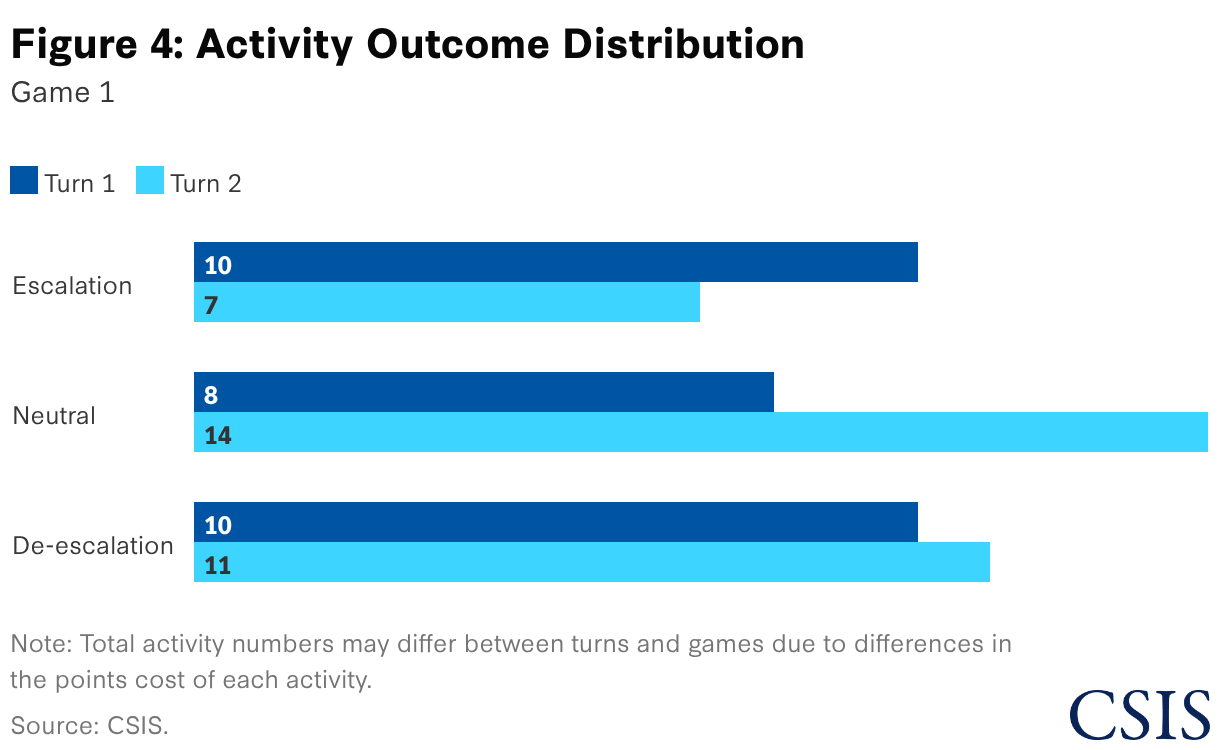
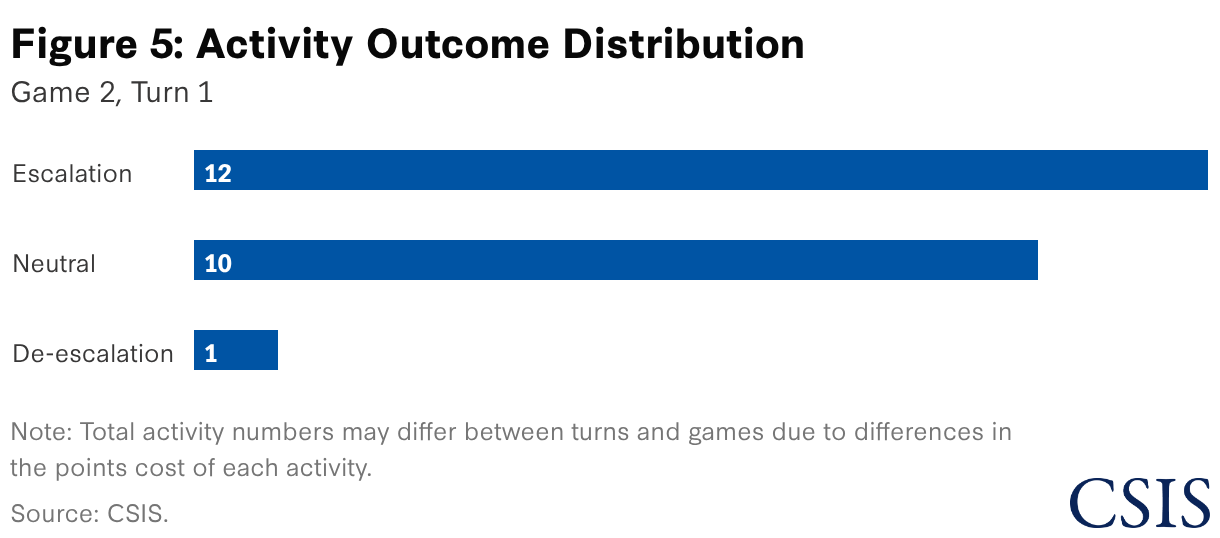
The first turn of the first iteration of the game concluded with a status quo scenario with exactly 10 escalatory actions, 10 de-escalatory actions, and 8 neutral actions taken in total by all parties. The second turn moved further toward de-escalation as China, Colombia, and Venezuela all took a number of actions aimed at resolving the conflict through multilateral and bilateral talks. By contrast, the second iteration was far more dangerous for interstate peace, with a total of 12 escalatory actions being taken compared to 10 neutral actions and just 1 de-escalatory effort by Colombia, which proposed a convening of the Community of Latin American and Caribbean States to discuss the border dispute. The subsequent result was a deterioration of the situation into outright conflict between Colombia and Venezuela at the start of the second turn. When asked how this situation might have evolved, most participants believed there would have been a move to negotiate a ceasefire during the second turn, with Russia and China seeking to box the United States out of peace talks. The exception to this was the Venezuela team, which argued for “calculated chaos,” including expanding attacks on Colombian border posts, potentially with ELN support. 

Russia was by far the most likely actor to escalate in both iterations, with 11 of its 16 total actions across both exercises being escalatory in nature. During the first iteration, however, the Russian push toward escalation was curbed by increased efforts from the United States, China, and even Venezuela to de-escalate. In the second iteration, Venezuela was far more willing to join Russia in escalating tensions, likely hoping that between military aid from the Kremlin and diplomatic interference from China it could push Colombia into a more favorable negotiating position and ward off direct U.S. military intervention.

Remote Visualization

Conclusion and Recommendations

The findings of this exercise indicate several actionable recommendations for U.S. engagement in LAC.

  1. Curtail the alliance options of China and Russia. The presence of anti-U.S. authoritarian regimes provides China and Russia with natural entry points for security cooperation during crisis scenarios. During the exercise, Russia benefited significantly from U.S.-Venezuela antagonism. Venezuela’s fear of a U.S.-backed Colombian incursion meant it naturally sought to ally with Russia during the first turn of both game iterations. Even when Venezuela became disillusioned with the Kremlin’s offers, it rebuffed U.S. overtures. Accordingly, limiting the number of anti-U.S. regimes in the Western Hemisphere—or at least raising the costs associated with security cooperation with Russia and China—is an imperative. The United States is, to an extent, doing this already with its current Venezuela policy, under which it seems highly unlikely that Delcy Rodríguez and the remaining Venezuelan inner circle would seek to cooperate with either China or Russia on military matters. In a similar fashion, the United States should seek credible assurances that Cuba dismantle its signals intelligence facilities as part of ongoing negotiations to relieve pressure on the island. Finally, the United States should pay greater attention to Nicaragua, which continues to strengthen its security and economic ties with both Russia and China, even in the midst of increased U.S. attention on the Western Hemisphere.
  2. Leverage the Shield of the Americas for security cooperation. The United States remains the partner of choice for most LAC countries when it comes to security cooperation. Today, as the region grapples with challenges ranging from sophisticated criminal insurgencies and vast illegal fishing armadas to growing demands for humanitarian assistance and disaster relief, the United States must meet the needs of its partners. The recently inaugurated Shield of the Americas and Americas Counter Cartel Coalition can be useful tools to reaffirm U.S. commitments to security assistance with its allies and partners in the region. To ensure these efforts remain durable sources of closer U.S.-LAC cooperation, the United States should expand trainings for members of the Americas Counter Cartel Coalition, as well as potentially expand billets at service academies for members of partner militaries and coast guards. The United States could also consider launching a new multinational Americas Counter Cartel military exercise to facilitate interoperability and knowledge transfer between partner governments. New security initiatives can also be leveraged to better compete geopolitically, for instance, with joint naval patrols targeting illegal Chinese deep water fishing fleets off the coast of South America.
  3. Increase support for defense modernization. Technology modernization is one area where the United States should focus additional resources to help boost the capabilities of its allies. LAC countries received just 5 percent of all U.S. foreign military financing between fiscal years 2020 and 2024, meaning that although U.S. equipment is sought after, it is often out of reach for countries operating with limited procurement budgets. During the tabletop exercise, for instance, the Colombia team was especially interested in obtaining drone and counterdrone technology. Indeed, the Colombian government today is embarking on a $1.7 billion drive to build up its air defenses as nonstate armed groups have embraced weaponized drones in their conflict with the state. The United States should increase foreign military financing for LAC, with a focus on uncrewed systems, counterdrone technologies, and aerial and maritime surveillance to help countries boost their domain awareness. The United States should consider instituting a buyback program where countries can exchange their Russian or Chinese military equipment for an amount of foreign military financing to buy more modern U.S. systems. In cases where U.S. equipment may not be suitable for partner countries’ requirements, the United States should endeavor to enlist like-minded allies with strong defense industrial bases like South Korea, Sweden, or Germany as a backstop.

Henry Ziemer is an associate fellow with the Americas Program at the Center for Strategic and International Studies (CSIS) in Washington, D.C. Ryan C. Berg is director of the Americas Program and head of the Future of Venezuela Initiative at the Center for Strategic and International Studies. From April 2026 to April 2027, he is on leave from CSIS and serving at the Development Finance Corporation with an international affairs fellowship from the Council on Foreign Relations.

This report is made possible through the generous support of the Smith Richardson Foundation.

Please see the PDF for the appendix.