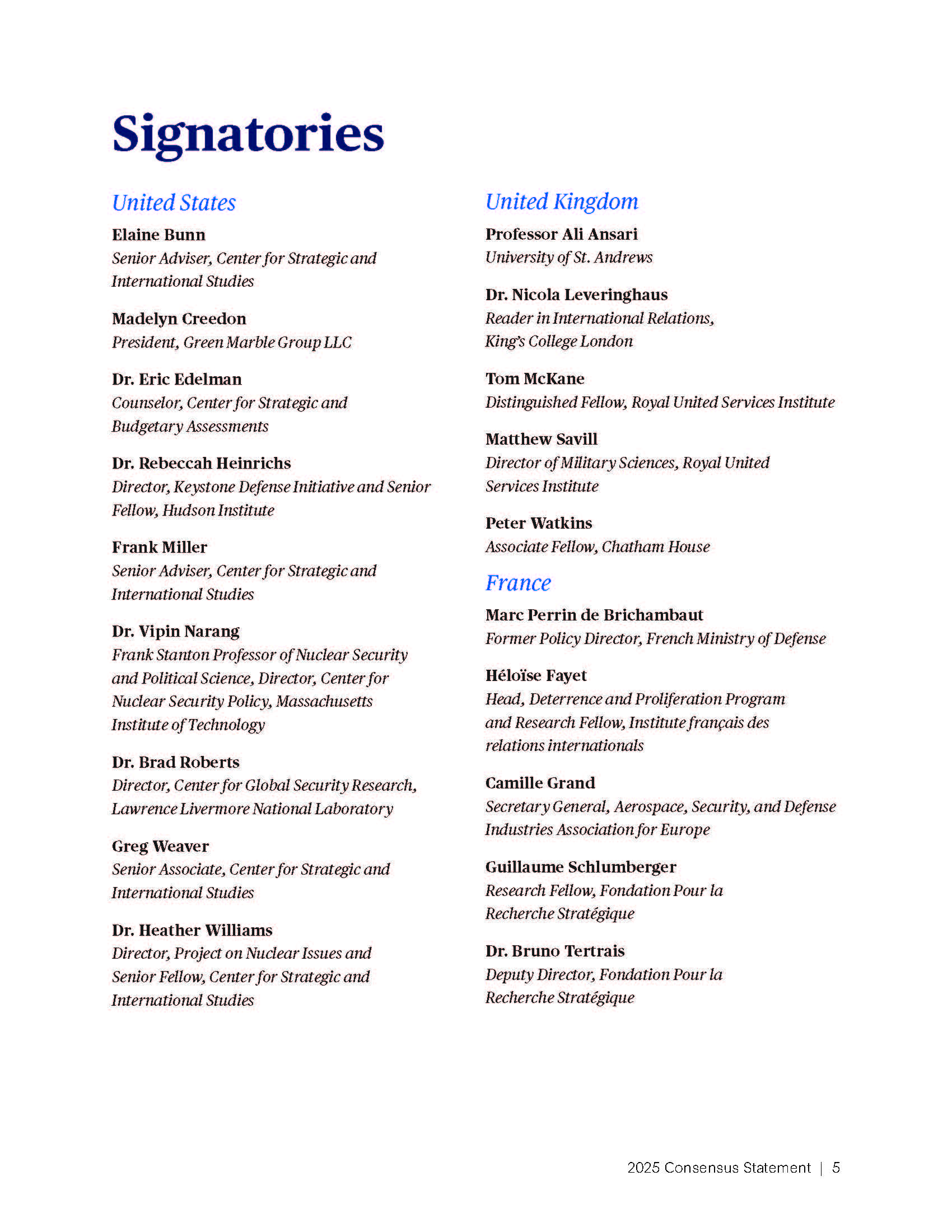
The U.S.-UK-French Trilateral Track 2 Nuclear Dialogues, organized by the Center for Strategic and International Studies (CSIS) in partnership with the Royal United Services Institute and the Fondation pour la Recherche Stratégique, have convened senior nuclear policy experts from the United Kingdom, France, and the United States (P3) since 2009 to discuss nuclear deterrence, arms control, and nonproliferation policy issues. By identifying issues of mutual concern and areas of consensus, the group seeks to improve collaboration and cooperation among the three nations across a range of challenging nuclear policy concerns. The majority of the experts are former U.S., UK, and French senior officials; the others are well-known experts and academics in the field. Since the dialogue’s inception, currently serving senior officials from all three governments have routinely participated in the discussions.
Each year, the Track 2 members of the group issue a consensus statement reflecting their discussions. All signatories agree to this statement in their personal capacities. In 2025, the group’s discussion addressed a range of emerging strategic challenges for the P3, which are reflected in this statement of their consensus after the 2025 round of meetings.
The United States, the United Kingdom, and France share common values and principles directed toward a shared purpose of sustaining global peace and security, as well as an understanding of their respective roles as responsible stewards of the nuclear order. While each of the three nations has unique perspectives and policies regarding nuclear issues and the nature of today’s security environment, as the three nuclear weapons states in the NATO alliance, together they play a unique and enduring role in the stewardship of international alliances and partnerships, especially in matters of nuclear deterrence, nonproliferation, and arms control.
National Policies, Alliance Management, and Extended Deterrence
The July 2025 Northwood Declaration marks a historic and positive forward step in British and French nuclear cooperation and sets a foundation from which the United Kingdom and France can make concrete progress toward playing a stronger role in European security. Real policy coordination between London and Paris on deterrence could improve the efficiency of P3 cooperation and demonstrate that the alliance’s two European nuclear powers are preparing to meet the challenges of the current security environment, all while maintaining separate centers of decisionmaking to increase adversary uncertainty and strengthen deterrence in Europe. These policy changes—alongside serious defense acquisitions, such as the British decision to purchase nuclear-capable F-35A aircraft and join NATO’s Dual-Capable Aircraft (DCA) mission—indicate a move by London and Paris to strengthen NATO’s overall nuclear deterrent. The Northwood declaration and subsequent nuclear cooperation between the United Kingdom and France are aimed at complementing, not replacing, U.S. extended nuclear deterrence in Europe. The United States should welcome and encourage deeper European policy and capability coordination as the alliance manages and redistributes the burden of multi-peer competition.
Concurrently, the United States should continue to modernize its existing arsenal and should utilize the apparent high degree of consensus in Congress to ensure the recommendations of the 2023 Strategic Posture Commission and the 2024 National Defense Commission bear fruit and deliver tangible progress in force modernization and growth. Partisanship and domestic political challenges in the United States could potentially inhibit ambitious but necessary nuclear modernization programs, and congressional consensus may not last in perpetuity. The optimal solution to resourcing the current deterrence needs at the speed and scale as demanded by the security environment will require collective action and alliance coordination; to this end, the value of consistent dialogue among the P3 is more critical than ever.
The security environment and various threat perceptions among NATO member states continue to be in flux. NATO’s eastern flank continues to experience an elevated threat posed by Russian conventional military capabilities as well as subversion and sabotage activities, while other member states should manage budgetary constraints and political parties skeptical of European cooperation and sympathetic to Russian aims and propaganda. Other regions, such as the high north, have transitioned from shared security with Russia to fully embracing the need for deterrence. Russia’s rhetoric suggesting future nuclear attacks against NATO members heightens this danger. The P3 should continue to support a realistic and managed pathway to ending the war in Ukraine while simultaneously encouraging the bolstering of Europe’s deterrence posture elsewhere on the continent. Again, in this effort, continued collaboration will be vital.
Despite Russia’s ongoing aggression, many Europeans—including some government officials—lack an understanding of the nuclear threats that their countries face. This problem exists even in DCA states and states that share a border with Russia. Gaps in the alliance’s nuclear knowledge complicate efforts to confront Russian aggression and revitalize NATO’s deterrent. NATO governments should work to better inform their populations about the threat from Russia and the critical importance of effective conventional and nuclear NATO deterrents in ways they deem most effective.
Modernization and Integrated Air and Missile Defense
Russia’s war on Ukraine has continuously highlighted the importance of both long-range precision strike capabilities and missile defenses as transformative capabilities in modern conflict. Both Europe and the United States continue to make significant investments in missile defense through the European Sky Shield and Golden Dome initiatives, respectively. While European and U.S. homeland missile defense pose different problems that will require different solution packages, continued collaboration between members of the P3 would improve the efficiency with which missile defenses can be scaled and the effectiveness of systems once deployed. Allied participation is a foundational aspect of the “Golden Dome” project, and the United States should avoid stoking fears among allies that its development will facilitate a U.S. retreat from other alliance commitments. Missile defense at large scale will be expensive, and burden sharing, particularly in technology development, could alleviate allied concerns and enhance alliance cohesion.
Each of the P3s is pursuing programs to modernize its nuclear deterrent forces. France has brought the newest variant of the M51, the improved M51.3, into service on board French nuclear ballistic missile submarines (SSBNs) and has fielded the modernized ASMPA-R air-launched cruise missile. As noted above, the United Kingdom will rejoin NATO’s DCA mission with its planned acquisition of F-35A aircraft, and the United States continues to move forward with the full-scale modernization of its nuclear forces, including the acquisition of augmented theater nuclear capability. Continued nuclear modernization is essential for ensuring sufficient extended deterrence coverage, continuing to present adversaries with separate credible centers of decisionmaking, and will provide the P3 with a flexible range of options for managing escalation in multiple theaters and domains.
Arms Control and Nonproliferation
While the P3 remain willing and ready to engage in good faith arms control should enabling conditions arise, neither Russia nor China appears interested in participating in real arms control measures in the near future. Russia’s violations of New START provisions, including suspending participation in the agreement when no such provision exists in treaty language and its violation of the Intermediate-Range Nuclear Forces (INF) Treaty, indicate that it does not take arms control seriously, and any Russian proposals should be treated with a high degree of skepticism.
Similarly, Russia and China appear to have little appetite for proactive cooperation with the rest of the P5 (France, the United Kingdom, and the United States) on nonproliferation issues. Indeed, adversary pushback on U.S. extended deterrence—a foundational tool in preventing allied proliferation—indicates that Russia and China, against their own interests, may care less about nonproliferation now than in the past.
The looming disappearance of meaningful strategic arms control, a decaying interest in P5 nonproliferation cooperation, and uncertainty surrounding the Iranian nuclear program will all come to a head at the 2026 Nuclear Non-Proliferation Treaty (NPT) review conference in April. The P3 should demonstrate continued solidarity and commitment to the NPT in 2026 while ensuring they extract value from the treaty, the review conference, and the P5 process in return. Ahead of April, the P3 should strive to combat disinformation around extended deterrence and nuclear sharing, while also developing a more ambitious agenda for the continued P5 process, to include continued progress on transparency of doctrines and sustaining the Young Professionals Network. The P3 have persistently sought to combat adversary disinformation in the NPT context while productively engaging with members of the Global South and other concerned parties regarding the future of nonproliferation and arms control; these goals have grown only more important ahead of a pivotal review conference in 2026.
Meeting the Challenges of a Dynamic Security Environment
Adversaries continue to seek to undermine P3 collaboration, fracture the NATO alliance, and develop novel capabilities intended to nullify NATO advantages and defenses in a variety of conflict contingencies. The political environment remains challenging for the P3 to navigate, and consistent dialogue and engagement at multiple levels of government, as well as at the Track 2 level, remain critical for alliance unity in the face of adversary aggression. Domestic political considerations in all members of the P3 will force difficult tradeoffs in how, when, and where they collaborate in the future. This year, adversary collaboration appeared relatively transactional. Despite support from China and North Korea, Russia has gained little ground in Ukraine. Iran has been left isolated and weakened. Members of NATO should recognize and celebrate the contrast between these outcomes and the comparative strength of the transatlantic alliance.
The experiences of World Wars I and II made ineluctably clear that North America’s security is tied to Europe’s security. A United States that tries to stand apart from Europe’s defense will increase the risk of a future European war into which it will inevitably be drawn. NATO’s 80 years of success in preventing major interstate war against alliance members is a lesson for the United States and for all ages.
This report was made possible with general support to CSIS.