Border Security and Defense Cooperation in North America: Addressing Emerging Challenges
June 17, 2026 • 9:00 am – 2:30 pm EDT
Hosted by Americas Program

Photo: MANDEL NGAN/AFP via Getty Images
Russia’s full-scale invasion of Ukraine has significantly altered the strategic landscape across Eurasia. The Kremlin’s resources have been stretched thin, weakening its grip over the countries in Central Asia and the South Caucasus. Simultaneously, the ongoing conflict in the Middle East has destabilized another anti-Western actor in the region, Iran. These developments have created greater space for the United States to engage more deeply with the region.
Washington has already begun to capitalize on this opening in several ways. In 2025, President Trump hosted a summit with Central Asian heads of state at the White House, unveiling multibillion-dollar trade and mineral deals. He also met with the Azerbaijani and Armenian presidents that year, announcing an agreement to establish a trade and transit corridor—later named the Trump Route for International Peace and Prosperity (TRIPP)—intended to help resolve the decades-long conflict over Nagorno-Karabakh by promoting trade and connectivity between the two nations.
While Washington’s recent advances are notable, Moscow and Tehran’s current distractions have also provided more opportunities for other interested actors to expand their footprint in the region. This commentary examines the intensifying competition for Eurasian influence following Russia’s 2022 invasion of Ukraine and the conflict involving Iran and discusses how the United States can build on its momentum to consolidate a more durable position in the region. With trade routes bypassing Russia and Iran and vast critical mineral wealth at stake, Eurasia is an increasingly important region for engagement. Washington must seize the current opening for strategic realignment in Eurasia before other actors fill the vacuum and crowd the United States out from a more serious strategic role in the region.
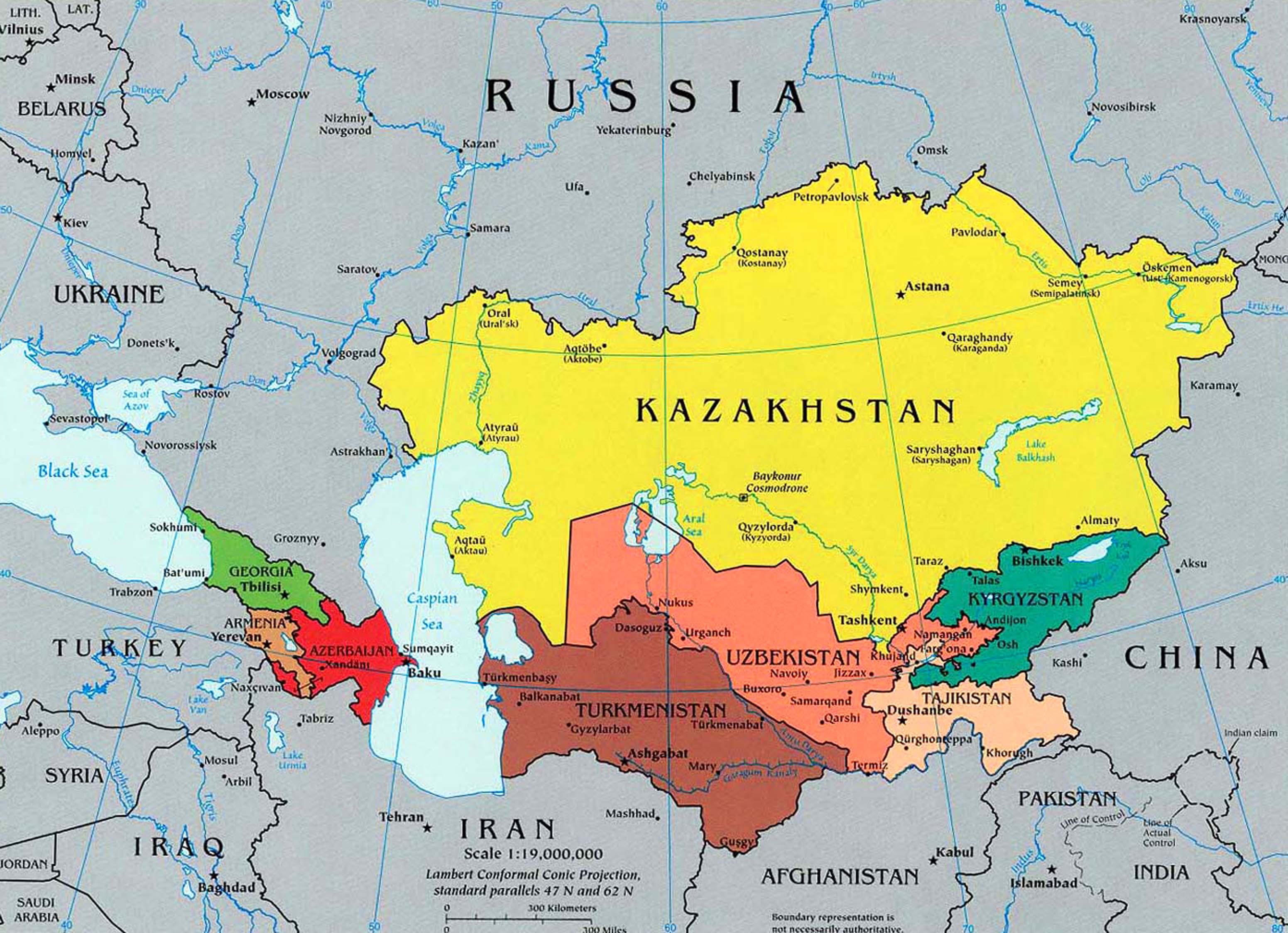
The South Caucasus and Central Asia. Photo: Apic/Getty Images.
Russia’s full-scale invasion of Ukraine has produced different impacts on its military-security and economic ties with Eurasian states.
In the military-security domain, Moscow’s attention and resources have shifted from Eurasia to Ukraine. In Central Asia, developments reflecting this shift include the diminished role of the Russia-led Collective Security Treaty Organization (CSTO) and declining arms sales. Established in 2002, the CSTO, which includes Kazakhstan, Kyrgyzstan, and Tajikistan, among other countries, enabled Russia to operate military facilities in these countries and to conduct regular military exercises in the region. CSTO members have also benefitted from this arrangement, gaining access to Russian arms at internal Russian prices. Russia remained the chief arms supplier for these nations for years following the Soviet collapse. Since 2022, however, Moscow has been forced to divert its military capabilities from the CSTO to the ongoing war, by, for instance, redeploying hundreds of soldiers stationed in its military bases in Tajikistan and Kyrgyzstan to Ukraine. Furthermore, given the dual impact of sanctions and wartime state defense needs, Russia’s arms exports to Central Asia have declined.
In the South Caucasus, prior to 2022, Russia’s security entrenchment stemmed from its ability to establish and maintain “controlled instability”: Moscow was viewed as a chief mediator in the Armenia-Azerbaijan conflict over Nagorno-Karabakh, supplying arms to both sides and deploying peacekeeping troops following the 2020 clashes. It also retained military-security ties with Armenia through CSTO membership and an army base. In Georgia, Russia had forces stationed in two secessionist regions, Abkhazia and South Ossetia, but was forced to redeploy some of its troops and military equipment from the occupied Georgian regions to Ukraine in 2022 (although it still maintains control over these territories). Russia was also unable to deter the 2023 Azerbaijani operation, leading to Baku seizing full control of Nagorno-Karabakh. The latter resulted in Armenia freezing its participation in the CSTO in 2024, with Armenian Prime Minister Nikol Pashinyan claiming that the alliance “had failed the country.”
Unlike the weakened military-security relations, Russia has seemingly boosted its economic and trade ties with Eurasia since 2022. Yet much of this commercial growth appears driven by Russia’s sanctions-evasion efforts and might be reversed once the war is over. In the case of Central Asia, Moscow’s trade with the region increased from 16 percent in 2015 to 19 percent ($51 billion) of the regional total in 2025. This rise is widely attributed in part to the ongoing export control restrictions on Russia. For instance, both Kazakhstan and Kyrgyzstan are members of the Moscow-led Eurasian Economic Union (EAEU), enabling goods originating in the member states to circulate freely within EAEU territory. This has reportedly made it possible for Kazakhstan and Kyrgyzstan to reexport Western-origin electronics into Russia under local trade codes. Russia has also been making inroads into the energy sectors of Kazakhstan and Uzbekistan, with Lukoil, Gazprom, and Rosatom maintaining a significant presence in these states. Since 2022, the Kremlin has also been actively working on the development of a sanctions-evading trade route, the International North-South Transport Corridor, that would link Russia to the Persian Gulf and India through Central Asia and the South Caucasus.
Similarly, sanctions-induced parallel imports of Western-origin sensitive technologies and the reexport of Russian oil may have contributed to a significant rise in Russia’s trade turnover with the South Caucasus states. For instance, between 2021 and 2024, bilateral trade between Russia and Armenia (also an EAEU member state) rose from $2.6 billion to $12 billion, while trade with Azerbaijan increased from $3 billion to $4.8 billion and trade with Georgia rose from $1.6 billion to $2.5 billion.
At the same time, Moscow’s focus on Ukraine has created opportunities for other actors to deepen their economic and security engagement with Eurasia. In Central Asia, trade with China reportedly hit a record $106 billion in 2025. Beijing has also strengthened its military-security ties with Central Asia through joint military drills, training programs for Central Asian security forces, and exports of surveillance technologies. The European Union has likewise increased its engagement with the region, with trade reaching €56 billion ($61 billion) in 2024 and the first EU-Central Asia summit in 2025 producing a multibillion-dollar investment package focused in part on regional infrastructure and connectivity projects. Turkey too has expanded its regional footprint, seeking to institutionalize its defense ties through the Organization of Turkic States. In the connectivity sphere, Ankara and Brussels share an interest in developing the so-called Middle Corridor, which bypasses Russia by connecting Europe to China through the South Caucasus and Central Asia. Finally, India and the Gulf states have increased their investment in the region, particularly in the critical minerals and renewable energy sectors.
In the South Caucasus, China signed strategic partnership agreements on the expansion of political and economic ties with Georgia in 2023 and Azerbaijan and Armenia in 2025. In Armenia, Turkey and the European Union have also expanded their diplomatic engagement. The potential (yet still politically fraught) reopening of the Turkey-Armenia border, long closed due to Ankara’s support for Baku in the Nagorno-Karabakh conflict, could significantly enhance Armenia’s connectivity to the Middle Corridor and, by extension, to European markets (provided that the corridor continues to attract sustained investment from the participant countries). Finally, India and the Gulf states have become more engaged with the region, with India emerging as an important arms supplier to Armenia since 2022 and Saudi Arabia becoming a flagship partner in Azerbaijan’s wind energy ambitions.
Just like Russia’s invasion of Ukraine, the Iranian conflict has highlighted the importance of overland routes traversing Eurasia that bypass Russian and Iranian territories, such as the Middle Corridor. However, Iran’s destabilization, both internally and in its external projection of kinetic activity, carries the potential for disruptive consequences for the South Caucasus in particular, as all three states share either direct borders or deep historical and demographic ties with Iran, making spillover risks more immediate and tangible.
For Georgia, security risks have centered on threats to the Baku-Tbilisi-Ceyhan oil pipeline, and while the plots targeting this line thus far have been disrupted, they have resulted in a heightened threat perception and potential for increased insurance costs. But while the conflict in the region has raised logistics costs and changed trade flows, some of this has benefitted Georgia, which has seen a surge in rerouted trade coming through its territory.
In the case of Armenia, Iran has long been one of its most reliable diplomatic backers in the Nagorno-Karabakh conflict and an economic lifeline. But a weakened or distracted Iran (in addition to Russia) may facilitate increased Western influence in Armenia (this is not to minimize the current Western footprint in the country, but to call out the opportunities of the moment). For example, Iran has opposed the TRIPP project, viewing it as a direct threat to its own role as a key transit player in the South Caucasus. But while Iran retains the ability to disrupt TRIPP through border incidents and proxy pressure on Armenia or Azerbaijan, its capacity to block the corridor in its currently weakened military and economic state is significantly diminished.
Azerbaijan has a particularly complex relationship with Iran. Iran is home to an ethnic Azerbaijani population estimated at more than 15 million, meaning there are more ethnic Azerbaijanis in Iran than in Azerbaijan. But Azerbaijan has a long-standing strategic partnership with Israel that ranges from energy to defense and intelligence cooperation. Azerbaijan supplies approximately 40 percent of Israel’s oil through the Baku-Tbilisi-Ceyhan pipeline, and Israel was a key provider of advanced weaponry during both the 2020 and 2023 Nagorno-Karabakh clashes. Reports have suggested that Israeli operatives have used Azerbaijani territory as a platform for operations against Iran, a claim Baku has denied.
In March 2026, drones, allegedly launched from Iranian territory, struck an Azerbaijani airport, among other sites. Iran did not claim responsibility and the situation was de-escalated through a direct conversation between the Azerbaijani and Iranian presidents. But this underscores how quickly the offshoots of conflicts involving Iran may spill directly into the South Caucasus. While Azerbaijan stands to gain economically from elevated global oil prices, these benefits come with heightened security risks and potential disruptions to transit routes.
Post-2022 developments in Eurasia reveal both growing opportunities for U.S. engagement and intensifying competition from U.S. partners and allies (including the European Union, Turkey, the Gulf States, and India) and U.S. adversaries (including China and a weakened, but still coercive and embedded, Russia and Iran). If Washington does not build on its current advances in the region, the likely outcome is not a return to the pre-2022 status quo but rather a Eurasia bound by trade and security agreements that leave the United States either locked out of key areas of strategic competition or entirely dependent on partners and allies for engagement with the region. The following approaches outline a more strategic and institutionalized framework for U.S. engagement with Eurasia that advances both U.S. and regional interests:
Russia’s invasion of Ukraine and Iran’s destabilization have simultaneously spotlighted Eurasia’s strategic importance while testing the limits of the region’s historic alignments. While the conflicts carry both risks and benefits in the short term, in the longer term, decreased Russian and Iranian involvement in Eurasia will only act as an incentive for increasing Western, Indian, and the Gulf state investments in the region. As Moscow and Tehran’s grip loosens, the risks for the United States and its allies and partners of pursuing deeper regional engagement decrease significantly. Washington must seize this opening to advance connectivity, deter disruption, and ensure genuine diversification across the region. Doing so will generate profits that benefit the people of the United States, as well as Eurasia.
Tina Dolbaia is an associate fellow with the Europe, Russia, and Eurasia Program at the Center for Strategic and International Studies (CSIS). Leah Kieff is a senior associate (non-resident) with the Project on Prosperity and Development at CSIS.
The authors would like to thank Romina Bandura, Nicholas Fenton, Jeffrey Mankoff, Donatienne Ruy, and Maria Snegovaya for their valuable feedback and insights.
This commentary is made possible by a grant from the Andrew Carnegie Foundation, formerly Carnegie Corporation of New York.

Report by Maria Snegovaya, Tina Dolbaia, and Nicholas Fenton — April 16, 2026

Commentary by Leah Kieff — April 16, 2026

