Energy Shots: Middle Distillates and the Middle East
August 21, 2026 • 9:30 – 10:00 am EDT

Photo: Buddy Mays/Getty Images
No corner of the world has escaped the oil crisis caused by repeated closures of the Strait of Hormuz, but few economies are as exposed as the smaller, import-dependent Pacific Island countries (PICs). Sitting at the end of some of the world’s longest and thinnest supply lines, they import nearly every drop of fuel they burn, and their incomes depend largely on the growth of distant partners.
A 2012 International Monetary Fund (IMF) work found that PICs are tied to the Australian, U.S., and New Zealand economies over the long run. Updating that analysis shows that these anchors remain important across the region: When a large partner’s growth slows, PIC growth tends to slow with it. Oil price shocks remain the sharper threat: A 50 percent increase in the real oil price is associated with GDP losses of up to 4 percent in the hardest-hit economies, before accounting for any effect from slower partner growth. Dependence on partners and acute sensitivity to fuel prices leave these small, undiversified economies doubly exposed, straining their fiscal buffers and deepening reliance on outside powers just as the United States, its allies, and China compete for influence across the region. Without greater external support for energy supplies and government budgets, these countries face slower economic growth, and with it a weaker position from which to negotiate the terms of outside assistance.
Pacific Island economies are among the most open and least diversified in the world. They are import-dependent and export a narrow range of goods and services—tourism, fisheries, minerals, and agricultural commodities—to a handful of foreign markets. Australia, New Zealand, and the United States sit at the end of most of those channels, and World Bank assessments link swings in Pacific Island growth to labor demand, tourist arrivals, and remittance flows originating in those economies. This structure makes PICs unusually sensitive to global shocks.
The aforementioned 2012 IMF study provides guidance on measuring how tightly each island’s economy is anchored to its main economic partner. The same framework can then be applied to trace how different oil price scenarios affect each Pacific Island.
Australia is the natural anchor for most PICs, as it is the dominant source of tourists, remittances, and investment; the United States anchors the Compact of Free Association states (the Federated States of Micronesia, the Marshall Islands, and Palau); and New Zealand anchors Tonga and Samoa. For the purposes of this analysis, Niue and the Cook Islands were excluded because their free association with New Zealand places them outside standard PIC datasets. Naoero (formerly Nauru) was also excluded because reliable GDP data is unavailable before 2004.
The updated statistical analysis indicates that PICs remain closely linked to larger partner economies, but not to the same degree everywhere, as shown in Figure 1. The evidence is strongest for the Federated States of Micronesia, Samoa and Tonga, while several other economies show moderate evidence: Fiji, Papua New Guinea, Vanuatu, Tuvalu, the Marshall Islands and Palau. Only the Solomon Islands and Kiribati show limited evidence, and even there the estimated long-run elasticities sit within the same range as the rest of the sample.

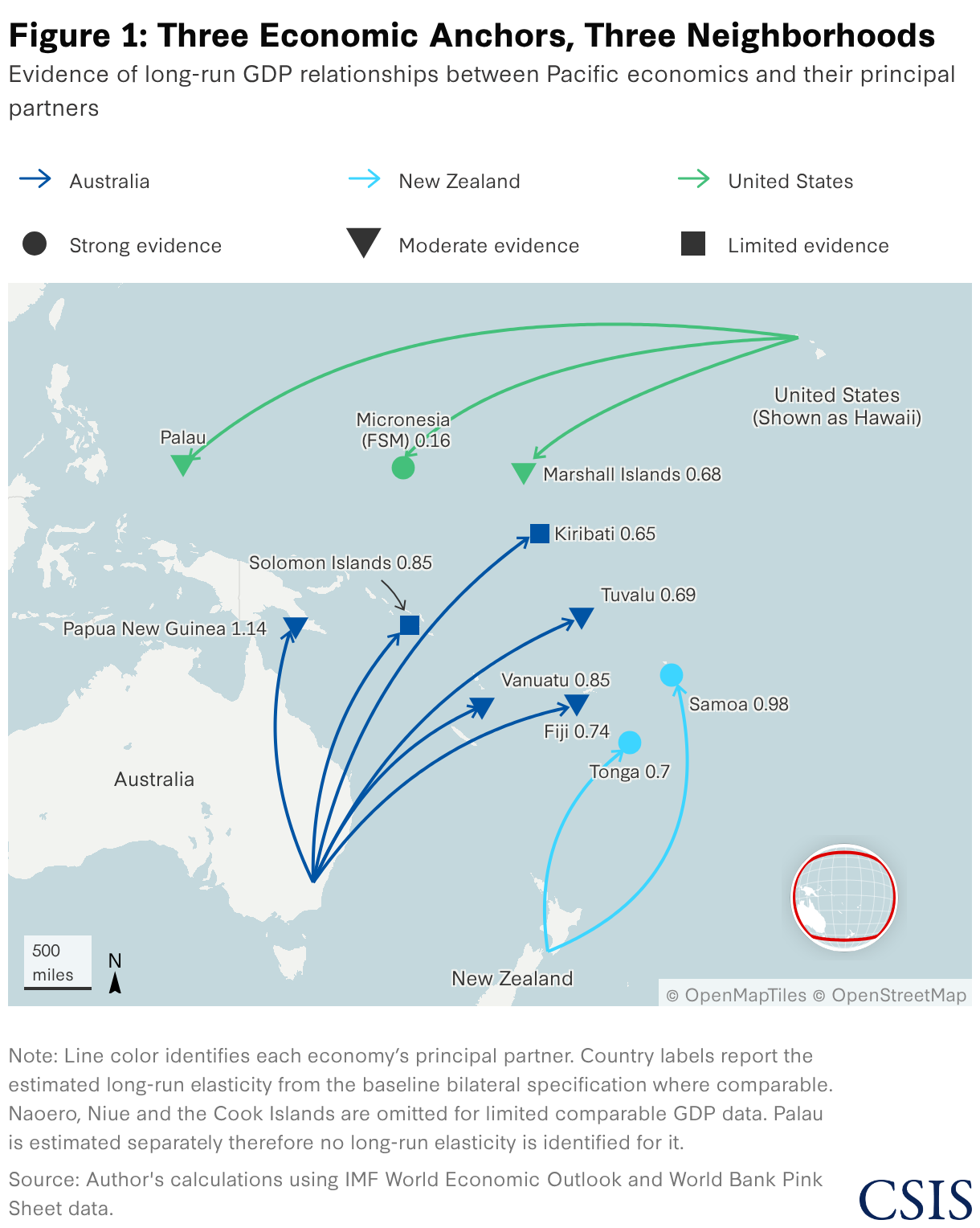
China’s expanding trade role makes it worth asking whether these traditional relationships are changing. China’s share of Pacific Island goods trade rose from about 13 percent in 2012 to 29 percent in 2023, and China is now among the three largest trading partners for most countries in the region. Re-running the analysis with Chinese GDP in place of the traditional partner, however, finds no case where China establishes a long-term relationship that the traditional partner does not (see technical appendix). This may reflect that Chinese trade is weighted toward resource extraction, which generates export receipts and infrastructure but fewer of the household-level linkages that transmit a partner’s growth into island GDP.
If weaker demand for goods and services from a major trading partner is one danger, oil price shocks are the other—and for most PICs, the more acute one. Oil supplies about 80 percent of the Pacific’s total energy, rising to as much as 98 percent in some countries, while many Pacific economies spend 5–15 percent of GDP on net oil and gas imports. In the Marshall Islands, the disruption tripled fuel costs, adding around 11.5 percent of GDP to its import bill; in Tuvalu, which spends roughly one-quarter of its GDP on petroleum imports, it forced rolling blackouts and a state of emergency. Tourism accounts for around 38 percent of GDP in Palau and roughly a quarter in Fiji and Samoa, meaning higher jet fuel costs and thinner flight schedules can reduce the flow of visitors on which a large part of domestic activity depends. Because these economies import almost all their fuel, a spike in the global oil price passes through to transport, electricity, food, and freight costs—not to mention secondary effects in the health, education, and business sectors.
Using the historical relationships between each Pacific Island GDP and the global oil price, it is possible to extrapolate how a rise in oil prices would affect GDP, as shown in Figure 2. A 50 percent rise in the real oil price is associated with sizable GDP losses across much of the Pacific, reaching around 4 percent in Palau, close to 4 percent in Papua New Guinea, around 3.5 percent in Tuvalu, and around 2.5 percent in Tonga, Fiji, Palau, the Solomon Islands. Negative estimates also appear for Kiribati, the Marshall Islands and Samoa, though the evidence is weaker, while Vanuatu and the Federated States of Micronesia show no clear adverse effect. Overall, the contrasts with Australia’s experience are striking: Recent Reserve Bank of Australia modeling suggests that a 10 percent increase in oil and liquefied natural gas prices would reduce Australian GDP by less than 0.1 percent.

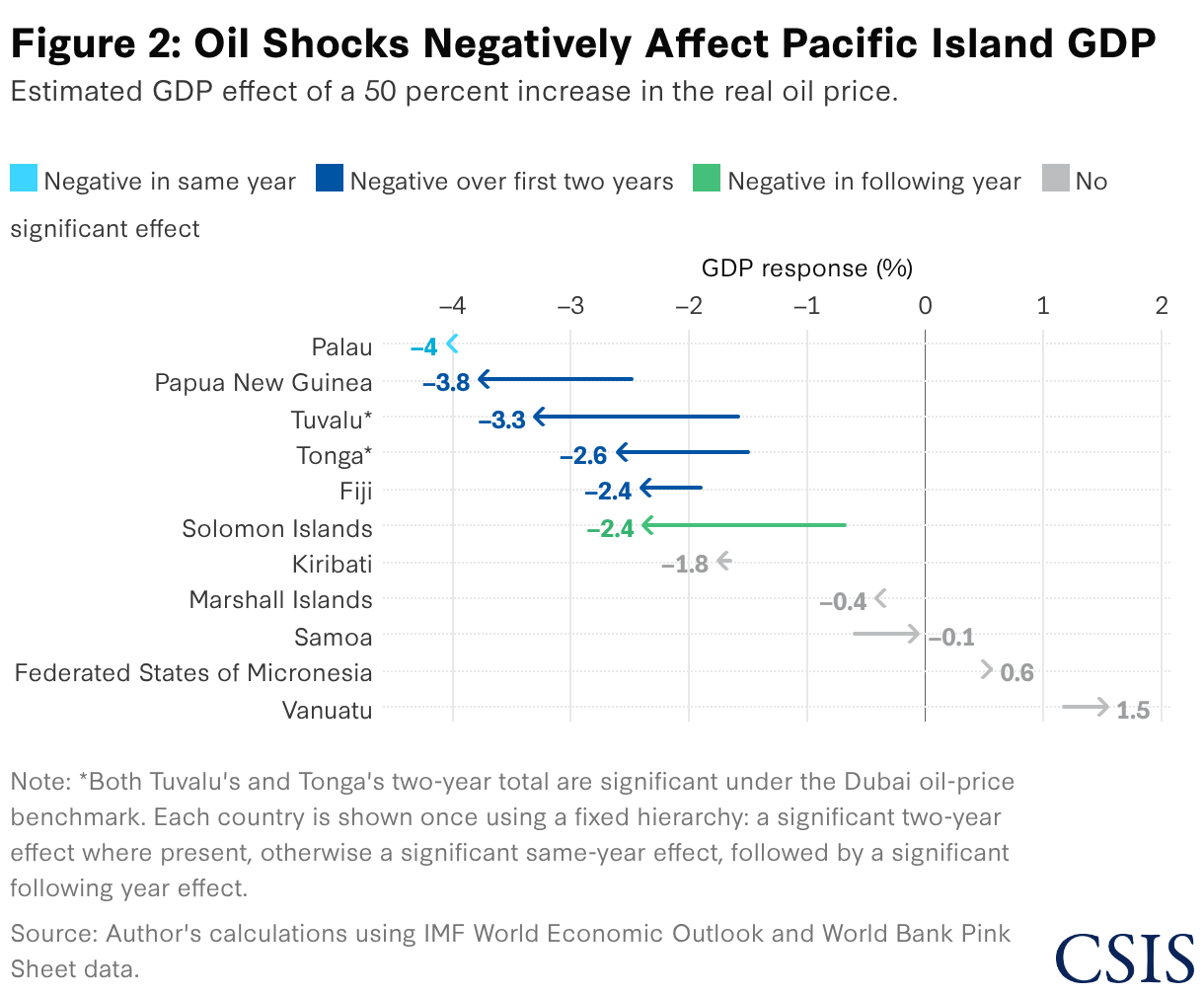
The true GDP losses are likely larger than estimated here. The analysis captures the direct hit from higher fuel, freight, and electricity costs, but not any additional drag from weaker growth in major partner economies.
PICs face two often compounding external pressures: the demand cycle of their largest partners and changes in world fuel prices. Two implications follow. In the near term, fiscal buffers are small relative to the shocks Pacific Island economies must absorb, so rebuilding reserves and preserving borrowing space is the first line of defense against volatility these economies cannot quickly diversify away. Over the longer term, there is a case for diversification of export markets and energy sources. The sequence matters: Buffers buy the fiscal space that funds diversification.
Yet these challenges do not affect just the PICs. Economic vulnerability in the Pacific can quickly become strategic vulnerability. A prolonged oil price shock would strain public finances and widen financing gaps, presenting opportunities for economic influence just as the United States, Australia, China, and others are expanding their engagement across the region.
Recent agreements demonstrate how partners are leveraging economic assistance to gain access and influence. Under the Nauru-Australia Treaty signed in December 2024, for example, Australia pledged A$100 million ($70 million) in budget support over five years (equivalent to roughly half the average dei-Naoero’s annual salary, per person). In return, Naoero agreed to seek Australian agreement before engaging other states on security, telecommunications, or banking infrastructure. The 2023 Falepili Union with Tuvalu paired budget support and a migration pathway with a comparable commitment.
Thus, economic fallout in the Pacific induced by oil shocks becomes a multifaceted challenge with strategic implications. Budget support offered during a fiscal squeeze buys more than the same money offered in calm conditions, because the recipient’s alternatives are worse. Pacific governments have proven adept at extracting terms from competing suitors, but the terms available depend on how badly the money is needed—and fiscal stress can narrow governments’ options and increase the leverage of outside partners. Extreme oil dependence is therefore not only an economic risk; it determines how much room island governments have to choose their partners, and on what terms.
Angelina Bruno is the 2026 Thawley Scholar with the Australia Chair at the Center for Strategic and International Studies in Washington, D.C. The views expressed are her own and do not represent those of the Reserve Bank of Australia.