The Hormuz Implications for Energy Policymaking: Japan and South Korea
August 18, 2026 • 8:00 – 9:00 am EDT

Photo: Chris Jung/NurPhoto/Getty Images
One month into the Iran conflict, no noncombatant country has been hit harder than South Korea. The effective blockade of the Strait of Hormuz, a chokepoint through which South Korea routes 70 percent of its crude oil imports, has exposed severe vulnerabilities across energy, petrochemicals, semiconductors, and the broader macroeconomy. The KOSPI recorded its worst single-session in its 43-year history. The South Korean won hit a 17-year low. A total of 26 South Korean–flagged vessels remain stranded in the Persian Gulf. And the government’s strategic petroleum reserves may now only be enough to cover 26 days of actual consumption. The Organisation for Economic Co-operation and Development downgraded South Korea’s growth forecast by 0.4 percentage points, the steepest among major economies, and raised its inflation projection to 2.7 percent. Inflationary price ripple effects are expected to hit transportation, logistics, petrochemicals, agriculture, food, and beverage over the next two to six months. Officials warn of a triple shock to the South Korean economy: high inflation, elevated interest rates, and a weakened won.
President Lee Jae Myung is managing a whole-of-government mobilization with local elections just two months away, and warnings of stagflation growing closer by the week. His administration has not been passive: emergency fuel price caps, a record planned International Energy Agency (IEA) reserve release of 22.5 million barrels, a $17 billion supplementary budget, 24 million barrels of crude secured from the United Arab Emirates (UAE), accelerated restart of nuclear reactors from maintenance, and a high-level dual emergency response structure helmed by the president himself.
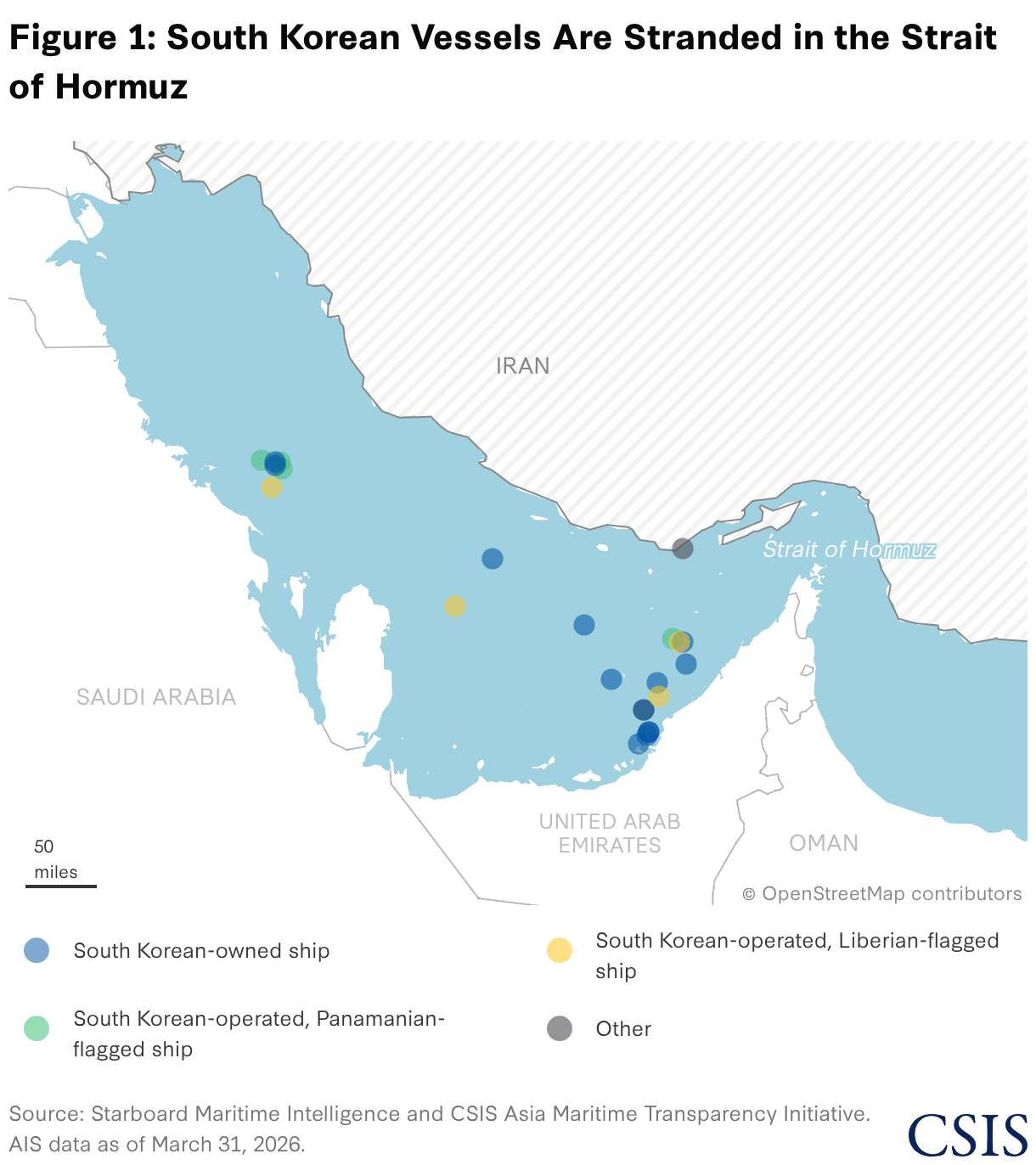
CSIS identified 23 of 26 South Korean–owned or operated ships stranded in the Strait of Hormuz. The fleet’s composition reflects the full breadth of South Korea’s trade exposure: 17 crude and oil tankers, 5 bulk carriers, 2 gas carriers, a container ship, and an auto carrier.

Since the conflict began, South Korean shipping through the Strait of Hormuz has been effectively halted. In February, before the conflict, there were 33 South Korean–flagged ships that transited through the Gulf, excluding additional South Korean–owned or operated (but not flagged) ships.

Three out of four major South Korean refiners have U.S. or Saudi ownership stakes, with the exception of SK Energy.

In addition to crude oil dependence, roughly 35 percent of South Korea’s naphtha, a key feedstock for petrochemicals, plastics, and synthetic fibers, transits through the strait. In response to potential shortages, Seoul quickly banned naphtha exports and designated it as an economic security item.
Beyond energy supplies, the blockade has exposed vulnerabilities in South Korea’s semiconductor supply chain. South Korea sourced 64.7 percent of its helium from Qatar, impacted by the same Iranian strikes that halted production at Ras Laffan Industrial City. The price of helium has since increased by more than 40 percent, and there is no viable alternative to helium. The Korea Semiconductor Industry Association said short-term supplies are sufficient and companies have diversified supply routes, though Seoul has added helium among the 14 semiconductor inputs under heightened monitoring.

South Korea’s official petroleum reserve position looks more robust on paper than in operational reality. It holds 208 days’ worth of strategic oil reserves under the IEA standard, but that is calculated on a net-import basis, not actual consumption. At South Korea’s actual refinery throughput of 2.9 million barrels per day, government-only stocks (100.1 million barrels) will only last 34 days, while the combined total with private sector stocks covers approximately 67 days. South Korea’s contribution of 22.5 million barrels to the IEA’s coordinated 400-million-barrel emergency release on March 12 reduced government reserves to 77.6 million barrels, or roughly 26 days. The separate UAE emergency procurement of 24 million barrels on March 18 adds a further eight to nine days.
Victor Cha is president of the Geopolitics and Foreign Policy Department and Korea chair at the Center for Strategic and International Studies (CSIS) in Washington, D.C. Andy Lim is deputy director and fellow with the Korea Chair at CSIS.
The authors appreciate Madison Bruno’s and Sabina Hung’s work in publishing this commentary.

