NSF's National Security Mission for the Twenty-First Century
April 3, 2026 • 9:00 am – 12:30 pm EDT
Hosted by Renewing American Innovation

Photo: Copyright Airbus @ DS 2025
On Saturday, April 26, a major explosion struck the Shahid Rajaee port, Iran’s largest container port. In the days since, the death toll has risen to at least 70 people, with more than 1,000 injured. By Tuesday, April 29, firefighters had gained control of the fire but were still working to suppress its final stages.
Q1: What caused the port explosion?
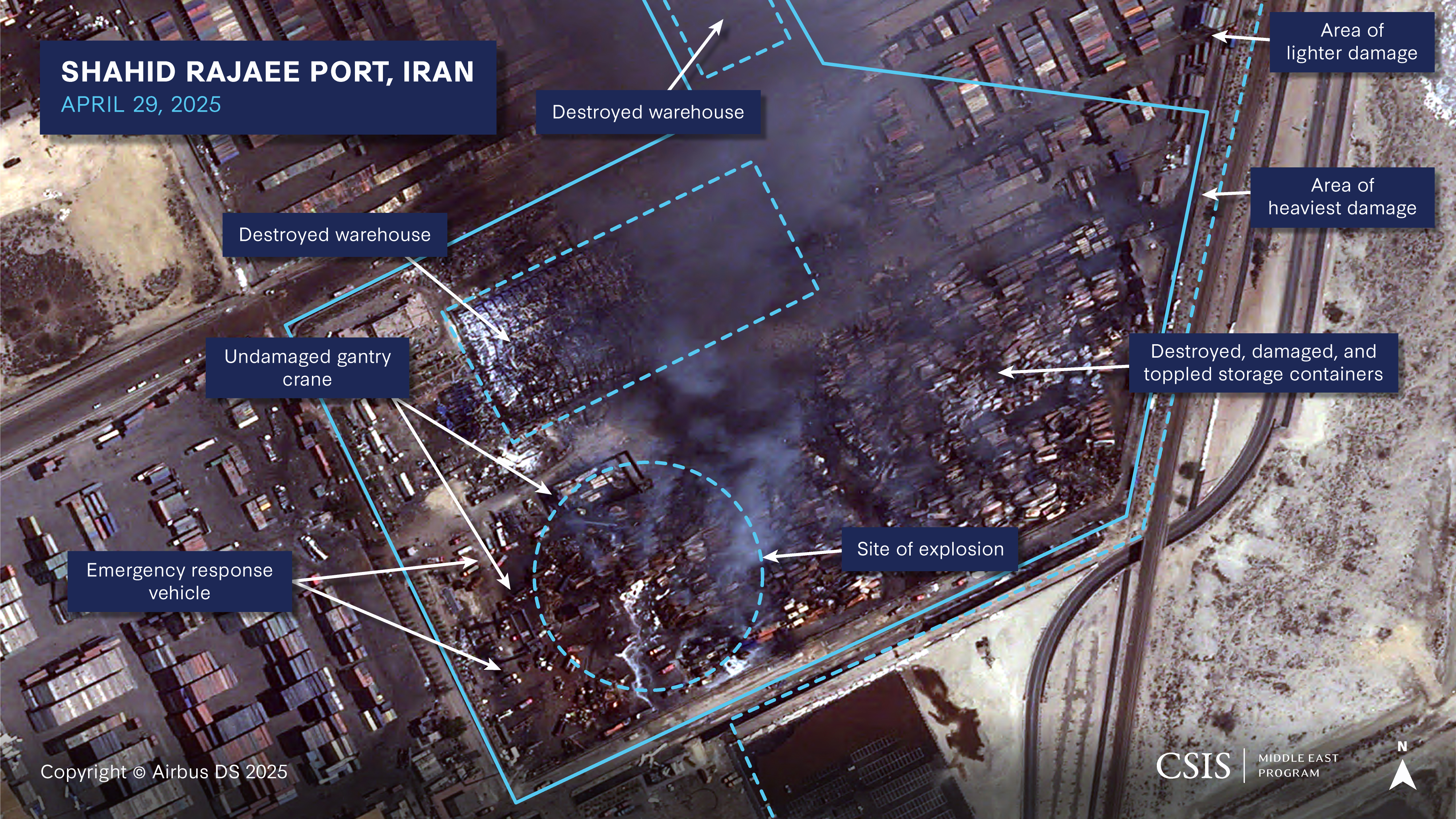
A1: There are still competing reports about the exact nature of the substance that triggered the initial explosion, although attention is focusing increasingly on either sodium perchlorate or ammonium perchlorate, precursors of solid fuel for missiles. An explosion inside one shipping container seems to have triggered nearby containers to explode. While the immediate trigger remains unclear, human error is the most likely explanation. Iranian officials insist that the containers in question had been improperly labeled, lacking any reference to the potentially volatile nature of the contents. Still, sabotage or attack cannot be ruled out. The area destroyed by the explosion was an open-air container yard rather than a closed warehouse, potentially enabling sabotage or attack.


Q2: Why was the explosion so large?
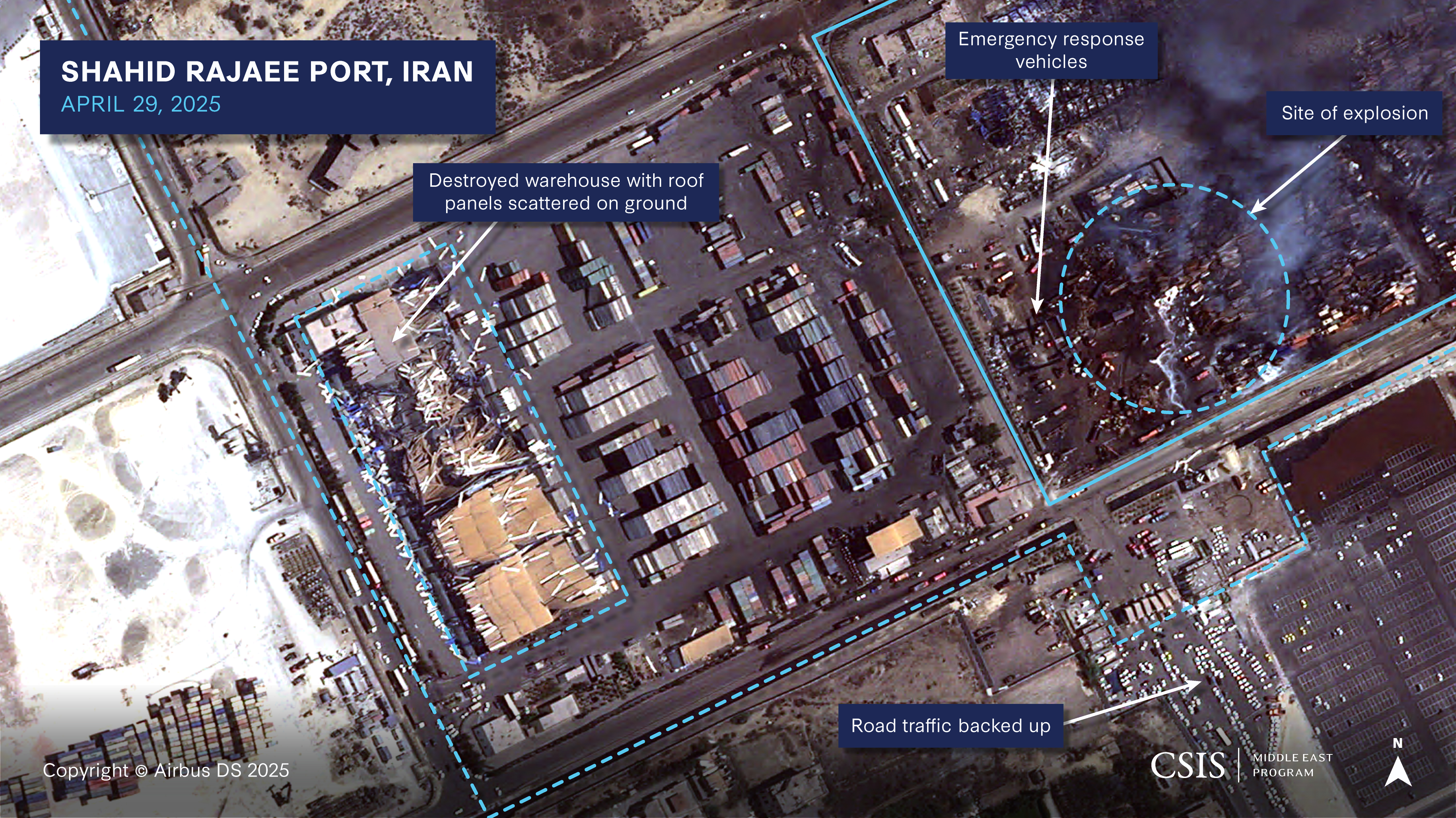
A2: Standard-sized shipping containers typically carry maximum payloads of about 63,000 pounds, creating ample fuel for a large explosion. Satellite imagery acquired on April 29, 2025, along with CCTV footage, suggests that the initial explosion triggered secondary and tertiary blasts. Hazardous materials are often stored together, which would help explain why multiple containers in the vicinity of the initial blast might have contained explosive material.
Q3: Why does the disruption at the Shahid Rajaee port matter for Iran, and how will the damage to the area impact the port’s operations?
A3: The Shahid Rajaee port is a crucial economic lifeline for Iran. Although Iran has 11 major ports, Shahid Rajaee processes up to 85 percent of the total container loading and unloading carried out across all Iranian ports. Its significance has only grown in recent years, with the port witnessing 13 percent growth in 2024 and reaching a throughput of more than 3 million TEU (20-foot equivalent units, corresponding to half the size of a standard shipping container). The damage to the port also comes as Iran faces growing economic pressure. Even before the new Trump administration entered office, Iran had been grappling with persistent inflation—hovering above 30 percent—and a currency that had plummeted to historically low values. With President Trump renewing his “maximum pressure” campaign on Iran in pursuit of a new nuclear deal, the country was already facing growing economic pain and social discontent even before the port explosion.
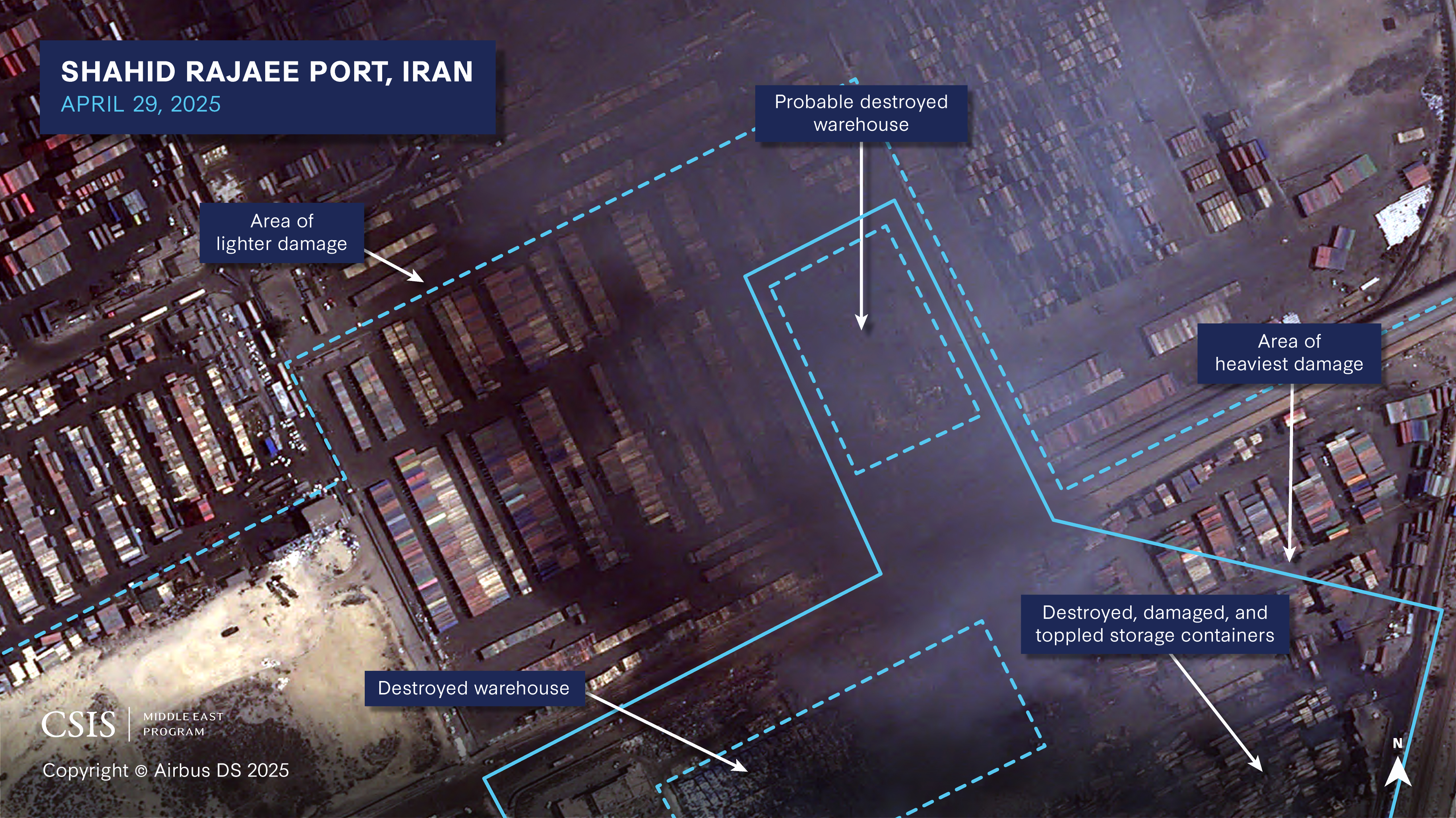
However, the fallout of the port explosion appears to be short term. Iranian officials announced in recent statements that critical equipment, such as gantry cranes, were undamaged. Satellite imagery analysis conducted by CSIS appears to confirm that such equipment did not appear badly damaged. Similarly, while the railroad tracks leading into and out of the port are likely to be affected by debris from the explosion that will need to be cleared, the tracks do not show any visible signs of structural damage, suggesting that they may be back in operation in a matter of days.
Q4: What does the explosion mean for ongoing U.S.-Iranian negotiations?
A4: The damage to the port is unlikely to impact high-level negotiations at the moment. Because the blast avoided structural damage to critical supply lines, infrastructure, and equipment, the economic disruption caused by the damage to the port is likely to remain relatively contained. Iranian officials have also been quick to blame the containers’ allegedly improper documentation for instigating the explosion, rather than accusing a state of attacking or sabotaging the port. However, negotiations could be complicated should evidence emerge that the blast was a consequence of another state’s action.
Martin Pimentel is a program manager and research associate for the Middle East Program at the Center for Strategic and International Studies in Washington, D.C. Jennifer Jun is an associate fellow and project manager for satellite imagery analysis with the iDeas Lab and Korea Chair at CSIS. Joseph S. Bermudez Jr. is a senior fellow for satellite imagery analysis with the iDeas Lab and Korea Chair at CSIS.
