A Close Encounter in Space: What Is Russia Planning? | Space Strategic Dialogue
October 21, 2026 • 8:00 – 9:00 am EDT
Hosted by Aerospace Security Project

Photo: SAMEER AL-DOUMY/AFP via Getty Images
Quantum information science and technology (QIST) has the potential to become a foundational platform technology, with wide‑ranging applications in national security, advanced manufacturing, communications, and scientific discovery. Despite this strategic importance, U.S. public and private investment in quantum research, development, and commercialization remains modest. This underinvestment has slowed the transition of quantum innovations from the laboratory to the marketplace and weakened the development of a resilient domestic quantum supply chain.
In 2024, U.S. private investment in artificial intelligence reached $109.1 billion—roughly 109 times greater than investment in quantum technologies.
In 2024, U.S. private investment in artificial intelligence reached $109.1 billion—roughly 109 times greater than investment in quantum technologies. Similar gaps appear in public funding: From FY 2019–2024, federal R&D spending on quantum information science totaled about $5 billion, compared with more than $50 billion in five‑year appropriations for the semiconductor ecosystem, plus tens of billions in tax credits. International competition further heightens concern, as China is estimated to have invested roughly $15.3 billion in quantum technologies, compared with U.S. public investments of about $3.8 billion.
In this context, the federal Small Business Innovation Research (SBIR) and Small Business Technology Transfer (STTR) programs are modest but highly effective tools for addressing some of the quantum funding gap. SBIR is a competitive public‑private partnership that provides non‑dilutive, early‑stage funding to small businesses for research and development with commercialization potential. As a complement, STTR strengthens these efforts through partnerships with universities and nonprofit research institutions. Together, SBIR and STTR invested roughly $4.7 billion in FY 2023 across their technology portfolios.
SBIR is particularly well suited to early‑stage, high‑risk technologies, supporting small firms developing critical quantum components, systems, and enabling infrastructure. While SBIR investments in quantum are small, they can play a strategic role in developing and retaining domestic suppliers for quantum systems. Notably, by stabilizing the emerging specialized supplier base, SBIR strengthens the broader quantum ecosystem and accelerates commercialization.
While SBIR investments in quantum are small, they can play a strategic role in developing and retaining domestic suppliers for quantum systems. Notably, by stabilizing the emerging specialized supplier base, SBIR strengthens the broader quantum ecosystem and accelerates commercialization.
Evidence from federal award data and regional ecosystems—most notably data from Colorado’s quantum cluster reviewed in this paper—shows that SBIR funding catalyzes company formation, supplier development, and early commercialization when aligned with agency missions and complemented by state and local programs.
Congress created the SBIR program in 1982 (Public Law 97-219), stating that, despite the role of small businesses as “the principal source of significant innovations in the Nation,” the vast majority of federally funded R&D is performed by large businesses, universities, and federal laboratories. Per this legislation, the SBIR program seeks to advance four objectives: (1) stimulate innovation; (2) increase the use of small businesses in addressing federal R&D needs; (3) foster the participation of socially and economically disadvantaged individuals in innovation and entrepreneurship; and (4) increase private sector commercialization of technologies derived from federally funded R&D. Federal agencies with extramural R&D budgets of $100 million or more are required to allocate a portion of that funding (currently 3.2 percent) to conduct an agency-run SBIR program. Currently, 11 federal agencies operate SBIR programs: the Departments of Agriculture (USDA), Commerce (DOC), Defense (DOD), Education (ED), Energy (DOE), Health and Human Services (HHS), Homeland Security (DHS), and Transportation (DOT); the Environmental Protection Agency (EPA); the National Aeronautics and Space Administration (NASA); and the National Science Foundation (NSF).
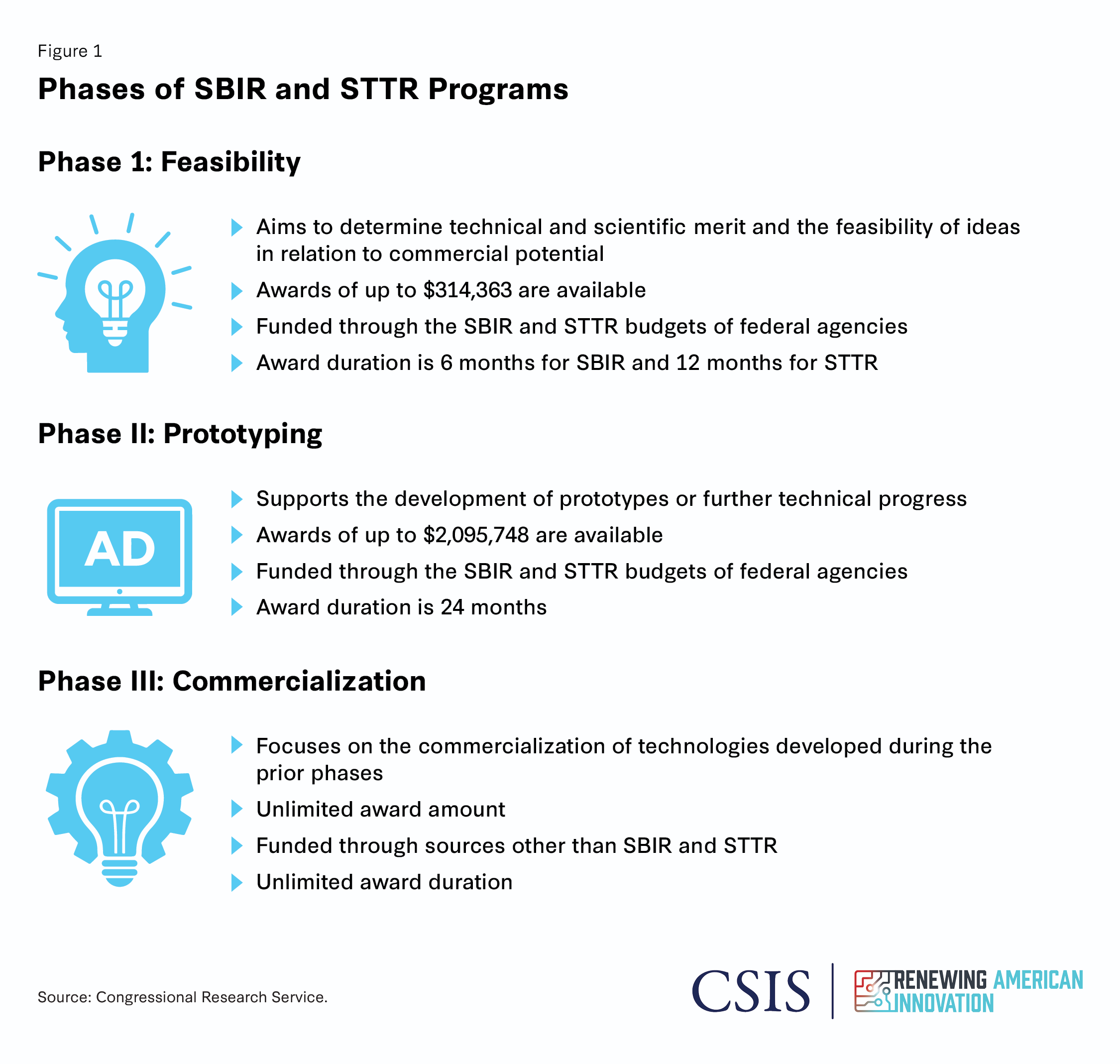
A complementary program, the STTR program, was created in 1992 (Public Law 102-564) to facilitate the commercialization of university and federal R&D through support for cooperative R&D between small businesses and research institutions. Federal agencies with extramural R&D budgets of $1 billion or more are required to allocate a portion of that funding (currently 0.45 percent) to conduct an agency-run STTR program. Six federal agencies currently operate STTR programs: the USDA, DOD, DOE, HHS, NASA, and NSF. Each federal agency is required to administer its own SBIR and STTR programs in accordance with the statutory provisions of 15 U.S.C. §638 and the policy directive issued by the U.S. Small Business Administration (SBA). The SBA is also required to provide coordination across federal agency SBIR and STTR programs, monitor implementation, and report annually to Congress. The SBIR and STTR programs have three phases: feasibility, prototyping, and commercialization.
According to the SBA’s most recent SBIR/STTR annual report, in FY 2022, federal agencies obligated $4.12 billion in SBIR awards and $618.3 million in STTR awards to small businesses. A total of 3,859 Phase I awards were offered, of which 39 percent were first-time awards, and $2.76 billion in Phase III funding came from non-SBIR federal sources, such as procurements. As Table 1 shows, however, very few awards have been granted to support quantum small businesses.
The federal SBIR program has been subject to numerous rigorous, independent, and comprehensive reviews by the National Academies of Sciences, Engineering, and Medicine, requested by Congress as part of the Small Business Reauthorization Act of 2000. These included all of the major funding agencies: the DOD, NIH, DOE, NASA, and NSF. These detailed reports found that the program was sound in concept and effective in practice, often achieving the objectives of the agencies, and offered specific findings and recommendations. Reports on the program from the DOD, NSF, and DOE, among other agencies, demonstrated that the SBIR program was particularly useful for emerging technologies at the early stages of R&D.
Since its creation in 1982, the SBIR program has been repeatedly reauthorized or extended by Congress. Both chambers of Congress have now voted to authorize the SBIR and STTR programs through September 30, 2031, via the Small Business Innovation and Economic Security Act.
Quantum technologies have the potential to provide significant military and strategic advantages in applications such as secure communications, precision navigation, and advanced sensing; however, the limited amount of SBIR funding for this technology may be limiting technological advancement and commercialization.
There has been progress. From 2015 to 2023, U.S. government agencies offered 575 Phase I awards and 287 Phase II awards under the SBIR program for QIST, totaling approximately $400 million to eligible small and emerging firms (excluding Phase IIA and Phase IIB funding).
While these investments reflect a positive trend, as Table 1 shows, the percentage of SBIR funds allocated to quantum technology is arguably low relative to its strategic importance. Despite the huge potential of quantum technologies, only 1.7 percent of DOD SBIR awards between 2015 and 2023 were allocated to quantum technology projects. Likewise, despite the potential for QIST to advance progress in these fields, the leading agencies with SBIR programs—the DOE, NASA, HHS, and the NSF—provided similarly small numbers of quantum-related projects.
This disparity between QIST’s potential and actual SBIR funding for QIST projects, coupled with the rapid growth of Chinese state funding, suggests a growing need for agencies to focus on QIST’s potential impact on their missions and prioritize funding for quantum projects.
This disparity between QIST’s potential and actual SBIR funding for QIST projects, coupled with the rapid growth of Chinese state funding, suggests a growing need for agencies to focus on QIST’s potential impact on their missions and prioritize funding for quantum projects.
Quantum science is still at an early stage in its development and commercialization pathway and is closely connected to federal agencies and university research organizations. Accordingly, it is useful to examine a regional quantum innovation ecosystem and its relationship to SBIR companies.
The principal driver of Colorado’s ascendancy in quantum technology has been its research universities working in concert with federal agencies. Colorado and the Mountain West region overall have emerged as the national center of the QIST industry, home to more quantum organizations, companies, and jobs than anywhere else in the country
As explored in greater depth in a February 2026 CSIS report, A National Asset: The Colorado Quantum Ecosystem, NIST has been operating a major research facility in Colorado since 1954 and has done more than any other agency to promote the state’s efforts in quantum science. NIST formed the nation’s first government-university research center, the Joint Institute for Laboratory Astrophysics (now known only by the acronym JILA), at the University of Colorado Boulder. NIST Boulder and JILA have become world-leading centers of precision measurement, driving international measurement standards.
Recognizing the science and technology resources that have been developed in the community, federal agencies have provided new funding and developed new partnerships to maximize their potential through the NSF’s National Quantum Lab, the DOE’s Sandia National Laboratory, the Defense Advanced Research Projects Agency’s Quantum Benchmarking Initiative, and the DOD’s APFIT program. Significantly, in 2024 the DOC awarded Elevate Quantum, a multistate consortium, $40.5 million from the Economic Development Administration’s Tech Hub program, the only hub award focused on quantum technology.
The long-term federal investment in QIST R&D in Colorado, complemented by robust and creative state support, has fueled the emergence of a cluster of early-stage companies that have been stimulated by SBIR funding. A review of 18 Colorado-based companies that received SBIR awards between 2015 and 2023 is illuminating.
The SBIR program is shaping a distinctive, emerging quantum regional industry and helping to build the broader quantum value chain. There has been progress in accelerating quantum commercialization. For example, Maybell Quantum successfully advanced from Phase I to Phase II for scaled production of High-Density Cryogenic Flexible coAXial (FLAX) RF ribbon cables in 2023. Maybell attracted more than $25 million in private capital in 2024 and commercialized multiple products.
Current policies and programs offer lessons for scaling up an SBIR program to advance quantum research by leveraging or revising existing authorities.
As part of the CHIPS and Science Act, the DOC and NIST were appropriated over $50 billion to support the semiconductor ecosystem. Given the size of the CHIPS budget, and depending on how the various components are categorized, NIST could potentially provide hundreds of millions of dollars for CHIPS-related SBIR awards, including an allocation for STTR awards. In April 2024, the CHIPS R&D Metrology Program issued a notice of funding opportunity (NOFO) offering up to $54 million across 24 awards: approximately 14 as open topics (aligned to seven specific Metrology Grand Challenges) and 10 as closed topics. The NOFO included the full range of flexibilities allowed under SBIR programs, including the following:
To encourage commercialization, NIST offered the following:
In September 2024, NIST announced an award of $5 million to 17 companies, committing as much as $37 million in funding. If NIST decides to issue a second NOFO, and, depending on the breakdown of fast-track and Phase II awards, it could provide an additional $15 million. In short, the NIST CHIPS SBIR funding launch illustrates how focused attention on quantum might be advanced through a dedicated funding source.
The TABA Program, authorized by Congress in 2019, provides funding for commercialization and business assistance expenses not allowed under regular SBIR funding. Although program specifics vary by agencies, generally up to $6,500 may be provided to Phase I SBIR winners in addition to the award amount, and up to $50,000 may be allowed as part of a Phase II award. The assistance must be provided by a third-party entity, either chosen by the company or offered by an agency. Services include technology assessments, market analysis and strategy, business model development, commercial road mapping, investment readiness assessment, IP, and regulatory affairs support.
State and local governments have developed innovative policies to broaden the base of SBIR applicants and support the commercialization of SBIR-funded technologies. Continuing and expanding these programs to emphasize quantum technologies would effectively amplify the impact of federal funding and support the growth of the quantum industry.
The State Science and Technology Institute published a comprehensive State SBIR/STTR Resource Guide that describes state-level programs. Every U.S. state and Puerto Rico has a set of programs, which can include (1) proposal development and mentorship; (2) financial assistance; (3) commercialization support; and (4) technical assistance and networking. Representative examples include the following:
Montgomery County, Maryland, is home to some of the nation’s most prominent federal agencies and research organizations, including the FDA, NIH, NIST, and DOD research institutions, and it operates the only county-level SBIR/STTR matching grant program. In a recent revision of the program, the county
The following are specific recommendations regarding federal oversight and coordination, agency policies, state and local programs, and the SBA.
Federal Oversight and Coordination Authorities
The National Quantum Initiative Act (Public Law 115-368, passed on December 21, 2018) calls for a coordinated approach to quantum research and development efforts across the U.S. government, including the civilian, defense, and intelligence sectors. To further the objectives of the legislation, the following actions should be undertaken:
Federal Agencies
State and Local Programs
The Small Business Administration
Only a small proportion of total SBIR funding has been allocated for SBIR grantees to carry out QIST R&D efforts, despite the enormous potential impact that new advances in QIST could have on U.S. national competitiveness. Additional SBIR resources beyond present levels are critical for sustaining U.S. leadership in the QIST field.
There is great potential for additional funding through the use of Other Transaction Authorities and other programs at the federal, state, and local levels to help address the funding opportunities represented by this novel technology. Ramping up efforts at all levels of government to prioritize increased funding, utilize existing programs, and strengthen policy coordination for QIST is urgent.
Additional SBIR resources beyond present levels are critical for sustaining U.S. leadership in the QIST field.
It is important to capture the benefits of one of the most important and effective U.S. public-private partnerships to foster U.S. leadership in the context of growing international competition. The United States should reinforce and keep building upon this proven recipe to advance quantum commercialization and strengthen the domestic supply chain.
The Center for Strategic and International Studies’ Renewing American Innovation program is undertaking a review of the U.S. Quantum Opportunity, as requested by the National Institute of Standards and Technology and in cooperation with the Quantum Economic Development Consortium.
Phillip Singerman is a senior adviser (non-resident) with Renewing American Innovation at the Center for Strategic and International Studies (CSIS) in Washington, D.C. Hideki Tomoshige is a fellow with Renewing American Innovation at CSIS.

Commentary by Hideki Tomoshige and Phillip Singerman — March 16, 2026

Commentary by Hideki Tomoshige and Phillip Singerman — March 16, 2026

Report by CSIS Scholars — February 20, 2026

