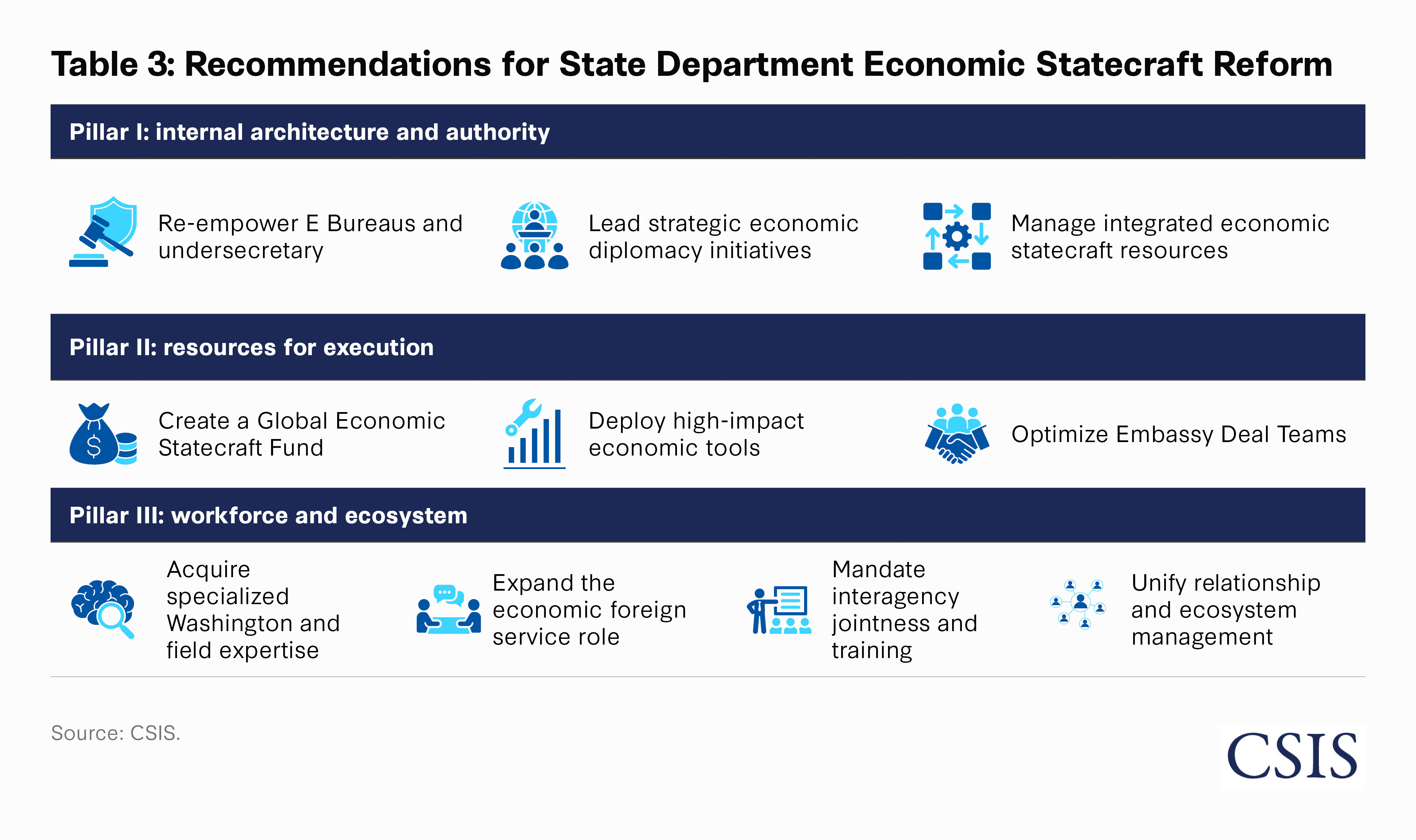
Pillar I: State Department Internal Architecture and Authority
Re-Empower the Economic Bureaus and Undersecretary for Economic Affairs
Economic statecraft, due to its global scope, should be the job of all relevant parts of the State Department as a whole—not of a single office, envoy, or initiative. The undersecretary for economic affairs is the right institutional home for the leadership of this mission inside the State Department. Indeed, it already is on paper: a Senate-confirmed, high-level official with direct access to the secretary who can join relevant NSC Deputies Committee meetings. However, the undersecretary—or “E,” as the person is called inside State—needs to be better positioned and authorized to marshal department resources in service of global economic statecraft goals and harmonize State’s actions with broader whole-of-government strategy. The role is not only critical in supporting the secretary of state’s chairmanship of the executive boards of the DFC and MCC and participation as an ex officio member of the EXIM board; the E line of bureaus should also be transformed into stronger entities that can exercise thought leadership and coordination power and be a hub for managing economic statecraft resources.
Avoiding Special Envoys: There is a temptation to demonstrate policy ambition by appointing a special envoy for top priorities, such as clean energy. This is understandable, but it is also self-defeating. Envoys with broad mandates signal to everyone outside their remit that administration priorities are someone else’s job, hollowing out the institutional responsibility that should sit with Senate-confirmed leaders and established bureaus. By empowering the undersecretary of economic affairs, the shifts inside the State Department toward a greater focus on economic statecraft would also be institutionalized, making it harder for them to drift from their original purpose in the future. Where special negotiators at State are genuinely needed—for multilateral climate talks, specific corridor arrangements, or economic partnerships—their mandates should be narrow, time-limited, and explicitly linked to the undersecretary. They should be empowered by E, not positioned above or adjacent to it.
Pull quote: The State Department’s diplomacy can serve as the connective tissue that gives economic statecraft overseas its strategic coherence, so that the tools of DFC financing, EXIM loan guarantees, Commerce export promotion, and bilateral energy partnerships can be made greater than the sum of their parts.
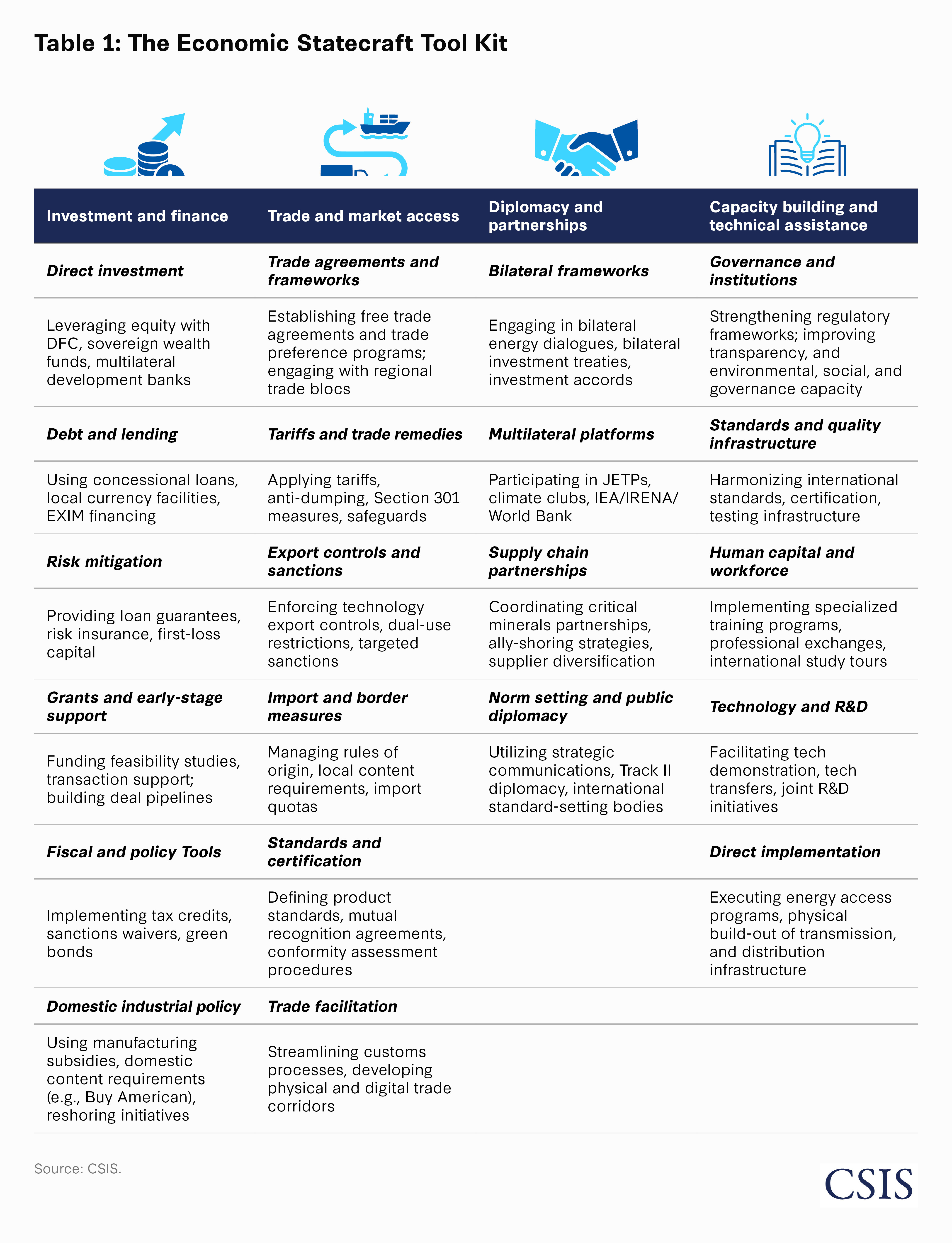
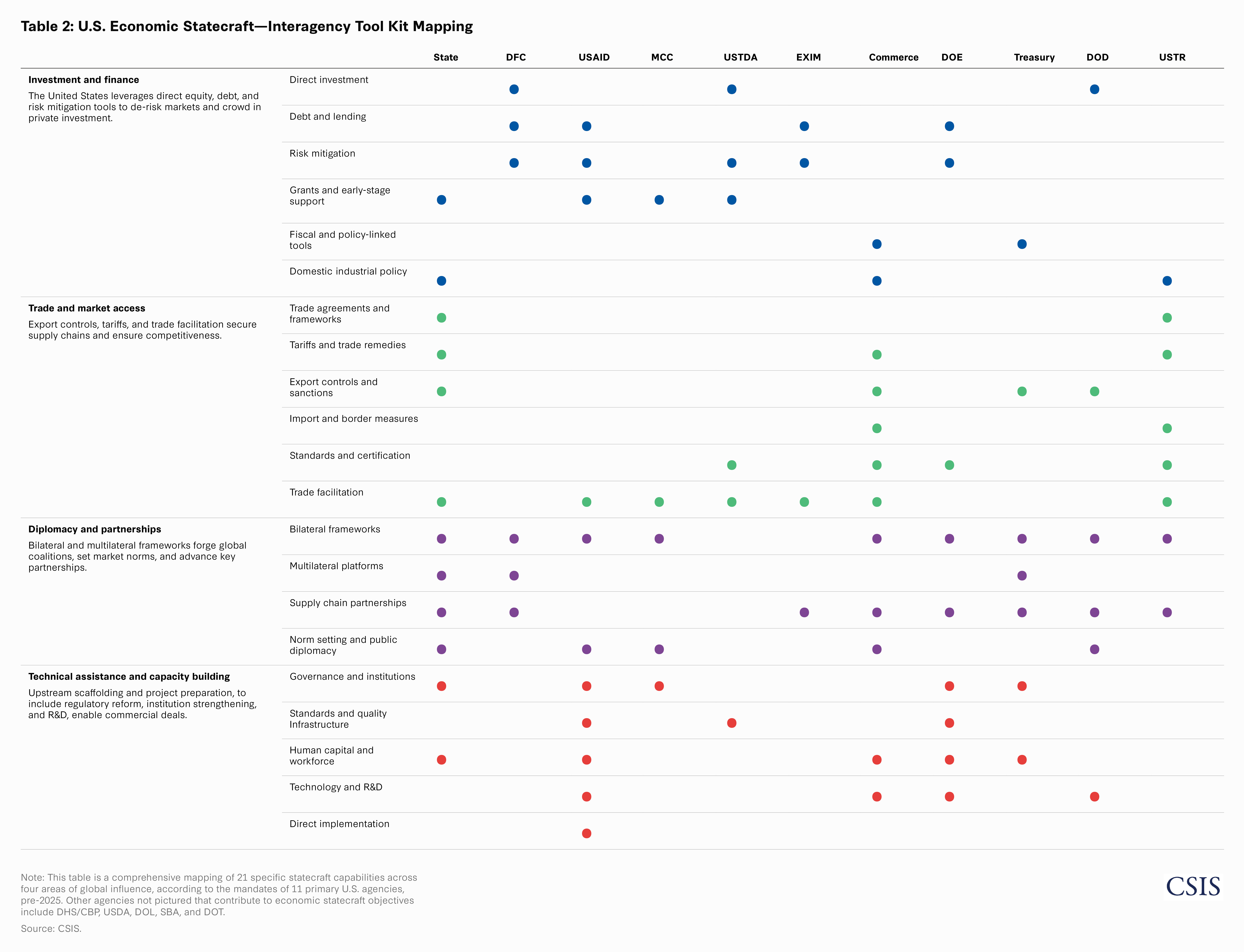
Leading Economic Diplomacy Initiatives: The State Department’s enduring comparative advantages are its presence in every country and its direct relationships with foreign governments, which enable it to lead bilateral frameworks, multilateral platforms, and supply chain partnerships. The State Department’s diplomacy can serve as the connective tissue that gives economic statecraft overseas its strategic coherence, so that the tools of DFC financing, EXIM loan guarantees, Commerce export promotion, and bilateral energy partnerships can be made greater than the sum of their parts. E should lean into this broader role by owning and managing economic diplomacy initiatives. The Minerals Security Partnership—now the Forum on Resource Geostrategic Engagement (FORGE), a group of 55 countries that focuses on pricing and trading critical minerals—is a prime example. The proposed Energy Security Compact model—as referenced in recent draft Senate and House legislation—is another kind of initiative that E should be positioned to lead.
Managing State’s Economic Statecraft Resources: The E Bureaus should assume full responsibility for coordinating and managing State’s economic statecraft programming to advance U.S. economic goals and industrial policy in partnership with allies and the private sector. Consolidating strategic direction over these resources under E, rather than managing them as separate bureau equities spread throughout the department, would give the undersecretary real tools to match the coordinating role the position demands. This critical function has a foundation in the ongoing programmatic work within the E Bureaus but would require significant enhancements to handle greater responsibilities. For example, estimated program levels in FY 2023 included $224 million at the Bureau of Energy Resources, the Bureau of Economic and Business Affairs, and the Bureau of Oceans and International Environmental and Scientific Affairs, collectively. The first two bureaus now compose a single Bureau of Economic, Energy, and Business Affairs.
Anticipating Regional Bureau and Functional Bureau Dilemmas: Because regional bureaus control bilateral and regional policy, E’s ability to advance topline economic goals depends on retaining control of economic statecraft resources. This requires E to strike a careful balance between devolving a portion of resources for field-level execution, building specialized units to manage global contracts and awards, and working in coordination with the Office of Foreign Assistance Oversight (formerly known as the F Bureau) and regional bureaus. Technical offices in the E Bureaus should manage complex, high-dollar, or globally scoped programs that require specialized civil servant expertise. For example, catalytic grants to private funds and endowments demand financial and contractual experience that cannot easily be replicated in regional bureaus or in the field. Similarly, diplomatic and policy partnerships whose advancement requires funding—and in which program design is inseparable from political strategy—should be managed from technical offices within E that can integrate both dimensions.
This does not mean that regional bureaus do not have a vote in how economic statecraft resources are spent. On the contrary, regional bureaus and embassies should concur with program resources that touch their regions and countries, and should be integrated in program design efforts led through E. In many instances, E Bureaus may decide to pass resources directly to regional bureaus or embassies—or even other agencies—for further program design and obligations, but this decision needs to be made consciously as part of a larger strategy with defined goals. See further discussion below on devolving resources to the field to accelerate country-level program execution.
Pillar II: Resources for Execution
Create a Branded “Global Economic Statecraft Fund”
Congress should establish a distinct pot of foreign assistance resources, branded the “Global Economic Statecraft Fund,” initially scaled at $1–2 billion, to provide the interagency with targeted resources to advance U.S. economic goals, energy resilience, and industrial policies. This fund would be developed in partnership with allied countries and target markets, in both developed and developing countries. It should be broken out from the current $6.8 billion National Security Investment Program, which consolidated the Economic Support Fund, Development Assistance, and Assistance for Europe, Eurasia, and Central Asia accounts in the FY 2026 appropriations, or from the administration’s $5 billion America First Opportunity Fund request in the FY 2027 budget, for better oversight and specific uses. Under the guidance of the Office of Management and Budget and a newly empowered coordinating authority for U.S. economic statecraft efforts (i.e., an ESC or other entity), these foreign assistance resources would be provided to the State Department to implement national economic strategies overseas and create new programs that help solve specific gaps (see Economic Tools below). These resources can (and sometimes should) be passed to other agencies to leverage their unique contributions toward specific outcomes.
In its appropriating language, Congress should specify the principles guiding the fund’s management at the State Department, which could include
- promoting U.S. domestic economic growth and U.S. economic interests overseas by leveraging the fund’s resources through partnerships with the private sector on all endeavors;
- steering investments in energy infrastructure and supply chain diversification that strengthen the resilience of allied energy markets against coercion;
- mandating information sharing among operating units at State and other agencies who receive these funds, thereby maintaining a high-level common operating picture of the use of the resources, avoiding duplication of efforts, and promoting overall coherence;
- encouraging an ethos that balances sound management of taxpayer resources while also using a private sector mindset to embrace innovation and accept calculated risk;
- leveraging tools and strengths from other agencies through joint planning and sharing of resources (i.e., interagency agreements); and
- articulating the U.S. national interest in this fund to foster an understanding of the interplay between U.S. economic tools, sectoral and industrial policies, and the potential to expand mutual prosperity with foreign partners through foreign assistance programming.
Double Down on Useful Economic Tools
With the elimination of USAID, the U.S. government lost a primary source of upstream scaffolding. Although USAID’s most prominent and well-established work involved public health and humanitarian response, the agency’s economic growth programs—which grew from $2.8 billion to $8.6 billion annually over the past 10 years—were squarely focused on private sector development and institutional strengthening that created jobs, expanded markets, and attracted investment opportunities.
Drawing from the Global Economic Statecraft Fund discussed above, these tools should include the following:
- Upstream and Market-Enabling Funding: A flexible pot of $200–250 million globally for technical assistance, sectoral feasibility studies, regulatory reform, energy grid integration, and market-enabling activities—as similarly advocated by other experts—can also help align and coordinate U.S. and partner country industrial policies. Technical assistance funding can help address regulatory barriers, support trade harmonization, and assist partner governments with developing transparent procurement frameworks. All of this helps U.S. companies enter markets, compete on a more level playing field, and streamline supply chain integration; conversely it can help countries negotiate better infrastructure deals with China that do not preclude U.S. follow-on investments. For instance, Power Africa’s technical assistance to the government of Kenya facilitated the adoption of standardized power purchase agreements and a streamlined regulatory framework that attracted the international investment consortium behind the $700 million Lake Turkana Wind Power project—the largest private investment in Kenya’s history. This illustrates how field-driven technical support can de-risk a market enough to convert high-level reform into a massive commercial win.
- Risk-Tolerant Capital: Within this fund, the State Department should set aside higher-risk, catalytic grants ($5–10 million) as seed or junior funding in private sector–managed investment funds and endowments managed from Washington. Mobilizing private capital in service of U.S. economic goals requires financial instruments capable of assuming risk that other agencies are reluctant to assume. The DFC, as the government’s primary overseas lending institution, plays a leading role in this area—but it operates as a bank, focused on later-stage, commercially viable debt and equity investments with larger ticket sizes and slower evaluation timelines. It is built to be conservative. Recognizing this challenge, Congress directed the DFC through its 2025 reauthorization to improve its risk tolerance. Even with positive steps in this direction, the DFC still lacks grant-making authority. While Congress could provide DFC with grant authorities through a separate Better Utilization of Investments Leading to Development (BUILD) Act amendment, there is no legislative momentum to do so, and the DFC’s next reauthorization is 2031. That leaves an immediate critical gap at the early stage, where catalytic grants can act as seed funding in private sector–managed investment funds and endowments, unlocking deals that would otherwise never reach the DFC.
USAID filled this gap by partnering with institutional investors and fund managers to provide catalytic grant capital and seed funding in emerging market funds, often with success in leveraging 10–100x the amount of private capital. For example, the Green Guarantee Company, the first privately managed guarantee company dedicated to promoting climate finance through green bonds and loans, was seeded with an initial $8 million grant from USAID and Prosper Africa, $2 million from the State Department, and other investments from the United Kingdom’s FCDO, the Nigeria Sovereign Investment Authority, and Norfund. The fund raised $100 million in initial investments from public and private sources for its 2024 listing on the London Stock Exchange and has the ultimate goal of a $5 billion guarantee capacity for climate finance.
Because State’s primary metric is geopolitical and national security outcomes rather than financial returns, it can justify a higher risk premium than the DFC. State’s grant-making capabilities in this area would be designed to complement the DFC’s debt, equity, and risk guarantee tools. Successful execution, however, requires a genuine cultural shift: a “patient capital” mindset with longer planning horizons, contracting and legal approval processes that correspond to how the tool works, and a willingness to move away from short-term diplomatic announceables toward long-term strategic positioning.
- Transaction Advisory Services: Generating a pipeline of viable commercial deals that advance U.S. economic statecraft goals and industrial policies is easier said than done. Some projects take years to mature, while many never materialize at all if private companies ultimately determine a deal is not commercially viable. USAID (via Power Africa and Prosper Africa) offered transaction advisory services through small grants ($5,000–50,000) to professional services companies that could help an embassy, U.S. company, or local partner assess a deal, conduct due diligence, provide limited investor matchmaking, and refine financial models—all of which can make the difference in reaching financial close, whether in Malawi, Morocco, or Mozambique. A $20 million global allocation to fund transaction advisory services through small, rapidly deployed professional services targeted at specific deals could also be valuable in helping to structure complex clean energy deals and build project pipelines that can be handed off to other interagency partners or direct investors.
Optimize Embassy Deal Teams for Transactional Focus
Introduced during the first Trump administration and reinforced during the Biden administration, U.S. Embassy Deal Teams are the tip of the spear for U.S. economic statecraft priorities overseas. These interagency working groups—usually chaired by an economic officer or jointly with a foreign commercial service officer—bring together the relevant sections and agencies at an embassy and help U.S. companies do business in their markets. Sectoral expertise and resources often reside in Washington, but these officers offer invaluable firsthand experience and context on specific market opportunities.
Critiques of Deal Teams abound. They tend to become focused on process, incoming visitors, and readouts from government meetings, or are simply gathering data in a shared Excel file. Further, in many mid- and small-sized embassies, officers may lack the expertise or connections to filter or advance viable commercial opportunities. Some might argue that the lack of “game-changing” deals advanced via Deal Teams suggests that little has been gained through this model thus far. The desire for quick wins at the embassy level is strong, but deals can sometimes take years to advance and reach financial close.
Embassy Deal Teams should be distinct in purpose from traditional economic working groups, which might handle the routine business and work processes at embassies; Deal Teams should instead focus on private sector transactions. The most effective Deal Teams have front office leadership and participation. An ambassador or deputy chief of mission routinely meets with private sector partners in the course of their duties, and the White House and Economic Security Council should charge them with specific economic mandates. An ambassador is uniquely positioned to secure time and resources from Washington to give a commercial opportunity full consideration and assist it in moving from one stage of the project life cycle to the next. Ambassador leadership can help prioritize transactions that Deal Team members should work on collectively, and ambassadors should be responsible for their Deal Team efforts. A top 10 list of priority deals with front office visibility could be particularly useful in bringing clarity and focus.
Getting the right mix of participation at Deal Team meetings is as important as the deals under consideration. The inclusion of embassy local staff can help bring institutional experience to bear in the consideration of new opportunities. Regionally based agency representatives, such as Commerce, USTDA, the DFC, and the U.S. Department of Agriculture (USDA), are invaluable participants—even if virtual—during Deal Team meetings. Congress can also help to increase the effectiveness of Deal Teams by expanding Commerce’s Foreign Commercial Service (FCS), which is badly under-resourced and under-staffed for its vital mission overseas. For example, Commerce deploys roughly a dozen FCS officers across all of sub-Saharan Africa—a woefully thin footprint in a region that is poised for enormous market expansion and sits at the center of geostrategic competition with China. Absent the direct participation of FCS officers or USTDA, DFC, and USDA staff, State’s Embassy Deal Team members need to have baseline knowledge of the U.S. government tool kit to make referrals to the appropriate agency, be it in the realm of exports, critical minerals, or energy infrastructure.
Pillar III: The Economic Workforce and Ecosystem
Today’s geopolitical competition will be won by professionals who can leverage economic interdependence. The State Department needs to aggressively upskill its workforce and enhance staff expertise and networks both in Washington and in the field. President of the Economic Security and Technology Department at CSIS Navin Girishankar argues that the United States urgently needs a new class of “economic warriors” and that the State Department should take up this call.
Acquire Specialized Expertise in Washington and in the Field
The next era of economic statecraft demands specialized expertise in the fastest-growing sectors of the global economy—energy, AI and digital technologies, infrastructure, critical minerals, and healthcare—as well as fluency in the life cycle of a deal, project finance, and trade and investment issues. The Department of State depends on foreign service officers (FSOs) and foreign affairs officers (civil servants) who were trained as generalists and expected to learn on the job.
The Department of State should not seek to replicate the deep sectoral expertise housed elsewhere in the interagency, but should instead cultivate steady civil servants with sectoral backgrounds and program management skills. In order to better leverage and bring forward expertise from other departments and agencies, the E Bureaus in Washington need baseline fluency in these sectors to help translate between technical agencies, engage foreign governments on complex energy partnerships and ally-shoring objectives, and participate meaningfully in deal origination and project finance considerations. This could include a baseline competency in the commercial and technical life cycle of renewable power and critical minerals. It could also include training on how to interpret power purchase agreements or assessing the viability of carbon capture and hydrogen technologies, ensuring staff are not just aware of energy but can actually facilitate deals. The State Department also needs to attract and cultivate civil servants who can help reinforce its program management capabilities (program design, contracting, legal, financial management, and monitoring and evaluation). Civil servants—long-term staff who are more specialized than FSOs—are the right people to lead the building of this type of consistency and sustained relationship. New hiring mechanisms may also be needed to bring in the right talent and allow experts from the private sector to come in and out of government; new, flexible hiring authorities from Congress should be part of this discussion.
Leveraging Locally Employed Staff (LES): LES can bring irreplaceable institutional knowledge of foreign regulatory environments and established relationships with ministries and regulatory authorities. The challenge of maintaining the right expertise is even more acute in the field. An economic officer may develop meaningful sector-specific knowledge over 2–3 years on an energy, trade, or digital portfolio in a given country, but that institutional knowledge departs when the officer rotates to a new assignment, often seeking a job with a different subject area to broaden experience and improve promotion prospects. The result is a department that is structurally prevented from building depth. The rehiring of USAID local staff in particular, if done at competitive pay scales, will attract a highly skilled and connected local team that can help embassies retain in-country expertise in critical sectors.
Accelerating Country-Level Program Execution: In terms of both speed and impact, this requires bringing program management and sector programming expertise into the field. To give country teams meaningful agency, embassies should be authorized to directly award grants or contracts that clearly fit within specified economic strategies up to a defined threshold—$250,000–$500,000 would be a reasonable starting point. This enables a faster response to time-sensitive opportunities without requiring a lengthy Washington approval process and may also help maintain a healthy balance of program management functions between the E Bureaus, regional bureaus, and embassies. In addition to the designation of more state economic officers and other embassy staff as contracting officer’s representatives for programs managed from Washington, staff based in the field should be empowered to manage the types of programs that require context-specific expertise: technical assistance, market-enabling programming, and transaction advisory services. LES and other specialists in economic growth and energy programs who are well-versed in U.S. government operating principles and in executing complex, market-building agreements with foreign entities should be hired or rehired.
Expand the Scope of the Economic Foreign Service Officer Role
A foreign service economic officer has traditionally played two roles: (1) economic diplomacy (i.e., macroeconomic analysis, reporting, and trade policy) and (2) commercial diplomacy (i.e., using diplomatic tools and government-to-government engagement to advance U.S. business interests and ensure a level playing field). These roles widen at “Partner Posts” where Commerce and State jointly designate an economic officer to play specific Commerce-branded commercial functions in the absence of a U.S. FCS presence. The next era of economic statecraft requires two additional tasks: (1) deploying technical assistance and (2) guiding finance and investment.
Deploying Capacity Building and Technical Assistance: To promote trade and strengthen investment climates—particularly in sectors such as critical minerals and clean energy—the United States should deploy foreign assistance programs that unlock future commercial activity. The upstream, market-enabling activities described above (see tools in the Global Economic Statecraft Fund section) will require input from the field during program design to create impactful interventions. Economic officers will need to gain proficiency in participating in program design processes led by Washington-based experts.
Pull quote: To promote trade and strengthen investment climates—particularly in sectors such as critical minerals and clean energy—the United States should deploy foreign assistance programs that unlock future commercial activity.
Guiding Finance and Investment Tools: As with economics-focused staff in Washington, economic officers need to develop fluency in the broader U.S. government finance and investment tool kit. Officers who master these tools will be able to help bridge the gap between high-level diplomatic announcements and actual commercial execution. As part of their participation and leadership of Deal Teams, economic officers should also be empowered to spend time working on deal origination, vetting referrals, and helping U.S. companies troubleshoot regulatory and other problems in potential deals. Higher levels of expertise in this area will help generate a pipeline of bankable deals that can be handed off to the DFC, EXIM, or private investors. At embassies in energy-rich or resource-critical markets, State should create a specific “energy dealmaker” designation. This would signal that the officer is not just an analyst, but a project facilitator empowered to troubleshoot regulatory hurdles for energy firms—effectively acting as a dedicated project liaison. Equally important, State officers should expand beyond Commerce’s remit, which currently only involves supporting U.S. exporters. Countering China’s market dominance and diversifying critical supply chains requires the United States to actively support allied-nation firms as well, and ought to help U.S. manufacturers source the goods and materials they need to produce in the United States. The Minerals Security Partnership illustrates this point: Effective supply chain strategy can also mean backing Australian, Canadian, and other partnercountry companies, not just U.S. businesses.
This makes for an expansive role for economic officers—one that is unavoidable given the dynamic demands and necessary links between financing, budget, and policy. This could be managed by creating “tracks” within the ranks of economic officers: one track that is focused on analysis and reporting, and another that is more hands-on, focusing on investment, assistance, and dealmaking. Different positions could be designated for these skills or by specific topic, just as previous efforts have been made to create a cadre of environment, science, technology, and health officers within the economic cone, and the Biden administration’s effort to designate climate officers.
Aligning Incentives and Culture: Expanding the role of an economic officer is meaningless if the promotion and recognition system continues to reward traditional diplomatic duties and reporting over economic execution. The State Department should elevate economic statecraft as a recognized competency that leads to career advancement. Concrete steps could include (1) shifting promotion criteria to reward economic depth alongside regional knowledge, (2) establishing new performance metrics tied to economic statecraft outcomes such as deal pipeline development, ally-shoring facilitation, and private capital mobilization; and (3) creating department-level awards for economic statecraft achievement. A 2022 Government Accountability Office report recommended that State explicitly factor Deal Team participation into promotion decisions to encourage FSO engagement. The Office of Personnel Management should also formally define “economic security competencies” applicable across agencies, giving the whole-of-government effort a common professional framework.
Mandate Interagency “Jointness” and Specialized Training
Building a true corps of economic professionals with cross-disciplinary expertise requires sustained commitment from both the executive branch and Congress. Three cultural failures currently undermine U.S. efforts to create economic warriors: (1) a risk-averse institutional culture across State and partner agencies, (2) siloed thinking that struggles to bridge domestic and foreign policy, and (3) insufficient working knowledge of other agencies’ tools, mandates, and authorities.
The most direct fix is structural. Adapting the Goldwater-Nichols model, the U.S. government should mandate—or create strong promotion incentives for—cross-agency rotations of 6–12 months within the first five years of a career. Embedding State foreign service and civil service officers at the DFC, Commerce, Treasury, and other agencies (and vice versa) builds a workforce fluent in the full interagency tool kit and attuned to the distinct mandates, risk tolerances, and strengths of partner agencies. Increased effectiveness in designing and managing economic statecraft foreign assistance funds can also be expected from this training. Critically, these rotations should be treated as core professional development—not leadership programs targeting senior managers—so that jointness becomes a baseline expectation rather than an elite credential. Performance evaluations should also take into account an officer’s ability to successfully inherit or hand off projects in a pipeline or contribute to other agencies’ achievements.
This structural reform should be matched by a training overhaul. A National Economic Security Academy—established as a specialized interagency center within the State Department’s Foreign Service Institute—should replace the current theoretical approach to economic diplomacy with a practical curriculum built around the machinery of government: the tools, authorities, and resources that drive economic statecraft. Officers would also gain technical fluency in the project life cycle from inception to financial close, alongside a working knowledge of priority sectors, key markets, and supply chains. The curriculum should also incorporate economic wargaming and stress tests developed in collaboration with Treasury’s and Commerce’s economic intelligence units, giving practitioners the analytical skills to anticipate the second-order consequences of export controls, sanctions, and other restrictive measures, while identifying “positive” opportunities in foreign markets.
For the academy to function as a true interagency institution rather than a Foreign Service Institute add-on, Congress should authorize and fund it independently, with a governing board that includes Treasury, Commerce, the DFC, and EXIM alongside State. Mandatory attendance—tied to promotion eligibility across participating agencies—would require statutory direction, but doing so would signal serious commitment to building this cadre.
Unify Relationships and Ecosystem Management
The private sector is the ultimate driver of economic growth and U.S. economic power, but the U.S. government cannot mobilize private capital if it cannot coordinate its own outreach. Securing resilient supply chains for critical minerals, semiconductors, and clean energy technologies and countering foreign market manipulation requires the United States to act as a single, coherent entity. It currently does not.
The State Department and other agencies maintain their own contact management systems, cultivate their own business relationships, and guard deal information. This produces a fragmented landscape of U.S. private sector engagement that slows response times, creates duplicative outreach, and leaves the interagency unable to present a unified front to the companies it needs to mobilize. Some agencies have strived for a “no wrong door” approach: Regardless of which agency, office, or website a business first contacts, it should be guided to the right resource or point of contact without having to start the search over from scratch. It is difficult to eliminate the bureaucratic maze that private sector entities often face when trying to engage with the U.S. government. Past efforts at a one-stop-shop model—a single entry point for companies that do not know where to start—have not easily scaled. The fix is a unified customer relationship management (CRM) system, something that is currently used as an essential tool in the private sector but that is not systematically employed at State or across the government. Agencies and staff are understandably cautious about sharing proprietary transaction details or carefully cultivated contacts within a large bureaucracy, and companies are right to worry about sensitive information circulating across government.
A well-designed system addresses this through tiered permissions: A State officer might see that USTDA is engaged with a given company in a given market, even without access to the underlying details. That baseline visibility is enough to eliminate duplicative outreach, enable smart referrals, and provide senior officials with a more complete picture prior to strategic engagements. A unified CRM allows the interagency to capture private sector leads, check the status of referrals, make decisions about providing transaction advisory services, see the full pipeline of deals in a given sector or market, and track closed deal metrics. Without it, coordination depends on personal relationships, email updates reaching the people who need them, and institutional memory—all of which are vulnerable to single points of failure and do not scale.
Imagine a senior official preparing for a meeting with a major U.S. clean energy developer. With a unified CRM, the official could see, in seconds, every instance in which agencies across the U.S. government have provided a guarantee, a technical assistance grant, or an advocacy letter for that company’s global portfolio, allowing for a much more cohesive and strategic conversation. Currently, it would take a formal data call to understand every U.S. touchpoint with major U.S. or multinational companies. Commerce, which already operates a customer management platform and could manage legal and governance issues, is the natural home for such a system, with access extended to State, the DFC, EXIM, and others.
Taking Action
The escalating reality of international economic rivalry—characterized by the race for critical minerals, technological supremacy, and assertive energy and industrial policy—necessitates a comprehensive modernization of the U.S. statecraft tool kit. The inherited institutional framework, currently defined by fragmentation and siloed resources, is ill-equipped for this moment. To restore the nation’s competitive advantage, the United States should pivot from initiative-centered approaches toward a more unified strategic architecture. For the State Department, this requires elevating E’s institutional role in economic statecraft vis-à-vis other bureaus and embassies, restructuring economic programming and delivery mechanisms by doubling down on private sector-focused tools, and cultivating a specialized workforce capable of meeting the transactional and technical rigors of this contested landscape. These integrated reforms, which may accompany other agency-specific reforms and improved interagency coordinating structures, provide a blueprint for a more strategic and impactful U.S. presence at a moment where imagination and determination is required to secure future prosperity.
Allison Lombardo is a senior associate (non-resident) at the Center for Strategic and International Studies (CSIS) in Washington, D.C. Jonathan Gandomi is the former senior adviser for policy and interagency engagement at Prosper Africa.
This report is made possible by general support to CSIS. No direct sponsorship to CSIS contributed to this report.
Please see the PDF for a list of acronyms and abbreviations.