Strengthening Australia's Weapons Sustainment Ecosystem
August 31, 2026 • 9:00 – 9:30 am EDT
Hosted by All About the Base

Photo: chokniti/Adobe Stock
If the United States intends to manufacture the next generation of technologies critical for the nation’s economic competitiveness and national security, a well-trained “Skilled Technical Workforce” (STW) is paramount. In recent years, federal policies from subsidies to tariffs have sought to revive manufacturing in the United States. But manufacturing will not take proper root in the absence of a robust workforce training ecosystem. Renewing this ecosystem begins with realigning broken incentive structures and bridging information gaps. Below, we describe the key features of this ecosystem and identify potential solutions.
Q1: What is the definition of Skilled Technical Workforce?
A1: The term “Skilled Technical Workforce” describes workers who possess high-level knowledge in a technical domain that typically does not require a four-year bachelor’s degree for entry. By contrast, “high-skilled jobs” typically refer to positions that require advanced degrees in specialized science and engineering fields. Both these workforce categories are essential components in a competitive economy.
Higher numbers of skilled technical workers are essential to renew U.S. leadership in fields such as advanced manufacturing, healthcare, logistics, construction, and energy. Depending on how it's defined, this group constitutes between 11.9 percent and 23.1 percent of the U.S. workforce.
Q2: What happened to the U.S. STW?
A2: Although the volume of U.S. manufacturing output has grown over the past four decades, U.S. manufacturing employment has tumbled, reflecting the sharp erosion of the nation’s manufacturing base. Since the late 1970s, U.S. manufacturing employment has dropped by more than 30 percent. Between 2001 and 2009 alone, the United States lost over 42,000 factories.
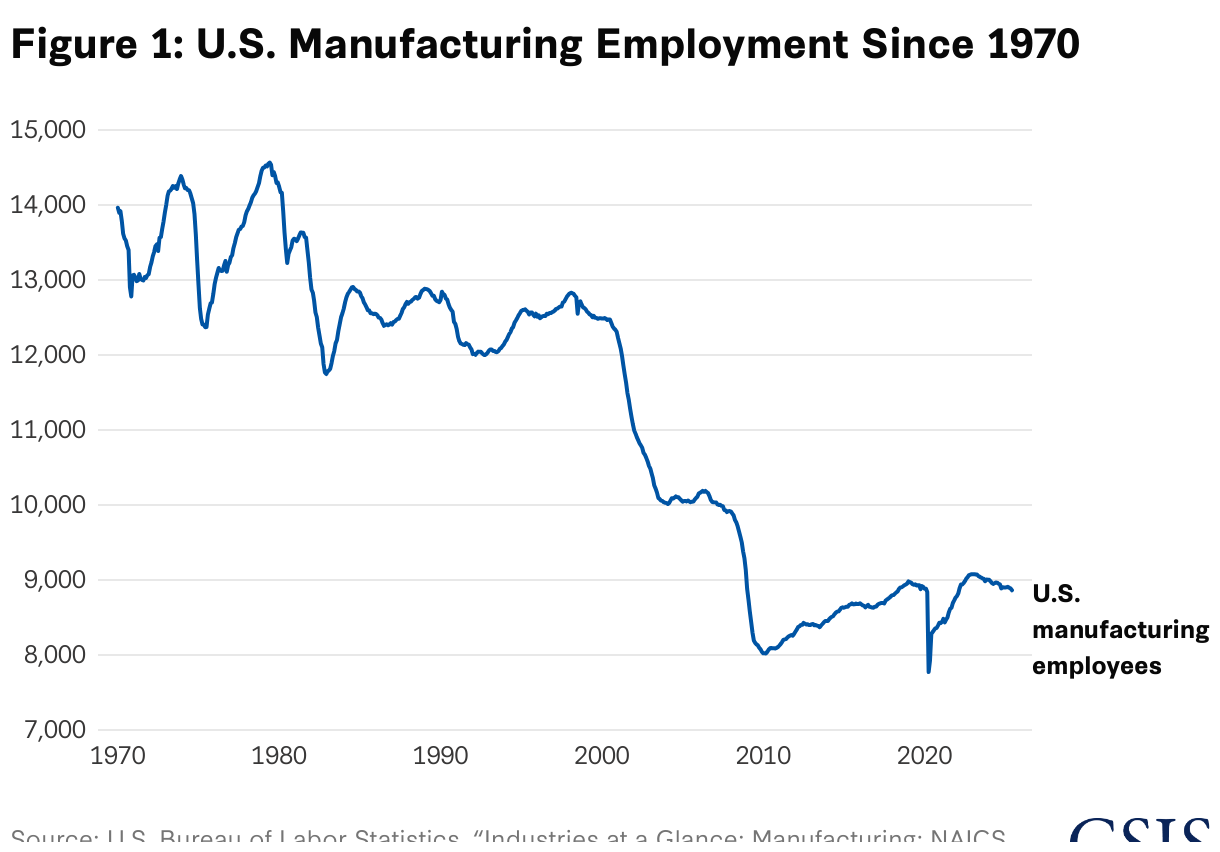
Pressures to offshore production grew in the 1990s and accelerated rapidly in the 2000s, especially with the accession of China to the World Trade Organization. Over time, this imperative for lower-cost production based in Asia led to a structural separation between “innovate here” and “produce there.” While some production was reshored after 2009 over decreased energy costs and supply chain resilience concerns, much of the damage was already done: Reducing U.S.-based production eroded the U.S. industrial commons—that is, the networks of skills, suppliers, and know-how needed to support manufacturing innovation. As U.S. industry intentionally offshored production, the U.S. domestic skilled manufacturing workforce declined.
Meanwhile, major global competitors to the United States, particularly China, have invested heavily in domestic manufacturing capacity, process innovation, and workforce development. This is a serious gap. Failing to adequately develop and sustain an advanced manufacturing workforce with the skills needed to compete in the twenty-first century not only limits the United States’ ability to capture the full economic and security benefits of its most advanced innovations but also threatens the nation’s long-term capacity to invent, build, and lead in critical sectors, including those directly related to national security.
Q3: Why is this labor force strategically important?
A3: Today, as the United States seeks to rebuild its advanced manufacturing base to support greater innovation in diverse fields such as semiconductors, quantum technology, and biotechnology, the shortage of skilled technical workers presents a first-order constraint.
Importantly, improving critical emerging technologies often relies on the process innovations developed during advanced manufacturing, which in turn demands a workforce with the right mix of skills to meet the changing needs of rapidly developing technologies.
Conversely, an insufficiently skilled technical workforce also imposes costs across the U.S. economy. As described in a 2017 report by the National Academies of Sciences, Engineering, and Medicine, an insufficiently skilled workforce places “significant burdens on the U.S. economy, including higher costs to workers and employers and lower economic productivity.”
Moreover, linking Americans with the skills needed to seize the opportunities provided by the innovation economy creates a virtuous cycle. It connects them with high-value jobs that afford a higher living standard. This, in turn, contributes to support for sustaining investments in science and innovation-based growth.
Q4: What STW shortages are faced by U.S. advanced manufacturing industries, and what are the implications for U.S. competitiveness?
A4: A 2023 report by the Semiconductor Industry Association and Oxford Economics projected that 58 percent of required semiconductor manufacturing and design roles in the United States could go unfilled by 2030, with the most acute shortages among skilled technicians. Some see these shortages as already contributing to production delays, such as Taiwan Semiconductor Manufacturing Company Limited (TSMC)’s fab in Arizona.
The case for action goes beyond immediate labor needs: It is also crucial to proactively invest in the workforce of future advanced manufacturing fields. Advanced industries like semiconductors, quantum computing, and biomanufacturing advance on rapid timelines. If the United States cannot scale talent to match industry needs for innovation, it will fall behind. The National Security Commission on Emerging Biotechnology, for example, has warned that the United States has a short window to invest in biotechnology development or risk losing global leadership in the sector. In the same vein, the University of Colorado Boulder–led quantum workforce roadmap estimates that 80–90 percent of the jobs created by quantum capabilities will not require a PhD. To meet this emerging need, the roadmap recommends proactively building experiential training programs and quantum-related career pathways for fields as diverse as lab technicians, welders, and salespeople.
Moreover, as many advanced manufacturing skills are transferable across strategic industries, investing in talent pipelines now will pay dividends across sectors such as semiconductors, aerospace, and quantum manufacturing. To facilitate cross-industry movement, skills and credentials can be stacked and modified in response to emerging industry needs. While some argue that the skilled technical workforce will become obsolete with automation, this remains to be seen. Systems that integrate AI and robotics, for example, will require a strong, skilled technical workforce to make, manage, and maintain them. The more transferable the credentials are, the more fluid and adaptable the labor market is.
Q5: What are the barriers to growing the U.S. skilled technical workforce training system?
A5: A lack of focus by policymakers has resulted in decades of underinvestment and neglect in vocational education. Manufacturing occupations requiring technical skills are often also seen by the public as low-status and poorly paid, even though the remuneration for these STW positions is often superior to those requiring a four-year college degree. Institutionally, misaligned incentives between educational stakeholders have created a mismatch between industry needs and community college educational programs.
Studies show that returns on investments in technical skills in the labor market are strong, including for businesses, when students successfully complete their training and gain industry-relevant credentials. However, students often are not enrolled in courses addressing industry needs, and without the means to continue their studies, often fail to finish their programs. Most directly, these gaps in supply, demand, and incentives come from systemic misalignments between the major actors of students and future employees, technical colleges, and industry employers. As demonstrated in the graphic below, this results in a “Bermuda Triangle” for the STW.
Misalignments between students and technical colleges include the following:
Misalignments between employers and students include the following:
Misalignments between technical colleges and employers include the following:
Distributed Responsibility: Crucially, in the U.S. federal system, workforce development is largely a state and local responsibility. The result is a patchwork of solutions across the nation. Some regions have successfully built integrated workforce ecosystems that link education, training, and employers in ways that draw from universities and directly support local pharmaceutical and biotechnology industry needs. The Massachusetts Life Sciences Cluster, located around Boston, is an example of a notable region, while Indiana stands out with effective state-wide programs. To meet both local industry needs and emerging opportunities, other regions need to better assess their own labor and industrial ecosystems and actively seek to align programs and services.
Q6: What immediate actions can policymakers take to build the STW?
A6: Recent legislation, including the CHIPS and Science Act, which creates incentives for semiconductor firms to build large fabs in the United States, has created a large demand for STW and, in turn, demand to upgrade the related STW training pathways. For example, the Department of Commerce invested $250 million into the National Semiconductor Technology Center Workforce Center of Excellence. Several public and private sector efforts also aim to form networks for technical education curriculum development. However, these programs must be adequately funded and integrated with state and local systems.
One positive model deserving reinforcement is the National Institute for Industry and Career Advancement (NIICA), a nonprofit that aims to support talent development for strategic industry tech sectors important to national security.
As of July 2025, NIICA has partnered with 147 employers and 156 technical college partners across 25 states, with nearly 10,000 participants to develop customized registered apprenticeships and stackable curricula with competency standards. For example, NIICA runs a U.S. Department of Labor–funded program that partners with industry to expand registered apprenticeships in nanotechnology and semiconductor manufacturing across the United States. Additionally, NIICA offers resources such as the digitalized National Talent Hub, which matches job-seekers with necessary training and job opportunities, and Semiconductor Industry Network of Colleges, which connects community colleges to develop best practices that meet industry and student needs.
As the National Academies of Sciences, Engineering, and Medicine committee, chaired by Senator Jeff Bingaman, identified in its report, Building America’s Skilled Technical Workforce, building STW capacity involves three key steps:
Initiatives like NIICA’s—which identify specific employer skill requirements, define career pathways and credentials, introduce competency-based curricula and training models, create industry-defined performance indicators and certifications, and develop resources for career exploration and guidance—can help align incentives between students, technical colleges, and employers.
Q7: What are the stakes of the STW issue?
A7: It is important to underscore that the need for a skilled technical workforce is not just a labor market issue but an innovation and security imperative. The United States cannot reclaim manufacturing leadership in emerging strategic technologies or deliver on major public investments without the right talent infrastructure. And a strong talent supply chain cannot be built without policy alignment, regional action, and sustained support.
Sujai Shivakumar is the director of Renewing American Innovation and a senior fellow at the Center for Strategic and International Studies (CSIS) in Washington, D.C. Julie Heng is a research associate with Renewing American Innovation at CSIS.

Congressional Testimony by Sujai Shivakumar — June 5, 2025

Newsletter by Arrizka Faida — October 18, 2024

Newsletter by Julie Heng and Yutong Deng — April 11, 2025

