All About the Base | AATB on Location: Conversations from AUSA
November 2, 2026 • 9:00 – 9:30 am EST
Hosted by All About the Base

Photo: The 2R Artificiality/Adobe Stock. Image was generated with AI.
Shortly after taking office in 2024, Taiwan Foreign Minister Lin Chia-lung announced a new strategy to navigate the volatile geopolitical landscape. Termed “integrated diplomacy” (總合外交), the strategy declared that “every citizen will be a diplomat and every ministry will be a foreign ministry.” Its whole-of-society approach emphasized three pillars: (1) values-based diplomacy, (2) alliance diplomacy, and (3) economic diplomacy.
Though global in scope, the success of the “integrated diplomacy” strategy can be assessed in large part by its impact in Taiwan’s own neighborhood, and particularly in South and Southeast Asia. Since then-President Tsai Ing-wen launched the New Southbound Policy (NSP) in 2016, these regions have steadily grown in importance for Taiwan. In 2025, President Lai extended NSP under the auspices of “NSP+,” placing greater emphasis on Taiwan’s advanced technologies and people-to-people exchanges. Though some observers have concluded the Lai administration is now deemphasizing the NSP, the policy’s geographic focus offers a useful lens for evaluating how integrated diplomacy can advance Taiwan’s international position—especially now, as the NSP marks its 10-year anniversary.
Unlike with G7 democracies, for whom shared values and geopolitical alignment can facilitate cooperation with Taiwan, the NSP region is predominantly composed of nations unwilling to challenge Beijing on Taipei’s behalf, notwithstanding their deep commercial and people-to-people ties with Taiwan. Stakeholders in South and Southeast Asia are generally less interested in appeals to democracy than in tangible economic opportunities and human capital development. These nations would be deeply affected by a cross-strait conflict, but most see no role for themselves in preventing such a crisis.
In this context, it is unsurprising that integrated diplomacy’s “economic diplomacy” pillar has played a leading role in deepening Taiwan’s regional ties. At the same time, “alliance diplomacy” has the potential to deliver important gains with regional countries whose geopolitical alignment with Taiwan is strongest, and “values-based diplomacy” can support Taiwan’s broader regional integration by building trust with civil society and the next generation of leaders.
Foreign Minister Lin has described integrated diplomacy as an effort to generate momentum globally, helping the island seize “the diplomatic offensive” and pursue “proactive” engagements. To achieve its overarching goal of expanding Taiwan’s international space, the strategy aims to “(1) deepen international connections through democratic values, (2) strengthen regional security through bilateral and multilateral cooperation, and (3) build [Taiwan] into an economic powerhouse.” The strategy’s three pillars—values, alliances, and economics—are intended to promote three core concepts: democracy, peace, and prosperity. The Lai administration has stylized these objectives under the same acronym as the ruling party, DPP.
The strategy’s first pillar is values-based diplomacy. It seeks to deepen Taiwan’s connections with the international community by championing democracy, human rights, freedom, and the rule of law. Moving beyond bilateral diplomacy, which can be difficult for Taiwan to access, this pillar seeks to empower civil society to share Taiwan’s democratic achievements and build grassroots international connections. The pillar also positions Taiwan, which President Lai described as “ground zero” for disinformation, on the frontline of defending global democracy against hybrid and cognitive threats from authoritarian regimes.
The second pillar, alliance diplomacy, focuses on cooperating with like-minded nations to preserve the cross-strait status quo and, more broadly, peace in the Indo-Pacific. This requires deeper political and security cooperation with Taiwan’s closest partners, but the strategy also envisions cooperation to combat Beijing’s legal warfare against Taipei. As the People’s Republic of China (PRC) intensifies pressure on third countries to endorse its vision for “reunification” and isolate Taiwan, Taipei aims to work with partners to counter Beijing’s narratives, reaffirm the legitimacy of its international engagements, and preserve the cross-strait status quo.
The third pillar, economic diplomacy, leverages Taiwan’s advantages in “Five Trusted Industry Sectors”: semiconductors, artificial intelligence, military, security and surveillance, and next-generation communications. It presents Taiwanese capital, talent, and technology-enabled solutions as key assets in its global outreach. The economic pillar also aims to construct resilient, “non-red” (i.e., non-PRC) supply chains. This vision has been pursued through a variety of initiatives, including the Diplomatic Allies Prosperity Project, cross-ministerial task forces, talent development exchange programs, and specialized financing to help Taiwanese businesses expand overseas and stimulate industrial development in partner nations.
Economic diplomacy serves as the foundation of Taiwan’s engagement in South and Southeast Asia. By delivering tangible economic benefits to its partners and embedding itself in their models of economic growth, Taiwan can generate shared prosperity and deepen economic interdependence. In doing so, it can foster a material self-interest among NSP partners in maintaining stability across the Taiwan Strait.
The economic impact of integrated diplomacy can be viewed as a continuation of a decade-long economic diversification effort formalized through the NSP, which sought to create a “sense of economic community” with NSP partners. It encouraged two-way exchanges in economic relations and talent and called on Taiwan’s private sector to adopt its own “New Southbound” strategies when developing business plans. Integrated diplomacy’s goals of increasing diversified trade flows and building resilient supply chains can complement these existing efforts.
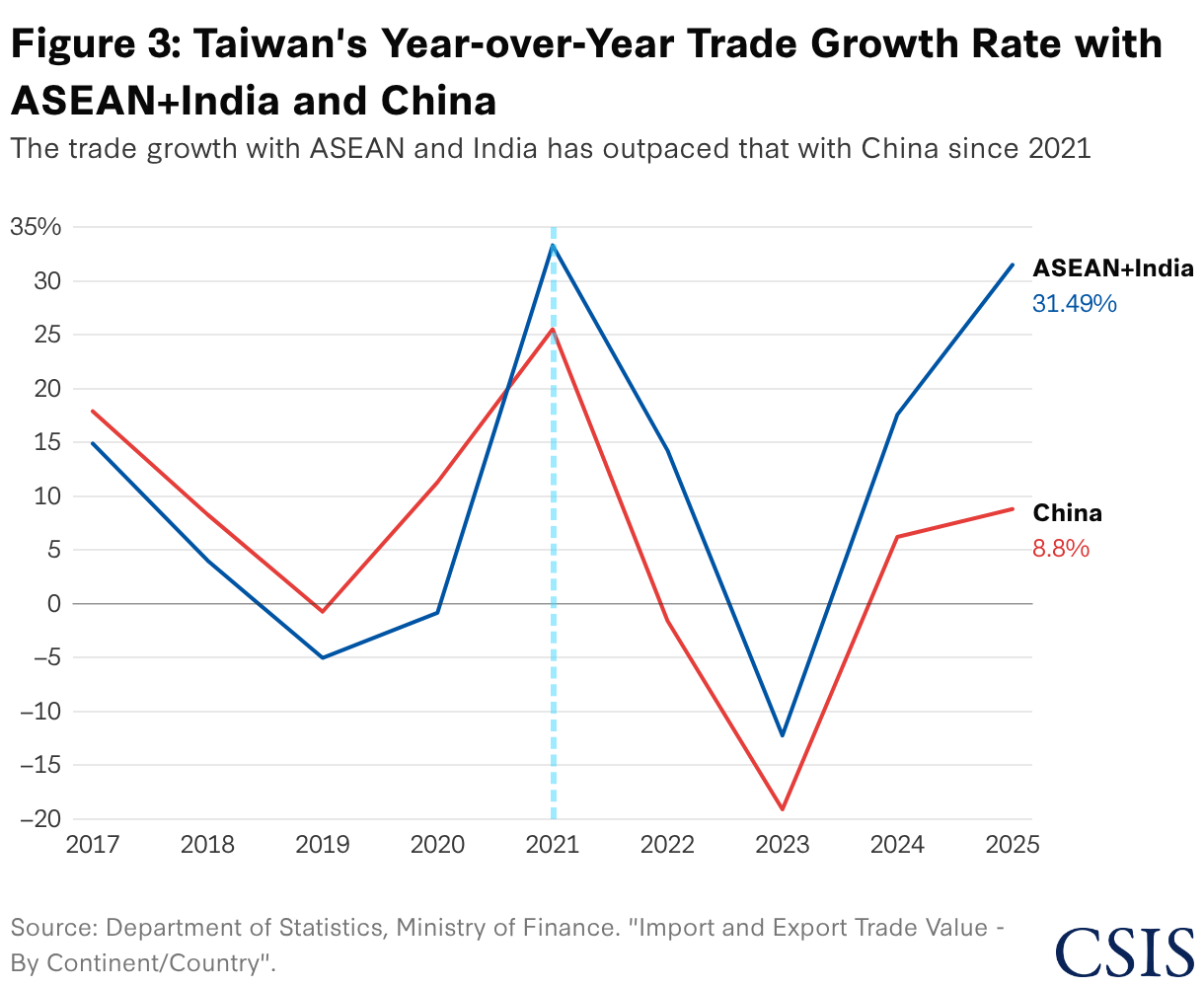
Trade statistics demonstrate that Taiwan has already made significant progress in diversifying away from the PRC market and deepening economic relations with NSP partners. In 2025, Taiwan’s trade with Association of Southeast Asian Nations (ASEAN) members surged 32.5 percent to $181.5 billion, and its trade with India reached a historic high of $12.5 billion. Yet Taiwan’s exports to Southeast Asia and India far outpace its imports, a pattern also evident in the island’s global trade. Skyrocketing exports of integrated circuits, predominantly semiconductors, can partially explain Taiwan’s growing trade surplus with NSP partners. For example, integrated circuits went from 1.6 percent of Taiwan’s exports to India in 2016 to 51 percent in 2025, reflecting a structural shift in bilateral trade as India positions itself as a key node in technology supply chains.
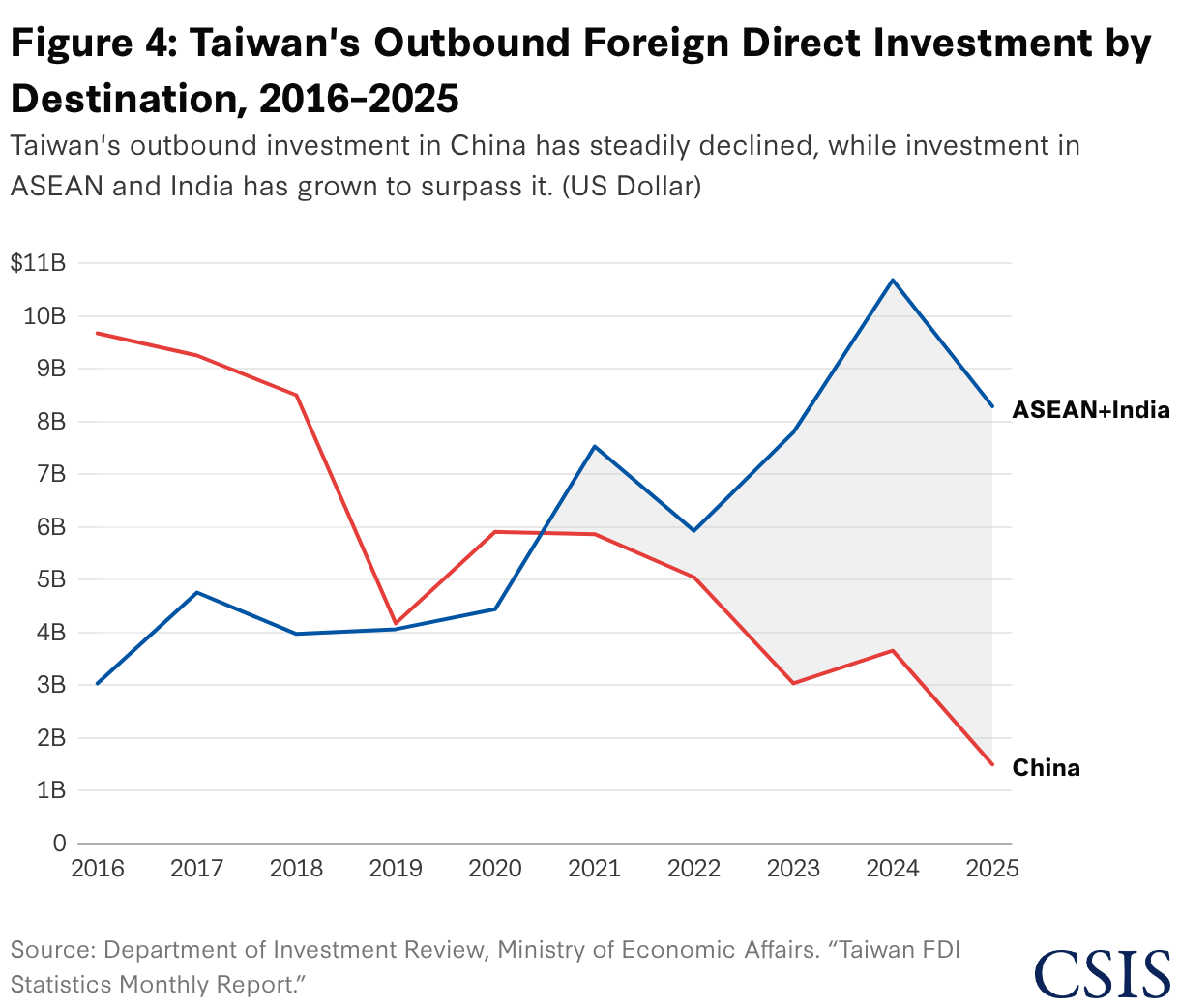
Taiwan’s growing foreign direct investment in South and Southeast Asia also aligns with integrated diplomacy’s prioritization of supply chain diversification. Investment from Taiwan in the PRC has steadily declined over the past decade, and in 2025 alone it fell by 59 percent. This capital has been redirected, in part, toward supply chains that lessen reliance on the PRC in South and Southeast Asia.
Recognizing that resilient supply chains depend on human capital, integrated diplomacy also seeks to expand educational and people-to-people exchanges. Initiatives such as the NSP Elite Study Program and the International Industrial Talents Education Special Program actively recruit talent from South and Southeast Asia, though these programs remain modest in scale. In 2025, Taiwan awarded scholarships to 283 students from 37 countries to study in Taiwan. It also facilitated exchanges and training opportunities for 630 students from 68 countries in strategic fields such as semiconductors and public health.
Other regional projects have advanced integrated diplomacy’s goal of exporting smart solutions in a manner that supports regional economic integration. In August 2025, Taiwan launched the Taiwan-Philippines Economic Corridor (TPEC), through which Taiwan began to align its semiconductor and smart agriculture investments with the preexisting U.S.-Japan-Philippines Luzon Economic Corridor. By synchronizing these efforts, TPEC aims to embed Taiwan within a broader minilateral economic security architecture. In Vietnam, meanwhile, the Taiwan Smart Healthcare Alliance, a coalition of Taiwanese technology enterprises, has introduced telemedicine and surgical imaging solutions that help address Vietnam’s shortage of healthcare professionals. In Indonesia, Taiwan has provided smart agriculture solutions in areas such as Karawang, deploying satellite monitoring, AI, drone-assisted field management, and other advanced technologies.
Regional partners have generally welcomed Taiwan’s investments and technology projects, and several have signed bilateral economic agreements with the island. For example in 2024, Taiwan and Thailand signed the Agreement for the Promotion and Protection of Investments, following earlier agreements between Taiwan and the Philippines, India, and Vietnam. In 2025, Taiwan and Indonesia signed a trade promotion memorandum of understanding, covering medical equipment and digital services. These initiatives leverage Taiwan’s specialized industrial expertise to promote mutual prosperity and resilience.
Most countries in South and Southeast Asia remain cautious about deepening security or political ties with Taiwan, for fear of drawing Beijing’s ire. Notwithstanding these headwinds, integrated diplomacy seeks to build broad international partnerships. To that end, in 2025 Taiwan launched the Double-12 Initiative, a framework for expanding Taiwan’s diplomatic focus beyond its 12 official partners to 12 additional nations that are crucial to the island’s future, including the Philippines and India.
Taiwan’s partnership with the Philippines bears enormous potential, in part due to the shared risks that Manila and Taipei must manage. The Philippines’ northernmost point lies less than 100 miles from Taiwan, making it difficult for Manila to avoid the impact of a cross-strait conflict. Under President Ferdinand “Bongbong” Marcos Jr., the Philippines has signaled a newfound enthusiasm for expanding cooperation with Taiwan beyond commercial, labor, and people-to-people ties. This has provided Taipei a unique opportunity to draw on its alliance diplomacy tool kit within Southeast Asia. Since 2025, the Philippines has removed restrictions on engagement between Philippine and Taiwan officials, received Foreign Minister Lin in the Philippines as the head of a business delegation, and hosted Taiwan representatives for discussions on future coast guard cooperation, including intelligence sharing and capacity-building.
India also occupies a special position within the integrated diplomacy and NSP frameworks. Driven largely by its strategic rivalry and territorial disputes with the PRC, India’s relationship with Taiwan has expanded beyond the commercial domain, and unofficial diplomatic engagement has increased. In 2024, for example, Taiwan established a new Taipei Economic and Cultural Center in Mumbai. Parliamentary diplomacy has also grown; for example, a cross-party delegation of Indian members of parliament visited Taiwan for a formal six-day program in May 2026. This deepening of institutional ties combats PRC efforts to isolate Taiwan internationally—a key goal of the alliance diplomacy pillar.
In addition, India has carefully refrained from endorsing Beijing’s One China Principle. Following a 2025 visit by Chinese Foreign Minister Wang Yi, a Chinese readout claimed India agreed that “Taiwan is a part of China,” but India’s Ministry of External Affairs swiftly contradicted this. This is especially significant for Taiwan’s international standing because of India’s leadership role in the Global South.
When tailored for a regional context, integrated diplomacy’s values-based pillar offers further opportunities for engagement. Appeals to shared democratic values will gain little traction among regional governments, most of which are unwilling to frame their relationship with Taiwan in ideological terms. However, Taipei has taken steps to recalibrate this pillar to instead demonstrate that its democratic system can deliver tangible value for its partners. In its 2025 Annual Review report, Taiwan’s Ministry of Foreign Affairs changed the name of integrated diplomacy’s first pillar from “values-based diplomacy” (價值外交) to “values-added diplomacy” (加值外交).
This update highlights the practical utility of democratic principles, recasting Taiwan’s values as a source of transparency, reliability, and innovation. Whereas the PRC weaponizes economic interdependence to punish countries that defy its will, Taiwan links its democratic governance to its capacity to anchor reliable supply chains. In building the digital economies of the future, Taiwan also promotes concepts such as “digital solidarity” and “clean networks,” presenting itself as a safer and more trustworthy option for addressing the critical infrastructure needs of NSP partners.
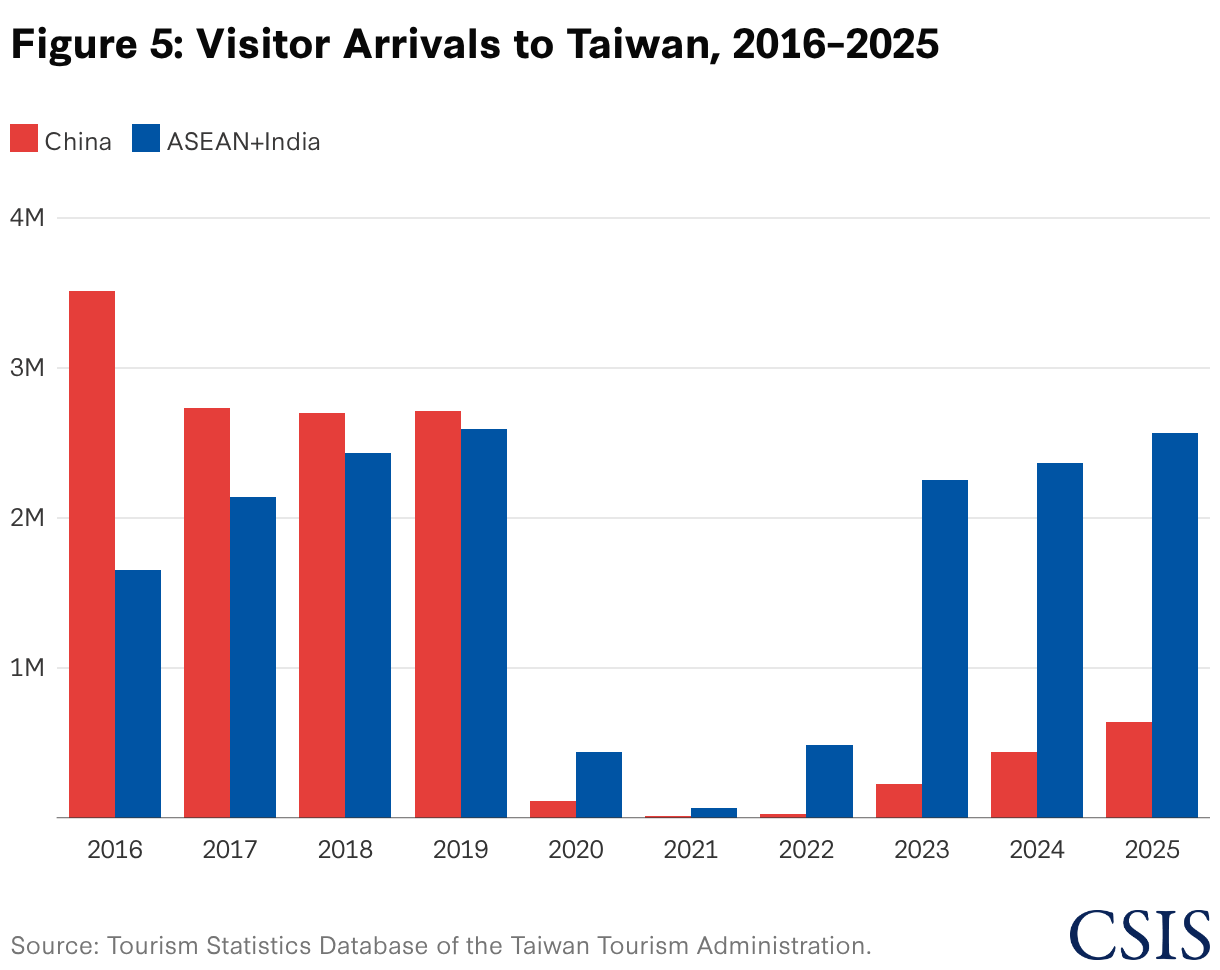
People-to-people ties represent another concrete opportunity for Taiwan’s values-based diplomacy to deliver for its partners. The Lai administration has extended visa-free entry for citizens of Thailand, Brunei, and the Philippines through July 2026, complementing existing arrangements with other ASEAN countries such as Singapore and Malaysia. As depicted in Figure 5, visitor arrivals to Taiwan from the PRC have remained low since the pandemic, while ASEAN arrivals have steadily increased, rebounding to their pre-pandemic peak in 2025. Initiatives such as the International Youth Ambassadors Exchange Program and the expansion of international NGO networks in Taiwan can also cultivate familiarity with and trust in the island among the next generation of leaders.
Over the long term, people-to-people exchanges can help to build influential constituencies in countries in the region where personal experience may translate into broader support for friendly relations with Taiwan. But Taiwan’s ability to sustain these gains ultimately depends on the quality of foreign visitors’ experience on the island. Discrimination against Southeast Asian migrant workers, for example, can easily undermine the credibility of Taiwan’s values-based messaging.
While it remains too early to deliver a definitive evaluate of Taiwan’s integrated diplomacy, the 10th anniversary of the NSP provides an important opportunity to assess its trajectory in Taiwan’s neighborhood. Moving forward, Taiwan may consider the following policy options to ensure integrated diplomacy succeeds in South and Southeast Asia, accelerating implementation of NSP+ and advancing Taiwan’s position in this critical region.
Henrietta Levin is a senior fellow with the Freeman Chair in China Studies at the Center for Strategic and International Studies in Washington, D.C. Daniel Castro Bonilla is a former intern with the Freeman Chair at CSIS.
This commentary is made possible by support from the Taipei Economic and Cultural Representative Office in the United States.