The Future of Global Energy: Insights from the 2026 Statistical Review
July 21, 2026 • 12:00 – 12:45 pm EDT

Photo: Dhiraj Singh/Bloomberg/Getty Images
India is moving toward electrification of its transportation, backed by policies that aim to increase demand, facilitate domestic production, and expand associated infrastructure. This includes policies such as Faster Adoption and Manufacturing of Hybrid and Electric Vehicles (FAME I & II), PM Electric Drive Revolution in Innovative Vehicle Enhancement (PM-E DRIVE), and Production Linked Incentives (PLI) for batteries, to name a few.
Along with these national-level policies, more than 30 subnational governments have passed their own electric vehicle (EV) policies that significantly contribute to the national goal of making 30 percent of all new cars and 80 percent of two- and three-wheelers electric by 2030. However, a major policy instrument that is often overlooked is India’s trade policies. While domestic EV manufacturing is picking up pace, India remains heavily reliant on imported battery cells, critical minerals, and advanced components, creating potential supply chain vulnerabilities due to global events.
A 2026 publication by the CSIS Chair on India and Emerging Asia Economics assesses India’s recently signed trade agreements with Australia, the European Free Trade Association (EFTA), the United Arab Emirates (UAE), and the United Kingdom, focusing on India’s approach to the EV transition. These agreements mark a shift toward “structured openness”: high protection on finished vehicles, selective liberalization for upstream EV inputs, and a stronger focus on investment, standards, and technology cooperation.
Trade data analysis shows that these four partners (Australia, EFTA, the UAE, and the United Kingdom) account for only a small share of India’s EV-related imports. As a result, heavy dependence on a small number of geographies, including China, Taiwan, Japan, and South Korea, heightens the supply chain risks for the EV transition and underscores the case for broader diversification.
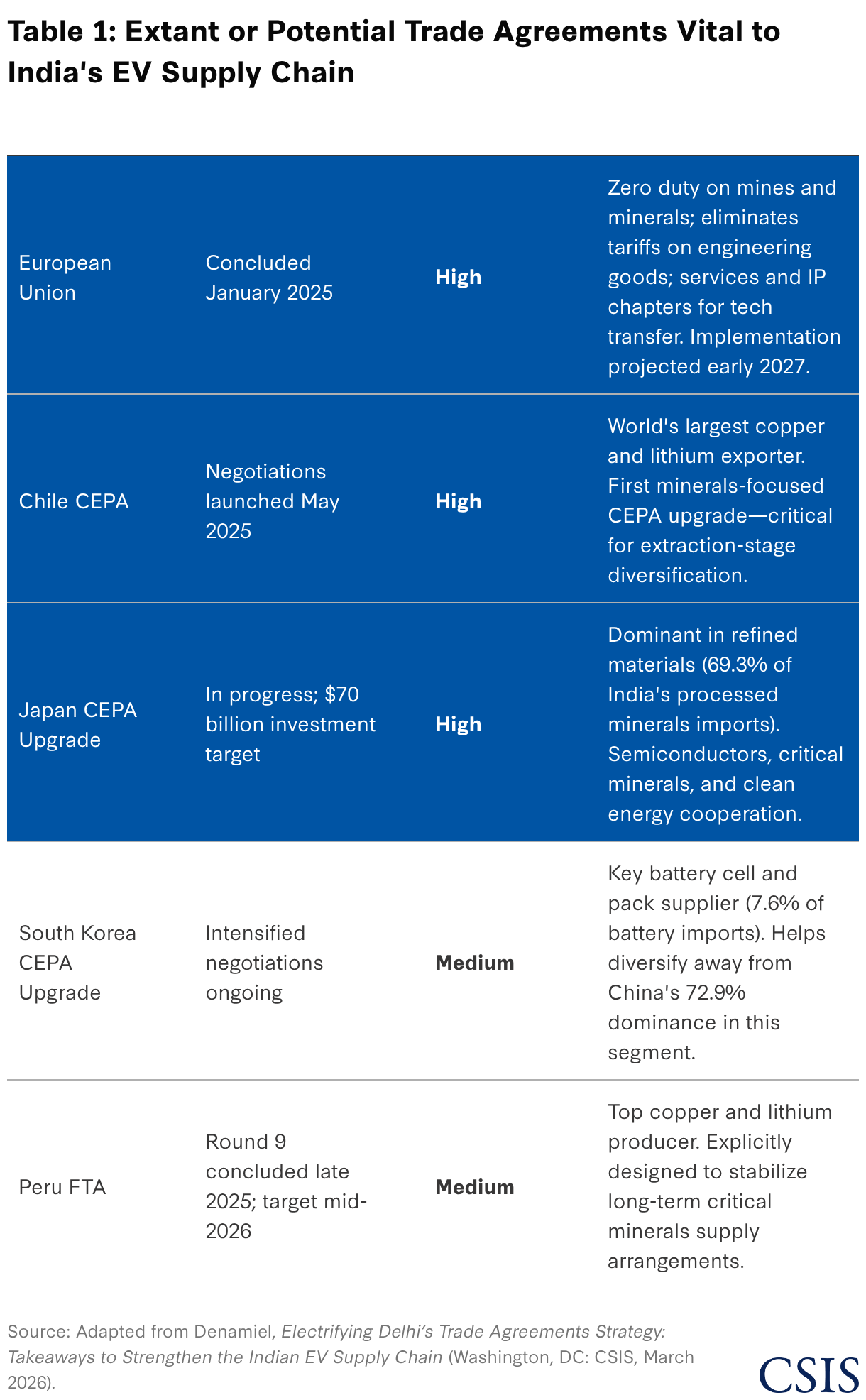
India is currently in the process of negotiating trade agreements that will be consequential to its EV sector. The Chile Comprehensive Economic Partnership Agreement (CEPA) negotiations, launched in 2025, mark the first time India has explicitly sought a minerals-focused agreement with a major import source of minerals. Further, the proposed upgrade to the Japan CEPA, anchored by a $70 billion investment target, is vital given Japan’s dominance in refined materials. Agreements with South Korea and Peru round out the list, given South Korea’s dominance in battery cell capability and Peru’s in copper and lithium mining.
However, a key consideration is the nature of supply chain concentration risks. Specifically, the overreliance on a few countries across battery cells, critical minerals, and advanced components could create vulnerability to export restrictions or geopolitical disruption. Accordingly, the authors have suggested Delhi categorize its trade partners into two tracks:
As such, India’s subsequent trade agreement negotiations must prioritize the intersection with global supply chain hubs while managing the concentration risk embedded within those regional supply networks.
The six instruments examined in this paper—tariffs, rules of origin, government procurement, technology transfer, regulatory standards, and investment—are drawn from trade agreements worldwide. For each instrument, this section sets out the global best practice, its implications for India, and the specific Track A or Track B calibration India should adopt in negotiations.
Tariff design has emerged as one of the most promising levers influencing the cost, competitiveness, and adoption of EVs, as well as their supply chains. Across recent trade agreements, there is a clear pattern toward the liberalization of upstream inputs combined with continued protection of finished vehicles. Agreements such as the New Zealand–UK Free Trade Agreement, the Comprehensive and Progressive Agreement for Trans-Pacific Partnership (CPTPP), and green-oriented frameworks such as the Singapore-Australia Green Economy Agreement (GEA) prioritize tariff elimination on environmental goods, including EV components such as batteries and charging infrastructure, to reduce input costs and accelerate domestic manufacturing.
At the same time, experience in transatlantic and U.S.–China–EU trade exemplifies how tariffs can also be deployed defensively. The 100 percent U.S. tariff on Chinese EVs and the European Commission’s company-specific countervailing duties point to growing concern over subsidized foreign capacity shaping domestic EV markets. Compared with the U.S. approach, the European Union’s more differentiated measures, which layer additional duties on top of the standard 10 percent import tariff, offer a more precise framework for necessary trade protection.
For India, this dual approach is particularly salient. Tariffs on EV inputs directly raise production costs, and evidence shows even modest duties can significantly increase final EV prices, slow adoption, and delay the scale-up of domestic manufacturing. At the same time, maintaining protection on finished vehicles supports local assembly and aligns with India’s broader Make in India strategy. It is worth noting that the rationale for such defensive tariffs can vary significantly across jurisdictions: Some measures are framed primarily around national security, while others aim at neutralizing distortions created by state subsidies. However, India’s case rests more explicitly on industrial policy grounds. The challenge, therefore, is not choosing between liberalization and protection but sequencing them across the value chain and across partners.
The two-track strategy provides a way to effectively balance liberalization and protection:
This approach aligns tariff policy with both industrial and security objectives by lowering input costs where India needs foreign integration and preserving policy space where supply chains remain exposed to concentrated geopolitical risk.
Rules of origin (RoO) sit at the heart of EV-related trade governance because they shape where investment flows and how supply chains evolve. The U.S.-Mexico-Canada Agreement (USMCA) provides one of the most robust examples of RoO as a tool for industrial strategy. The 75 percent regional value content requirement, high thresholds for steel and aluminum sourcing, and labor value content rules effectively channel EV and battery-related investments into North America, accelerating the construction of gigafactories and advanced component facilities across the region.
A similar logic underpins the UK-EU Trade and Cooperation Agreement (TCA), which offers similar lessons but focuses on flexibility. By extending timelines for tightening local value requirements from 2024 to 2027, the region prevented a scenario in which EVs (but not internal combustion engine vehicles) would suddenly incur tariffs, an outcome incompatible with European and UK decarbonization goals. The structure of cumulation rules is equally important. Bilateral cumulation in the UK-EU TCA allows EU and UK content to be counted together toward RoO, aiming to adopt real-world supply chain integration. Where bilateral cumulation has been withdrawn, as in the UK-Canada automotive trade, exporters immediately faced tariff exposure.
In short, an Indian trade strategy geared toward the EV transition would pair ambitious RoO trajectories with flexible cumulation that supports integrated regional supply chains while allowing targeted exclusions only for clearly defined security-sensitive components.
Government procurement mechanisms in trade agreements increasingly serve as a demand-side pillar for accelerating EV adoption. Even when procurement chapters are not EV-specific, many now explicitly allow environmental criteria such as life-cycle emissions, charging compatibility, recyclability, or energy efficiency to be included in tender specifications, provided foreign firms can compete on equal terms. This feature ensures that tenders for public buses, municipal fleets, or government-operated charging networks favor low-emission technologies without violating nondiscrimination obligations.
In agreements such as the Singapore-Australia GEA, procurement is further linked to collaborative innovation. Beyond simply opening procurement markets, these provisions encourage joint demonstration projects, data sharing, and the coordinated rollout of smart charging infrastructure.
In other words, the agreement leverages procurement not only to liberalize markets but to direct public purchasing power toward innovation, network build-out, and early-stage EV ecosystem development. For India, existing schemes such as PM-eBus Sewa represent precisely the procurement vehicles where EV-specific environmental criteria can be embedded without violating World Trade Organization (WTO) nondiscrimination norms, provided treaty partners are extended equal bidding rights. It is worth noting that India is not a signatory to the WTO Government Procurement Agreement, so such obligations arise from bilateral treaty commitments rather than multilateral rules. Procurement chapters can thus serve as demand anchors for Track A firms willing to invest in India’s domestic EV ecosystem.
Additionally, for India, procurement policy can enable EV adoption at scale and leverage public demand to support domestic manufacturing. However, current agreements largely provide limited and uneven procurement access, with significant carve-outs for sensitive sectors. As such, there is a space for India to strategically direct public purchasing power toward innovation, network build-out, and early-stage EV ecosystem development.
Technology transfer and cooperation provisions have also expanded in recent trade and partnership agreements to account for the technical complexity of EV supply chains and the strategic nature of critical minerals processing. The U.S.-Japan Critical Minerals Agreement (CMA) is emblematic of a new form of sector-specific agreement focused on a defined industrial objective rather than broad market liberalization (“functional trade agreement”), designed to diversify supply chains for lithium, nickel, cobalt, and other inputs. By enabling Japanese critical minerals to qualify under U.S. EV tax credit rules, the CMA encourages allied investment in extraction and refining outside concentrated geographies.
Similarly, emerging EU-UAE Strategic Partnership Agreement negotiations incorporate structured cooperation on battery technologies and integrated EV-charging networks. These agreements move beyond general references to technology exchange by institutionalizing joint research efforts and regulatory cooperation related to the green transition.
For India, the central challenge is ensuring that cooperation translates to domestic capability in upstream and midstream segments where dependence is high. In parallel, poorly structured partnerships risk embedding Indian supply chains within external technology ecosystems without meaningful upgrading, reinforcing existing dependencies rather than building domestic capability.
The regulatory standards dimension of trade has become central to the EV transition. Multilateral rules can be crucial here: The WTO Agreement on Technical Barriers to Trade (TBT) sets a baseline framework that encourages members to base regulations on international standards, avoid unnecessary barriers, and maintain transparency through notifications. Recent regulatory updates submitted by China, the United States, Japan, and South Korea on high-voltage equipment, grid-integration technologies, and energy efficiency standards illustrate how countries can modernize EV-adjacent regulations while maintaining TBT consistency.
Likewise, other international agencies such as the International Electrotechnical Commission (IEC) undertake invaluable work to harmonize EV supply chain regulations, such as EV charging standards. Beyond the multilateral system, bilateral and plurilateral initiatives are aiming for deeper regulatory convergence. EU-U.S. discussions on mutual recognition of vehicle approvals (particularly relating to EV safety and charging standards) show the potential for reduced compliance duplication and faster cross-border deployment.
In other words, these discussions anchor EV-relevant technical rules in shared or mutually recognized standards, embedding regulatory cooperation committees directly into trade agreements and establishing forward-looking work streams on emerging issues such as battery passports and recycling requirements.
Investment chapters in trade agreements are being reshaped to align with the industrial requirements of the EV transition. EV and battery supply chains demand large, long-term capital commitments: Predictable treatment and transparent investment rules matter. Investment chapters in contemporary trade agreements are increasingly being designed not only to protect investors but also to actively steer capital toward the sectors and supply chains underpinning the EV transition.
The EU-Angola Sustainable Investment Facilitation Agreement exemplifies a facilitation-oriented approach focusing on reducing nontariff barriers to sustainable investment. The agreement improves transparency and predictability through published investment rules and clearer administrative procedures and streamlines permit processing via e-government tools and dedicated investor contact points. Likewise, the EU-Chile Advanced Framework Agreement embeds investment protection within a broader sustainable development framework. It strives to secure reliable and environmentally responsible access to lithium and copper for EV batteries by guaranteeing nondiscriminatory market access in strategic sectors critical to the battery supply chain. These agreements combine legal certainty and equal treatment for investors with explicit environmental and governance commitments, thereby lowering risk and guiding capital toward climate-aligned projects.
Implementing protections in India is particularly important for EVs given the scale of investment required to build domestic capacity. While policies such as the PLI schemes create domestic incentives, trade agreements and investment protections determine if foreign capital is willing to commit to long-horizon projects. The central challenge is to attract investment that strengthens domestic capacity without reinforcing external supply chain dependencies.
The following partner-specific recommendations are grounded in the two-track framework, which determines how tightly or permissively each instrument is applied depending on whether the partner is actively diversifying its supply chains (Track A) or maintaining or deepening those ties (Track B).
Chile and Peru supply over 43 percent of India’s extraction-stage critical mineral imports. For Chile, where CEPA negotiations launched in May 2025, India should apply the UK-India CETA’s tariff template—zero duties at entry into force (EIF) on lithium, copper, cobalt, and nickel—with the Australia ECTA’s coequal origin rules and India-Japan CEPA–style investment protections for long-horizon extraction projects. The agreement should include a dedicated critical minerals chapter that goes beyond what any of India’s existing agreements contain. The same architecture applies to Peru, where finalization is targeted for mid-2026.
The agreed CEPA upgrade should extend the existing agreement’s technology cooperation provisions—which already allow industrial collaboration under TRIPS-aligned IP protections—to cell chemistry, cathode processing, and power electronics. The India-Japan Clean Energy Partnership provides a ready institutional vehicle for embedding these provisions.
The EU-India FTA finalized in January 2026 provides zero-duty access on minerals and engineering goods. India should use the pre-EIF period to push for a battery standards chapter that builds on the UK-India CETA’s regulatory cooperation precedent and aligns with the EU Batteries Regulation. This would reduce recertification costs and extend the UK CETA’s coequal origin and open procurement provisions across both markets.
A future U.S.-India agreement should apply the UK-India CETA’s tariff liberalization model for upstream EV inputs, the Australia ECTA’s coequal origin rules to maximize preference utilization, and India-Japan CEPA–style investment protections to attract U.S. capital into Indian gigafactory projects linked to PLI scheme eligibility. Joint standards work should build on the UK-India CETA’s regulatory cooperation chapter and extend to battery safety and EV software.
Several Southeast Asian and Middle Eastern economies serve as reexport hubs. India should apply the UAE CEPA’s full anti-transshipment tool kit: HS six-digit tariff-shift rules and 40 percent value-addition thresholds, among others, for battery cells, packs, and electrodes. Commercial opportunities in final assembly and charging infrastructure remain open within this framework.
South Korea leads in battery manufacturing but remains embedded in concentrated cathode supply chains. India should apply UK-India CETA–style origin rules and Japan CEPA–style investment protections where South Korean firms source from diversified suppliers, as well as UAE CEPA–style tariff-shift and disclosure rules to map where South Korean value chains are routing their midstream processing. Procurement provisions should reward South Korean foreign direct investment that builds Indian domestic cell capacity rather than treat India as an export destination.
When it comes to India’s trade policy, provisions pertaining to the electric mobility sector have often been placed at the periphery of broader market access objectives. But this must change given India’s EV ambitions and the need to add domestic value and jobs. The EV supply chain should be prioritized as the organizing priority around which India’s trade agreements are designed. The New Zealand–UK FTA, the USMCA, the UK-EU TCA, the Singapore-Australia GEA, the U.S.-Japan CMA, and India’s recent CEPAs demonstrate that trade agreements are already functioning as industrial policy for the EV transition in other jurisdictions. India has the domestic demand and the manufacturing ambition. But to reach its EV goals, it needs to leverage the opportunity to design trade agreements that support its ambitions.
Trade agreements must be designed to strengthen the supply-side ecosystem, not simply to open export markets. Tariff liberalization on upstream inputs expands access to the raw and processed materials India needs for domestic battery manufacturing. RoO provisions that allow cumulation across allied partners build out regional supply chain depth, and government procurement chapters provide specific demand signals. Technology cooperation chapters transfer the process knowledge needed to move India up the value chain from assembly toward cell chemistry and cathode production. Regulatory alignment reduces the compliance cost of integrating into global EV supply networks. And investment chapters complement tariff mechanisms by lowering risks for foreign investment and effectively support India’s capability-building efforts while maintaining control over supply chain exposure. It also provides legal certainty to attract the patient capital required for industrial advancements. Used together, these six instruments give India the tools to shift the focus from being a demand center to becoming a supply hub.
Akanksha Golchha is a senior associate (non-resident) with the Chair on India and Emerging Asia Economics at the Center for Strategic and International Studies (CSIS) in Washington, D.C. Aryan D’Rozario is an associate fellow for the Chair on India and Emerging Asia Economics at CSIS.
The authors extend sincere gratitude to Thibault Denamiel and Abhinav Subramaniam for their invaluable inputs and research support. We gratefully acknowledge the research support provided by the Shakti Sustainable Energy Foundation throughout the course of this project. Special thanks to Richard Rossow, Hugh Grant-Chapman, and Rishabh Sethi for their technical review and insightful feedback, which shaped this report.
This report was made possible by a direct grant from an international foundation.

Report by Thibault Denamiel, Abhinav Subramaniam, Aryan D’Rozario, and Akanksha Golchha — March 23, 2026