The Impossible State Live Podcast: Cold Peace: Engaging DPRK to Reduce Risk and Threat
May 19, 2026 • 11:00 – 11:45 am EDT
Hosted by Korea Chair

Photo: FEDERICO PARRA/AFP/Getty Images
On March 1, a Venezuelan warship entered Guyana’s exclusive economic zone (EEZ), approached the Liza Destiny, an ExxonMobil oil facility, and demanded information from its crew. This provoked another escalation in the long-running conflict between the two countries. Guyana—with support from the broader international community—condemned the incursion and mobilized its own military, pledging to seek a peaceful resolution to the conflict but promising to protect the nation’s sovereignty. Venezuela responded in kind by alleging these waters form part of a contested maritime zone and refuted claims that it violated Guyana’s sovereignty.
Q1: What has been happening in the Essequibo and maritime border dispute over the last year and a half?
A1: Tensions in the dispute over the Essequibo territory have ebbed and flowed, resulting in recurring periods of heightened friction. In September 2023, the Venezuelan National Assembly initiated a referendum process to gain public support for creating the state of “Guayana Esequiba,” despite the International Court of Justice’s (ICJ) ruling that Venezuela must refrain from action until a decision is reached. With the referendum vote held on December 3, 2023, the Maduro regime sought to further consolidate support within Venezuela by attempting to unite the country on what has been historically a cross-party issue. In response, Guyana swiftly challenged the legality and outcome of the referendum. Simultaneously, Venezuela’s armed forces were enlarging a military base and airfield on Anacoco Island, a piece of the Essequibo territory the country had forcefully occupied in 1966. Within days, however, President Irfaan Ali of Guyana and Nicolás Maduro met in Saint Vincent and the Grenadines, where they signed the Argyle Accords, agreeing to deescalate tensions, avoid the use of force, and refrain from any actions that could impact the status quo.
Despite this agreement, tensions between Guyana and Venezuela persisted. In late December 2023, the United Kingdom sent a warship to Guyana as a show of diplomatic support, triggering a strong response from Venezuela’s regime, which began preparations for marine defensive exercises allegedly with 6,000 military personnel. In the months that followed, CSIS tracked and discovered that the Maduro regime had violated the terms of the Argyle Accords by massing troops and military equipment near the border. Then, in April 2024, Maduro signed a bill into law that established the state of “Guayana Esequiba” and formally sought to bring it under Venezuelan control—even though Guyana still exercises sovereignty over the area—eliciting an immediate response from Guyana’s government.
Throughout the following months, tensions waned as the Maduro regime prepared for presidential elections. The regime returned to the Essequibo issue in January 2025 when Venezuela announced its intention to elect a governor for the state of “Guayana Esequiba” in April, prompting Guyana to seek assistance from the ICJ to de-escalate the situation and block the action. Following these escalations, six soldiers from the Guyana Defense Force were wounded by Venezuelan gang members in a shootout on the border.
Q2: Why is the Maduro regime returning to the Essequibo issue and maritime border dispute?
A2: Several indicators suggest that Maduro has focused on the Essequibo dispute both to consolidate support internally and to test the geopolitical waters externally. In the months prior to the Venezuelan presidential election, CSIS satellite imagery uncovered a buildup of troops and naval assets in the Essequibo region—an action that, according to experts, gave the armed forces task and purpose, ensuring their political support and loyalty to the regime. Externally, conducting military exercises in the Essequibo was part of a compellence strategy to coerce Guyana into a preemptive negotiation over the contested region. By focusing on a renewed outside threat, Maduro could create a “rally-around-the-flag effect” among the armed forces and his political base. However, the cessation of activity in the Essequibo coincided with Maduro’s efforts to orchestrate a plan to brazenly steal the election, and the use of the military to suppress protesters.
Maduro’s return to the Essequibo dispute comes at a particular crossroads in the evolution of the United States’ approach to Venezuela, and it is an effort to show Washington that it too can threaten U.S. interests in the region. After what seemed like friendly overtures by Richard Grenell, President Trump’s special envoy for special missions, in return for accepting and financing deportation flights originating from the United States, the Trump administration made the sudden decision to end General License (GL) 41. GL 41 authorized the U.S. company Chevron to operate joint ventures in Venezuela, adding a layer of opacity to transactions between Chevron and the Maduro regime, “[abolishing] checks and balances, and [enforcing] confidential conditions” according to experts. It is estimated that GL 41, along with other licenses granted by the Biden administration, have provided close to $500 million per month to Maduro. This move, seen by many as putting pressure on the regime, comes after Grenell said that “Donald Trump is somebody who doesn’t want to do regime change” in Venezuela. Thus, Maduro’s assertiveness might be intended to demonstrate that should there be a shift in U.S. policy to a harder stance, that he can sow regional instability that impacts the United States.
Additionally, the renewed activity in the Essequibo comes on the heels of President Trump’s public argument with President Zelensky of Ukraine. The meeting was seen by many as a clear indication that the United States is unlikely to come to the aid of its allies, with the exception of Israel. The meeting has encouraged Maduro to explore geopolitical pressure vis à vis Guyana, probing Trump’s appetite for getting involved in international conflicts. In fact, the Venezuelan Ministry of Foreign Affairs went so far as to send a communiqué calling President Irfaan Ali the “Caribbean Zelensky.” It is well known that the Guyanese defense forces would not be able to match Venezuela’s capability in a protracted conflict without U.S. assistance. Venezuela’s actions may also be designed to influence or intimidate the Guyanese people ahead of the country’s elections in December of this year. By escalating tensions, Maduro seems poised to benefit from the strengthening of Guyanese political factions that favor a less confrontational approach to Venezuela.
Q3: What makes this incident different than past incidents in the maritime border dispute?
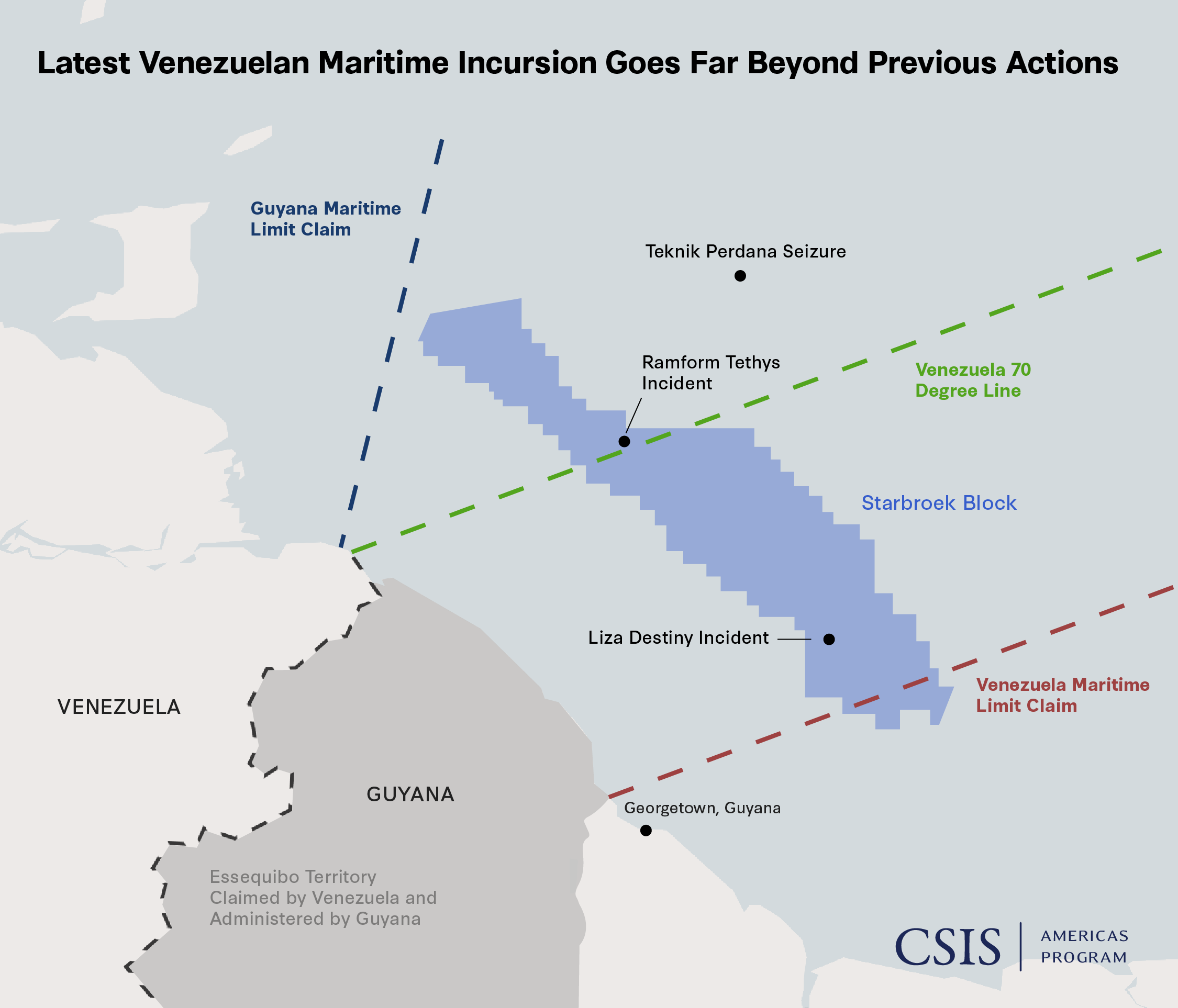
A3: Venezuela and Guyana have overlapping maritime claims, stemming from their longstanding territorial dispute. Guyana claims its maritime space is the area between a 10 degree azimuth line, which starts at Punta Playa (the border between Venezuela and the Guyanese-administered Essequibo territory) and projects north into the Atlantic Ocean, and its established maritime border with Suriname. Venezuela claims its maritime space extends all the way east up to a line beginning at a point in the mouth of the Essequibo River, and extending 70 degrees northwest into the Atlantic Ocean.
Within these overlapping claims, Venezuela has only been exercising sovereignty over the maritime area, which lies to the north and west of a 70 degree azimuth line beginning in Punta Playa on the Essequibo coast and extending into the Atlantic Ocean. This area is only about half of the country’s maritime claims in the Atlantic. It includes part of an oil exploration block, the Stabroek Block, that Guyana leased to a consortium led by ExxonMobil. Venezuela regularly patrols the area with ships and aircraft. In October 2013, the Venezuelan navy intercepted and boarded the Teknik Perdana, a ship which had been contracted out to Texas-based company, Anadarko Petroleum, and had been carrying out a survey of the seabed off the coast of Essequibo well north of the 70 degree line. The navy sailed the Teknik Perdana to Margarita Island in Venezuela, before later releasing it. Then, in December 2018, three years after Exxon made a major offshore oil discovery in the Stabroek Block at a site known as Liza-1 in Guyana’s exclusive economic zone (EEZ), Venezuela’s navy intercepted another ship, the Ramform Tethys, conducting seismic surveys for oil on behalf of ExxonMobil in waters just north and west of the 70 line. The navy attempted unsuccessfully to land a helicopter on the exploration vessel, which later sailed east, back over the 70 degree line. Following this incident Exxon paused its exploration activities in the area. Guyana for its part also declared a moratorium on oil exploration northwest of the 70 degree line in February 2024, at the height of the tensions between the two countries over the December 2023 referendum and other stated efforts to annex the Essequibo territory.
The incident that occurred on March 1, 2025, represents a significant escalation of Venezuela’s intimidation and harassment of Guyana’s oil exploration and extraction activities. The Liza Destiny floating production storage and offloading (FPSO) vessel was located approximately 200 kilometers southeast of the 70 degree line (projected from Punta Playa) when a Venezuelan navy warship sailed next to it and told the vessel it was in Venezuela’s EEZ. This location is in waters that are offshore of Georgetown, the country’s capital, a land area that is not remotely in dispute between the two countries. Later in the day, the Venezuelan warship broadcasted live-fire exercises on social media. The consortium led by Exxon operates three FPSO vessels in these waters, with a fourth ship, the FPSO One Guyana, about to come on-line. This will bring the consortium’s production to an average of 940,000 barrels per day (bpd) later in 2025, from an average of 616,000 bpd in 2024. This new capacity means Guyana would eclipse Venezuela’s oil production. The intended message from March 1 was very clear: Guyana’s oil operations are at the mercy of Venezuela’s armed forces.

Q4: What is the role of the international community in resolving this ongoing dispute?
A4: International engagement will be crucial to solving the present crisis. Without commitments of support from regional players and the United States, Caracas has little incentive to cease its provocations, which could plunge the region into chaos.
Maduro appears to believe he can manipulate the Trump administration towards a favorable outcome. Venezuela’s effort to paint President Ali as a “Caribbean Zelensky” appeared carefully directed not only to play to the regime’s traditional allies in Moscow, but to capitalize on the acrimonious White House meeting between the Ukrainian and U.S. leaders. Maduro, following in the footsteps of Putin, is violating international accords and recasting Guyana’s outrage as provocatory. Despite this posturing, however, Maduro may have overplayed his hand with these recent maneuvers. For one, while the Trump administration has brought about a general U.S. retrenchment from its far-flung security commitments abroad, the rationale for such moves has been to refocus resources at home in the Western Hemisphere. A U.S. government that sees the world increasingly in terms of spheres of influence will consequently be far more invested in ensuring that war does not break out within its own neighborhood. Maduro has little in the way of leverage outside of hostage negotiations and migrant repatriation, and his government has already made concessions on both. Reneging is likely to provoke an even more assertive response from a Trump administration. This is not to say that the United States is assured to take the side of Guyana, but Venezuelan threats risk destabilizing the region and imperiling global energy markets—outcomes that Washington is unlikely to look upon positively.
A mercurial posture from the United States also opens the door for other powers to intervene in the interest of resolving the Venezuela-Guyana dispute. Brazil has played this role regionally, and itself has a stake in the outcome of negotiations as the Geneva Agreement of 1966 determines Brazil’s own land border with Venezuela. However, the contentious relationship between Maduro and Lula after last July’s stolen election in Venezuela may hinder Brazil’s ability to be a credible interlocutor at this time. Another player that could take center stage is China. Beijing has important equities in Venezuela and Guyana alike. The China National Offshore Oil Corporation (CNOOC) is one of three oil firms in the consortium led by ExxonMobil awarded concessions to produce in the Starbroek block, and CNOOC CEO Zhou Xinhua affirmed after previous escalations that the “current development area is in a location without any disputes.” However, with recent events suggesting Venezuela’s willingness to pursue more maximalist maritime aims, Beijing could find itself caught in an uncomfortable diplomatic position again.
Finally, the ongoing crisis offers an opportunity for Europeans to assert themselves more formally as stewards of the international order. Following Venezuela’s December 2023 referendum, the United Kingdom dispatched the HMS Trent to Guyana in order to reaffirm its support for Georgetown in resisting foreign aggression. Because of nearby French Guiana, Paris has an interest in regional stability as well. In May 2024, it initiated the first ever, Guyana-France joint working group, to discuss cooperation in defense, regional security, and other issues. France was also quick to issue a communiqué over the March 1 incursion. The Netherlands as well may have important equities in this dispute due to Amsterdam’s overseas territories in Aruba and Curaçao that abut Venezuela, as well as its continued ties to Guyana’s neighbor and former Dutch colony of Suriname. While several actors have a stake in seeing Venezuela-Guyana tensions defused, a chaotic and disorganized international response risks creating opportunities for Maduro to expand his provocations. A coordinated response, challenging as it may be to achieve in the present moment, which aims to deter Venezuela from further military action towards its neighbor, is sorely needed.
Ryan C. Berg is director of the Americas Program and head of the Future of Venezuela Initiative at the Center for Strategic and International Studies (CSIS) in Washington, D.C. Christopher Hernandez-Roy is the deputy director and senior fellow of the Americas Program at CSIS. Rubi Bledsoe is a research associate with the Americas Program at CSIS. Henry Ziemer is an associate fellow with the Americas Program at CSIS. Eitan Casaverde is a research intern with the Americas Program at CSIS.


