Energy Shots | The Venezuelan Oil Deal Portends A New Era of Power Politics
September 4, 2026 • 9:30 – 10:00 am EDT
Hosted by Energy Shots

Photo: MAHESH KUMAR A./POOL/AFP/Getty Images
Trustee Chair in Chinese Business and Economics > Trustee China Hand
According to recent reporting, Senator Steve Daines recently concluded a trip to China, during which he visited universities and tech companies in Hangzhou and Guangzhou just weeks before Xi Jinping’s planned visit to Washington. It was his second trip to China this year, making him one of the very few members of Congress still traveling there.
Based on a unique database of congressional delegations (Codels) maintained by CSIS, Senator Daines represents an outlier in congressional interaction with China. Only a month earlier, a bipartisan delegation of the U.S.-China Economic and Security Review Commission (USCC), a body created by Congress to scrutinize China, had returned from its first fact-finding trip since 2019. Its chair, Randall Schriver, noted that the commission “went to test . . . [its] analysis against the ground truth.” That even the body Congress created to monitor China and the United States’ China strategy had stayed away for six years underscores how far firsthand engagement has fallen.
As seen in Figure 1, the number of congressional delegations to the People’s Republic of China (PRC)—in this case, specifically mainland China and Hong Kong—decreased in the late 2010s as U.S.-China relations worsened; dropped off a cliff at the onset of the global pandemic; and has never recovered to earlier levels. But equally significant and somewhat surprising, since 2023 (when we last reported on Codels), congressional travel to Taiwan has also fallen sharply.
Figure 1
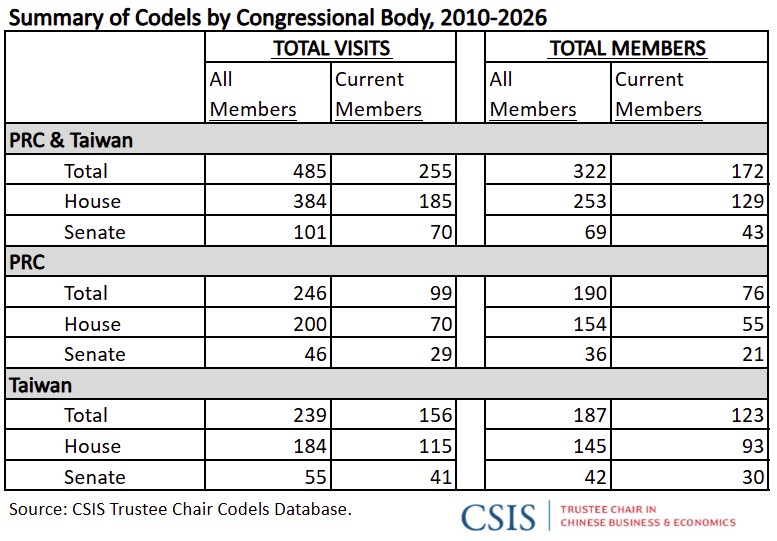
As Figure 1 shows, between 2010 and 2026, there have been 138 congressional-member delegations to the PRC (including mainland China and Hong Kong) and Taiwan, comprising 485 individual member visits, 255 of them by current members. Counted by unique individuals, 322 members of Congress have made these trips, 172 of whom are still in office. Just under half of the delegations (64) went to the PRC, accounting for 190 members and 246 visits. The remaining 74 delegations went to Taiwan, involving 187 members and 239 visits.
Figure 2
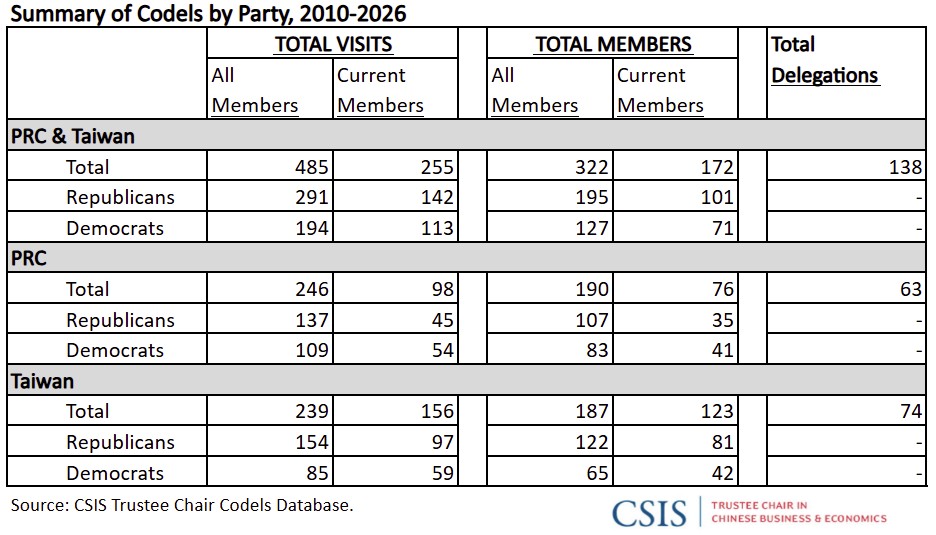
As highlighted in Figures 2 and 3, these trips continue to be bipartisan and bicameral activities, but Republicans still maintain an edge, conducting more visits in total than Democrats (291 to 194). This gap is narrower for trips to China (where Republicans account for 56 percent of visits) and wider with regard to travel to Taiwan (64 percent to 36 percent). The split also skews by chamber, with the House accounting for 79 percent of all visits, a pattern that holds across both the PRC (81 percent) and Taiwan (77 percent).
Figure 3
As noted above, travel to Taiwan has dropped precipitously. After peaking at 39 visits in 2023, there were only 17 visits in 2025, and so far, there have been only 14 visits in 2026. One possible factor may be the lingering fallout from House Speaker Nancy Pelosi’s August 2022 visit, which prompted Beijing to launch large-scale military exercises around the island, raising the security and political stakes of subsequent trips. Another factor could be the Trump administration’s more ambivalent posture toward Taiwan and a desire to reassure Beijing by being less supportive of Codels to Taiwan.
Another item to note is the number of current members in the House and Senate who have visited the PRC and Taiwan. Only 32 percent of current sitting members of Congress (172 of 535) have ever traveled to the PRC or Taiwan. With Codels in decline, that share is shrinking, leaving fewer members with firsthand experience of the region precisely as China becomes more central to U.S. foreign policy.
Travel to China by Americans from all walks of life has remained a fraction of the rates a decade ago. This is especially visible in educational exchange, where fewer than 2,000 Americans are now estimated to be studying in China, down from a peak of 11,000 in 2019. The result is a substantial drop in China-literate talent, including at the federal level. The flow in the other direction has also receded: Chinese enrollment in U.S. universities peaked at 372,532 in 2019 and has declined every year since, a trend compounded by new restrictions on H-1B visas, curbs on research exchange, and accusations of espionage on campuses. This growing distance comes as China races ahead in strategic sectors from electric vehicles to pharmaceuticals, leaving even members who have traveled there likely carrying an image of a country that is continuously evolving.
As China assumes increasing strategic importance, firsthand understanding of the country continues to decline among the American public and Congress alike, as the cohort of members who previously visited the PRC leave and newer members arrive with less direct experience for one of the United States’ most consequential relationships. This is why Codels remain an irreplaceable source of on-the-ground knowledge, one that written analyses and videos cannot replace.
Congress should prioritize travel to both the PRC and Taiwan. In addition to advancing U.S. interests broadly, such trips give members a firsthand understanding of issues that matter to their constituents: Senator Daines, for instance, has pressed to restore Chinese market access for U.S. beef producers. Members can also bring state-level officials, as Congresswoman Tammy Duckworth did on her July 2026 Taiwan trip with Illinois State Treasurer Michael Frerichs and State Senator Paul Faraci. To be worthwhile, though, such visits must reach past a curated itinerary of showcase development to the realities of China’s economy and society, which requires Beijing to open access and allow candid dialogue.
The politics of access remain a significant constraint. China has sanctioned members of Congress before, including now–Secretary of State Marco Rubio over Xinjiang and Hong Kong in 2020, and the presence of such sanctions on colleagues can discourage travel. Yet when Rubio sought to travel to China for the Trump-Xi meeting in May 2026, it appears that Beijing determined that the sanctions applied only to his tenure as a U.S. senator. This kind of exemption is not something all members can count on, however, and the presence of sanctions on multiple members sends negative signals to prospective congressional visitors.
Regular visits to China, such as the recent travel by Senator Daines and the USCC, offer an opportunity to expand future congressional travel and underscore the importance of a broader congressional presence. This kind of engagement can benefit policy at all levels of government. But it depends on open access and candid dialogue, which requires Beijing’s cooperation as much as Congress’s initiative.
Scope. These figures include only member-based Codels. They exclude delegations centered on congressional or committee staff (“Staffdels”). Data for 2026 is current through September 1.
Categorization. “PRC” includes travel to mainland China and Hong Kong. No delegations in this dataset traveled to Macau; had any done so, they would be counted under the PRC. Taiwan is counted separately throughout.
Counting visits versus members. “Visits” count each member’s trip to a destination, so a member who traveled multiple times is counted once per trip. “Members” count unique individuals, so a member who traveled repeatedly is counted only once. Because some members traveled to both the PRC and Taiwan, the PRC and Taiwan member subtotals do not sum to the combined total.
Chamber counting. Members who transitioned from the House to the Senate are counted under the chamber they held at the time of each visit. For example, Senator Marsha Blackburn traveled to mainland China as a member of the House of Representatives and to Taiwan as a senator; she is therefore counted in the House totals for her PRC travel and in the Senate totals for her Taiwan travel, appearing once in each chamber’s respective totals but only once in the combined PRC and Taiwan total. As a result of this treatment, House and Senate subtotals do not always sum to the combined totals.
Sources. Data are from a variety of sources from the United States and Taiwan, each of which is identified in the accompanying database.
Ryan Featherston and Nancy Wei, “All Bark and No Bite? The 118th Congress on China,” CSIS, Trustee China Hand, September 6, 2024, https://www.csis.org/blogs/trustee-china-hand/all-bark-and-no-bite-118th-congress-china.
Scott Kennedy, “Codels: Fortifying Congress’s Role on China Policy,” CSIS, Trustee China Hand, October 13, 2023, https://www.csis.org/blogs/trustee-china-hand/codels-fortifying-congresss-role-china-policy.
Scott Kennedy, “Congress on China: Then and Now,” CSIS, Trustee China Hand, June 21, 2021, https://www.csis.org/blogs/trustee-china-hand/congress-china-then-and-now.
Scott Kennedy, “Thunder Out of Congress,” CSIS, Trustee China Hand, September 11, 2020, https://www.csis.org/blogs/trustee-china-hand/thunder-out-congress-china.