The Implications of the Hormuz Energy Crisis for Energy Policymaking in Southeast Asia
October 2, 2026 • 8:30 – 9:30 am EDT

Photo: EKATERINA ANISIMOVA/AFP/Getty Images
Despite sanctions, Russia is still able to maintain a consistent flow of revenue to carry out its war of attrition against Ukraine. Russian fossil fuel exports still generate an estimated €193 billion (roughly $220 billion) annually, making them one of the Kremlin’s most important sources of wartime revenue. At the same time, these exports are coming under increasing pressure. Ukraine is successfully targeting Russia’s shadow fleet and oil infrastructure across the Black Sea and the Russian mainland, while the United States and EU members are seizing shadow fleet vessels and tightening existing sanctions.
To further increase pressure on Russia’s war economy, the United States and European Union should target Russia’s Arctic export capacity. Analysis by the CSIS Futures Lab found that Russia’s seaborne Arctic crude exports have generated an estimated $18.8 billion in gross export revenue since February 2022, with an estimated 53 percent passing through just two floating storage vessels in the High North. In addition, year-round shadow fleet operations in the Arctic are highly dependent on a specialized pool of about 100 ice-class tankers and eight nuclear icebreakers. These icebreakers carve routes through the sea ice, allowing energy exports to reach international markets and generate revenue for Moscow. Though Arctic crude exports account for a small portion of Russia’s overall fossil fuel export revenues, even minor disruptions to these revenue streams can intensify pressure on Putin’s regime amid the war in Ukraine and contracting economy.
The Arctic export concentration presents a bottleneck that the United States and European Union can target through regulation that constrains Russia’s icebreaker fleet and limits Arctic export capacity over the long term. This includes constraining the construction of new icebreakers. According to the Kremlin, up to 40 percent of production components are not domestically produced, leaving them vulnerable to Western sanctions. Equally important is undermining Russia’s ability to maintain and repair these vessels in Arctic waters, for example, by blocking the procurement of a floating dock capable of servicing its Project 22220 icebreakers. At the same time, dismantling the shadow fleet requires enhanced maritime domain awareness to track and highlight Russian sanctions evasion. This includes systematic monitoring of Russian floating storage to uncover illicit ship-to-ship (STS) transfers and improve the ability to track the movement of sanctioned oil. The collected information should inform U.S. and EU sanctions enforcement and be made public so that identified vessels and operators can be denied access to ports, insurance, and other critical maritime services.
Russia’s Arctic energy exports are concentrated at an estimated five transshipment points where oil is moved from one ship to another on its way to international markets. Sea ice and extreme weather close off the region to non-ice-class vessels for much of the year. Only a small fleet of about 100 expensive ice-class tankers can reach these offshore terminals year-round. Because these vessels are highly specialized, they do not carry the oil all the way to the end customer. Instead, they deliver their product to a handful of stationary storage tankers, known as floating storage and offloading (FSO) vessels. From these FSOs, conventional shadow fleet tankers take on the sanctioned oil via STS transfers and export it internationally. This intermediate storage allows the few ice-class vessels to return to offshore terminals such as Varandey roughly every two weeks, compared with only about once every three months if they carried the cargo directly to international markets. This division of labor boosts the efficiency of the exports but also leaves them dependent on just five relevant transshipment sites where these transfers take place.
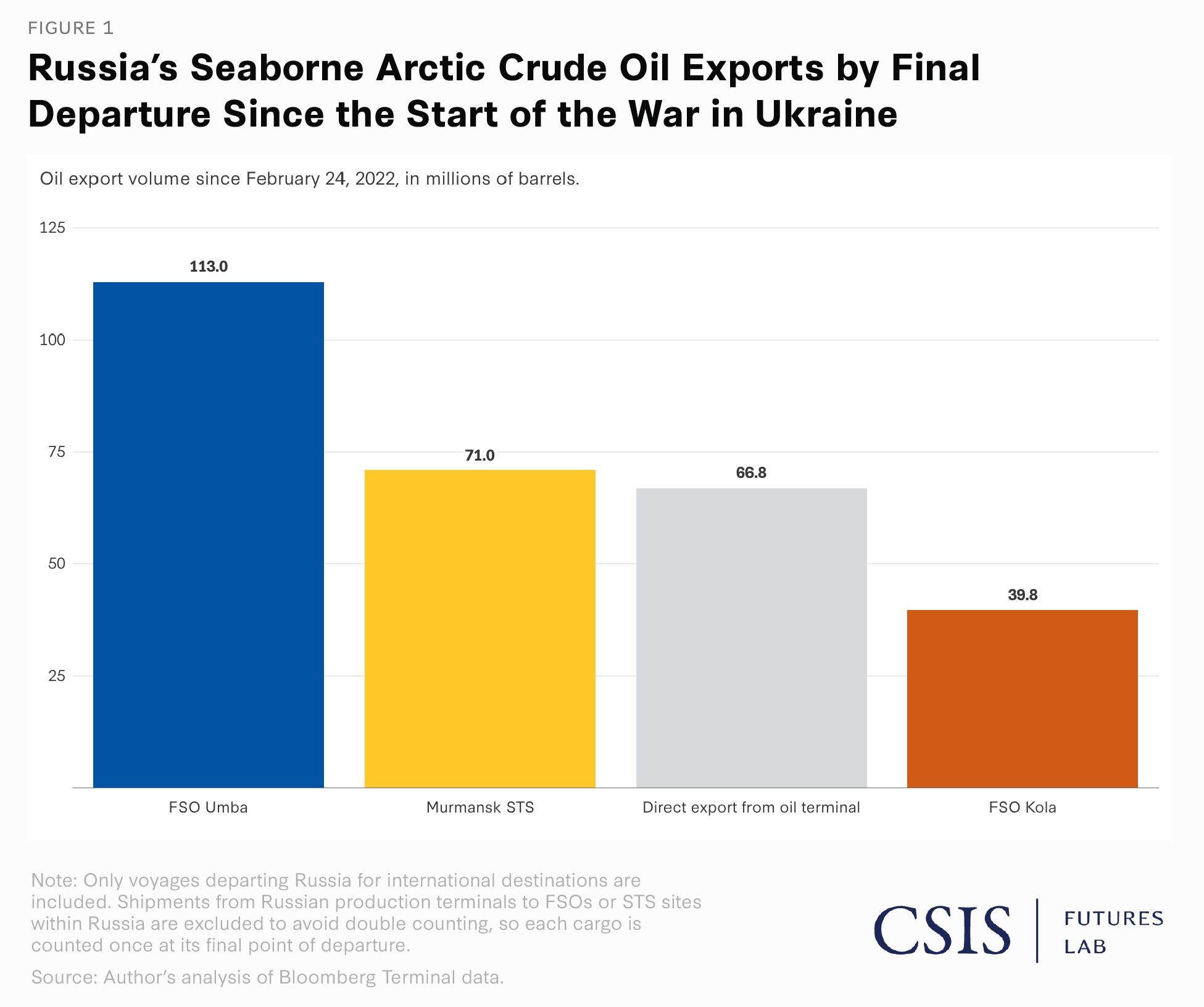
As shown in Figure 1, two FSO vessels alone, the Umba and Kola, have handled an estimated 53 percent of all seaborne Russian Arctic oil exports since the start of the war. This pair of vessels channeled an estimated 2.2 percent of Russia’s total seaborne crude oil exports. The neighboring Murmansk STS in the Kola Bay accounted for an additional 24 percent of Arctic crude, highlighting the importance of oil transshipment in the Arctic. By contrast, only 23 percent of Arctic crude got exported directly to international markets without relying on floating storage vessels or the Murmansk STS anchorage. A similar pattern emerges for liquefied natural gas (LNG) based on Bloomberg Terminal data analysis; Arctic LNG makes up an estimated two-thirds of Russia’s total seaborne LNG exports. To sustain these flows, Russian energy conglomerate Novatek positioned two floating storage units (FSUs) at both ends of the Northern Sea Route (NSR) to serve its LNG projects.
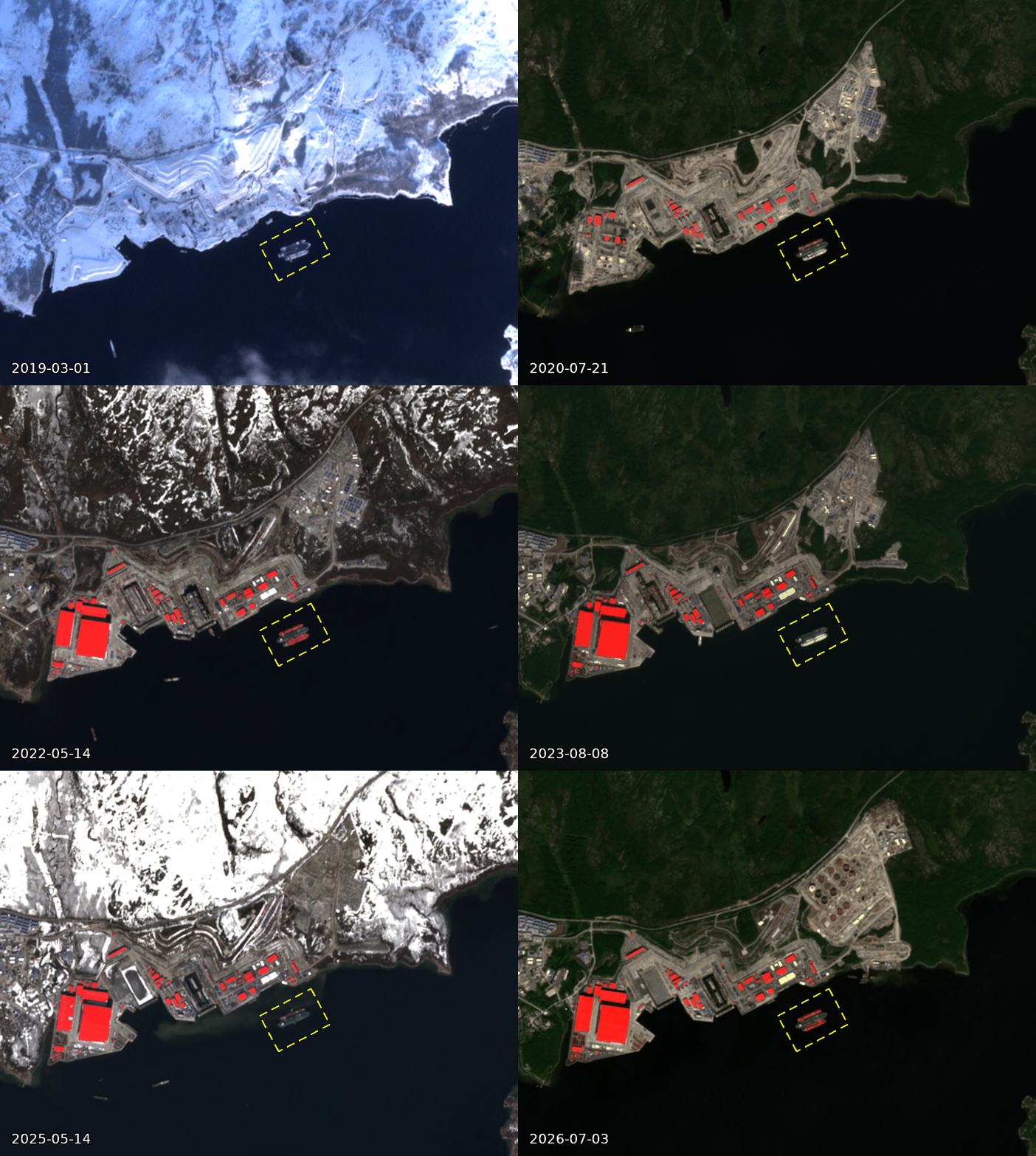
Note: The red coloring of roofs is a result of image compression, not an annotation or intentional coloring. | Source: Sentinel-2 imagery
Satellite imagery captures the central role these FSOs and FSUs play in Russia’s energy exports. A timelapse in Figure 2 illustrates the dark STS transfers at the Umba. Similar dark transfers can be observed at the Kola for crude oil or at the Saam FSU near Murmansk and the Koryak FSU off Kamchatka for LNG. This evidence highlights the relevance and little-known activity being carried out by the FSOs and the lifeline they provide for Putin’s war effort. Because the operator of the FSUs is under U.S. sanctions, any LNG tanker that transships thus takes part in the circumvention of Western sanctions. The export shares in Figure 1 likely understate how much these ships actually carry.
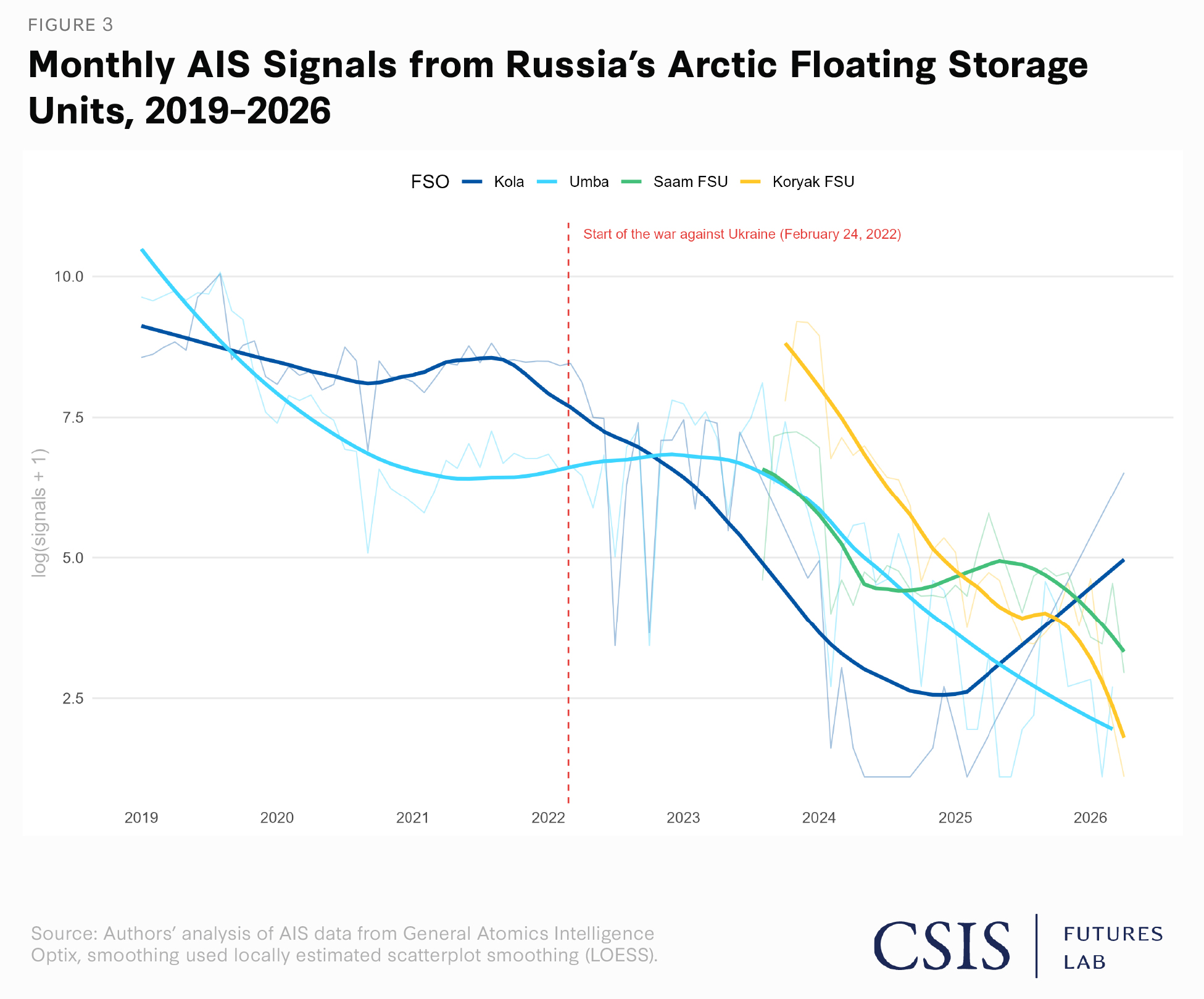
The same FSOs and FSUs that concentrate Russia’s Arctic energy trade are also becoming increasingly difficult to monitor. The floating storage vessels, and the shadow fleet vessels serving them, follow a similar playbook to mask their identity and launder Russian energy exports. The research team used aggregated data from General Atomics Intelligence platform Optix for Figure 3 to illustrate the volume of observable AIS signals from these vessels over time. For the Arctic oil FSOs Kola and Umba, observable AIS activity has fallen by roughly 85 percent from pre-2022 levels, a decline that has continued as U.S. and EU sanctions have tightened. Both the Umba and Kola hide their activity by switching off their AIS transponders (“going dark”) or manipulating their AIS signals (“spoofing”). For example, the Kola’s spoofed signal places the vessel off the coast of Nigeria while it continues to operate in the Arctic. Taken together, the decline in observable AIS activity is evidence that FSOs and FSUs are adopting more sophisticated methods of concealment. By going dark or spoofing their locations, they make it harder for governments, insurers, ports, and researchers to identify cargo origins, track STS transfers, and enforce sanctions. The result is a growing maritime blind spot that helps sustain Russian energy revenues while increasing regulatory, environmental, and navigational risks.
At the same time, it is precisely this concentration that also leaves Russia’s Arctic energy exports exposed. Since February 2022, at least 77 percent of sanctioned Arctic crude oil exports, worth approximately $14.5 billion, have passed through only three fixed sites: the Umba, the Kola, and the Murmansk STS anchorage. Each therefore represents a potential chokepoint, where enhanced monitoring, sanctions enforcement, or operational disruption could have a disproportionate impact on Russia’s ability to sustain Arctic energy exports.
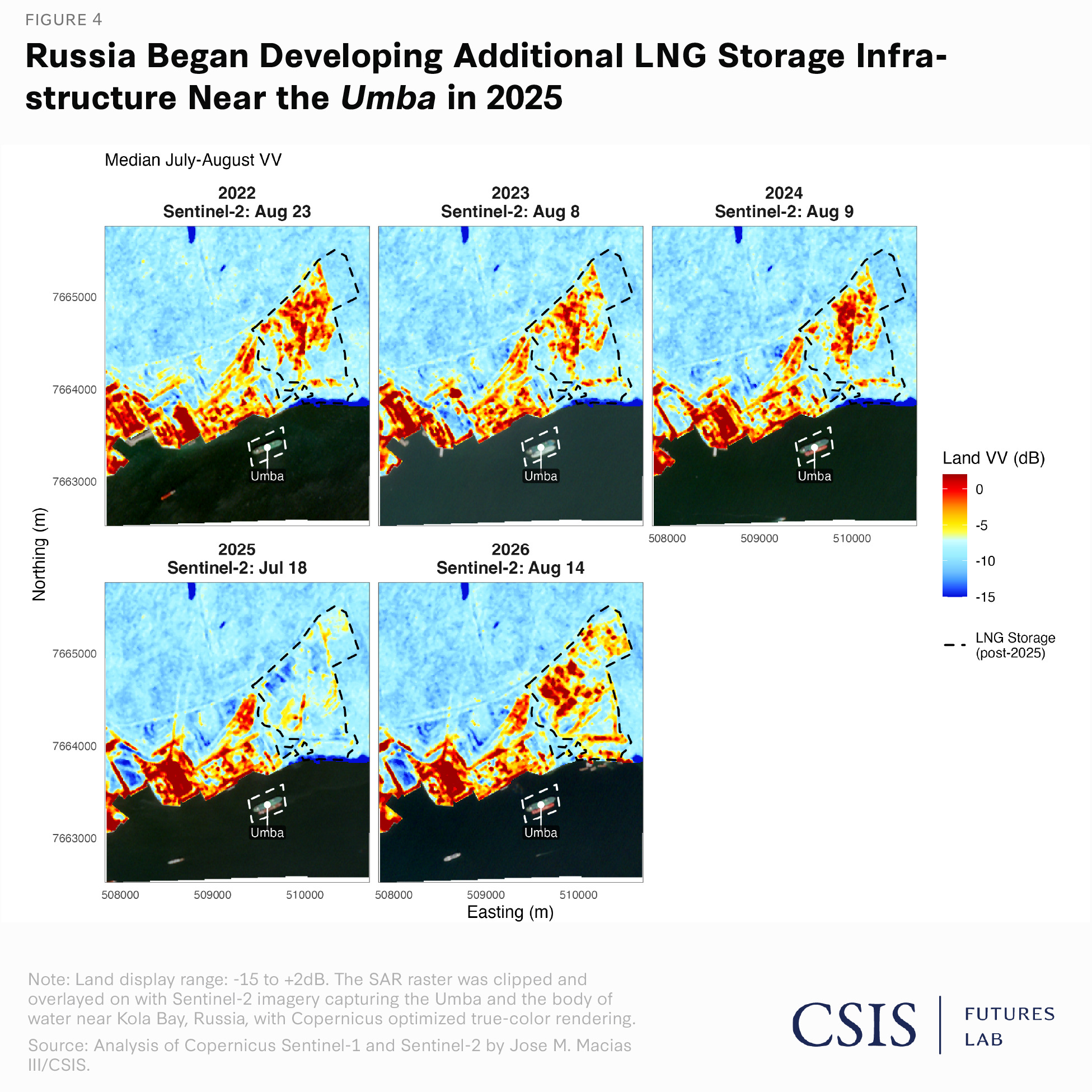
Russia, however, is already trying to build around some of these constraints. Despite Western sanctions, Moscow is investing in new LNG export infrastructure that could reduce its long-term dependence on scarce ice-class tankers and floating storage. The planned Murmansk LNG project provides a clear example of this adaptation. Figure 4 presents annual summer composites of Sentinel-1 synthetic aperture radar (SAR) imagery around the Umba. The figure depicts vertically transmitted and vertically received (VV) radar backscatter. The color scale represents median July–August backscatter intensity in decibels, with brighter (red) values indicating hard-edged, structurally complex surfaces, such as buildings and infrastructure. Conversely, smooth, flat surfaces tend to appear darker because they reflect the radar pulse away from the sensor, as illustrated by the dark water visible across each panel.
The localized change visible in 2025 is consistent with the construction of at least 15 new reservoir tanks associated with the Murmansk LNG project. Scheduled to be operating by 2030, Murmansk LNG would add LNG export capacity in the relatively ice-free waters of Kola Bay. Unlike exports from Yamal LNG and Arctic LNG 2, LNG produced here could be exported without relying on scarce ice-class tankers. For now, however, these existing bottlenecks remain central to Russia’s Arctic LNG trade.
Russia’s Arctic energy exports depend not only on a handful of transshipment platforms but also on a small number of highly specialized ice-class tankers and icebreakers. Figure 5 shows how traffic of these vessels is concentrated along several key energy corridors in the High North. Russian icebreakers (shown in red) enable exports from the Gulf of Ob, home to the Yamal LNG and Arctic LNG 2 terminals, during times when sea ice would otherwise block the shadow fleet from access. They also support traffic between the Varandey oil terminal and Murmansk, where Arctic crude is transshipped through the FSOs described above. In addition, they keep key shipping routes, including the NSR, navigable for energy exports during the ice season. In doing so, Russian nuclear icebreakers regularly escort the shadow fleet’s aging tankers carrying sanctioned oil and LNG through Arctic waters. Since February 2022, the research team identified 110 cases in which sanctioned tankers of the shadow fleet were escorted by a Russian nuclear icebreaker for more than an estimated six hours.
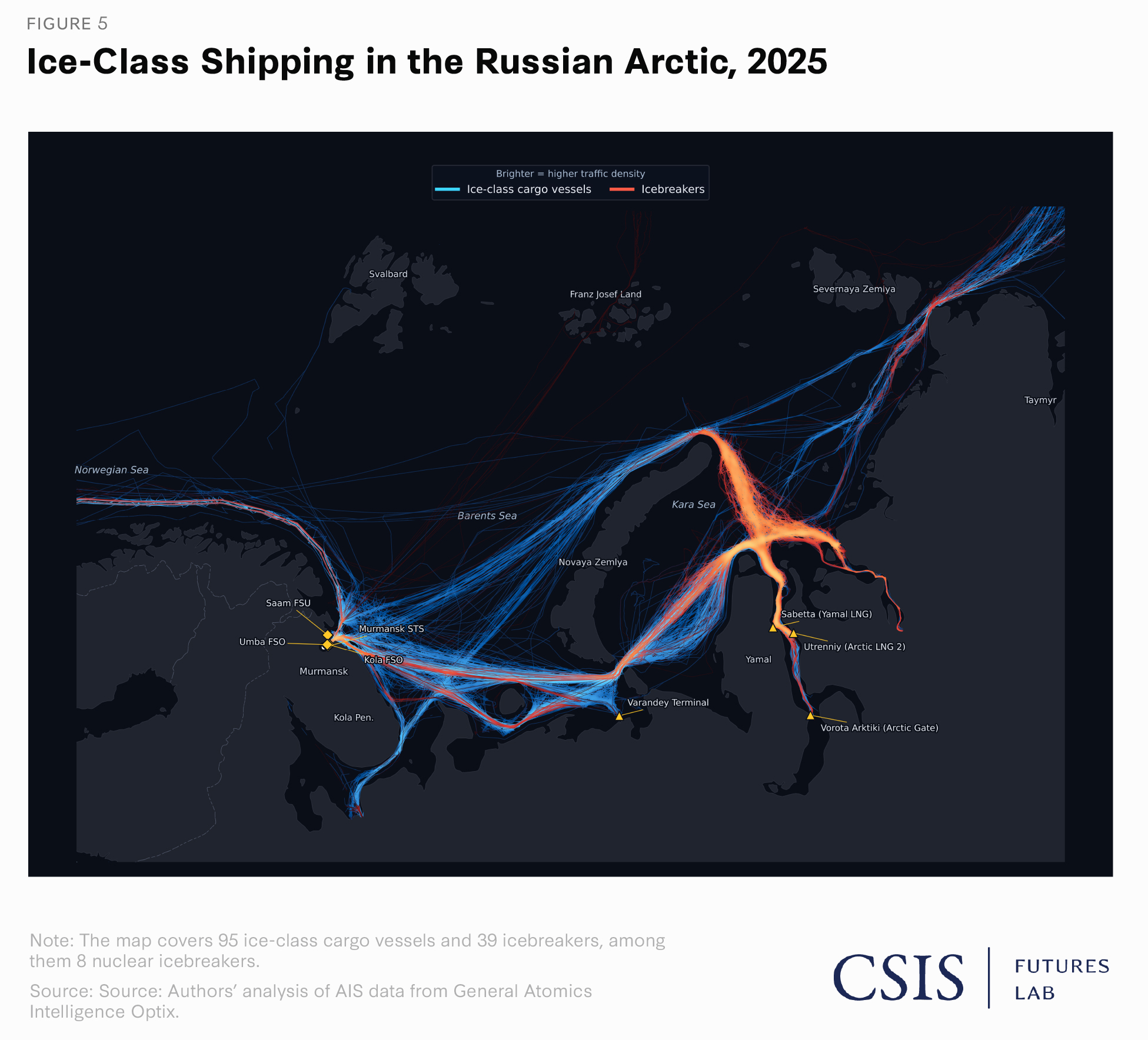
These strategic enablers, however, are coming under increasing pressure as Russia struggles to replace its aging fleet and keep exports flowing. Russia currently operates eight nuclear icebreakers, three of which, the Taymyr, Vaygach, and Yamal, are expected to reach the end of their service lives by 2030. Rossiya, the lead vessel of Russia’s next-generation class of nuclear icebreakers, was originally scheduled to enter service in 2027. However, Western sanctions, supply chain disruptions, and rising construction costs have delayed its completion by at least three years. To compensate for its aging fleet, Rosatom has reportedly raised the annual operating target for its nuclear icebreakers from 240 to 270 days, thereby cutting maintenance and reactor-downtime windows. At the same time, Rosatom estimates that up to 14 nuclear icebreakers will be required to sustain year-round navigation along the NSR by 2030. In practice, Russia is unlikely to operate more than around 10 vessels for years to come.
The growing gap between operational requirements and available capacity is already forcing Russia to accept higher operational risks. In recent years, an increasing number of tankers have transited the NSR without sufficient ice-class or icebreaker escorts. In several cases, these voyages appear to have violated the Polar Code, showing that Moscow is increasingly willing to compromise navigational and environmental safety to keep Arctic export flows moving.
Another structural bottleneck concerns the maintenance of these critical assets. Russia lacks a dry dock in the Arctic capable of servicing the four newest Project 22220 nuclear icebreakers. To address this shortfall, Rosatomflot commissioned a new 220-meter-long floating dock in Turkey. However, its delivery to the Russian Arctic was successfully prevented by British sanctions while it was transiting the Mediterranean. As a result, Russia’s newest nuclear icebreakers remain dependent on the Kronstadt Marine Plant near St. Petersburg for maintenance and repair work. The next Project 22220 icebreakers are currently under construction at the Baltic Shipyard, also in St. Petersburg.
Similar constraints are emerging in Russia’s ice-class LNG fleet. Western sanctions have prevented Russia from acquiring additional foreign-built Arc7 LNG carriers and have forced the country to develop domestic shipbuilding capabilities. However, Russia remains dependent on foreign infrastructure to maintain the existing fleet. Up to six Arc7 LNG carriers are expected to undergo routine maintenance at Denmark’s Fayard shipyard before the EU ban on maintenance services for LNG tankers operating in Russia takes effect on January 1, 2027.
Revenue from Arctic oil and LNG exports enables Russia to sustain its war against Ukraine. Increasing pressure on Russia should therefore focus on limiting this export revenue. This should be combined with deterrence by detection, improving the U.S. and allied ability to identify and expose the shadow fleet vessels, energy nodes, and companies that underpin Russia’s energy trade. These measures should concentrate on highly specialized capabilities that enable the export of sanctioned oil and LNG. Maintaining pressure on Russia’s shipbuilding industry is equally important. Recent U.S. sanctions provide a roadmap for restricting access to key foreign technology. Together, these measures will constrain Russia’s ability to sustain and expand its Arctic export capacity and, in turn, limit Putin’s capacity to wage war:
1) Prevent Russia from developing the industrial capacity required to independently maintain and expand its icebreaker fleet. As shown above, Atomflot remains dependent on a small number of specialized construction and repair facilities. Because the nuclear icebreaker fleet enables the shadow fleet’s operations in ice-covered Arctic waters, constraining the industrial base that supports it directly targets a critical enabler of Russia’s Arctic energy trade. Its continued dependence on the Baltic Shipyard for the construction of Project 22220 nuclear icebreakers and on the Kronstadt Marine Plant for major maintenance concentrates these critical capabilities around St. Petersburg. This concentration leaves Russia’s icebreaker fleet and supporting industrial infrastructure exposed to Ukraine’s successful long-range drone campaign for years to come. The United States and its allies should compound this pressure by systematically identifying remaining foreign dependencies for icebreaker construction and maintenance, tracing the supplier networks that sustain them, and restricting access to those inputs. They should also target intermediaries and third-country suppliers that facilitate sanctions circumvention and reroute restricted goods to those already sanctioned Russian shipyards. Continued intelligence sharing with Ukraine can further expose vulnerable supply chains and industrial nodes supporting the construction and maintenance of Russia’s icebreaker fleet.
2) Bring forward the EU services ban on Russia’s LNG fleet. EU member states should agree to shorten the remaining transition period, currently running until January 1, 2027, for the services ban covering LNG tankers operating in the Russian High North. This would prevent additional Arc7 LNG carriers from receiving maintenance at European shipyards and deny Russia one of the few remaining specialized maintenance options for the small fleet on which its Arctic LNG exports depend. This also aligns Europe closer with the U.S. Congress, which recently passed the Lindsey O. Graham Sanctioning Russia and Iran Act of 2026. The act empowers the U.S. president to sanction energy projects in the Arctic, including any future successor project.
3) Increase maritime domain awareness and strategic declassification in the Arctic. The small number of FSOs and FSUs identified above constitute clearly identifiable nodes within Russia’s Arctic export network. The United States and its allies should continuously monitor these platforms using data fusion platforms to detect dark activity, task satellites to capture imagery, and expose illicit STS transfers. These methods can also be used to identify additional shadow fleet tankers and enable more targeted sanctions against the vessels and their owners and operators. Findings should also be released publicly to reduce plausible deniability for governments and companies complicit with the shadow fleet’s business. Insurers, ports, banks, and other maritime providers could then easily identify the vessels and operators of the shadow fleet and deny them access to critical financial, insurance, and other maritime services.
The United States and EU members should sustain pressure by constraining the supply chains needed to build and maintain Russia’s icebreaker fleet, denying Russian ice-class LNG tankers access to European maintenance services, and increasing maritime domain awareness around key Arctic export nodes. This could constrain Moscow’s long-term export capacity in the High North, thereby cutting the Arctic lifelines that help fund Putin’s war of aggression.
Tobias Oestreich is a research intern with the Futures Lab at the Center for Strategic and Internation Studies (CSIS) in Washington, D.C. Jose M. Macias is an associate data fellow and data scientist in the Futures Lab within the Defense and Security Department at CSIS. Benjamin Jensen is director of the Futures Lab and a senior fellow for the Defense and Security Department at CSIS.
The research team would like to especially thank Tao-Hung Chang, Taiwan’s visiting military fellow at CSIS with the China Power Project for providing his naval expertise. Tao contributed to analyzing the strategic importance of Umba as it relates to storing oil and advising on recommendations.

Commentary by Benjamin Jensen and Jose M. Macias III — December 15, 2025

Critical Questions by Jose M. Macias III — January 8, 2026

Commentary by Benjamin Jensen — January 7, 2025