AI Agent Containment Failures: Technical Realities and Policy Responses
August 24, 2026 • 2:00 – 4:00 pm EDT
Hosted by Wadhwani AI Center

Photo: Li Gang/Xinhua/Getty Images
On January 24, 2026, China’s Ministry of National Defense announced that the military’s top general, Zhang Youxia, and the chief of the Joint Staff Department, Liu Zhenli, had been placed under investigation for serious disciplinary and legal violations. The downfall of these two senior generals marks the most dramatic move yet in Xi Jinping’s years-long campaign to gut the leadership of the People’s Liberation Army (PLA). The removal of Zhang, Liu, and several other generals from the Central Military Commission (CMC) has left only one general, Zhang Shengmin, serving on China’s top military decisionmaking body alongside Xi. However, the purges within the CMC are only the tip of the iceberg. Since 2022, over 100 senior PLA officers from across virtually all areas of the armed forces have been swept aside or gone missing, amounting to an unprecedented purge of China’s military.
The scope and depth of these purges showcase Xi’s resolve to renovate the PLA, root out corruption, eliminate obstacles to his ambitious military modernization objectives, and ensure absolute political loyalty. The purges raise serious questions regarding the current state of PLA readiness and what the future might hold for the force. This report brings together leading experts on the PLA to address some of these most critical questions, with the recognition that our understanding of what is unfolding is at best partial. The analyses in this report draw on a groundbreaking 2026 CSIS Database of Chinese Military Purges developed by the CSIS China Power Project with significant contributions from Suyash Desai and support from Jonathan A. Czin, Allie Matthias, and John Culver from the Brookings Institution.
By John Culver
Xi Jinping has long staked his personal primacy on the history of the Chinese Communist Party (CCP), including supervising publications and closely controlling official party history research organs. It is not a stretch to view his purge of the PLA general officer corps through the lens of lessons the CCP leadership drew from key crises that tested civil-military relations—the Long March; the Yan’an and Gutian conferences, which Mao Zedong used to consolidate his control over the CCP and PLA; the upheavals of the Cultural Revolution; and especially the 1989 Tiananmen Square crisis and its aftermath.
The June 1989 military crackdown on prodemocracy demonstrations came after three months of turmoil that split the party leadership and fractured PLA cohesion. When troops finally moved toward Tiananmen Square late on June 3, 1989, the decision to use lethal force came after weeks of internal PLA resistance, with senior revolutionary-era generals and serving senior commanders initially opposing military intervention.
In the aftermath of mass deaths and international condemnation, tensions within the PLA only worsened. Competing senior camps strove for control over the military, with one faction—led by President and CMC Vice Chair Yang Shangkun and his half-brother, CMC Secretary General Yang Baibing—maneuvering to purge or sideline key generals who had initially opposed the army’s intervention. The result between June 1989 and mid-1992 was the replacement of six of seven military region commanders, the consolidation of the CMC from ten members (the chair and nine PLA officers) to just four, and the wholesale turnover of PLA representation on the Central Committee. This churn—which was contested between the Yang Brother faction and Deng Xiaoping’s faction, which included elders and senior officers who had initially opposed PLA intervention in 1989—only ended on the eve of the 14th Party Congress, when both Yang brothers were removed from all of their military positions.
The full scale was comparable to Xi’s current campaign in terms of scope and its impact on CMC membership, which was reduced from ten members to four, and in terms of its effect at the military region/theater command level. Xi’s campaign, however, has been more intense at the service chief and deputy department levels. It is hard to compare the old general departments, which had CMC representation, and today’s departments under Xi’s CMC system, where most are not full CMC members.
Ironically, the PLA senior officers who emerged after the 14th Party Congress were largely affiliated with the factions that opposed the army’s 1989 intervention. This cohort, and their successors prior to the Xi era, drove modernization to defend China against external adversaries. As corruption deepened after 2002, the PLA became increasingly autonomous from CCP direction, likely leading to the situation that Xi encountered when he was promoted to the CMC in 2010 as first vice chairman, two years before he succeeded Hu Jintao as party general secretary, president of China, and CMC chairman.
Xi’s purges of senior PLA positions surpass those of 1989 to 1992, signifying his more encompassing goal—not only to disrupt the guanxi (informal patronage and loyalty) networks of other active and retired senior influencers but also to ensure that the PLA is absolutely subordinate and responsive to CCP control. While Xi’s actions are likely to harm PLA readiness and combat effectiveness over the next few years, he is also ensuring that the force will be more politically reliable—not only in the event of war, but in the face of a potential repeat of Tiananmen-era internal turmoil, this time without the military opposition to party direction that occurred in 1989.
Regarding drivers of the purge, caution is warranted in ascribing any weight from the U.S.-China relationship to internal moves of PLA command positions. Although tensions may have eased, the relationship remains highly abnormal and subject to wild swings due to events or the pique of respective autocrats. What Xi is doing to the PLA really is not about the United States, except at a tertiary level. If Taiwan or the United States run over a red line for military force, China has a lot of options to punish, teach a lesson, and declare its own “victory,” and those options, short of invasion or a complete, open-ended blockade, do not require highly coherent command coordination.
John Culver is a nonresident senior fellow in the John L. Thornton China Center at the Brookings Institution.
By M. Taylor Fravel
The second wave of purges of senior PLA officers by Xi Jinping is unprecedented in the history of the PLA. The Chinese Communist Party’s Central Military Commission, which oversees China’s armed forces, has been organizationally decapitated. Of the six generals named to the CMC in 2022, only one remains. Additionally, he is a political commissar whose career has focused on discipline and personnel issues, not military operations and training.
Yet, as the new data gathered by the CSIS China Power team shows, the significance of this round of purges extends far beyond the CMC to impact the entire PLA leadership. In the PLA’s organizational structure, an officer’s grade is more important than their rank and usually corresponds to the grade or level of the unit they command, oversee, or direct. Below the CMC, the highest grade an officer can hold is theater command leader, which includes the commanders and political commissars of the four services and five regional theater commands, as well as the directors of key departments within the CMC. The next most important grade is theater command deputy leader, which includes the multiple deputies to the positions above, the associated chiefs of staff, the directors of other departments within the CMC, and other positions.
A focus on grades indicates that the PLA leadership comprises roughly 176 billets or positions. In addition to the six CMC positions (two vice chairs and four members), these include 25 theater command leader positions and another 145 theater command deputy leader positions, according to TextOre’s Directory of PLA Military Leadership 2025. The CSIS Database on Chinese Military Purges shows that 101 senior officers who served in CMC, theater command, or theater deputy command grade positions have been dismissed or gone missing. After accounting for positions in which more than one purge has occurred, such as the commander of the PLA Rocket Force, approximately 52 percent of positions in the PLA leadership have been impacted.
This figure is striking and extraordinary, demonstrating the depth of Xi’s campaign and the unprecedented churn in the PLA leadership. It has affected the commanders and political commissars of each service (Army, Navy, Air Force, and Rocket Force) and each theater command, as well as the directors of six CMC departments, among many other senior leadership positions and deputy leadership positions. Put differently, all CMC positions and theater command level positions have experienced a purge as measured in the CSIS data. And purges have occurred in approximately 38 percent of all theater command deputy leader positions.
Several implications follow from this analysis. First, the depth of the purge suggests that dissatisfaction with the PLA leadership’s performance is a major factor in Xi’s calculus (in addition to concerns about corruption, political loyalty, military autonomy, military obedience, or policy differences).
Second, rebuilding the PLA leadership will take time. A large gap exists at the theater command leader grade, with 38 officers in such positions having been dismissed or disappeared. They can only be replaced by officers serving in theater deputy leader command positions, yet with 56 officers in this grade having been dismissed, the pool of potential officers who can be promoted to theater command level positions has been cut by more than one-third. Moreover, to be promoted to a higher grade, an officer typically must serve three to five years in their current grade, further complicating efforts to replenish the leadership positions.
Third, the purge underscores the challenges that PLA leadership would face, either with empty billets or newly promoted officers inexperienced in their new roles, in undertaking large-scale military operations such as a blockade or amphibious assault of Taiwan. Although roughly half (53 percent) of theater command–level officers who were purged came from the command track, this proportion grows to around two-thirds (68 percent) at the deputy theater command level, highlighting the difficulty that the PLA will face to meet its ambitious modernization goals.
Taylor Fravel is the Arthur and Ruth Sloan Professor of Political Science and the director of the Security Studies Program at the Massachusetts Institute of Technology.
By Thomas J. Christensen
The detention of Zhang Youxia was the capstone arrest of the greatest series of purges in the history of China’s PLA. Only one general is left on the Central Military Commission. Other high-level officers—including the chairman of the Joint Staff Department, the commanders of regional combat commands, the rocket force commander, and a former acquisitions chief and minister of national defense—have been removed. General Zhang was accused of corruption. This is a red herring. The entire PLA has long been corrupt, and anyone toward the top of that order has used bribery, received bribes, and/or witnessed and tolerated bribery.
Significantly, Zhang was accused of other crimes. He was charged with trampling on the “chairman responsibility system” of the Central Military Commission, a convoluted way to say that he was not respecting Xi Jinping’s civilian leadership over the military. Xi either saw him as a direct political threat or believed that Zhang’s inability to make sufficient progress on Xi’s goals for the PLA (see below) suggested disloyalty. There is a debate about which of these two was more important, but the two categories overlap to such a degree that this may be a false debate. Zhang was also accused of conducting espionage for the CIA regarding China’s nuclear secrets. This charge is likely specious. Treason is a politically useful charge for Xi to deploy to explain to other officers why a respected commander was taken down. No one can complain about Zhang’s removal if he is deemed a traitor.
Zhang’s removal, and the broader purge of which it is a part, has implications for U.S. policy. An amphibious invasion of Taiwan, which Xi has reportedly ordered his military to be ready for by 2027, is an incredibly complicated and risky operation, especially since Taiwan, the United States, and Japan have been working hard to create countermeasures against such an invasion. (The 2027 goal was apparently for capability development, not a deadline for action.) Invasion would also be politically risky for Xi because a failed invasion cannot be spun as a victory and therefore could prove to be a disaster for regime legitimacy and Xi’s personal legacy. Other military actions could easily prove less politically decisive but could subsequently be called off and still spun as an episode of successful coercive punishment of Taiwan.
Xi’s demonstrated lack of faith in his military is good from the perspective of the United States and Taiwan for deterring an invasion. Unfortunately, the good news ends there. Unlike an invasion, a blockade of Taiwan would be relatively easy for the PRC, and there is little that Taiwan or the United States could do militarily to stop it. Moreover, since the ill-advised visit of Speaker of the House Nancy Pelosi to Taiwan in August 2022, China has had the opportunity to practice complex blockade actions near Taiwan. Beijing was able, with some success, to blame the United States for triggering the tensions, thereby minimizing the diplomatic costs of launching such aggressive exercises. So even if Xi has insufficient confidence in the PLA to order an invasion, he almost certainly has great confidence in creating a blockade or a quarantine. Zhang Youxia’s firing may have little or no impact on such military options short of invasion. So, the implications of Zhang’s firing for deterrence in the next year or two are real, but limited. China is still very capable of taking actions to attack Taiwan and, in the process, to spoil the United States’ whole day.
One problem that Xi Jinping faces moving forward is whether he will get honest advice from newly promoted military officers. If one of the reasons that top generals on the Central Military Commission were arrested is that they were expressing realistic doubts about the ability to meet Xi’s 2027 goals for readiness, and thereby fostered Xi’s distrust, future officers will have a strong incentive to only pass good news up the chain to Chairman Xi. This is dangerous for crisis management because it could make Xi unrealistically confident in his military’s capabilities in future contingencies.
Thomas J. Christensen is the Pritzker Chair in the Geopolitics and Foreign Policy Department at the Center for Strategic and International Studies and director of the China and the World Program at Columbia University’s School of International and Public Affairs.
By Joel Wuthnow
There is little question that recent purges have disrupted command and control of the PLA. The Central Military Commission has ceased to function as an effective decisionmaking body, reduced to just Xi Jinping and anti-corruption czar Zhang Shengmin. As the CSIS Database on Chinese Military Purges makes clear, there are also many key operational and administrative posts at lower tiers that are vacant or only recently filled. These include theater commands, service headquarters, and key national level departments such as for training and the joint staff.
Such a disruption will complicate the PLA’s ability to reach the ambitious targets that Xi has given it to be ready for conflict by its 2027 centennial anniversary. As the latest congressionally mandated report on China’s military explains, those goals include being able to achieve a “strategic decisive victory” against Taiwan, “strategic counterbalance” of the United States, and “strategic deterrence and control” of other adversaries who might create problems for China during wartime. The gutting of the leadership will make it difficult for the PLA to plan and train for these objectives, and if troops are ordered into battle, the senior commanders will be new to their positions. Such factors could lead Xi to push those deadlines back by a few years.
Organizational disruption, however, often proves to be catalytic. Xi’s 2015–16 reforms to the PLA’s command structure and the 2020 pandemic were also disruptive, but the military came out stronger through those experiences. Cleaning the slate will allow Xi to reach into the ranks of the PLA’s rising stars to fill important roles. Those officers will be better educated, more technically literate, and have greater operational experience than their predecessors. They also represent a more confident generation of officers who grew up in a rising China with a narrative that the United States and its military are in a state of decline. They will presumably have gone through extensive vetting and could be better trusted by Xi than powerful members of the old guard.
A new leadership would create risks for China’s adversaries later this decade and into the 2030s. Assuming that Xi remains firmly in charge of the military, the new top brass could have the expertise and confidence to push the boundaries against territorial rivals and ramp up aggression against Taiwan. They will also inherit the impressive hardware that their predecessors pushed through the acquisition system and is now making its way into the inventory, including large stockpiles of drones and precision long-range missiles—many of which were paraded in Beijing in September.
These personnel changes could give Xi reason to believe that the PLA will have brighter prospects in a war over Taiwan. Factors such as the threat of economic ruin and a possible military defeat at the hands of the United States could constrain Xi, but the results of a campaign that he believes has finally gotten corruption under control and put true professionals in place would push in the other direction. Most worrisome, new generals might be in a weaker position than those who came before them to push back if Xi entertains the same war optimism that convinced Putin to attack Georgia and Ukraine. China’s opponents should therefore take little comfort in the recent disruption and prepare for these more concerning futures.
Joel Wuthnow is a senior research fellow in the Institute for National Strategic Studies at the National Defense University (NDU). This represents his views and not those of NDU, the Department of War, or the U.S. government.
By Bonny Lin
Given the extraordinary purges within the PLA, to what extent have the purges already impacted China’s ability to engage in military operations against Taiwan? In the near term, given the significant vacancies, it would be incredibly difficult for China to launch large military campaigns against Taiwan. Even below that threshold, there is evidence that the purges have negatively impacted China’s exercises around Taiwan in 2025.
The purges within the PLA have not only led to a nine-month gap, from March to December 2025, during which there was no Eastern Theater Commander, but they have also created significant vacancies throughout the force. In some cases, interim leaders with less experience have stepped up. This would complicate any PRC efforts to execute a large-scale military campaign against Taiwan that requires significant national mobilization and integrated joint operations involving different military services and theater commands:
Below the threshold of large-scale military campaigns, China has largely maintained or increased its regular count of gray zone military activities vis-à-vis Taiwan. In 2025, for example, China conducted record-breaking levels of air and maritime activity around Taiwan and continued its trend of holding two large named military exercises around the island.
Leadership gaps, however, may have delayed China’s ability to execute large exercises around Taiwan in 2025. In 2024, China reacted within three to four days to what it viewed as “problematic” behavior from Taiwan, launching two Joint Sword exercises in May and October. In contrast, it took the PLA 19 days to launch a large-scale exercise in April 2025 and 12 days in December 2025.
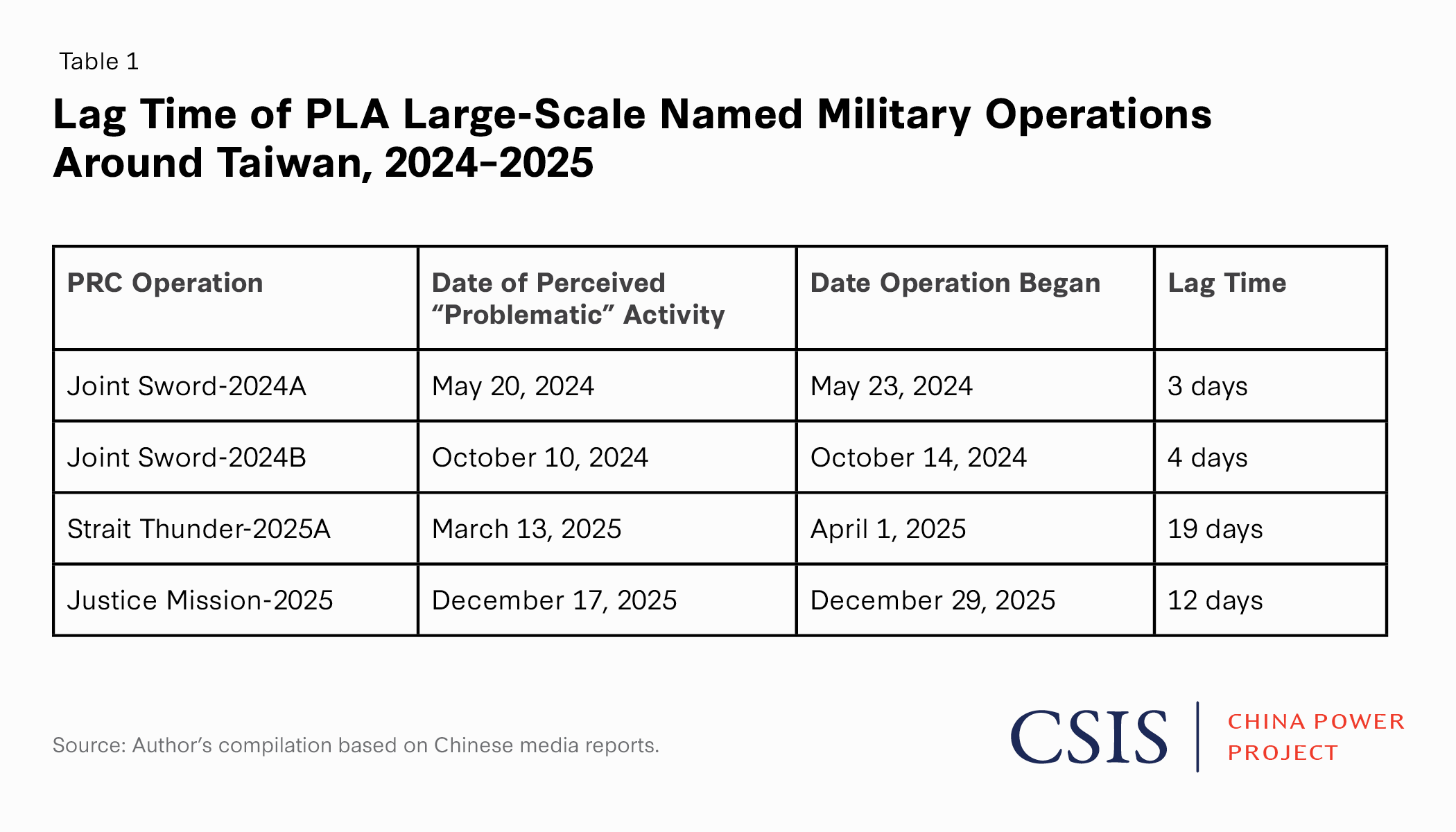
Although it is possible that both exercises were delayed for political reasons, the April 2025 drill, Strait Thunder-2025A, did not match the quality or size of prior named military exercises. First, China designated it a military drill (演练). In contrast, the Joint Sword series and Justice Mission 2025 were exercises (演习), which are by definition larger and more complex. Exercises often involve components lacking in a drill, including scenarios, an opposing force, and an exercise director department to plan and organize.
Second, as some assessed, Strait Thunder-2025A featured “various discrete training activities with minimal connection between them, thus falling short of the complexity associated with an exercise.” Some of the exercise components also did not reflect realistic scenarios involving Taiwan, and many of the activities in the drill mirrored operations that the PLA had conducted before.1
Third, the rollout of the drill was problematic. The name was belatedly announced on the second day of the exercise. The press release was short and omitted the typical sentence describing the political purpose of the exercise. The Eastern Theater Command (ETC) also did not announce any specific exercise zones. Overall, this suggests that Strait Thunder-2025A was hastily organized and not well planned despite taking almost two additional weeks to put together compared to the 2024 exercises.
The loss of key leadership in the CMC and ETC likely impacted the planning and execution of Strait Thunder-2025A. By late January 2025, ETC Army Commander Lieutenant General Kong Jun was likely purged. In March 2025, ETC Commander General Lin Xiangyang was detained, and it is possible that ETC Deputy Commander and Commander of the ETC Navy Vice Admiral Wang Zhongcai was also purged around then. That was the same month that CMC Vice Chairman He Weidong—who has had a large role in organizing military exercises around Taiwan—was last seen in public, and he was likely purged then too.
Perhaps learning from past mistakes, Xi promoted Deputy ETC Commander Yang Zhibin to commander on December 22, 2025. Seven days later, the ETC executed a larger and well-planned military exercise, Justice Mission 2025.
Bonny Lin is director of the China Power Project and senior adviser at the Center for Strategic and International Studies.
By Suyash Desai
Political scientists have maintained that China’s border dispute with India constitutes a “secondary strategic direction” rather than the central focus of its military planning. However, recent developments—including the 2017 Doklam stand-off; the 2020 Galwan clashes, which resulted in loss of life on both sides; the subsequent protracted, conflict-like military deployments; and China’s military modernization and dual-use infrastructure development in the region—indicate that the PRC has accorded this dispute heightened strategic importance. More recently, the consistent tempo of military exercises and training within these regions, despite China’s recent military purges, demonstrates that this priority has endured, even amid disengagement and a reduction in tensions along the Line of Actual Control over the past two years.
The Western Theater Command (WTC), Tibet Military District (TMD), Xinjiang Military District (XMD), and the Southern Theater Command’s 75th Group Army, based in Kunming, Yunnan, are responsible for managing the Indian contingency in the Tibet and South Xinjiang regions. As the CSIS Database of Chinese Military Purges indicates, the most significant crackdown occurred in 2024 and 2025, when six senior officials were purged from the WTC, XMD, and TMD, including commanders, deputy commanders, commissars, deputy commissars, and chiefs of staff. However, the crackdown extended beyond the leadership level and encompassed multiple layers within the WTC, XMD, and TMD, including operations, bureaucracy, training, and management. Additionally, service chiefs within theater commands and military districts, as well as officials from the regional Joint Operational Command Center, have gone missing.
Counterintuitively, despite these purges, the number of military exercises and drills per year across the WTC, XMD, and TMD has largely remained constant over the past three to four years. These activities include PLA annual military exercises at the beginning of each calendar year, which began following an order from Xi Jinping, chairman of the Central Military Commission, to mobilize troops. They also include seasonal training drills conducted by the PLA at the onset of harsh Tibetan winters to acclimatize units, as well as joint bilateral exercises with foreign armies in the region. More importantly, the exercises also include at least five special military exercises, joint operations training and drills, and contingency-specific exercises that units in these regions have conducted annually since 2022.
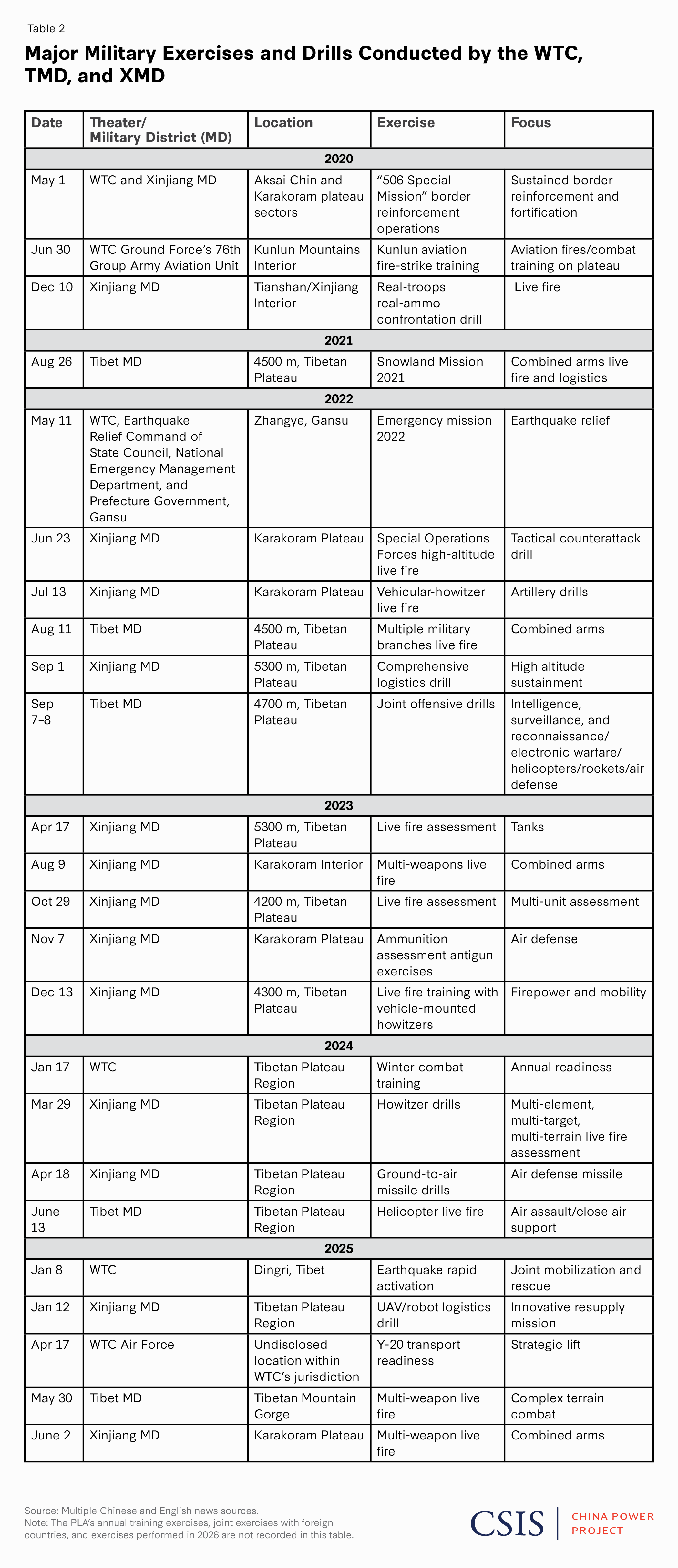
This pattern suggests three key findings. First, the PLA as an institution is stronger than the personnel running it. The recent purges have not decreased the quantity of military training, drills, and preparedness—at least in the WTC, XMD, and TMD.
Second, and more importantly, the consistency in the number of exercises during this period—combined with China’s evolving operational posture, investment in dual-use infrastructure, the recent preferential treatment to these theater commands and military districts, and contingency-focused military modernization—indicates that Beijing continues to prioritize the potential for a border conflict with India despite the recent relative easing of tensions. Furthermore, it highlights that China no longer regards the dispute with India as secondary in its military strategic calculus, particularly in the wake of the Doklam and Galwan standoffs.
Third, despite a consistent number of training drills and exercises in this region, significant concerns remain regarding the quality of exercises conducted by the PLA during this turbulent period. There are two contrasting possibilities: degradation or intensification. The quality of these military exercises may have declined amid purges and leadership instability. In a politically charged environment, commanders and operational heads of these commands could have become risk averse, which in turn could have led to political correctness and a preference for routine over innovation. The propensity to undertake new initiatives might have diminished, as anything innovative would likely attract attention, and exercises could have become more robotic and scripted. Persistent fear and insecurity could affect the quality of military exercises, training, and preparedness. In this scenario, the PLA risks reverting to what CCP leadership refers to as “the Peace Disease” (和平病, heping ping) and the “the Five Incapables” problem (五个不会, wu ge buhui). Put simply, according to the Chinese leadership, these are limitations in PLA officials’ situational judgement, intentions, and operational decisionmaking capabilities—precisely the shortcomings that realistic, high-intensity, and unscripted military exercises and drills are designed to rectify following Xi’s military reforms.
On the contrary, it is also possible that under greater political scrutiny and stricter standards, officers might push to demonstrate rigor as a sign of loyalty and discipline, principles Xi has emphasized as core military priorities. Military training could be more inspection-driven, thereby enhancing stricter compliance with directives. But this is a general phenomenon, not specifically limited to this region. Thus, the net effect is uncertain: The purges might reduce training realism and innovation, improve discipline and compliance, or do both.
Thus, despite recent purges, the PLA’s sustained military exercises in this region suggest that its operational tempo has remained intact, underscoring the heightened importance of the border dispute with India in China’s strategic-military calculus. However, the consequences of the purges may be visible in the quality of training and the risk calculus of frontline commanders along the India-China border.
Suyash Desai is a non-resident fellow at the Foreign Policy Research Institute in Philadelphia.
By Jonathan A. Czin and Allie Matthias
While the precise reasons for Xi Jinping’s toppling of any particular senior officer remain unclear, the data shows that the scope and scale of this purge have few precedents—and underscores that Xi has culled virtually an entire generation of senior PLA officers. As John Culver and Jonathan A. Czin argue in Foreign Affairs, Xi seems to have concluded that virtually none of the military leaders in the current leadership generation are up to the twin tasks he had set for them: ensuring that the military is thoroughly politicized and willing to fulfill its role as the ultimate guarantor of party rule should it be challenged by internal unrest; and building a military that can fight foreign adversaries, including the U.S. military, if needed by Xi.
The Chinese Communist Party has almost completely decapitated its supreme military body—the Central Military Commission (CMC). Besides Xi, only Vice Chairman General Zhang Shengmin—the officer overseeing the investigations that have ensnared all of his erstwhile CMC colleagues—has been left untouched. And even Zhang is in the unusual, and presumably uncomfortable, position of not holding a concurrent seat on the Politburo—a departure from precedent in the post-Mao era. Across the PLA high command, at least 36 total senior officers officially have been expelled or dismissed—and as many as 101 officers may have in fact been removed.2
The obliteration of the CMC opens a wide array of possibilities for how Xi will reconstitute this body—much as occurred a decade ago when Xi revamped the PLA’s organization and restructured the CMC. Whereas the changes that Xi made a decade ago were intuitive, in part because they were long overdue as the PLA modernized and dramatically expanded its capabilities outside of the ground forces, today we can only speculate what kind of structure Xi might prefer instead. The key question is not just who will join the CMC, but how it will be structured. Throughout its history, the CMC has been a highly fungible body, undergoing multiple reorganizations with fluctuating personnel numbers just within the twenty-first century.
The vast hole Xi has blown in the ranks of the high command beyond the CMC means that he has a significantly smaller pool of officers from which he can fill those positions at the top. Given the extent of the disappearances and purges, Xi will need to use helicopter promotions and draw from the deputy theater command grade officers to reconstitute the PLA leadership. And he will likely have to start making these moves a mere 18 months out from the next Party Congress—when the leadership was already scheduled to go through significant turnover.
To make any changes to the CMC, Xi would need to convene a plenum of the Central Committee. Indeed, the Chinese Communist Party’s constitution does not specify which positions should be represented on the CMC; only that the Central Committee is the body with the authority to select new members for the CMC. Fortunately for Xi, he skipped a plenum in this political cycle when he postponed the Central Committee’s third plenum from 2023 till 2024, and therefore, he could very well convene an extra plenum this year—much as he did when he abolished presidential term limits in 2018. Xi may very well need to do so sooner rather than later to restore some semblance of rational functionality to the CMC.
Jonathan A. Czin is the Michael H. Armacost Chair in Foreign Policy Studies and a fellow in the John L. Thornton China Center at the Brookings Institution. Allie Matthias is a senior research assistant in the John L. Thornton China Center at the Brookings Institution.
By Brian Hart
After eviscerating the high command, Xi Jinping has a laundry list of decisions to make about how he reconstitutes the PLA’s leadership. In trying to anticipate his moves, it is useful to consider some of the most important factors that will shape his decisionmaking.
It is worth restating the adage that the PLA is not loyal to the state but to the Chinese Communist Party. At the most fundamental level, Xi and the CCP leadership view the military through the lens of regime security. As he moves forward, Xi will prioritize loyalty to him and his vision over other attributes like professional experience—though those matter greatly as well.
This has implications for the types of individuals he taps for senior positions. On the one hand, he may want highly capable firebrands who can step into organizations, root out their problems, and whip them into shape. This would be especially important if Xi is looking to move rapidly on key issues.
On the other hand, if Xi worries about factionalism or rival power bases within the PLA—as some believe his purging of Zhang Youxia could suggest—Xi may be hesitant to promote bold, strong leaders as they could then build up their own power bases that eventually undermine Xi’s own influence. In that case, Xi may instead prioritize putting in place implementers who will be deeply loyal to him, keep their heads down, and focus on getting the job done.
A related factor at play will be the future of party-military relations. Unlike the U.S. military, which has civilian control embedded in its organizational and cultural DNA, China’s PLA is in many ways a distinct and powerful beast within China’s political system. As chairman of the Central Military Commission, Xi is the central nexus through which the party implements control over the armed forces. There are no other civilians within the military’s upper echelons.
Xi could change that going forward. If he is deeply worried about the PLA’s loyalty, or if he has decided that the PLA’s problems are so entrenched that it is incapable of righting itself, he could decide to take new moves to implement deeper civilian control. That would be a fundamental shift for the PLA, and it could pose new unforeseen challenges, but it could very well be up for consideration.
If Xi did want to impose greater civilian influence within the PLA’s ranks, a clear step might be to appoint a civilian as a vice chairman of the Central Military Commission. But historically, appointing a civilian as CMC vice chairman has been tantamount to tapping a successor to be China’s top leader. Xi himself became a vice chairman in 2010, two years before he became general secretary of the CCP. Barring any major black swan events, it is a safe bet that Xi will retain his position at the next party congress in 2027, which would leave him as party leader until at least 2032. Thus, it would be surprising if Xi were to tap a civilian CMC vice chairman in the near term, so far in advance of that timeline.
Taking a step back, succession politics likely have been a factor in Xi’s overall purges of the PLA leadership. Xi knows well that controlling the PLA is crucial to his long-term political future. When former leader Jiang Zemin stepped down from his role as party leader, he did not fully hand over the reins of power to his successor, Hu Jintao. Jiang retained his position as chairman of the CMC for two additional years, providing him a perch from which to influence politics and significantly undermining Hu’s own power base.
Xi will want to ensure that, even after he does step away from the top position, he is able to influence the levers of power. By sweeping aside a generation of military leaders and eventually putting in place a new one, Xi is no doubt focused on doing so in ways that will give him lasting influence with the PLA.
Moving beyond politics, Xi will also be intent on putting in place competent leaders who can achieve his ambitious military modernization goals and, more importantly, prevail in a conflict if one comes.
Analysts have long emphasized the importance for China of putting in place commanders with real-world combat experience. The problem for China is that, because the PLA has not fought a full-scale war since 1979, few commanders in China have battlefield experience today. And the number of those who do have that experience is rapidly dwindling due to Xi’s purges. Zhang Youxia and Liu Zhenli rose to their roles on the CMC in part thanks to their rare experience fighting on the battlefield. Their downfall has wiped that from the CMC.
Among the shrinking pool of senior officers who have not been purged, Eastern Theater Commander General Yang Zhibin (杨志斌) and Central Theater Commander General Han Shengyan (韩胜延) have been singled out as potential candidates for promotion. However, neither of them has combat experience: Both entered service after the 1979 Sino-Vietnamese War.
Given the dearth of combat veterans, Xi will likely look to other types of experience. For instance, he may focus on officers with experience commanding units that have a particularly high tempo of operations, such as commanders from within the Southern Theater Command with experience conducting naval and gray zone operations in the South China Sea, or officers in the Eastern Theater Command (ETC) with experience operating around Taiwan. Lieutenant General Wu Junbao (吴俊宝) could be one such candidate for future promotion. He has been deputy commander of the ETC and commander of the ETC Air Force since 2021. So far, Wu appears to have weathered the purges that struck down other senior ETC leaders, though there are unsubstantiated rumors he may have been demoted. Time will tell whether he and others emerge unscathed.
Xi may also look to other more novel types of experiences and skills. He is hell-bent on transforming the PLA into a more modern “intelligentized” (智能化) force through the incorporation of artificial intelligence and other advanced technologies. Xi could increasingly turn to younger generations who boast more hands-on experience operating and experimenting with such systems.
These are only some of the key factors likely weighing on Xi’s mind. As he moves forward with reconstituting the PLA’s high command, Xi will have to untangle a web of interconnected issues and juggle competing trade-offs. No matter what, the choices he makes will have generational impacts on the PLA.
Brian Hart is deputy director and fellow of the China Power Project at the Center for Strategic and International Studies, where he also helps to lead the Hidden Reach initiative.
This report is made possible by generous support to the CSIS China Power Project from the Carnegie Corporation of New York.
Please consult the PDF for references.




Commentary by Bonny Lin, Brian Hart, and Truly Tinsley — February 5, 2026