All About the Base | AATB on Location: Conversations from AUSA
November 2, 2026 • 9:00 – 9:30 am EST
Hosted by All About the Base

Photo: Bill Muntean III/CSIS
The significant differences between the Arctic and Antarctic have traditionally made it challenging for U.S. policymakers to form a coherent strategy covering both polar regions. The Arctic is dominated by an ocean with rapidly declining ice cover and is surrounded by countries with clear sovereignty over Arctic land and dependent seas, allowing citizens to take unimpeded a full range of political, economic, and military activities. On the opposite side of the globe, Antarctica is a continent covered by miles-thick ice sheets and surrounded by an ocean with huge annual fluctuations in its sea ice, all of which is governed under an international treaty system championed by the United States that limits participant countries’ political, economic, and military activities.
By virtue of Alaska, the United States is an Arctic country with American citizens living in the region. As Deputy Defense Secretary Kathleen Hicks said when releasing the 2024 Arctic Strategy, “The Arctic region of the United States is critical to the defense of our homeland, the protection of U.S. national sovereignty and the preservation of our defense treaty commitments. Our Arctic strategy will guide the [Defense] Department’s efforts to ensure that the Arctic remains a secure and stable region.” Similarly, it is in the national interests of the United States for Antarctica to not be a source of international strife and instead to be used only for peaceful purpose, even if the United States has never made a claim to sovereignty in the region. Its 2024 Antarctic Policy states that “the United States will continue to lead cooperative international efforts through the Antarctic Treaty System to maintain the Antarctic Region for peaceful purposes, protect its relatively pristine environment and ecosystems, and conduct scientific research.”
At the same time, the polar regions are experiencing an increase in activity by great power competitors such as China and Russia. In the Arctic, Beijing and Moscow have deepened their cooperation by conducting multiple joint military and scientific missions as well as pioneering a commercial shipping route. Meanwhile, in Antarctica, both powers are coordinating activities to strengthen and expand their presence. Their actions in the two polar regions highlights the need for the United States to ensure that its policies are backed by capabilities.
Unfortunately, sustained neglect of the U.S. polar defense industrial base has given potential competitors the false impression that the United States has forgotten the two regions. The increasing age and declining numbers of key operating equipment are insufficient to achieve the goals the United States has established for itself. To reverse this capabilities neglect, the United States should establish and maintain a powerful U.S. polar defense industrial base as the nucleus of a unified polar strategy and an adjunct to larger efforts to revitalize the broader U.S. defense industrial base. Modernizing U.S. polar defense capabilities, particularly icebreakers and cargo airplanes with ski-landing equipment, would advance U.S. policy goals by building the equipment needed to protect U.S. sovereignty in the Arctic and keep both regions peaceful, respond to the expanding presence of China and Russia in those regions, and create thousands of jobs in the United States.
The United States currently does not have sufficient modern icebreakers to meet current and future needs in the two polar regions. The only two icebreakers the United States regularly operates in the Arctic region are the medium-strength USCGC Healy, which recently suffered a significant mechanical failure, and the USCGC Storis, which was purchased in 2024 after a 12-year history of private sector polar operations when it was known as the M/V Aviq. As China and Russia increasingly send their own purpose-built vessels into eastern and western Arctic waters, the United States requires more than a vessel getting repairs and a rebranded commercial vessel to safeguard its domestic and international Arctic interests.
In the Antarctic, the sole U.S. heavy icebreaker, the 50-year-old USCGC Polar Star, is needed to break thick ice to resupply the research stations essential to maintaining an active and influential U.S. presence in a region. The ship also contributes significantly to other U.S. national security missions in the region, such as unannounced arms control inspections of other nation’s research stations as provided for by the Antarctic Treaty. However, it is risky to rely on one vessel to achieve such vital missions when that one vessel is well beyond its service replacement date.
The Trump administration has made notable efforts in recognizing and acting on the need for a domestic icebreaker industrial base. In June 2020, the Trump administration issued a Presidential Memorandum to catalyze government and industry action on the need to domestically produce icebreakers for the U.S. Coast Guard to protect the country’s interests in the Arctic and Antarctic. During the second Trump administration, those efforts have been expanded while adopting different approaches to spur domestic construction of icebreakers for the two polar regions..
For the Arctic, the United States is working with Canada and Finland via the ICE Pact created under the Biden administration to design and build medium-strength icebreakers called Arctic Security Cutters (ASCs). The United States has not built an icebreaker on its own since 1976, and has demonstrated—via its failed efforts in recent years—that it can no longer can so. The ASCs would supplement and eventually replace the Healy and Storis. In May 2026, the U.S. Coast Guard finalized a $3.5 billion contract to build five ASCs. Two of the vessels will be built in the Helsinki Shipyard in Finland, with the first expected to be delivered in 2028, and three will be built at Davie Defense’s Gulf Copper facilities in Galveston and Port Arthur, Texas. Davie and Texas state officials have announced that more than 2,400 jobs will be created through this contract. In July 2026, the U.S. Coast Guard finalized a second contract valued at $3.3 billion for six more ASCs, which would have slightly greater capabilities. Four would be built at Bollinger Shipyards in Pascagoula, Mississippi, and two at Rauma Marine Constructions in Finland, with the first being delivered in 2028. Officials estimate that Bollinger will hire an additional 300 workers for this contract. The U.S. Coast Guard has already determined that the first two ASCs built will be based out of Kodiak and the third out of Seward, Alaska. This is consistent with their expected area of operation in western Arctic. The homeport location for the other ASCs remains to be determined, although Maine has requested it be selected as the base for U.S. eastern Arctic capabilities.
To meet its operational needs for the Antarctic, the United States will continue to rely on existing domestic capabilities to build heavy-strength ice breakers called Polar Security Cutters (PSCs). These PSCs would replace the Polar Star. Recognizing that two PSCs have been in the pipeline since 2019 but have made little progress, the fiscal year 2026 National Defense Authorization Act, Section 7117, requires the U.S. Coast Guard and chief of naval operations to regularly report on the status of the PSC acquisitions until the three vessels are operational. The One Big Beautiful Bill Act that became law in July 2025 provides an additional $4.3 billion to complete those two PSCs and begin construction of a third. The first PSC, which will be called the USCGC Polar Sentinel, is currently estimated to arrive in 2030, six years after the initial arrival date, and will be homeported in Seattle, Washington, along with the other new PSCs once built, continuing that city’s strong polar connection that has existed since 1976.
For FY 2027, the Trump administration included in its budget request for the National Science Foundation $900 million for the construction of an Antarctic Icebreaking Research Vessel (ARV) to replace the two research vessels it abruptly halted using. The requested U.S.-built ARV would provide vital knowledge of the changing polar seas by being the platform for year-round oceanography, geology and geophysics, biology, and atmospheric research, much of which would be useful to maintain basic operational knowledge in rapidly changing environments. Unless it builds the platforms and funds polar research, the United States will operate at a disadvantage by relying on other countries—including its potential competitors—for information, or being ignorant of the current ground truth in the two polar regions.
For air capabilities, the United States relies on the LC-130 Skibird and the C-17 Globemaster III to supply remote stations and bases in the two polar regions. Similar to icebreakers, the U.S. defense industrial base for these aircraft types has stagnated: Boeing no longer produces Globemaster IIIs and there is no replacement plane planned. However, the potential exists to replace the existing fleet of Skibirds, which is long overdue since some of the aircraft were built in the 1970s and use 1950s-era technology.
These two airplanes give the United States much greater operational flexibility than other countries in the two polar regions. The LC-130H Skibird is the world’s largest tactical aircraft able to operate in extreme polar climates, most notably being able to land on snow or ice without a paved or gravel runway. This unique capability to move large quantities of equipment and people with little prepared infrastructure gives the United States the ability to operate the second-largest station in all of Antarctica at the continent’s most prestigious and geopolitically important real estate, the geographic South Pole. The Skibird also gives the United States significant operational flexibility in the infrastructure-poor North American Arctic, including Greenland. The Skibirds are operated by the New York Air National Guard (NYANG) 109th Airlift Wing; however, only 4 of the 10 were deployed last season due to their advanced age and lack of spare parts. The result is that the United States does not have as significant an operational advantage over its competitors in real life as it should on paper, which could give competitors false impression of U.S. capabilities and commitment to the polar regions.
Fortunately, the replacement for the antiquated Skibird, the LC-130J, can be made by Lockheed Martin in Marietta, Georgia. It has been producing C-130J since 1994 and can add specialized equipment, including the crucial skis that create the nickname, after producing one of the base units. The FY 2025 Department of Defense Appropriations Act signed into law in December 2024 provided $29 million for engineering and $200 million for two LC-130J aircraft and their components. The FY 2026 Department of Defense Appropriations Act signed into law in February 2026 provided an additional $29 million for engineering and $165 million for the initial LC-130J aircraft and its components. It also requires the U.S. Air Force to report to Congress on this program. The NYANG estimates three years to build the first replacement plus another year to modify it for polar operations.
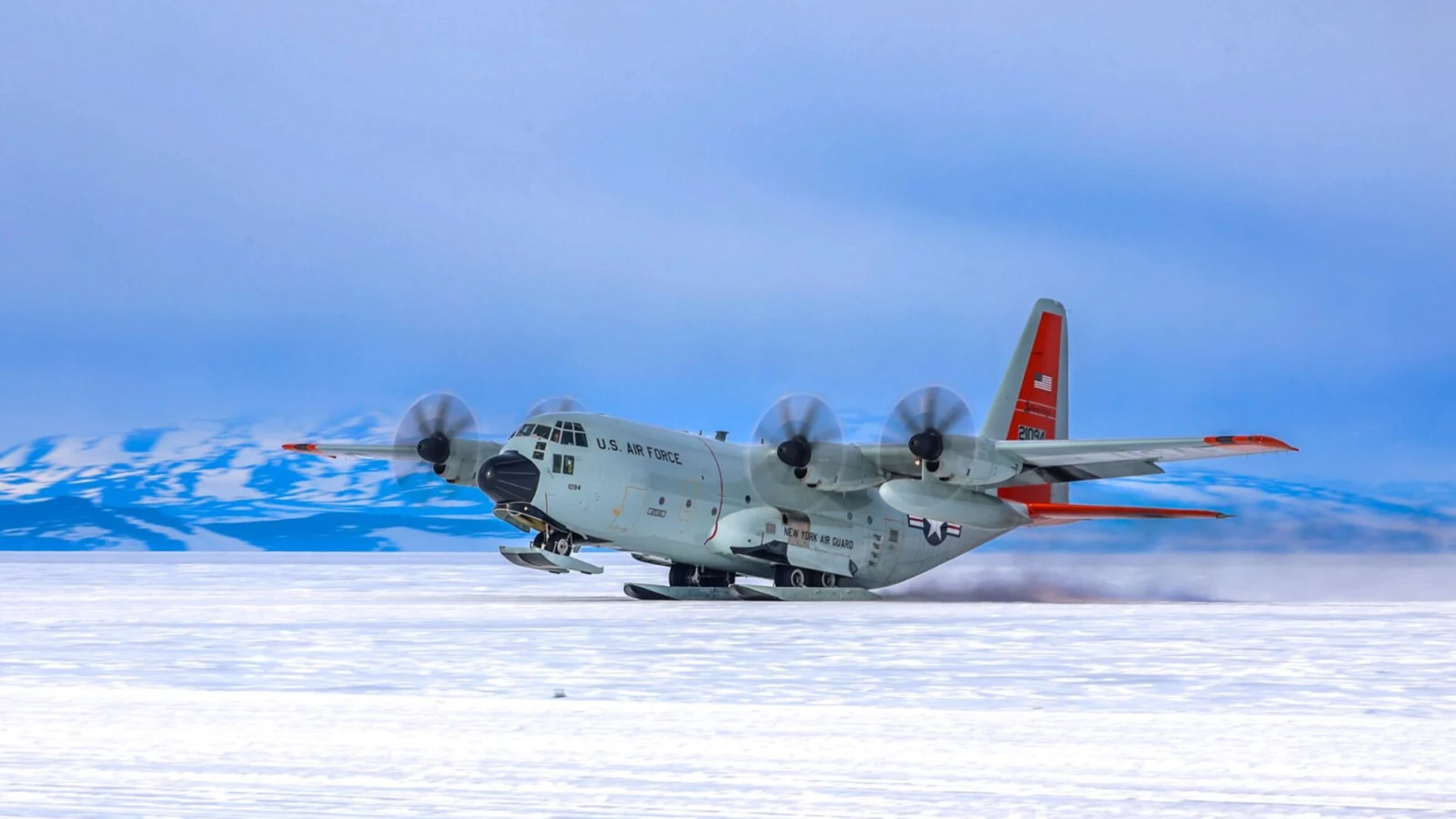
A New York Air National Guard LC-130 Skibird takes off.
Photo: US Air National Guard.
The C-17 Globemaster IIIs, part of the U.S. Air Force’s 62nd Airlift Wing, cannot land on the South Pole station skiway. Instead, they operate to transport personnel and equipment between New Zealand and the U.S. McMurdo station, where they land on a compacted snow runway. On the other side of the world, Globemasters regularly participate in Arctic exercises such as the 2024 Exercise Arctic Shock, and resupply Canadian and NATO forces via the northernmost airfield located in Canada. Production of the C-17s halted in 2015 when the last plane was completed. Although long expected, the closing resulted in over 5,000 jobs being lost. Similar to revitalizing U.S. icebreaker building capacity, restarting production of the C-17, which has significant non-polar utility, would strengthen U.S. defense industrial base. Currently, there is no successor plane in the works, although the National Defense Authorization Act for FY 2027includes a provision that would require the Air Force to report on plans to develop a next-generation strategic airlifter to augment or replace the C-17. Additionally, Boeing is reportedly pursuing opportunities that could result in the production line restarting, although the estimated $8 billion cost to rebuild and restart the line will be a factor.
Through decisive action across two presidential terms, the Trump administration has made significant strides in breaking the decades-long stagnation in U.S. icebreaker building capacity for the Arctic. However, it is currently unclear if it has had similar success with expanding domestic icebreaker building capacity to address its needs for the Antarctic. The administration should build upon its current efforts to ensure the United States can domestically produce both heavy- and medium-strength icebreakers, including research vessels, to advance its interests in both the Arctic and Antarctic. It should further strengthen the U.S. polar defense industrial base by procuring enough LC-130J ski-wheel cargo airplanes and expedite planning for the next generation C-17 to meet expanding operational needs in both polar regions.
Rebuilding the polar defense industrial base, along with developing a pipeline for training and promotion for individuals who specialize in the polar regions, will create jobs and position the United States as a polar leader for the coming decades rather than responding to the advances of great power competitors in the Arctic and Antarctic. Doing so will safeguard the U.S. homeland in Alaska as well as keep the region and the rest of the United States safe from potential threats via the north. It will also allow the United States to remain the country with the greatest capability of independent action in Antarctica, which it has used for decades to insulate that region of the world from international strife.
Domestic collaboration between the White House, Congress, and the elected officials of key states will facilitate sustaining such an effort, as will international collaboration with key allies and neighbors. The result of this investment in the U.S. polar defense industrial base, if done correctly, will be greater operational capabilities to advance U.S. interests in the Arctic and Antarctic and the flexibility to respond to future needs, all of which are in the interest of the United States and maintaining peace in these two regions.
William Muntean is a nonresident senior associate with the Americas Program at CSIS. Alexander B. Gray served as deputy assistant to the president and chief of staff of the White House National Security Council (2019–21), as special assistant to the president for the defense industrial base at the White House National Economic Council (2017–18), and as director for Oceania and Indo-Pacific security at the National Security Council (2018–19).