Manila Strategy Forum 2026
September 9 – 10, 2026
Hosted by Southeast Asia Program

Photo: Wisam Hashlamoun/Anadolu/Getty Images
As the war with Iran marks its 100th day, the conflict is on the verge of full resumption following (1) a dramatic military escalation between Israel and Iran and (2) the Houthis announcing a Red Sea naval blockade of Israeli vessels. In just 24 hours, the tension has spiked considerably starting with Israel’s strikes on Beirut’s southern suburbs and Iran’s retaliation against Israel. Despite President Trump’s urging Israel not to retaliate, Israel subsequently hit targets in Iran, including a petrochemical plant, which could prompt Iran to once again target Gulf energy infrastructure. The president has insisted that the tit-for-tat escalation between Israel and Iran will not affect prospects for a deal and that Israeli Prime Minister Benjamin Netanyahu must accept any deal the United States negotiates with Iran.
Yet, with this latest escalation, prospects for a near-term end to the war—initially predicted by President Trump to last four weeks—remain distant. Diplomacy remains at an impasse as the ceasefire with Iran unravels. The threat of full-on conflict raises some important questions on the prospects for negotiations, the type of deal is on offer, and the potential end states.
Israel’s recent strikes come as fighting between Israel and Lebanon—the Iran war’s second front—escalated as negotiations to renew the April 16 ceasefire were rejected by Hezbollah, the Iran-backed militia in Lebanon. On June 6, Israel targeted a vehicle carrying Lebanese Armed Forces soldiers, killing three, including a Lebanese general, the most senior Lebanese official killed since the war between Israel and Hezbollah resumed on March 2. Hezbollah has undertaken increasingly lethal attacks against the Israel Defense Forces, including using fiber-optic first-person view drones, which are largely impervious to electronic jamming. The military escalation threatens to collapse the ceasefire, which has largely existed only on paper as both Israel and Hezbollah have continued to exchange attacks.
Prior to this latest escalation between Iran and Israel, a June 3 Iranian drone attack on the Kuwait International Airport marked the most significant escalation in recent weeks. It was the first time Iran has returned to hitting Gulf civilian infrastructure, causing one death and multiple injuries. In the same attack, the United States and Bahrain intercepted Iranian missiles and drones targeting Bahrain, where the U.S. Fifth Fleet is based. The strikes came as part of a mounting tit-for-tat campaign: U.S. Central Command launched strikes on Iran’s Qeshm Island on June 6, following Iranian strikes targeting the Strait of Hormuz.
Despite ongoing behind-the-scenes talks mediated by Pakistan, diplomacy between the United States and Iran appears at an impasse, although a surprise breakthrough is always possible. The diplomatic stalemate has been marked by head-spinning announcements of near peace and potential war, perpetuating a dizzying sense of confusion as to where talks stand. President Trump has at times promised that an Iran deal was imminent, for example, in a May 23 Truth Social post noting an Iran deal was “largely negotiated,” only to pull back and signal a less certain timeline and potential resumption of full-on conflict. In a June 5 interview, the president tempered expectations, noting, “It takes years to do these things,” and comparing the current Iran war with the 19-year-long Vietnam War.
Significant differences divide the United States and Iran, centering on three key issues: (1) Iran’s nuclear ambitions, (2) the disposition of the Strait of Hormuz, and (3) the timing, amount, and source of monetary compensation to Iran. Long-standing negotiations with Iran have focused on curbing Iran’s nuclear ambitions in exchange for sanctions relief and the unfreezing of Iranian assets. Iran’s de facto control over the Strait of Hormuz—an unfortunate by-product of the current war—stands as an added and equally consequential element which now must be negotiated. Questions regarding Iran’s ballistic missile capabilities—U.S. intelligence sources estimate that Iran retains 70 percent of its capabilities—appear to have fallen off the negotiating table, as has its support for proxies such as Hezbollah.
The U.S.-Iran talks are essentially nested negotiations. First, there must be negotiations over an MOU to return to the negotiating table—talks to get back to talks. If successfully reached, the MOU would then trigger the resumption of the core negotiation over Iran’s nuclear ambitions. These talks were in their third round when the United States and Israel launched the war against Iran on February 28.
Three potential end states emerge from the various trajectories these nested negotiations could take: a successful peace, a hollow deal, or the resumption of conflict.
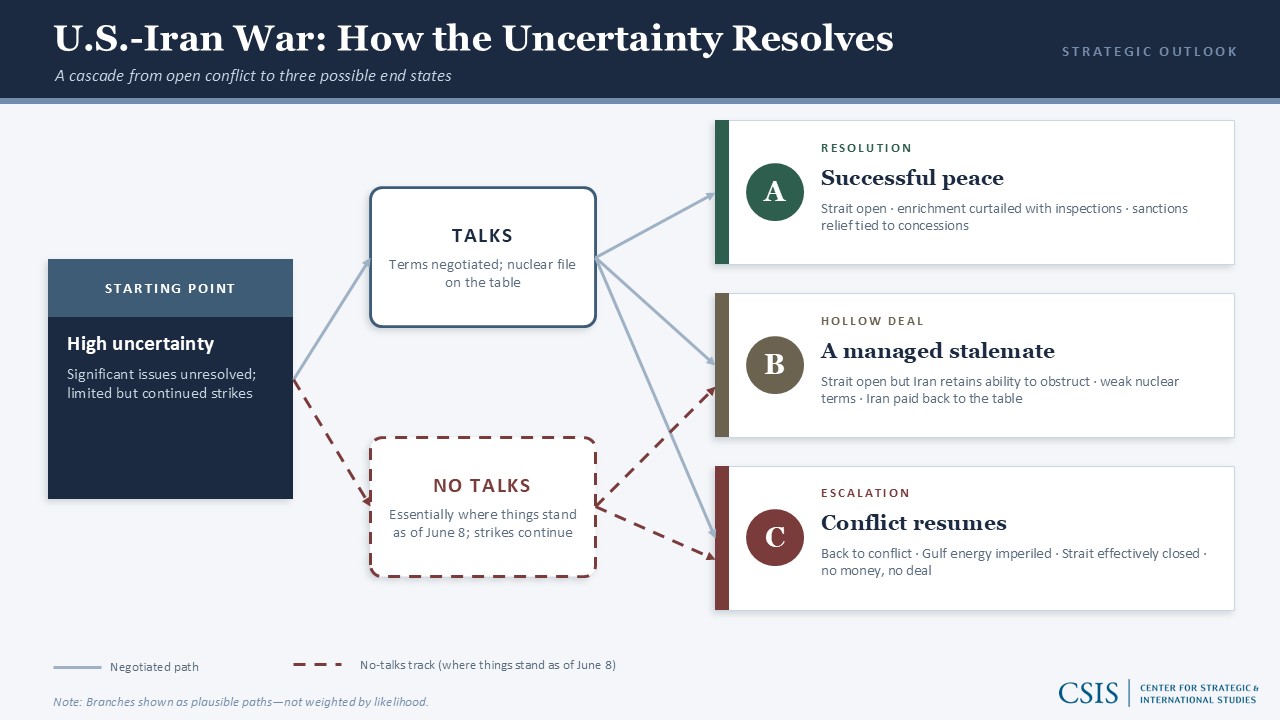
The first and best outcome would feature the strait’s unconditional reopening, a verifiable nuclear deal that curtails Iran’s nuclear enrichment and includes a serious inspection regime, in exchange for some amount of sanctions relief for Iran. Unfortunately, this is the least likely option.
More likely would be either a hollow deal or the resumption of conflict. A hollow deal would be marked by significant compromises and loopholes that favor Iran. It would include the conditional opening of the strait, with Iran either monetizing its de facto control or perpetuating its threat to disrupt traffic at any time. This could include an up-front payment to Iran (perhaps covertly) in exchange for an MOU. A follow-on nuclear deal likely would feature compromises on key issues of contention with Iran and would not include the rigorous inspections needed to verify Iran’s full compliance with any deal.
Most concerning would be a failure to resume talks that precipitates either a resumption of all-out conflict or an extended stalemate marked by episodic kinetic outbursts. This end state would feature the continued closure of the Strait of Hormuz and unchecked Iranian nuclear ambitions, and while Iran would receive no monetary compensation, it would continue to imperil Gulf energy infrastructure with the threat of drone and missile strikes.
Unfortunately, the pressures for President Trump to accept a hollow deal are only mounting. Politically, the conflict with Iran is increasingly unpopular, with a recent The Economist/YouGov poll indicating nearly 70 percent of Americans favor ending the war as soon as possible. Though symbolic, the recent successful House vote to invoke the War Powers Resolution, in which four Republicans joined Democrats, is another indicator of faltering support. Upcoming midterm elections could also figure into the administration’s calculus. Economically, energy companies warn of an impending physical supply crisis as stored supplies run down. While the United States has been less impacted by energy supply constraints, some predict acute price hikes as inventories dry up—leaving price adjustments as the only response to dramatically curtailed supply. Militarily, concerns about the dangerous decline of U.S. defensive missile stocks also contribute to a sense of constrained U.S. options.
One hundred days into the war with Iran, the likelihood of a positive outcome is slim. While negotiations offer the best chance of bringing the war to an end, a return to the status quo ante is unlikely. Instead, a “new normal” is taking shape: one in which Iran is likely to retain de facto control over the strait and its ability to threaten its Gulf neighbors. The coming months and years will feature moves to mitigate the worst impacts of this impending reality as regional and global stakeholders contend with its new features.
Mona Yacoubian is director and senior adviser of the Middle East Program at the Center for Strategic and International Studies (CSIS) in Washington, D.C.
