Capturing National Security Benefits from Offshore Wind
October 20, 2026 • 9:30 – 10:30 am EDT

Photo: U.S. Navy photo via DVIDS
Concern about the status of U.S. munitions inventories has intensified as reports emerge about high expenditures of Tomahawks, Patriots, and other missiles in the Iran war. As Operation Epic Fury remains paused in a shaky ceasefire, there is an opportunity to assess whether the U.S. military nears the point of going “Winchester”—or running out of ammunition.
Analysis of seven key munitions shows that the United States has enough missiles to continue fighting this war under any plausible scenario. The risk—which will persist for many years—lies in future wars.
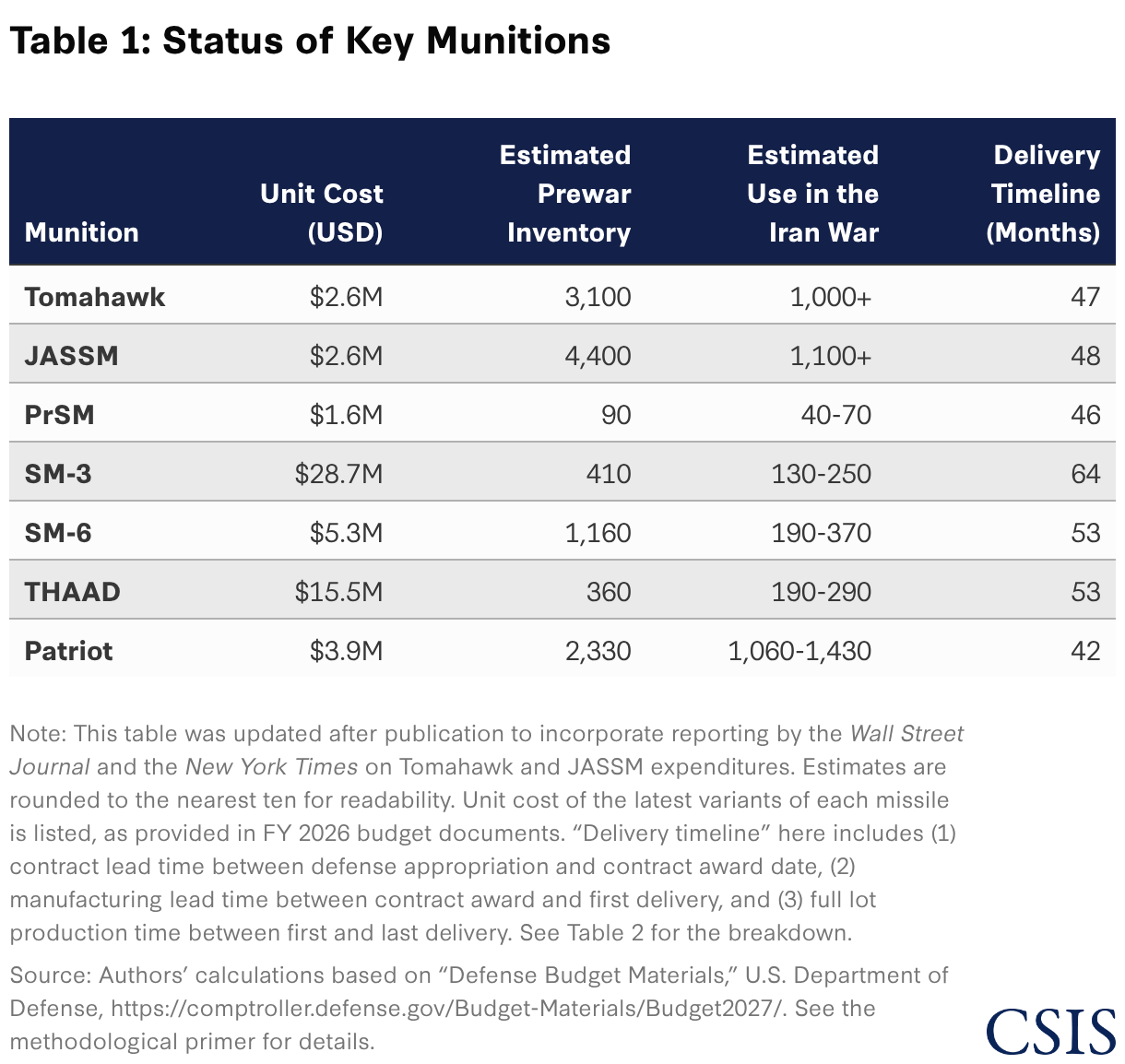
In the 39 days of the air and missile campaign before the ceasefire, U.S. forces heavily used the seven munitions in Table 1. For four of them, the United States may have expended more than half of the prewar inventory. Rebuilding to prewar levels for the seven munitions will take from one to four years as missiles in the pipeline are delivered. These missiles will also be critical for a potential Western Pacific conflict. Even before the Iran war, stockpiles were deemed insufficient for a peer competitor fight. That shortfall is now even more acute, and building stockpiles to levels adequate for a war with China will take additional time.
Diminished inventories will also affect the U.S. supply of Patriot, Terminal High Altitude Area Defenses (THAADs), and Precision Strike Missiles (PrSMs) to Ukraine and other allies and partners that use them. The United States will compete with those countries that also want to replenish and expand inventories.
Before delving into munitions with shortages, it is worth recognizing that many munitions have acceptable inventories. Thus, even if critical munitions run low or run out, the United States will be able to continue the fight.
For ground attack munitions, available alternatives are far cheaper but with the same explosive yield. To illustrate the cost difference, a BLU-110 bomb fitted with a Joint Direct Attack Munition guidance kit costs less than $100,000 while a Joint Air-to-Surface Standoff Missile (JASSM) costs $2.6 million. Both accurately deliver 1,000-pound payloads. These munitions, however, have a shorter range and, thereby, put launch platforms in more danger. Air superiority is required to use them extensively. The alternatives include, but are not limited to:

For countering drones and cruise missiles, the U.S. military has developed several low-cost interceptors, which are detailed in a subsequent section of this analysis. U.S. forces also have abundant—though not necessarily inexpensive—air-to-air missiles as backups.

The final category is countering ballistic missiles. Here, there is no good substitute for Patriot, THAAD, and Standard Missiles. These are part of the seven critical munitions discussed below.
These seven munitions come in two groups: (1) long-range ground attack and (2) air and missile defense. They have been highly effective in fighting this war, and expenditures have accordingly been high. Large numbers are also needed for a future conflict in the Western Pacific. Many allies and partners use these systems as well, creating competition for output.
The Trump administration recently announced a series of agreements with industry to boost production and put missile inventories on a “wartime footing.” The large quantities of munitions in the president’s FY 2027 budget request further underscore the urgency of rebuilding and expanding the inventory. Near-term deliveries, however, are relatively low because of small orders in the past. Even if Congress appropriates the requested FY 2027 funds, it will take years for these missiles to be delivered.
The figures below show inventories, operational usage in the Iran war, proposed FY 2027 procurement, and expected deliveries of the seven critical munitions in FY 2026. A technical note at the end of this report describes the methodology behind the estimates and calculations.
These munitions allow platforms to launch at a long, standoff distance from adversary air defenses. They would be particularly valuable in a conflict with China, which has strong air defenses and a large inventory of long-range cruise and ballistic missiles.
The United States struck more than 13,000 targets over 39 days before the ceasefire took effect. The share of exquisite strike munitions was high in the first few days of the war, as discussed in our previous analysis. As U.S. forces destroyed Iranian air defenses, they transitioned to using short-range, more plentiful munitions listed in Figure 1. Apparently, the United States continued to use some long-range munitions to strike targets too far away or too heavily defended for the alternative systems up until the ceasefire.
The Tomahawk Land Attack Missile (TLAM) is a long-range missile fired from sea at ground targets. Ground-launched versions exist but are not in theater. TLAMs have been in the U.S. Navy inventory since the 1980s, but earlier versions have since been retired. Tomahawks have been used extensively since their first use in Operation Desert Storm: ships can get into firing position without needing authorization from other countries and can also stay ready for extended periods.
The Washington Post reported that U.S. naval assets fired more than 850 TLAMs in the first month of the Iran war. Use evidently continued until the ceasefire, with the Wall Street Journal reporting an updated Tomahawk expenditure of more than 1,000. This could account for nearly all available Tomahawks in the region, assuming two guided missile submarines (SSGNs) are on station. In-theater inventory is constrained as ships cannot yet reload at sea and must return to port. While the exact loadout is classified, 10–50 percent of vertical launch system (VLS) cells on destroyers and cruisers—or 10–61 missiles—are typically loaded with Tomahawks. Each SSGN can carry up to 154 Tomahawks.

The small number of FY 2026 deliveries reflects, in part, an upgrade and life extension program for older TLAM versions, but these are not counted as new deliveries. RTX announced it will increase annual TLAM production to more than 1,000 under the framework agreement with the Trump administration.
Japan has reportedly been told that its deliveries of 400 Tomahawks may be delayed because of the Iran war. This is a blow to the U.S. position in the Western Pacific at a time when Japan builds a more robust military capability against China and needs these missiles to make that policy viable. A Japanese destroyer recently completed modifications to launch TLAMs.
The JASSM is a stealthy, air-launched, long-range missile with a 1,000-pound payload. The current Extended Range (JASSM-ER) version has a longer range than the baseline version. An even longer-range version—Extreme Range (JASSM-XR)—is in development, but none have been delivered yet. An earlier version, the baseline JASSM, is available in the inventory as shelf life is typically 20 years. JASSMs were first used in 2018 when President Donald Trump ordered strikes against the Assad regime’s chemical weapons facilities.
Bloomberg reported that more than a thousand JASSMs have been used in Operation Epic Fury’s first month. B-52s from Royal Air Force bases continued to fly attack sorties with these missiles, and around 1,100 JASSM-ERs have now been used according to the New York Times.

While Poland, Australia, and Finland also operate JASSMs, because they have not used any recently, competition for new production will not be as intense as for systems like Patriot or THAAD.
The PrSM is ground-launched by field artillery units—Multiple Launch Rocket System (MLRS) or High Mobility Artillery Rocket System (HIMARS). It succeeds the Army Tactical Missile System (ATACMS) with a longer range (>500 km vs. 300 km). The need to have access to friendly territory within range of targets limits their use. In the current conflict, these missiles have struck a wide variety of targets—including a submarine, apparently. An Army official reportedly shared that the “entire inventory of PrSM” had been expended in the Iran war, though other officials maintain some remain in the inventory.

PrSM inventory is limited as it is a relatively new system with deliveries beginning in 2023. Some of the shorter-range ATACMSs, perhaps as many as 800, are still available. Lockheed Martin has been scaling up PrSM production, setting an annual target of 400 units last year and announcing further increases under the framework agreement with the Trump administration. Ukraine has received ATACMSs and would like PrSMs. The shrinking inventory likely precludes further deliveries in the immediate future.
These munitions are needed in the Western Pacific because China has thousands of missiles that threaten U.S. and coalition forces in the region. They are not suitable for defense against drones because of their high cost and scarcity.
The Standard Missile 3 (SM-3) is a ship-launched interceptor against ballistic missiles. Shore-based versions exist (“Aegis ashore”) but are not in theater. Block IIA is the latest variant with improvements to the rocket and kinetic warhead. The Missile Defense Agency continues to procure the previous Block IB missile, despite previous plans to stop new production. Its first use in combat was in April 2024 when four to seven were fired to intercept Iranian ballistic missiles launched at Israel. Around 80 more were fired during the Twelve-Day War in 2025. As with the TLAM, in-theater inventory is constrained because of the need to be reloaded in port.

The Standard Missile 6 (SM-6) is also ship-launched, primarily against aircraft and cruise missiles, but can also be used against ships and ballistic missiles. It is a follow-on to the SM-2 but with greater range and a larger target set. Some SM-2s remain in the inventory. RTX plans to increase SM-6 production to more than 500 missiles a year.

The THAAD is ground-launched against ballistic missiles, with a longer range and higher intercept altitudes than the Patriot. The interceptor numbers were already limited, particularly after more than 150 were fired against Iranian ballistic missiles during the Twelve-Day War. The United States also has only eight THAAD batteries. At least two were outside the continental United States in Guam and South Korea before this war; several batteries have been deployed from the United States to the Middle East for Operation Epic Fury. The United Arab Emirates also has two, and Saudi Arabia has one. A THAAD battery consists of six launchers with eight interceptors each, one AN/TPY-2 radar, and various fire control and communications systems. The United States may have moved some THAAD components from South Korea to the Middle East in March to replace destroyed components or replenish expended interceptors.

The large FY 2027 budget request reflects the low inventory and high demand. There have been no new deliveries of THAAD interceptors since August 2023. Deliveries are set to resume by April 2027. Under the Trump framework agreement, Lockheed Martin announced it will increase THAAD interceptor production capacity to 400 a year from the current 96. Of the seven critical munitions, THAAD interceptors are the most critical due to their low inventory and lack of alternatives. Beyond the interceptor inventory, the possible damage or loss of multiple AN/TPY-2 radars that provide targeting data for THAAD batteries will cause a capability gap and take time to replace. Only 13 radars have been delivered to the United States so far.
The Patriot is ground-launched against aircraft, ballistic missiles, and cruise missiles. The current version is called the Patriot Advanced Capability-3 (PAC-3) Missile Segment Enhancement (MSE) with upgraded rockets and guidance technology. Figure 9 includes earlier PAC-3 interceptors procured throughout the 2000s and that remain in the inventory. Up to 400 of the older PAC-2 missiles may also still be in the stockpile but are not included in Figure 9.
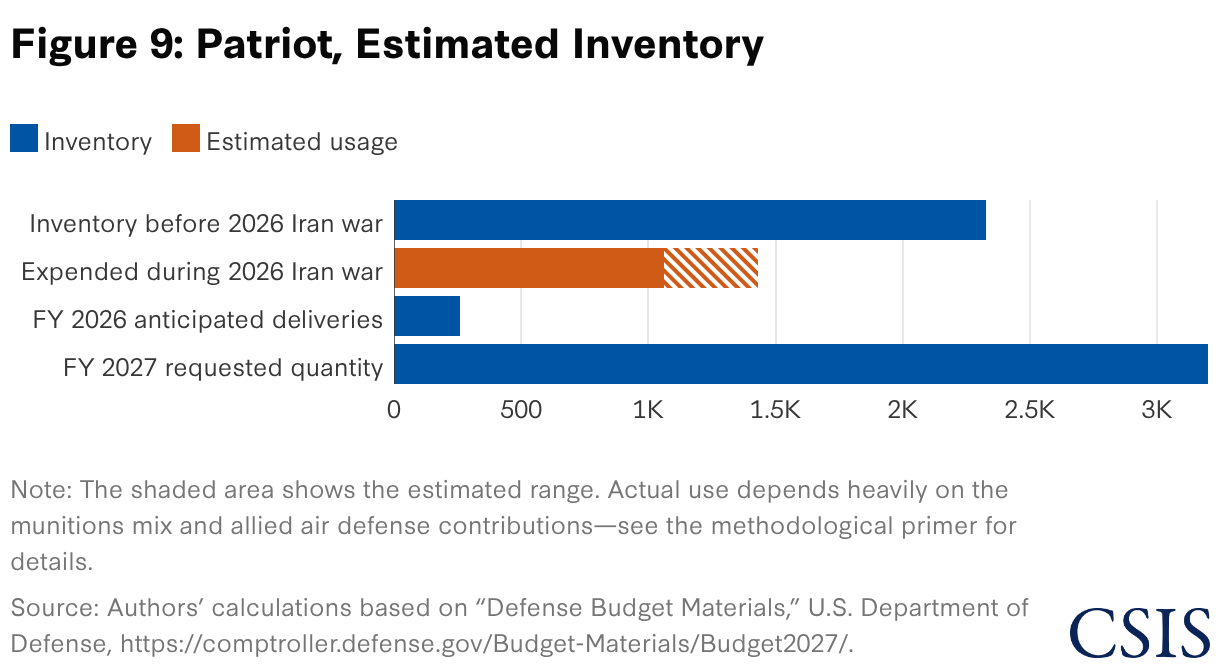
Because 18 other countries use the Patriot, these missiles are highly sought after. About half of the annual production goes to support these allies and partners. Ukraine is also a major user, having received more than 600 from the U.S. and other allies over the course of the war.
Lockheed Martin plans to increase annual PAC-3 MSE production to 2,000 by 2030—up from the current 600. Until this increased production becomes available, the United States will face choices on allocating production to meet demands. Pacific-oriented strategists will want the United States to withhold Patriot and other missile production for use in the Western Pacific. Meanwhile, Ukraine would want more interceptors. President Volodymyr Zelensky has pointed out that every Patriot fired in the Middle East is one fewer that Ukraine can acquire. The Swiss have threatened to buy an alternate system after being told its purchase might be delayed. Other U.S. allies are also in the queue.
There are many steps before these FY 2027 budget proposals become missiles in the field and on ships. First, Congress must pass an appropriation—difficult in the best of times and particularly challenging this year when much defense procurement spending is in a FY 2026 supplemental and a FY 2027 reconciliation bill.
Then, there is the manufacturing lead time for the first delivery. Historically, that has been about 24 months, but as munitions orders have outstripped production capacity in recent years, lead times have stretched to 36 months or more. Production time for the entire lot is another 12 months. That is about 52 months in all—over four years.

Many of these systems are constrained by production capacity, so manufacturing lead time is even longer. On the bright side, previous funding going back to the Biden administration supported the expansion of production rates for many systems, so the cycle time will come down.
The high-cost/low-inventory dynamics described above have driven many experts in and out of government to recommend that the United States build low-cost systems to complement or even replace the high-cost systems. Indeed, the FY 2026 reconciliation bill contains several billion dollars for this purpose (Sections 20004 and 20005).
As Figure 1 shows, the United States already has many inexpensive and short-range systems for ground attack. First-person view drones—which are vital to fighting in Ukraine—are not useful here because of their limited range of roughly 20 miles. To field an inexpensive and long-range system, the United States copied the Iranian Shaheed-136 (as did Russia). The result was the Low-Cost Uncrewed Combat Attack System (LUCAS).
The LUCAS ( $35,000) provides an affordable way to deliver standoff precision attacks, with a range of roughly 500 miles. The tradeoff is that it carries a small warhead of 40 pounds. The United States used some in the Iran war but did not have enough to match the salvos launched by Iran in this war or by Russia in Ukraine.
The other category is counter–unmanned aerial systems (c-UASs). The Department of Defense (DOD) began work on the c-UAS about a decade ago, but that proceeded at a measured pace. The war in Ukraine demonstrated how important such systems were, so the United States sent some prototype systems to support Ukraine and accelerated its own efforts. These efforts have produced several low-cost ways to intercept the inexpensive Iranian drones:
Except in rare cases, the United States has not used the very expensive systems (Patriot or SM-6) against cheap drones (the Gulf states may have done that in the early days of the conflict). It also has not had enough cheap interceptors. As a result, the United States and the Gulf states have used helicopters with guns, fixed-wing aircraft with guns, and air-to-air missiles to conduct the intercepts. Some of these air-to-air missiles (AIM-120) cost $1 million each. It is better to use one of those than let the drone get through, but that is not a long-term solution.
This section describes how CSIS developed the numbers in this analysis.
Munition inventories are classified, but publicly available information is sufficient to make estimates. The annual DOD budget documents are the starting point to calculate the total number of missiles delivered to the U.S. military:
Of the total deliveries, 5 percent was deducted for training, lot testing, and other nonoperational uses. Reported and estimated expenditures in past campaigns were also subtracted, where applicable. Deliveries to Ukraine from U.S. stockpiles came from DOD releases and our previous estimates.
Estimated munitions use during Operation Epic Fury was derived from the approach used in CSIS’s cost estimate of the war, detailed in a previous commentary. The starting point here was, again, DOD-released numbers that were then combined with data from Gulf countries, the theater order of battle, and historical employment patterns. The high and low estimates take into account that the actual expenditures will be highly sensitive to the coalition’s contributions to air defense, share of long-range systems for strikes, and the mix of munitions used. For TLAM and JASSM, the analysis reflects expenditures reportedly shared by DOD officials.
The best source on the various munition programs is the Selected Acquisition Report, where available, because of its comprehensive acquisition data. The FY 2027 budget amounts came from the DOD-published materials in early April. Though these documents are incomplete, they provide the number of munitions to be funded. Unit cost of missiles can vary year-to-year. This analysis provides the latest figures based on the FY 2026 budget documents.
If inventories are so depleted, how can the analysis conclude that the United States has enough munitions for this war? The answer lies in the dramatic drop in usage from the early days of the war. For ground attacks, the less expensive and more plentiful munitions of Figure 1 have largely replaced the long-range munitions (TLAMs, JASSMs, and PrSMs). Air and missile defense expenditures came down because Iran’s drone and missile attacks were way down after the first few days. Whereas Iran fired more than 2,000 drones and 500 ballistic missiles in the first four days, launches were down, respectively, by 83 and 90 percent after a week.
The diminished munitions stockpiles have created a near-term risk. A war against a capable peer competitor like China will consume munitions at greater rates than in this war. Prewar inventories were already insufficient; the levels today will constrain U.S. operations should a future conflict arise.
President Trump has accepted this munitions risk—alongside other tradeoffs like the diversion of forces from the Western Pacific. The theory here appears to be that it is important to decisively win the current war you are in, rather than to hold back and preserve capability for a future war that may never happen. Once Operation Epic Fury ends, the naval assets sent to the Middle East will return to the Pacific. Munitions inventories will start to recover, but restoring depleted stockpiles and then achieving the desired inventory levels will take many years.
Editor's Note: This report was updated on April 24, 2026, with new details on Tomahawk missile and JASSM expenditure from the Wall Street Journal and the New York Times, respectively.
Mark F. Cancian (Colonel, U.S. Marine Corps Reserve, ret.) is a senior adviser with the Defense and Security Department at the Center for Strategic and International Studies (CSIS) in Washington, D.C. Chris H. Park is a research associate for the Arleigh A. Burke Chair in Strategy at CSIS.
Madison Bruno and Sabina Hung reviewed and formatted this report with their characteristic—and sincerely appreciated—alacrity and diligence.
If you are interested in learning more about this topic, explore CSIS’s Executive Education courses Meeting China’s Military Challenge and Inside DOD’s FY 2027 Budget.

Commentary by Mark F. Cancian and Chris H. Park — March 25, 2026

Commentary by Mark F. Cancian and Chris H. Park — March 13, 2026

Report by Mark F. Cancian and Chris H. Park — January 27, 2026
Video — May 1, 2026

