Who's Paying for the Iran War? | The High Top
August 25, 2026 • 10:00 – 10:15 am EDT

Photo: JOEL SAGET/AFP/Getty Images
The United States needs a clearer way to use economic tools to strengthen its own defense base while making it harder for rivals to build military power. With the creation of the new Economic Defense Unit designed to synchronize economic competition efforts, as well as provisions in the FY 2026 National Defense Authorization Act allowing the Office of Strategic Capital “to collect fees for loan and guarantee recipients,” a new playbook is emerging. Together, and working alongside traditional offices in the Departments of the Treasury and Commerce, the goal is to transform “government contracts into bankable assets that companies can use to secure private loans,” thereby accelerating the United States’ ability to gain a military and technological advantage in long-term competition. The aim is to ensure the United States and its allies can produce critical military goods faster and more reliably than their rivals without disrupting peacetime economic growth.
This renewed thinking around an old idea requires a clearer conceptual map. Economic warfare once meant blockades, privateering, and other efforts to deny an enemy food, fuel, or trade. Today it also means shaping finance, supply chains, technology access, and industrial capacity. During the mid-twentieth century, economic warfare started to be seen more as a subset of irregular warfare. This placement is a byproduct of the emergence of modern unconventional campaigns during World War II linked to the Office of Strategic Services in the United States and Special Operations Executive in the United Kingdom. In the immediate aftermath of the war, the Central Intelligence Agency (CIA) expanded on these ideas, defining economic warfare as the use of multiple instruments of power to “impair an enemy’s economic support of his war effort.”
Yet how does a state balance both sides of the ledger? How should U.S. policymakers approach increasing the government’s ability to work through private markets—a major objective of the Economic Defense Unit—to more efficiently mobilize resources and limit the ability of rivals such as the Chinese Communist Party without destabilizing the global financial architecture?
This analysis addresses this question by providing a historical and conceptual context for thinking about what constitutes economic warfare and how best to align military and non-military instruments of power to gain an advantage in long-term competition. The key is to develop a clear objective function that achieves the basic goal of making it harder for an adversary to turn money, materials, and technology into military power, while protecting allies’ ability to do the same. This logic applies during both peacetime and wartime. Given that goal, this analysis proposes three key principles for thinking about maximizing utility: (1) fungibility, (2) elasticity, and (3) market making. These core economic and financial concepts provide a way to describe how states should approach economic warfare as a key component of both long-term competition and modern military campaigns.
First, there is a deeper tension that has historically separated these domains. Economics and warfare operate under traditionally opposing logics. Markets reward openness and efficiency, while war rewards advantage, secrecy, and the ability to impose costs. Markets optimize through voluntary exchange, competition, and price discovery, characterized by Adam Smith’s proverbial invisible hand. By contrast, warfare optimizes through coercion, deception, and the imposition of costs. As Carl von Clausewitz noted in his writings on the nature and character of warfare, it is “a continuation of State policy by other means,” as opposed to profit by other means. Markets tend to be analyzed in terms of relative gains, while absolute gains govern narratives of war.
Combining these ideas under the charged heading “economic warfare” seeks to harmonize two logics that traditionally contradict each other. In the abstract, markets want efficiency; warfare thrives on asymmetry. In the aggregate, markets require trust and transparency; warfare exploits information asymmetries to gain a position of relative advantage. While firms certainly seek information asymmetries and relative advantage in market competition, free market capitalism creates a series of feedback loops that, when working, tend to minimize inefficiencies and asymmetry, which in the extreme includes creative destruction. Any serious theory of economic warfare should acknowledge this tension rather than assume it away, then demonstrate how it can be managed without destroying either the economic system that generates national power or the coercive capacity that protects it.
The diplomatic, information, military, and economic power (DIME) framework puts economic warfare at the seam between economic and military power, which is where this tension lives (see Figure 1). A conventional military goes after an adversary’s armed forces. Economic warfare goes after the machinery behind them, specifically focusing on the flows of capital, materials, and access that a country converts into real capacity. It seeks to “starve” the system that builds an army, not beat one in the field. Tools such as sanctions, trade controls, capital restrictions, and standards all work because markets run on trust and openness and an adversary can be made to lose both or pay a high premium for opaque transactions. The harder question, tackled in the rest of this paper, is how to wage economic warfare without degrading the very markets that give capital-rich countries such as the United States power in the first place.
At its core, economic warfare is a contest over the “sinews of war”: the systems that mobilize resources and convert them into combat power. In practice, economic warfare consists of coercion and campaigning that target flows (e.g., goods, capital, energy, data, and people), conversion (e.g., industrial capacity, logistics, and finance), and access (e.g., infrastructure, standards, and market entry) in order to shape an adversary’s choices. It is equal parts coercion, industrial planning, and economic policy. The art involves not just affecting how states access and deploy capital (e.g., through sanctions) but also making investments that shape supply chains and financing to create military capabilities. The distinction matters because economic warfare is not simply warfare conducted by economic means. It is a fundamentally different form of strategic competition, one that operates against the adversary’s conversion function rather than against its fielded forces.
True strategy thus reflects both sides of the ledger: how a state increases its own ability to convert resources into military capabilities, access, and influence and how it constrains or even degrades that conversion in an adversary. By extension, this strategy can include multiple approaches, including the maritime tradition of blockades and privateering; the fiscal tradition of credit, subsidies, and monetary control; the administrative tradition of customs, inspections, licensing, and regulatory friction; and the infrastructure tradition of building ports, rail lines, pipelines, cables, and canals to shape regional advantage over decades. Regardless of what levers a state seeks to pull, for economic warfare to work it has to be treated akin to operational design, with a careful eye toward how to arrange forces and functions, sequence actions in time and space, select decisive points, anticipate system change, and stop short of the point where pressure stops working. In practice, this means choosing which economic pressure points matter most, when to apply pressure, and how to avoid harming allies or the broader market.
Given this objective, developing economic warfare strategies therefore requires first conceptualizing how a state generates military power. In his seminal work, The Pursuit of Power, William H. McNeill identifies a thousand-year trajectory wherein military activity transitioned from the direct command of rulers to a complex interaction with market forces. The historical arc bends inextricably toward capitalization and markets as more efficient mechanisms, with modern military power depending on a state’s ability to finance, build, move, and sustain forces. Ancient and medieval regimes, constrained by slow, command-driven extraction, eventually gave way to the disruptive market forces first glimpsed in Song dynasty China but truly unleashed in early modern Europe, where state survival demanded access to credit. As the Gunpowder Revolution drove the cost of lethality to unprecedented heights—with expensive artillery and capital-intensive bastion fortifications pricing smaller actors out of the security market—European monarchs were forced to wed the bureaucratic management of standing armies to the financial innovations of private bankers. This monetization of violence laid the groundwork for the modern era, during which the French Revolution collided with the mechanical throughput of the Industrial Revolution. By the time rail networks and rifled artillery dominated the late nineteenth and early twentieth centuries, combat power was no longer just about fielding mass formations but about the industrial integration of private enterprise and state survival. Over time, countries that could borrow money, mobilize industry, and organize supply chains gained a military advantage over countries that relied only on direct command.
This system continued to deepen as the modern nation-state emerged, complete with industrial planning and mass mobilization, often leading to complex political economies that connected elites, large firms, and the administrative state. This trajectory culminated in World Wars I and II and the establishment of a permanent military-industrial complex. Great powers were locked into a relentless cycle in which economic research and development became the ultimate engine of tactical superiority, proving that the true arbiter of war is—and always has been—the capacity to fund, build, and sustain major military campaigns. Furthermore, the system evolves based on supply chains, access to resources, and creative productivity gains that generate efficiencies, a phenomenon on display among Ukraine’s drone entrepreneurs. The lesson is that military advantage depends not only on weapons, but on the economic system that produces and sustains them.
Sanctions are the area bombing of economic statecraft. They impose costs on the target, but at a ratio of collateral damage to strategic effect that no modern military commander would accept.
The historical arc reveals a persistent and telling asymmetry. The instruments of military coercion have grown steadily more precise over centuries—from the indiscriminate bombardment of cities to precision-guided munitions and from conscripted armies to surgical special operations. Yet the instruments of economic coercion remain blunt almost to the point of self-defeat. Sanctions, for instance, are the area bombing of economic statecraft. They impose costs on the target, but at a ratio of collateral damage to strategic effect that no modern military commander would accept. Modern military targeting has become more precise, but many economic tools still impose broad costs because governments cannot always separate military-relevant activity from civilian commerce.
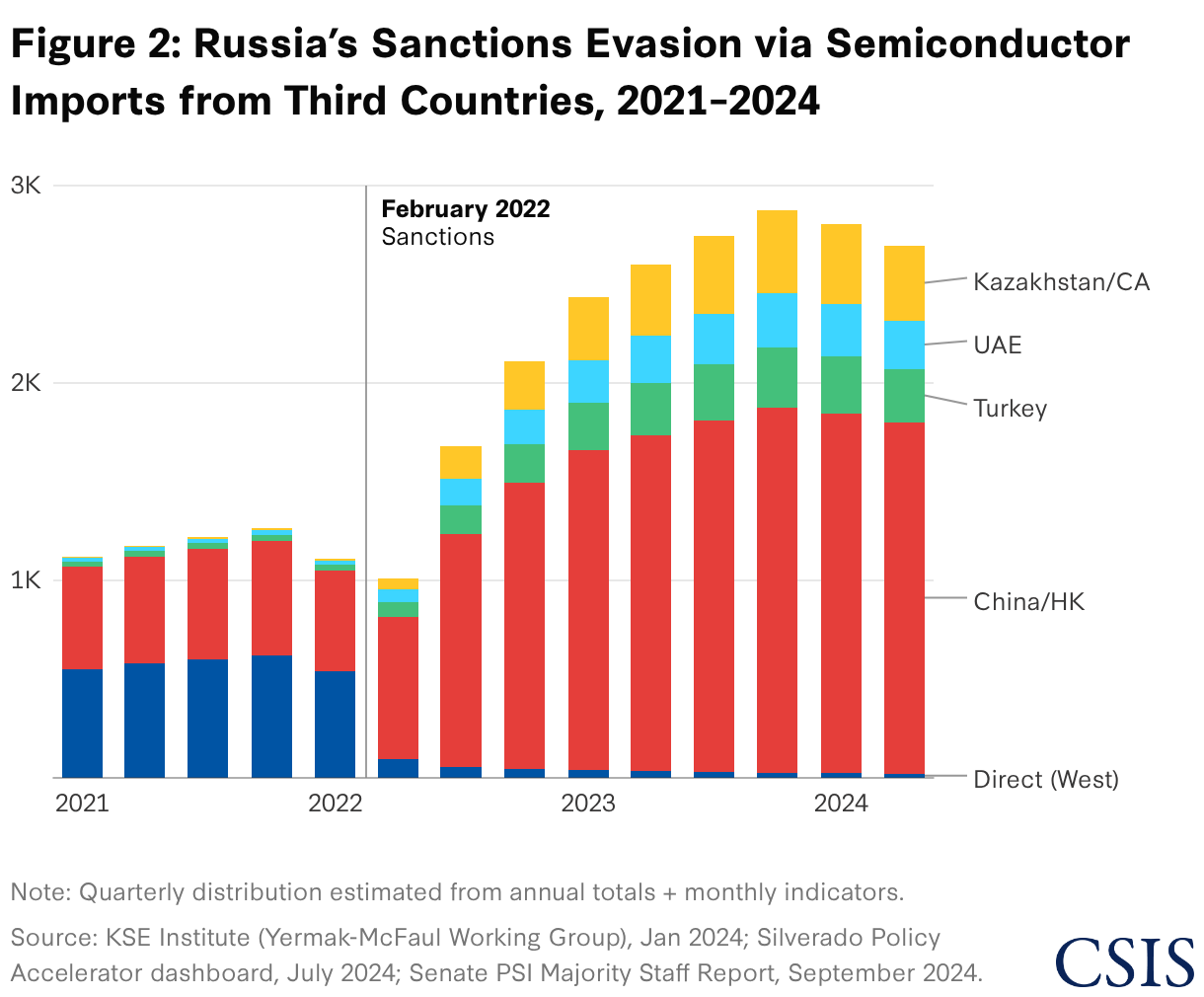
As shown in Figure 2, Russia demonstrated the feasibility to circumvent sanctions by changing country-level imports. U.S. semiconductor export controls disrupted allied automotive supply chains, energy sanctions were delayed for months while Europe scrambled to line up alternatives, and secondary sanctions challenged coalition unity rather than tightening it. The binding constraint was not political will but analytical precision, in this case the inability to distinguish military-relevant economic activity from civilian commerce with anything approaching the discrimination that modern targeting provides in the kinetic domain. This precision deficit is the central operational problem of economic warfare.
The optimal strategies involve maximizing the use of economic tools to reduce a state’s singular dependence on direct military action (i.e., a combined, interagency approach). The strategy employed by British Prime Minister Pitt the Elder during the Seven Years’ War shows how economic pressure and military action can reinforce each other. Pitt did not view the war as a series of isolated campaigns but as a single, coherent architecture. His strategy used subsidies, naval power, and attacks on colonial trade to stretch French resources and weaken France’s ability to keep fighting. This rendered Paris incapable of defending its lucrative sugar islands and fur trade or financing the naval expansion necessary to challenge British command of the sea. Simultaneously, the “eccentric attacks” on Louisbourg, Quebec, and Havana, Cuba, (after Spain joined France in 1761) were not mere territorial grabs but targeted strikes on the enemy’s economic centers, severing the commercial arteries that sustained the French state. Pitt’s approach was the ultimate expression of combined strategy, ensuring that every coin spent in Prussia bought time for a frigate in the Caribbean and ultimately proving that victory lies not in the clash of armies alone, but in the orchestrated collapse of an adversary’s capacity to wage war. This made him a master of limited liability warfare: prioritizing naval power and economic pressure while bankrolling allies to do the heavy fighting on land and only contributing small, professional expeditionary forces.
This focus on using strategic efforts to limit an adversary’s ability to generate combat power pervaded nineteenth and early twentieth century seapower debates. Commerce raiding alone was insufficient and required a broader strategic approach. Per Alfred Thayer Mahan, command of the seas set conditions to blockade an enemy’s ports and carry out a systematic attack on its commerce, including trade with neutral states. Prior to World War I, the British Admiralty had developed a sophisticated “short war” strategy designed to destroy the German economy rapidly, but political leaders abandoned it at the last minute due to fears of global financial collapse. The CIA also wrote multiple tomes on economic warfare in the aftermath of World War II.
Applied to the contemporary environment, these principles point toward what Henry Farrell and Abraham Newman have termed “weaponized interdependence.” In a connected global economy, power comes from controlling chokepoints such as payment systems, shipping routes, data networks, technology standards, and supply chains. Power emerges from a state’s position within a global economic network that allows it to shape resource and capital flows. For instance, technology standards govern the workings of global communications and AI. Likewise, shipping premiums, standardized containers, and associated laws and conventions shape the functioning of maritime commerce, which accounts for more than 80 percent of all trade. This perspective is a corollary to mercantilism and other efforts (such as import substitution) that favor autarky and command-driven economies over the creative potential of the free market.
Attestation is cheap, verification is expensive, and the gap between the two is where bad actors operate. The problem is not just false data, it is missing data: the unexplained gap, route change, shell company, or capacity mismatch that signals evasion
The weak point in the modern system is trust. A document may say a shipment is compliant, but governments still need a way to know whether that claim is true. A compliance certificate, a bill of lading, a country-of-origin declaration—these are all signals, and as George Akerlof has argued, markets break down when verifying a claim is more expensive than faking one. Sanctions evasion, cross-border financial fraud, and illicit supply chain activity are not failures of the system so much as predictable outputs of it. Attestation is cheap, verification is expensive, and the gap between the two is where bad actors operate. The problem is not just false data, it is missing data: the unexplained gap, route change, shell company, or capacity mismatch that signals evasion. Put simply, you cannot wage economic warfare if you cannot visualize and describe the adversary as a system and how that system converts goods into weapons and coercive leverage.
Policymakers need a repeatable way to decide which economic tools to use, when to use them, and what effects they should produce. Planners must move beyond ad hoc mercantilist reactions toward a more systematic understanding of how economic opportunity and pressure function. This analysis is not the first to call for principles of economic warfare. Earlier work sought to adapt principles of war to describe economic warfare while other, more recent accounts, focus on its more military dimensions in the form of blockades and maritime interdiction. The set of principles presented here is based less on Enlightenment-era thinking about war and military theory and more on core concepts from finance and economics. The three principles—fungibility, elasticity, and market making—provide a foundation for new thinking about economic warfare.
The fungibility of a resource determines its leverage. As a result, the United States should seek to make adversary resources less fungible and networks more so.
Fungibility describes the degree to which a resource can be substituted or redeployed for alternative uses without losing productive value. If an adversary can easily replace an input, pressure on that input will have limited effect; if the input is hard to replace, even a narrow restriction can create major leverage. The less fungible a resource, the more likely it is to provide a point of leverage, yet even small efforts to hold a non-fungible resource at risk (e.g., restricting a specific semiconductor manufacturing chemical) produce disproportionate systemic outcomes. The goal is to find low-fungible goods and services you can deny the adversary. This is precisely the leverage the Chinese Communist Party exercises against the United States by controlling access to its rare earth and critical minerals, which are essential to the 16 key sectors identified in the 2024 National Security Memorandum on Critical Infrastructure Security and Resilience.
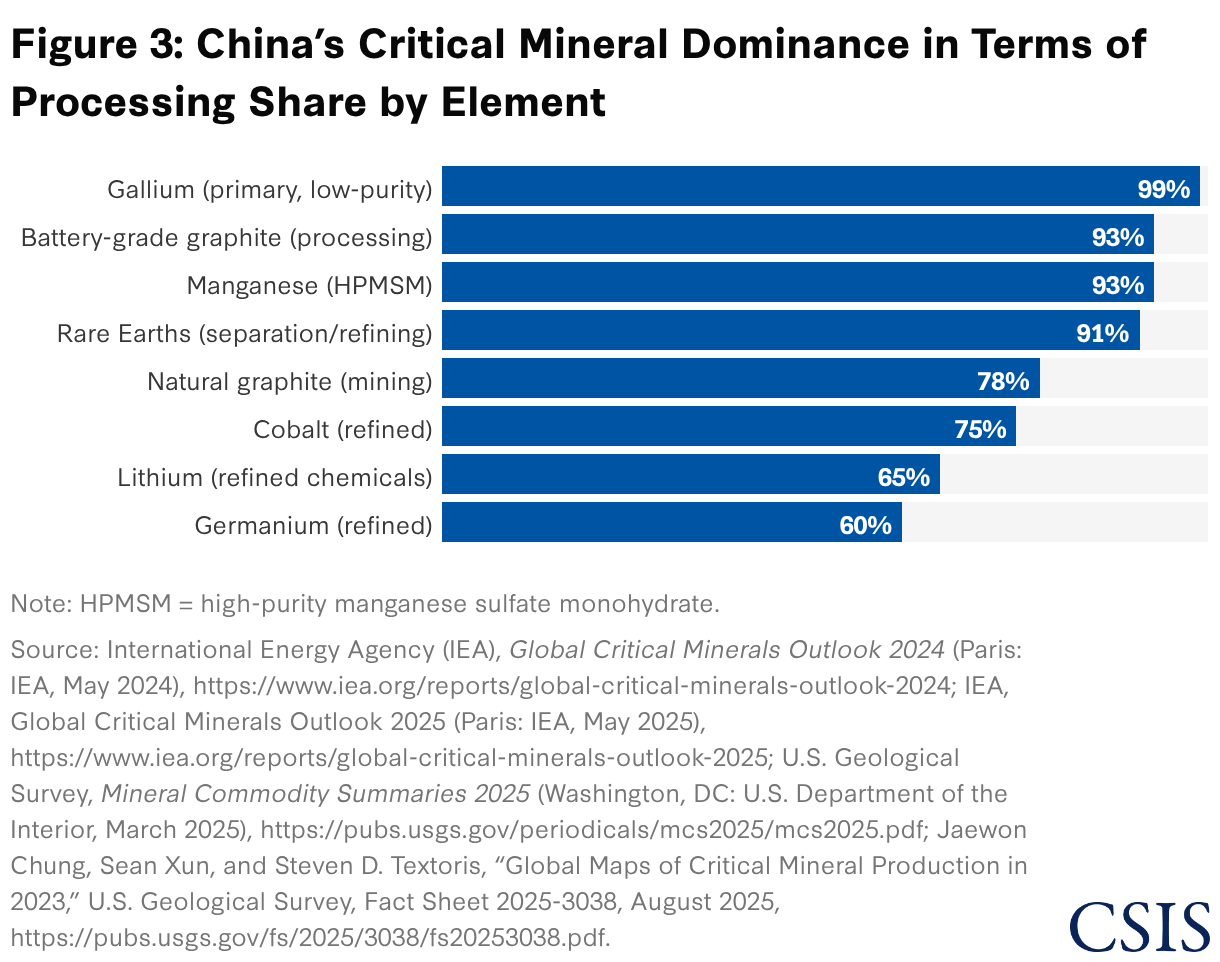
Naming the low- and non-fungible resources is not the same as controlling them. As shown in Figure 3, China accounts for roughly 60–70 percent of global rare earth extraction and more than 85 percent of processing capacity, while U.S. domestic processing for most of these elements is effectively nonexistent. This is the dependency that Defense Federal Acquisition Regulation Supplement 252.225-7052 and Foreign Entity of Concern (FEOC) exclusion rules were designed to address, but both regimes rely on self-attestation by primary contractors who often cannot verify what their own tier-three suppliers do. Without per-element chain of custody—the ability to trace an ore shipment from mine through separation to end use—“de-risking” remains a policy slogan that cannot be enforced at the transaction level.
Fungibility identifies potential leverage, but verification determines whether that leverage can be used. A state may correctly identify a low-fungibility input, such as a specialized mineral, chemical, or component, but the restriction will fail if adversaries can relabel, reroute, or comingle that input with compliant supply. In this sense, while verification does not create fungibility, it does preserve the policy distinction between restricted and unrestricted goods, without which even a low-fungibility input can be laundered back into the market as if it were interchangeable.
Coercive efficacy in economic warfare is a function of elasticity. The United States should strive to reduce price elasticity in how a rival converts goods into weapons of war and influence.
Elasticity asks how easily a targeted adversary can adjust. If the target has no substitute, pressure works better; if it can reroute or replace the input, pressure weakens. In economics, price elasticity measures the extent to which demand or supply responds to changes in price. In a coercive context, this determines the threshold of pain a target can withstand. If a target state has an intense need for a resource (e.g., energy or pharmaceuticals) and no domestic alternatives, the elasticity of demand is low, meaning demand is likely to persist despite price fluctuations. In this scenario, sanctions are highly effective at imposing costs. If the target can easily redirect trade to alternate markets or third-party “sanctions busters,” the demand is elastic and the coercion will likely fail to change the target’s behavior. As a result, coercive efficacy is conditional based on dependency. This occurs when a state needs specific inputs from an ally or neutral party and does not have the means to purchase them or find substitutes within the required time horizon.
In economic warfare, speed matters. A restriction only works if evasion is detected before the adversary turns the restricted input into military capability. What classical price theory omits is the detection lag. In textbook economics, elasticity is observed after the fact through price and quantity responses. In economic warfare, the variable that matters operationally is not whether the adversary finds substitutes, which they often can, but whether one can detect the substitution before the adversary’s conversion cycle completes.
As illustrated in Figure 4, Russia’s post-2022 invasion networks exploited exactly this gap. Sanctioned semiconductors moved through Central Asian intermediaries, oil was relabeled through Indian and Turkish refineries, and dual-use technology transited shell companies in the United Arab Emirates. Individual transactions were small and moved faster than the audit cycle could catch them. Mechanism design theory states that rules alone do not produce compliance when monitoring is imperfect and information is delayed. Compliance instead comes from incentive structures in which the desired behavior is also the agent’s preferred choice. The solution, then, is not tighter rules but better-designed enforcement, specifically systems in which compliant behavior is structurally cheaper than evasion. This shift transforms elasticity from a static property of the commodity into a dynamic property of the enforcement architecture itself.
Market power is a function of liquidity and centrality. The United States should strive to create deep, unavoidable markets for allies while forcing adversaries into markets they cannot afford to leave.
Market making means building markets so deep and useful that allies want to use them and adversaries find them hard to leave. In economics, market making involves providing liquidity to facilitate trade. This relies on network effects, wherein the value of a network increases alongside its user base, creating “lock-in” dynamics that make switching costs prohibitively high. The goal is to subsidize a state’s technical standards and platforms—from 6G protocols to dollar-clearing systems—to ensure they remain the deepest, most liquid markets in the world. Once an adversary is locked in, it is subject to the central actor’s surveillance and rules; if it attempts to defect to a rival system, it faces a liquidity desert wherein transactions are slow, visible, and inefficient.
Offensively, this strategy uses the logic of market depth as a weapon. A deep market absorbs large purchases without much disruption. A shallow market exposes buyers because large purchases move prices and leave a visible trail. A useful analogy is Kyle’s Lambda, which measures how much a specific trade impacts price. A deep market has a low Lambda (i.e., stability), while a shallow market has a high Lambda (i.e., volatility). The mapping to cross-border procurement is an analogy rather than a direct application. Kyle’s original model concerns information asymmetry in equity markets with specific microstructural assumptions, and its extension to geopolitical goods markets should be understood as the adverse-selection premium logic generalized rather than the equation applied. What survives the analogy is the intuition. An adversary that is forced to procure in thin, opaque markets pays an adverse-selection premium, encounters greater price slippage on large orders, and leaves a more observable footprint. By selectively denying adversaries’ access to deep Western supply chains, or at least forcing a premium, a state can push rivals to procure critical goods in those high-premium markets and thus degrade their ability to convert economic goods into warfighting weapons. Furthermore, adversary attempts at large-scale military procurement then cause observable price movements and capture cost. Coercive efficacy is therefore conditional on the network centrality of the exchange: The cost to an adversary for exiting the network (e.g., SWIFT, the dollar system, or a specific technology stack) must exceed the cost of compliance or the efficiency loss of creating a parallel system. If the adversary can build a sufficiently liquid “shadow market” or “sovereign stack” that bypasses the central node, the market maker loses both visibility and leverage. Accordingly, the United States should not—and likely cannot—push China out of the global economic system, but it can ensure the world’s second-largest economy remains dependent on markets where the West plays a central role.
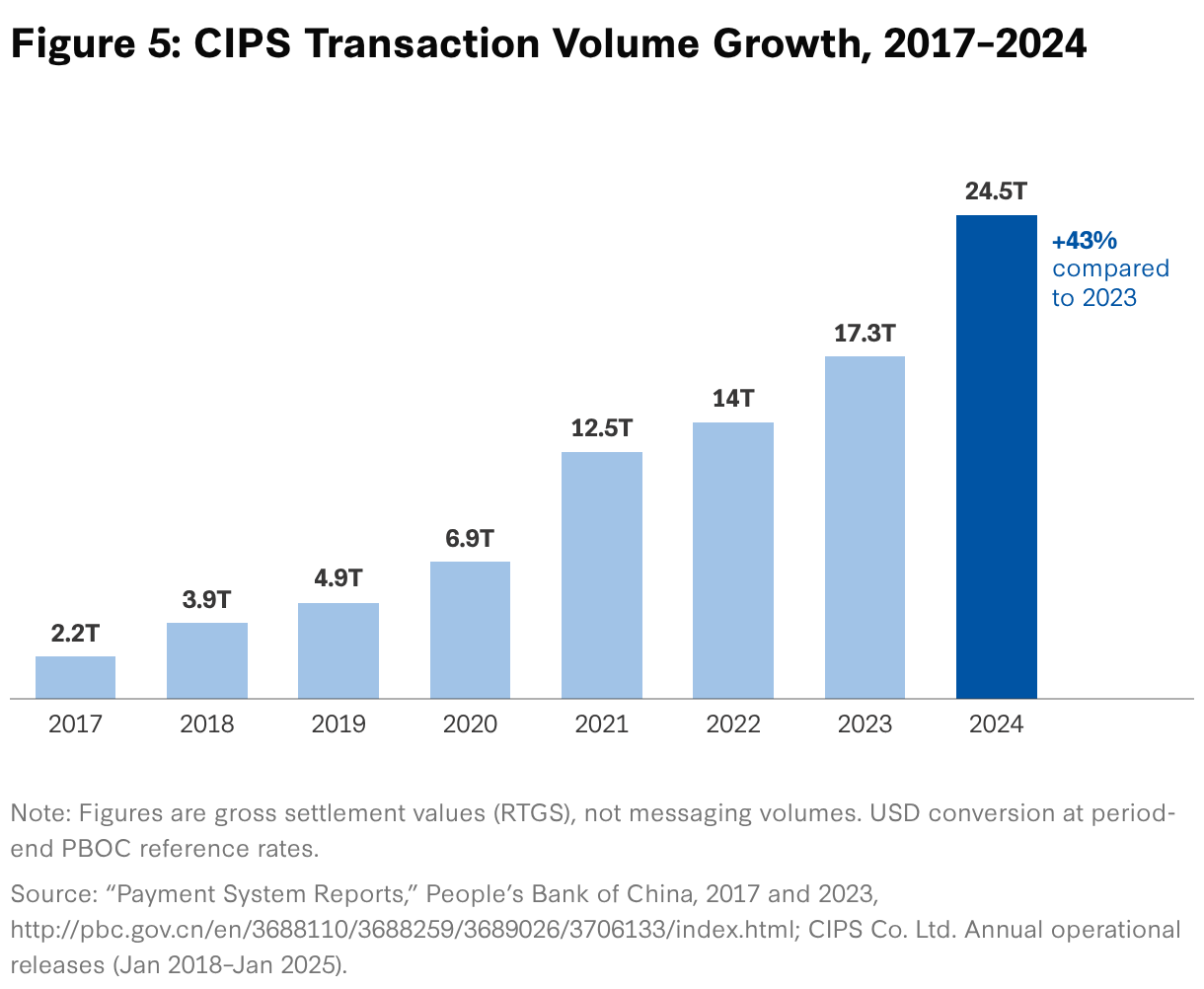
China’s alternative payment systems are not yet replacements for SWIFT and dollar clearing, but they are growing. The longer the United States waits to strengthen allied market infrastructure, the more time rivals have to build alternatives. This temporal dimension is decisive and underappreciated. China’s Cross-border Interbank Payment System (CIPS) reported cumulative transaction flows on the order of ¥17 trillion in 2023. However, this headline figure reflects transaction messaging volume, not settlement independence; analyst consensus is that the large majority of cross-border RMB settlement still routes through SWIFT messaging and U.S. dollar–correspondent networks, and CIPS’s role as a parallel financial architecture is best described as growing but not yet substitutive. What the figure does establish is the slope. CIPS settled roughly ¥1.2 trillion in 2017, its first full operating year, and roughly ¥24.5 trillion in 2024 (approximately $3.4 trillion USD at 2024 exchange rates), a more than twentyfold increase in seven years. By comparison, the Clearing House Interbank Payments System (CHIPS) in the United States settles on the order of $1.8 trillion USD in a single business day, so even at 2024 volumes CIPS’s entire annual settlement is on the order of two CHIPS days. The point is the trajectory, not the level. CIPS is onboarding participants and transaction volume at a compounding rate. Russia’s MIR payment system, though much smaller, makes the same point: Determined adversaries will build alternatives when the cost of dependence becomes visible. Figure 5 plots annual transaction flows reported by CIPS from its first full year at commercial scale through the most recent public release. The figure matters because it shows momentum. CIPS is not yet a full substitute for existing systems, but its growth shows why the United States should act before network effects become harder to reverse.
Every year of delay in hardening allied market infrastructure gives adversaries’ parallel systems time to achieve competitive depth, an advantage that becomes self-reinforcing once network effects tip. The strategic question is no longer whether to build deep, compliance-embedded allied markets but whether the window for establishing structural advantage remains open. Unlike military procurement cycles, financial infrastructure compounds at the speed of capital markets. And here, too, verification is upstream. The depth of an allied market is only usable as coercive power if the state can tell, at settlement, who a counterparty is and whether they are compliant. Deep markets without embedded compliance are merely liquid, but compliance-embedded deep markets are weaponizable.
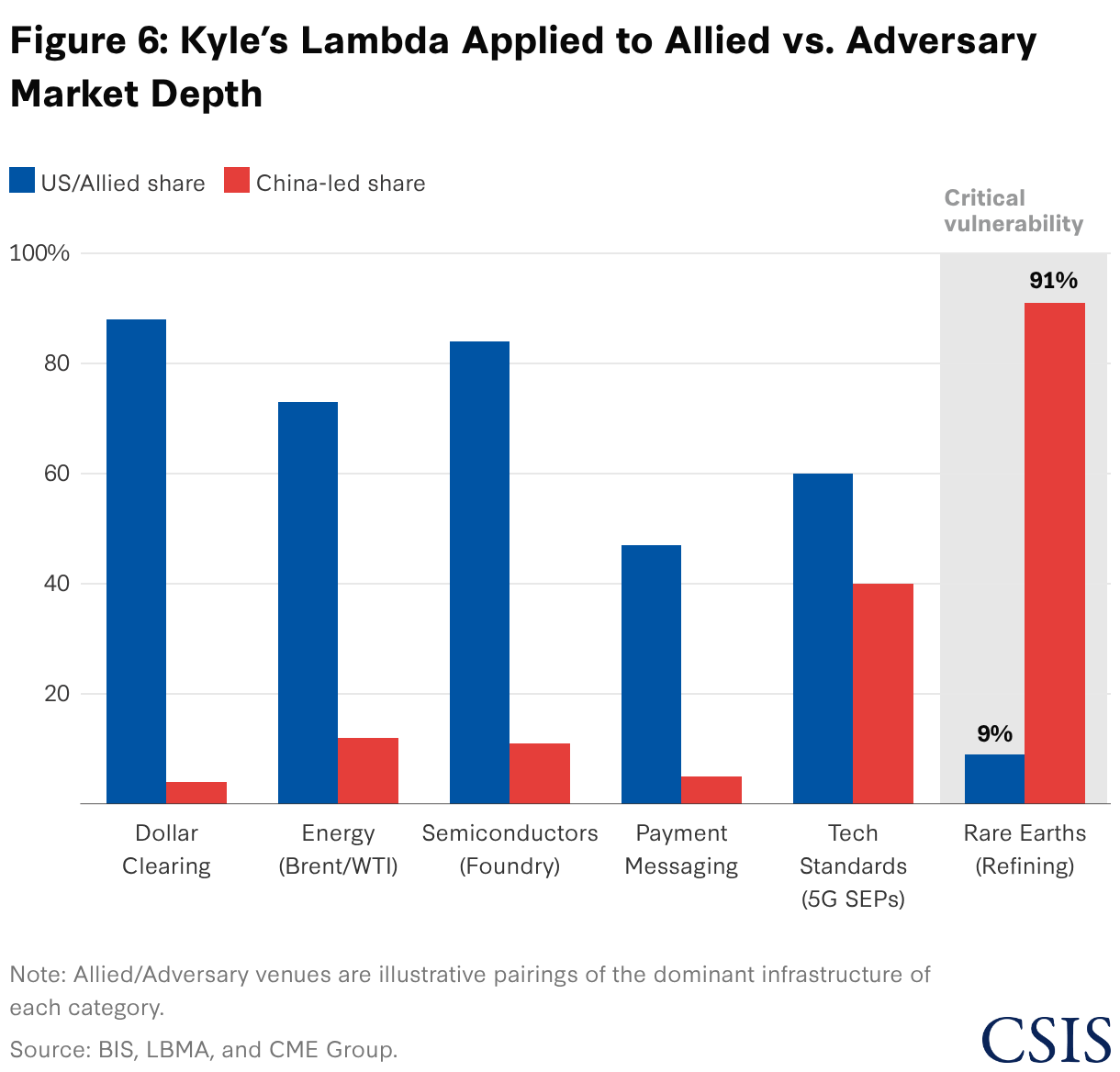
The policy goal is to keep allied markets deep and compliant while pushing adversary procurement into thinner markets where evasion is more expensive and easier to see. Figure 6 applies the Kyle’s Lambda intuition—that price impact per unit of order flow is a measurable proxy for market depth—across six strategically load-bearing categories, comparing the allied versus China-led share of activity in each, with the higher allied share denoting deeper, more absorptive infrastructure: dollar clearing at 88 percent versus 4 percent; energy (Brent/WTI) at 73 percent versus 12 percent; semiconductor foundry capacity at 84 percent versus 11 percent; payment messaging at 47 percent versus 5 percent; 5G standard-essential patent families 60 percent versus 40 percent; and rare earth refining at 9 percent versus 91 percent. The venue pairings under each bar are illustrative of the dominant infrastructure in each category: FedWire and CHIPS against CIPS for dollar clearing; TSMC- and Samsung-anchored capacity against SMIC for semiconductors; Intercontinental Exchange (ICE) and Chicago Mercantile Exchange (CME) futures liquidity against the Shanghai International Energy Exchange for energy; Western processing contracts against Shanghai-referenced pricing for rare earths; SWIFT and FedWire against CIPS for payment rails; and standards bodies led by the International Telecommunications Union (ITU), Institute of Electrical and Electronics Engineers (IEEE), and 3rd Generation Partnership Project (3GPP) against PRC-aligned alternatives for tech standards, calibrated against BIS, London Bullion Market Association (LBMA), and CME Group reference data.
In five of the six categories, the asymmetry runs decisively in the allied direction, with the allied share many times the China-led share—in dollar clearing and payment rails by roughly an order of magnitude—meaning a large adversary procurement attempt in the allied venue is absorbed without signal, while equivalent activity in the adversary venue leaves a documented premium and an observable volume footprint. Rare earths offer the inverted case, which the chart flags as a critical vulnerability: Allied refining’s share is roughly 9 percent (a thin, observable market carrying a large adverse-selection premium), while China’s share is roughly 91 percent (a deep, absorptive market), reflecting China’s roughly 91 percent share of global rare earth processing and refining. That single inverted bar is the policy thesis in compressed form—depth in general is not the goal, depth in the categories that matter strategically is—and rare earths represent the one category where the asymmetry has already inverted and now needs to be rebuilt rather than maintained.
As with fungibility, modern market making requires verification. A market is strategically useful only if the state can identify who is transacting, what is moving, and whether the transaction is compliant, or else the network becomes a free rider for non-compliant trade. Verification is the enabling condition. Without the ability to prove, at the transaction level, who made what, where it came from, and whose hands it passed through, markets become brittle. Economic warfare fails operationally when a state cannot tell the difference between a compliant and a non-compliant transaction. Sanctions on their own do not stop trade. They shift trade to intermediaries who attest that nothing sanctioned occurred. Export controls on their own do not stop technology transfer; they route technology through third countries with weaker attestation. The binding constraint across every tool in the economic-statecraft inventory is the same: the gap between what is asserted on paper and what can be verified in reality.
The Economic Defense Unit and the broader U.S. interagency should turn economic statecraft from a reactive sanctions process into an operational playbook. By mastering fungibility, shaping elasticity, and serving as the world’s market maker, the United States can secure a competitive advantage that transcends the binary of war and peace.
By mastering fungibility, shaping elasticity, and serving as the world’s market maker, the United States can secure a competitive advantage that transcends the binary of war and peace.
These three principles rest on a fourth enabling condition: verification. Fungibility, elasticity, and market making are only as strong as the state’s ability to prove, at the transaction level, who made what, where it came from, and whose hands it passed through. Without attestation at each node of the value chain and the enforcement architecture to act on it, the three principles remain exercises that sophisticated adversaries will continue to evade through shell companies, relabeling, and third-country transshipment. Verification is what turns an economic warfare strategy from a set of policy statements into a set of enforceable rules.
The United States should make allied markets faster, cheaper, and safer than the alternatives while making adversary procurement slower, more expensive, and easier to detect. This is the emerging logic of American economic warfare: ensuring that the adversary pays an escalating premium for every unit of military capability it attempts to generate, while the allied industrial base operates within deep, liquid, and structurally advantaged markets where compliance is embedded and conversion efficiency compounds over time. By adhering to this objective function, the United States can force its rivals to burn their reserves in high-friction, high-Lambda markets while it mobilizes with the efficiency of the world’s dominant financial architecture. The choice is not between free trade and protectionism, but between defining the rules of the game or being played by them. The ledger is open, and it is time to balance it in the United States’ favor.
Benjamin Jensen is director of the Futures Lab and a senior fellow for the Defense and Security Department at the Center for Strategic and International Studies in Washington, D.C. and a colonel in the U.S. Army Reserves. Jacob Clayton is the founder and CEO of SAGINT and a lieutenant colonel in the U.S. Marine Corps Reserves. The views expressed are his own.
This report is made possible by general support to CSIS. No direct sponsorship contributed to this report.