From Partners to Producers: U.S.-Australia Defense Cooperation
October 5, 2026 • 9:00 – 9:30 am EDT
Hosted by All About the Base
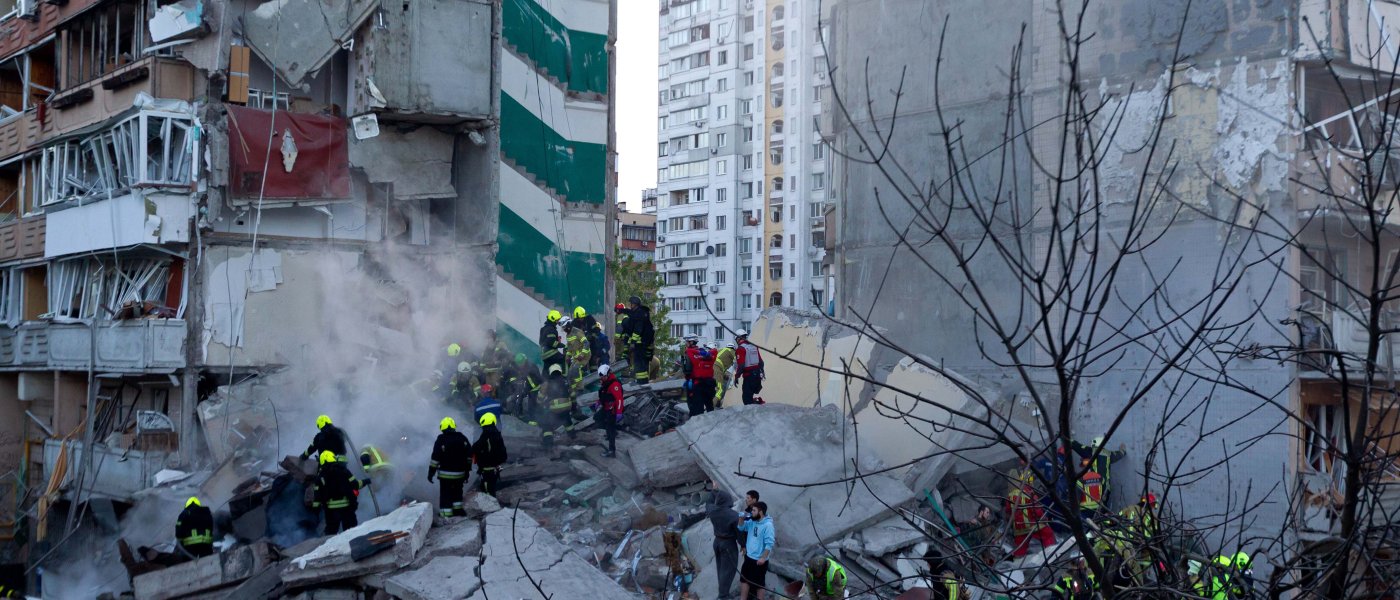
Photo: Kyrylo Chubotin/Ukrinform/NurPhoto/Getty Images
Russia’s missile and drone campaign in Ukraine is a coercive strategy built around geography. CSIS Futures Lab analysis of oblast-level damage reports from 2023 through early 2026 shows that reported damage in Ukraine has increased sharply, becoming concentrated in frontline and southern regions as well as areas with industrial, energy, and port infrastructure and major urban centers. This pattern suggests that Moscow is using long-range firepower to disrupt logistics, strain critical infrastructure, pressure civilians, and impose cumulative costs on Ukraine’s ability to fight, repair, govern, and negotiate. The campaign has been shaped by the strategic value of targets, the rapid growth of Shahed-type drone launches, winter attacks against energy infrastructure, and the expansion of a drone-dense kill zone near the front. Modern coercion turns infrastructure, distance, and civilian vulnerability into political leverage.
As Russia’s war in Ukraine enters its fifth year in 2026, long-range firepower remains central to Moscow’s strategy of coercion. Russia uses a mix of ballistic missiles, cruise missiles, glide bombs, one-way attack drones, and first-person-view (FPV) drones to pressure Ukraine across different parts of the battlefield and the rear area. Because these systems serve varying purposes, glide bombs and artillery-heavy strikes are concentrated closer to the front, while ballistic and cruise missiles target higher-value infrastructure and military targets. Shahed-type one-way attack drones meanwhile enable Russia to expand the scale, frequency, and geographic reach of its strike campaign at relatively little expense.
Russia uses firepower strikes as a form of coercion to impose military, economic, and psychological costs on the Ukrainian state and society so that Kyiv and its supporters will accept an outcome more favorable to Moscow—a classic punishment strategy. To that end, Russia employs massed salvos comprised of ballistic missiles, cruise missiles, and one-way attack drones to hit targets behind the battlefield’s front lines. These strikes seek to weaken Ukraine’s ability to fight, disrupt the systems that sustain the war, and increase pressure on Ukraine’s political leadership and population. By examining the geography of coercion, it is possible to understand how Russia is concentrating its attacks on places where military operations, infrastructure, economic activity, and civilian vulnerability intersect, maximizing its offensive impact and expanding the battlespace beyond the traditional front lines.
Analysis of Russian strikes reveals three overarching trends. First, Russia’s reported strike damage has increased over time, while the geography of damage has become more concentrated in key target areas. Second, many missile and drone attacks are aimed at logistical nodes that support Ukraine’s battlefield operations, especially in frontline and southeastern oblasts, where strategic strikes overlap with a denser ecosystem of artillery, glide bombs, FPV drones, and loitering munitions. Third, strategic industrial bases, energy infrastructure, ports, and major urban centers have become recurring targets as Russia seeks to raise the costs for Ukraine’s economy, civilians, and political leadership. Attacks on critical infrastructure weaken the physical systems that allow Ukraine to move goods, repair damage, sustain industry, export commodities, and support military operations. Attacks on major cities and residential areas, meanwhile, apply psychological pressure and signal that civilian life will remain vulnerable as long as the war continues.
In addition to the strategic value of the targets, several factors explain Russia’s geography of coercion in Ukraine. Proximity still shapes Russia’s attacks. Western oblasts are targeted less often, with most reported damage remaining concentrated in eastern and southeastern Ukraine. Russia’s expanding missile production, and especially the growth of Shahed-type drone production, has allowed Moscow to increase strike volume, depth, and frequency. Belarus’s operational role has also given Russia more options for routing drones and complicating Ukrainian air defense. Seasonal timing matters as well. Russia uses winter campaigns to increase pressure on Ukraine’s power grid, heating systems, and repair capacity during periods of maximum civilian and industrial dependence.
Building on the Russian firepower analysis conducted by the CSIS Futures Lab, this paper examines how the geography of Russian missile and drone strikes has evolved and what this evolution reveals about Russian campaign design. The analysis examines damage across Ukrainian oblasts reported by the Ukraine Air Force and verified by the authors using open-source intelligence (OSINT) techniques. While not inclusive of every Russian launch or every attempted strike, this dataset does capture where Russian attacks appear to have produced observable effects. To that end, examining the geography of reported damage reveals not only where Russia is attacking, but where its attacks are succeeding often enough to shape Ukraine’s military, economic, and civilian resilience.
To capture this, the study uses “damage-days” as its primary measure, which captures the number of days on which at least one damage report was recorded for each oblast in each month. In other words, damage-days captures how frequently an oblast experienced reported damage. It is not a count of individual strikes, and it is not a measure of their severity, since a day with one report and a day with many reports each count once.1
The theory of coercion emerged in international relations to describe the use of a combination of force and threats of force to compel an adversary to take a particular action. The coercer aims to shape the adversary’s course of action by making a particular option appear more attractive than the alternatives. Whether what Thomas Schelling described as the “latent diplomacy of violence” or pure brute force, the purpose is to shape the perceived costs and benefits of decisionmaking. In Bombing to Win, Robert Pape describes the purpose of military coercion as altering an adversary’s expected utility calculus. In peacetime and war, the logic of coercion relies on raising the cost of resistance (punishment), weakening the adversary’s ability to fight or sustain a war (denial), and demonstrating reach, resolve, and the ability to continue imposing pain (signaling).
In fact, long-range firepower has long been part of strategic coercion theory, and not just for Russia. Missiles and one-way attack drones allow an aggressor to impose costs across distance, threaten valued systems, and make an adversary believe that continued resistance will produce cumulative military, economic, and political damage. In contemporary conflicts, these weapons systems serve different purposes within the theory of coercion. Ballistic and cruise missiles offer speed, range, payload, and penetration against high-value targets such as airfields, command nodes, logistics hubs, ports, power plants, fuel facilities, bridges, rail junctions, and major urban centers. One-way attack drones, on the other hand, add scale, persistence, and asymmetrical costs. They usually carry smaller payloads, but their lower cost allows repeated attacks that stretch air defenses, consume (often pricy) interceptors, force dispersion of defensive capabilities, and keep repair systems under pressure. Importantly, the strategic effect does not require every drone to hit its target—the coercive impact can come from making defense more expensive, widening the area that must be protected, and forcing the adversary to live under continuous alert. In fact, Russia’s massive increase of Shahed drone launches aims to signal to Ukraine that it has the capability and willingness to continue imposing costs.
Moreover, long-range firepower allows the coercer to hit military targets to degrade the adversary’s ability to fight. Striking critical infrastructure degrades the enemy’s ability to move, repair, produce, and even govern society as it erodes the quality of life. Attacking urban targets increases psychological and political pressure on the leadership of the adversary. This is why the geography of strikes plays such a key role in coercion—being able to penetrate deep into the adversary’s territory offers the ability to increase pressure within the wider system of military endurance and political resilience.
Russian thinking connects this general coercive logic to a broader concept of strategic deterrence in which nuclear, conventional, informational, and nonmilitary tools are combined to shape adversary decisionmaking across peace, crisis, and war. Russian doctrine defines non-nuclear deterrence as a set of foreign policy, military, and military-technical measures aimed at preventing aggression through non-nuclear means. Moscow’s military strategy also emphasizes degrading adversarial military economic potential, striking critically important targets, and affecting both the adversary’s ability and will to sustain a fight.
Such logic can easily be observed in Russia’s war aims in Ukraine. Since the early months of the conflict in 2022, the Kremlin has framed the war around enforcing Ukraine’s demilitarization and denazification. Demanding Ukrainian withdrawal from the Donetsk, Luhansk, Kherson, and Zaporizhzhia areas, abandonment of NATO membership, acceptance of neutrality, and various other broader political concessions comprise Moscow’s primary negotiation positions. In coercive terms, the Russian theory of victory is to make Ukraine militarily weaker, economically strained, politically pressured, and diplomatically isolated enough that Kyiv and its supporters accept a settlement limiting Ukraine’s sovereignty, military capacity, territorial control, and Western alignment.
Russia has increasingly turned to its firepower as part of its coercive strategy because it is unable to gain advantages on the battlefield. By increasing the cost on Ukraine’s political leadership through a punishment strategy, Russia aims to end the war in a favorable position. To that end, Russia deploys one-way attack drones as well as ballistic and cruise missiles to attack: (1) key logistical nodes, to degrade support for the battlefield, (2) critical infrastructure, to increase economic costs, and (3) civilian areas, to increase psychological effects.
Notably, the ability to conduct sustained long-range strikes does not necessarily indicate the success of a coercive strategy. In fact, the Ukraine war illustrates that large-scale air and missile campaigns do not automatically produce rapid strategic outcomes, raising the broader question of how an air campaign that has neither broken Ukrainian political cohesion nor fully degraded its power grid may nonetheless accrue cumulative strategic effects over time.
Since the war began in February 2022, Russia has sustained a relentless campaign of missile and drone strikes, and although the front line has moved little since the first year of fighting, Russia’s long-range strikes have not only continued but scaled sharply. That scaling is clearest for Shahed drones, which Russia did not begin launching until September 2022, and only in the single digits that first month. In October 2022, Russia launched roughly 510 missiles and drones of all types across the entire month, of which about 250 were Shaheds. By the second half of 2025, Shahed launches alone totaled 5,000–6,000 per month. In October 2025 alone, Russia launched approximately 5,500 Shahed drones, marking one of the most intensive strike months of the war.
This scaling led to an increased number of reported damage events in Ukraine. According to the CSIS analysis, oblast-level damage reports rose from 358 in 2023 to 650 in 2024 and 1,553 in 2025. Figure 1 illustrates how total damage reports across all oblasts has changed over time.

Although the overall number of damage reports increased, Russia’s firepower campaign has not been evenly distributed across Ukraine. Figure 2 shows how the intensity of damage reports per month has increased and, furthermore, that attacks have concentrated on key oblasts. The most affected oblasts tend to fall into three categories—frontline and border areas, essential infrastructure regions, and strategic or symbolic spaces. The first category includes regions close to the front line or the Russian border, including Kharkiv, Dnipropetrovsk, Zaporizhzhia, Donetsk, Kherson, Mykolaiv, and Odesa. Regions with industrial, logistical, energy, or port infrastructure that Russia seeks to degrade comprise the second category. The third consists of major cities such as Kyiv, Kharkiv, Odesa, Lviv, and Poltava, which carry strategic and symbolic value.

In a two-prong strategy aimed at denying Ukraine’s ability to fight, Russia seeks to disrupt logistical nodes behind the front line while also attacking civilian infrastructure to impose costs. Russia targets Ukrainian positions, logistics routes, and nearby cities that are critical for military operations on the battlefield. According to the data, the most frequently damaged areas include the Donetsk region, Kharkiv, Sumy, Zaporizhzhia, and Kherson. Furthermore, as the range and volume of one-way attack drones has expanded, Russian strikes have reached deeper into cities that sit near, but not always directly on, the front line, including Kharkiv, Sumy, and Zaporizhzhia. The data reveals that Russia has been targeting logistics nodes with its long-range missile and drone strikes.
The southeastern Ukrainian oblasts form a distinct cluster because they sit at the intersection of battlefield operations and strategic strike campaigns. Zaporizhzhia, Kherson, Dnipropetrovsk, and Mykolaiv, in particular, are close enough to the front to face sustained tactical pressure, but these four oblasts also contain logistics routes, energy infrastructure, and transport nodes essential to Ukraine’s broader war effort. While some attacks on these oblasts are clearly tied to immediate battlefield needs, others look to be part of Russia’s broader attempt to weaken Ukraine’s military and economic capacity.
In 2025, Russia appears to have added a more specific objective set within this southeastern cluster—parts of the electricity grid east of the Dnipro River. The apparent logic is, first, to disable, or at least degrade, this portion of the grid and, second, to then create overloads and cascading stress across the wider Ukrainian electricity network. Similarly, in the southwest, Odesa and its power grid have also received sustained attention by Russia because of the oblast’s maritime and export importance. When power infrastructure around Odesa is severely damaged, port operations become much harder to sustain.
Figure 3, a box and whisker plot, compares how often three types of Ukrainian regions experienced reported damage from Russian missile and drone attacks between 2023 and 2025. Each observation in the figure is one Ukrainian region during one month. The measure is “damage-days,” meaning the number of days in that month when the region recorded at least one reported damage event. For example, if Kharkiv recorded damage on five days in March, that would count as five damage-days for Kharkiv in March. The line inside each box shows the median number of damage-days for that region type in that year. In plain terms, the median is the middle monthly value among the regions in that category. In 2023, frontline, coastal/southern, and rear-area regions had similar monthly levels of reported damage. By 2025, however, the typical frontline or coastal/southern region was experiencing reported damage much more often than the typical rear-area region. The median for frontline regions rose from 2 damage-days per month in 2023 to 12 in 2025. For coastal/southern regions, it rose from 3 to 7. For rear-area regions, it rose only from 2 to 3. Figure 3 primarily captures this widening gap between the regions: In 2023, the three region types showed similar, low levels with overlapping boxes, but the frontline and coastal/southern distributions stood clearly apart from the rear-area group by 2025. That separation implies that the rise in reported damage was geographically uneven, concentrated disproportionately on frontline and coastal/southern oblasts.
Russia’s coercion strategy focuses on imposing costs on the Ukrainian state and society by attacking the electricity grid, lowering living standards, and damaging the overall economy. Consequently, Russia employs one-way attack drones against civilian areas to keep social and political pressure high. Key critical infrastructure targets include power generation facilities, transmission infrastructure, substations, transformers, gas production and storage sites, rail nodes, ports, bridges, and infrastructure relevant to air defense. The geographical and target-selection patterns reveal Russia’s multilevel approach to geographical coercion. Russia is not merely trying to damage individual facilities. It is also trying to stress the systems that allow Ukraine to move goods, repair damage, sustain industry, export commodities, and support military operations.
The winter campaign of 2025–2026, which aimed to degrade Ukrainian energy security, saw the Russian military increasingly concentrate its fire on the Ukrainian power grid in Odesa. This trend is starkly highlighted by the night of December 13, 2025, when a barrage of nearly 500 unmanned aerial vehicles (UAVs) and various missiles left over 1 million Ukrainians without power. Throughout the winter, heavy strikes on Ukraine’s electricity grid led to widespread power outages and significant restrictions on energy consumption. In several regions, electricity was completely cut off for private households and, in some cases, even for industrial facilities. Additional energy-saving measures (e.g., limiting street lighting) were introduced. The Odesa region was heavily affected by attacks involving Shahed-drones and Iskander missiles equipped with cluster munitions, with strikes targeting infrastructure such as bridges. East of the Dnipro River, existing electricity supply challenges intensified, reflecting the cumulative strain on generation and transmission capacity. At the same time, Russia’s long-range strikes on infrastructure linked to the gas and oil sector, as well as key railway corridors, have resulted in sustained, substantial damage.
Figure 4 compares each oblast’s pre-2022 industrial importance with its average monthly damage-days, a quantity the analysis refers to as “damage intensity.” As Figure 4 illustrates, there is a positive correlation between damage intensity and pre-2022 industrial importance. In other words, the more industrially important the oblasts were before the Russian invasion, the more likely they are to be successfully targeted as part of Russia’s current geography of coercion.
In addition to critical civilian and military infrastructure, Russia has directed attacks at major urban centers throughout the war. In fact, key centers such as Kyiv, Kharkiv, Odesa, Dnipro, and Lviv have been repeatedly targeted for coercive pressure, including experiencing multiple double-tap Russian strikes, which, for example sequentially target infrastructure and then emergency responders. These urban strikes often combine military, economic, psychological, and political objectives. Figure 5 illustrates the positive correlation between prewar population and Russian strikes. Oblasts with a higher population are more likely to be targeted by Russia’s missiles and drones. Russia’s drone salvos, now far larger and more frequent than earlier in the war, regularly strike residential areas, even in the capital. Even the sound of drones loitering over Kyiv can build pressure on the population. Major industrial oblasts also tend to have larger populations. This makes it difficult to distinguish whether industrial importance, population size, or some combination of both is driving Russia’s increasing attacks.
Russia’s geographic strike patterns are shaped by five broad considerations: target location, range scaling, Belarusian involvement, seasonal campaigning, and the expanding kill zone near the front. First, CSIS analysis reveals that target proximity, specifically to the front line and to Russian launch areas, influences targeting decisions. Second, Russia’s growing use of Shahed-type one-way attack drones has allowed Russia to scale up long-range attacks. Third, Belarus appears be taking on an expanded role in Russia’s strike architecture by increasingly supporting routing, diversion, and navigation for loitering munitions. Fourth, the seasonal logic of Russia’s winter energy campaigns has helped shape targeting decisions. Fifth, the spread of drones, loitering munitions, glide bombs, and artillery has expanded the contested zone near the front, making the front line and nearby rear areas more vulnerable to repeated damage. When examined together, these factors explain why Russia’s campaign has not simply become larger over time but also shifted how—and where—strikes are concentrated, dispersed, and sequenced.
Russia’s attack patterns are likely shaped by geographic proximity as well as the strategic value of its targets. This is why western Ukraine has experienced a different pattern of attack than the rest of the country. With the exception of occasional peaks in places such as Lviv and Khmelnytskyi, the western oblasts generally record fewer successful strikes than the eastern and southern areas. Other oblasts act as buffer zones for the western regions, which are also farther from most Russian launch areas and, furthermore, are better shielded by Ukraine’s layered air defense network. Russian systems can still reach these areas, but doing so often requires longer routes, more complex flight paths, and a greater chance of interception. As shown in Figure 6, reported damage is more limited in the western part of the country, with most reported damage concentrated in the eastern and southeastern regions (indicated by color intensity).
The expansion of Shahed-type drone production has changed the scale and rhythm of Russia’s strike campaign, transforming the war in Ukraine into what could be called the first major drone war of the twenty-first century. Russia, as of early 2026, is deploying more than 5,000 drones per month on average. Because they are cheaper than cruise and ballistic missiles, the Shahed-type drones allow Russia to launch larger salvos more frequently. They also enable Russia to probe air defenses relatively cheaply, force Ukraine to expend interceptors (often at much higher cost), and create pressure across a wider geographic area. Russia’s focus on increasing Shahed-type drone manufacturing and employment has thus transformed its air campaign into one that relies on volume, repetition, and exhaustion.
Drone launches require cost-benefit analysis. For example, Shahed drones typically carry a payload (~50 kg) up to 10 times smaller than standard Russian missiles, decreasing their potential impact.2 Moreover, Russian drone waves include a significant portion of decoy systems (without explosives) in an effort to overwhelm air defenses and enable the relatively few payload-carrying UAVs to reach their targets. Furthermore, Ukrainian interception rates for drones are substantially higher than for ballistic missiles, meaning that Russia must launch a greater number of UAVs per target to achieve a comparable likelihood of success. However, even with these limits, the scalability and widely deployable character of these one-way attack drones (around 55,000 launched in 2025 alone) compared to missiles (just under 2,000 in 2025) increase the total payload of the delivered explosives in the war.
Russia’s strike pattern of Shahed drones has changed noticeably beginning in 2025. Russia has been able to deploy increasingly large numbers of drones in the war, oftentimes in large salvos. The largest single-night salvo of 2024, on December 13, reached 193 drones. This peak rose to 267 on February 23, 2025, and the largest nightly salvos frequently exceeded 300 drones from May 2025 onward. Figure 7 clearly illustrates the “Shahed effect,” whereby Russian long-range strike activity has become increasingly dominated by Shahed-type drones beginning in 2024. The stacked areas reveal how Shaheds grew from a marginal share of launches in 2022–2023 to the dominant category by 2024–2025. Together, the two series capture a Russian shift from a mixed missile-drone campaign toward a high-volume, drone-centered model of pressure and attrition.

With the growth in Shahed launches, the geographic scope of the campaign has also widened. Oblasts that had previously experienced relatively low levels of attack have become more regular targets, especially during concentrated waves against Ukraine’s energy infrastructure. Peripheral regions such as Zhytomyr, Chernihiv, and Sumy have also begun to record more damage reports, while central-western areas continue to experience increases. Moreover, these one-way attack drones have focused on critical infrastructure, applying sustained pressure. Specifically, Russia has repeatedly targeted electricity distribution nodes and transmission infrastructure, often returning to the same substations multiple times. Repeated strikes against the same nodes can slow repair, drain spare parts, force redistribution, and create cascading pressure elsewhere in the system.
Early in the war, Belarus primarily functioned as a logistical and operational support zone for Russian forces, enabling air and missile strikes against Ukraine without clear evidence of its direct involvement in drone warfare. Between 2022 and 2023, its role remained largely rear-facing, providing infrastructure and strategic depth rather than serving as an active component of drone operations. By 2024, however, Belarus had begun to shift from a rear-area support zone to an operationally relevant peripheral space, marked by sporadic but recurring drone-related incidents such as overflights, deviations, and isolated crashes in or near its airspace. While some of these cases could still be attributed to navigation errors or electronic warfare effects, their repetition indicated early-stage integration into Russia’s broader drone warfare architecture.
In 2025, this pattern evolved into a more consistent operational framework, with frequent drone movements involving Belarusian airspace, including transit and return trajectories. As observations from September 2025 clearly demonstrate—including at least 21 Russian drones entering Polish airspace after taking off in Belarus on the night of September 9—Russia is increasingly using Belarus both as an airspace corridor and as a tracking and routing zone for UAV operations within its long-range strike campaign. The increasing frequency of such activity throughout 2025 suggests systematic use, with Belarus functioning as a corridor, buffer zone, and tactical diversion route within Russia’s multi-axis drone campaign. By the end of 2025, it was increasingly evident that Russian drones were attempting to bypass Ukrainian air defense systems by using Belarusian territory as a routing corridor.
More recent developments point to the deeper integration of Belarus into Russian UAV operations, potentially accelerated by disruptions to Russian satellite-based communications, such as the degradation or loss of Starlink-enabled connectivity. Russia is reportedly shifting elements of long-range drone control from satellite-based links to ground-based relay networks leveraging Belarusian infrastructure, thereby enabling more resilient strike coordination.
As part of its larger coercion strategy, Russia has repeatedly leveraged winter conditions to increase pressure on Ukraine’s electrical and heating infrastructure during periods of maximum civilian and industrial dependence (i.e., cold months), meaning that Russia’s attacks lead to significantly more damage reports in the winter months. Ukraine’s energy grid has commonly suffered disruptions during the winter months. This is well documented by the data shared by DTEK, Ukraine’s largest energy company, and a crucial factor in the World Health Organization’s annual winter-risk assessment for Ukraine.
With that understanding, the CSIS Futures Lab investigated how damage due to missile and drone attacks changes in the winter months. The Futures Lab conducted a statistical analysis to determine whether winter months see significantly higher damage reports per oblast on average, and if there are any trends in those changes. A separate methodology document contains the details of the Futures Lab’s analysis, revealing that initial impressions of increased damage during the cold months were correct: Throughout the winter months, Ukrainian oblasts experienced significantly more damage than at any other point of the year, even controlling for other seasonal effects. Figure 8 illustrates how per-month damage intensity jumps by nearly 20 percent in winter months; this trend holds, from a significantly higher baseline, when restricted to industrially important oblasts (see Methodology). This winter increase extends across every category of Russia’s strike arsenal, indicating deliberate seasonal escalation: Shahed launches rise roughly 24 percent (nearly an additional 450 sorties per month on average), cruise missiles rise 14 percent (an additional 15 launches), and ballistic missiles rise 8 percent (about 3 additional launches).

Analysis of Russia’s winter campaigns also reveals that the geographical pattern of attacks changes, as do their intensity and weapons systems of choice. To explore this aspect, the Futures Lab analyzed damage reports to explain the geographic dispersion of Russia’s missile and drone attacks and how these attacks are shaped seasonally. To assess any Russian geographical changes in strike patterns across seasons—and especially during winter air campaigns since 2023—CSIS computed a monthly Gini coefficient across the 24 oblasts plus Kyiv City with damage data. The Futures Lab also calculated an oblast-level deviation from a baseline defined as each oblast’s damage intensity level during nonwinter months. While traditionally used by economists to measure income inequality within a population, the Gini coefficient serves as an effective statistical gauge in this context to quantify whether the damage from these attacks is highly concentrated in a few specific regions or instead is distributed evenly across the country, with a higher Gini coefficient value indicating that damage is concentrated in a few regions. In this way, the Gini coefficient allows winter strike patterns to be compared against a stable annual reference.
Figure 9 displays an analysis of Gini coefficients by winter month (November–February) for the full winter campaigns of the war in Ukraine. The data shows the annual Russian winter campaigns transition from broader geographic dispersion in November and December toward greater concentration in January and February. This pattern appears, to varying degrees, across all winter campaigns with complete datasets, though the transition is most pronounced during the winter of 2023–2024.

The third winter campaign—from November 2025 to February 2026—provides the clearest evidence for Russia’s intentional leveraging of seasonal conditions in its targeting strategy and overall geography of coercion. By November 2025, Russia possessed substantially greater drone capacity—in number and range—than when it first invaded. Yet the geographic distribution pattern of Moscow’s long-range strikes still shifted back toward greater concentration with the coming of the Ukrainian winter. Average Gini coefficients during the 2025–2026 winter are higher than in previous winters, indicating a more uneven regional distribution of strike effects. But this does not indicate a reduction in overall geographic reach. Rather, Russia has maintained geographic breadth while loading more damage onto a smaller subset of oblasts. Looking across the winter campaigns, the observed variation suggests that Russian winter strike campaigns have not converged on a single operational model but instead remain characterized by recurring shifts in targeting patterns and geographic distribution.
The final factor explaining the evolution of the strike patterns is the changing character of the battlefield near the front. Over the last two years, the traditional concept of a static front line has increasingly dissolved into a chaotic, expanding “front zone.” A kill zone now extends up to 30 kilometers from the forward line of contact and is characterized by mixed, overlapping positions where soldiers must prioritize basic survival and distinguishing friend from foe is highly difficult. In this environment, conventional linear warfare involving position-against-position combat has been replaced by isolated small teams that are sustained entirely by drone-based supply lines. Driven by the integration of systems with better weapons ranges, both Ukraine and Russia are actively attempting to increase the depth of this contested zone.
As this zone has expanded, the tactical geometry of the battlefield has fundamentally shifted. The traditional fortified trench has been superseded by the drone pilot position, which has emerged as the definitive “strong position” within this unpredictable space. From these localized nodes, operators are able to start controlling the surrounding rear areas and manage vital opportunities for evacuation and launching resupply drones. Because of their outsized influence on tactical logistics and situational awareness, these pilot positions have become critical, high-value targets.
To contest this expanded front zone, Russia has significantly escalated its mid-range strike capabilities, initially by emulating Ukrainian mid-range strike tactics through the increased use of its Lancet or BM-35. More recently, this tactical adaptation has evolved to rely on mass-produced, cheap systems known as the Molniya-2 drone. The proliferation of these drones and the Russian emulation of mid-range strike help explain a statistically significant increase in frontline damage. Combined with artillery, glide bombs, and other drones, these attacks illustrate how Russia seeks to overwhelm Ukrainian oblasts along the front line.
This study shows that Russia’s missile and drone campaign can be usefully interpreted in terms of the geography of coercion. Russia has used long-range firepower to impose costs beyond the front line, to disrupt the systems that sustain Ukraine’s war effort, and to increase pressure on civilians and political leaders over time. The growing scale and frequency of strikes reveals that Russia’s coercion logic relies on persistence. Overall, Russia’s drone and missile campaign strategy comprises scaling its attacks, concentrating damage on key logistical and industrial regions, expanding its use of Shahed-type drones, integrating Belarus as an operational corridor, and exploiting winter conditions to further increase pressure on Ukraine’s energy system.
This study’s findings suggest that Russia’s coercive strategy aims for success through cumulative pressure rather than decisive shock. Missile and drone strikes have not broken Ukrainian political cohesion or forced a rapid settlement. Yet they have created recurring costs for air defense, repair capacity, energy resilience, logistics, and civilian life. Based on emerging evidence from the war in Ukraine, while coercion in modern war may fail to produce immediate political collapse, it remains capable of shaping the long-term conditions under which a state fights, repairs, governs, and negotiates.
Winning future conflicts will require closer attention to the geography of strike campaigns. Ports, rail nodes, substations, fuel systems, industrial zones, and urban centers are part of the battlefield because they connect military operations to economic endurance and social resilience. Studying where damage occurs can therefore reveal how states try to turn infrastructure, distance, and civilian vulnerability into political leverage. At the same time, this study reveals that drones are fundamentally changing the economics of coercion. One-way attack drones do not need to match missiles in payload or speed to matter strategically. Their value lies in cost-effectiveness, volume, repetition, and persistence. These relatively cheap, increasingly mass-producible weapons systems force defenders to protect more places, spend more resources, and make more difficult choices about what to defend—and what to leave vulnerable. Future studies should therefore examine missiles and drones as part of a combined strike system rather than as separate weapons categories.
Finally, coercive campaigns are likely to become even more adaptive and seasonal. Russia’s winter campaigns show how timing, weather, and infrastructure dependence can shape strike design. In addition, the changing role of Belarus reveals how third-party territory, routing corridors, and relay infrastructure can affect the geography of attack. Future research should pay close attention to how states sequence strikes across seasons, exploit regional vulnerabilities, and use neighboring territories to complicate defense. Overall, the geography of Russian strikes in Ukraine exposes how modern coercion increasingly relies on scaling, persistence, and the ability to penetrate deeply into adversary territory to reach strategic targets. This analysis provides a framework for studying future wars in which long-range fires, cheap drones, critical infrastructure, and civilian resilience become tightly connected parts of the same campaign.
Marcus is a defense analyst at the Ukraine Air War Monitor in Berlin. Yasir Atalan is a deputy director and data fellow in the Futures Lab at the Center for Strategic and International Studies (CSIS) in Washington, D.C. Benjamin Jensen is director of the Futures Lab and a senior fellow for the Defense and Security Department at CSIS. Erik Tiersten-Nyman is a Pearson Fellow at the University of Chicago.
This report is made possible by general support to CSIS. No direct sponsorship contributed to this report.

Commentary by Benjamin Jensen — March 23, 2026

Commentary by Yasir Atalan, Erik Tiersten-Nyman, and Benjamin Jensen — November 14, 2025