The Implications of the Hormuz Energy Crisis on South Asia
September 21, 2026 • 8:30 – 9:30 am EDT

Photo: Yan Yan/Xinhua/Getty Images
In June 2026, for the first time in seven years, Chinese leader Xi Jinping visited Pyongyang to meet with Kim Jong-un. While Xi hosted over 20 leaders in the first half of the calendar year, this constituted the only trip abroad by the Chinese leader so far in 2026. A flurry of activity followed: two exchanges of congratulatory letters between Xi and Kim in July and a visit by a close aide of each leader to the other country around mid-July.
China appears to seek deepened strategic alignment and ties with the Democratic People’s Republic of Korea (DPRK) across the board, evidenced by wide coverage of Xi’s desire to increase trade and diplomatic cooperation with Pyongyang since Kim Jong-un’s visit to Beijing last year. However, one of the most underreported developments of this diplomacy was Xi’s inclusion of military affairs in the listed areas for greater development between the two countries—an unprecedented first public summit readout. The drivers for deeper cooperation extend beyond variables internal to bilateral relations. Among these include (1) China’s desires to lessen Russian influence on Pyongyang, (2) hedging bets against an unpredictable United States, (3) counterbalancing Japan’s military buildup, and (4) strengthening Beijing’s military options regarding Taiwan. It is unclear which of these factors motivates Xi the most but China’s shift toward a stronger relationship with North Korea and the possibilities it brings are worth exploring.
The June meeting between Xi and Kim was timed to showcase the 65th year of the China-DPRK Treaty of Friendship, Cooperation, and Mutual Assistance, China’s mutual defense treaty with North Korea, providing an opportunity to “reset” relations. The visit also came shortly after Xi hosted U.S. President Donald Trump (May 14–15) and then Russian President Vladimir Putin (May 19–20) in Beijing, affording Xi opportunities to both portray and assess levels of unity among the three in the face of a disrupted geopolitical environment. Xi’s willingness to make Pyongyang his first foreign stop in 2026 underscored the importance attached to reengagement with North Korea.
Xi’s prioritization of the summit with Kim and the expansive nature of the commitments announced suggest an effort to regain influence over Pyongyang amid North Korea’s deepening ties with Russia since the full-scale invasion of Ukraine. Shortly after landing in Pyongyang, Xi, stated that “the China-DPRK relationship stands at a new historical starting point.” Xi promised “to maintain close strategic communication” with Kim and to strengthen high-level leadership exchanges as well as build mutual political trust.
Nested under the building of relations at the leadership level were several other proposals, the scope of which suggests a reset of relations. Xi proposed exchanges in “diplomacy, law enforcement, military affairs, and others.” He also emphasized the need to expand practical cooperation, particularly in terms of development strategies and in areas such as “economy and trade, agriculture, construction, science and technology, and healthcare.” Xi further listed the desire to “enhance exchanges and cooperation in education, culture and the arts, tourism, sports, media, youth affairs, subnational engagement and sister-city relation, and promised to “make full use of each side’s strengths and resources” to support the exchanges and cooperation.
According to the Chinese readout, Kim echoed much of Xi’s proposed reset. He called for expanded cooperation and exchanges on “economy and trade, infrastructure, science and technology, education, as well as people-to-people and cultural exchanges, and strengthen exchanges of experience and mutual learning through inter-party channels.” North Korean media further described, in superlative language, that Kim and Xi created a “far reaching blueprint” to develop “into a model of the most powerful and strategic relations.”
Kim also flattered Xi, calling him the “most respected guest of the DPRK people,” and declared “the development of DPRK-China relations as the foremost strategic undertaking of the state.” Again, this explicit prioritization matters given North Korea’s ties with Russia, which has made Xi uneasy about losing influence over Pyongyang to Moscow.
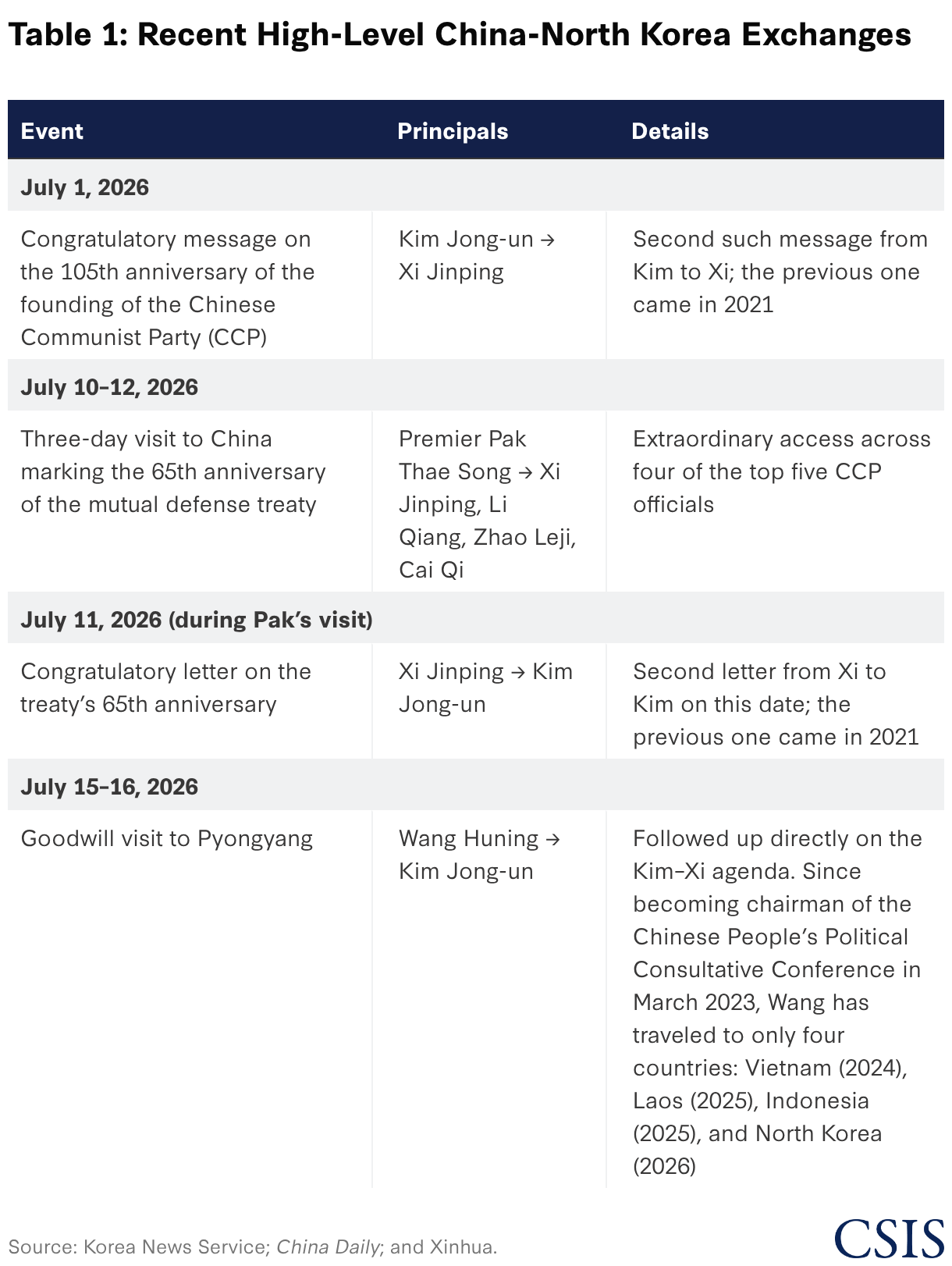
After the June summit, two rare congratulatory letters and two high-level meetings followed in quick succession, with accompanying symbols of homage to the special nature of the relationship, thus putting in practice Xi’s desire for a reset of relations (see Table 1).

The most significant omission from all of these high-level exchanges was any mention of North Korea’s nuclear program from the Chinese side. Denuclearization of the Korean peninsula had previously been a staple of all of Beijing’s statements on Korea. During Xi’s last visit to North Korea in 2019, the Chinese readout made clear Beijing’s intention to “play a positive and constructive role in achieving denuclearization of the Korean Peninsula.” And at a UN Security Council meeting in 2023, China’s Permanent Representative to the United Nations Zhang Jun reiterated that China’s position remains “very clear. We are committed to the denuclearization of the peninsula.”
The silence on North Korea’s nuclear program now likely showcases, in Beijing’s case, the expedient nature of the reset in relations. Unfortunately, it could signal China’s de facto willingness to accept North Korea’s nuclear status.
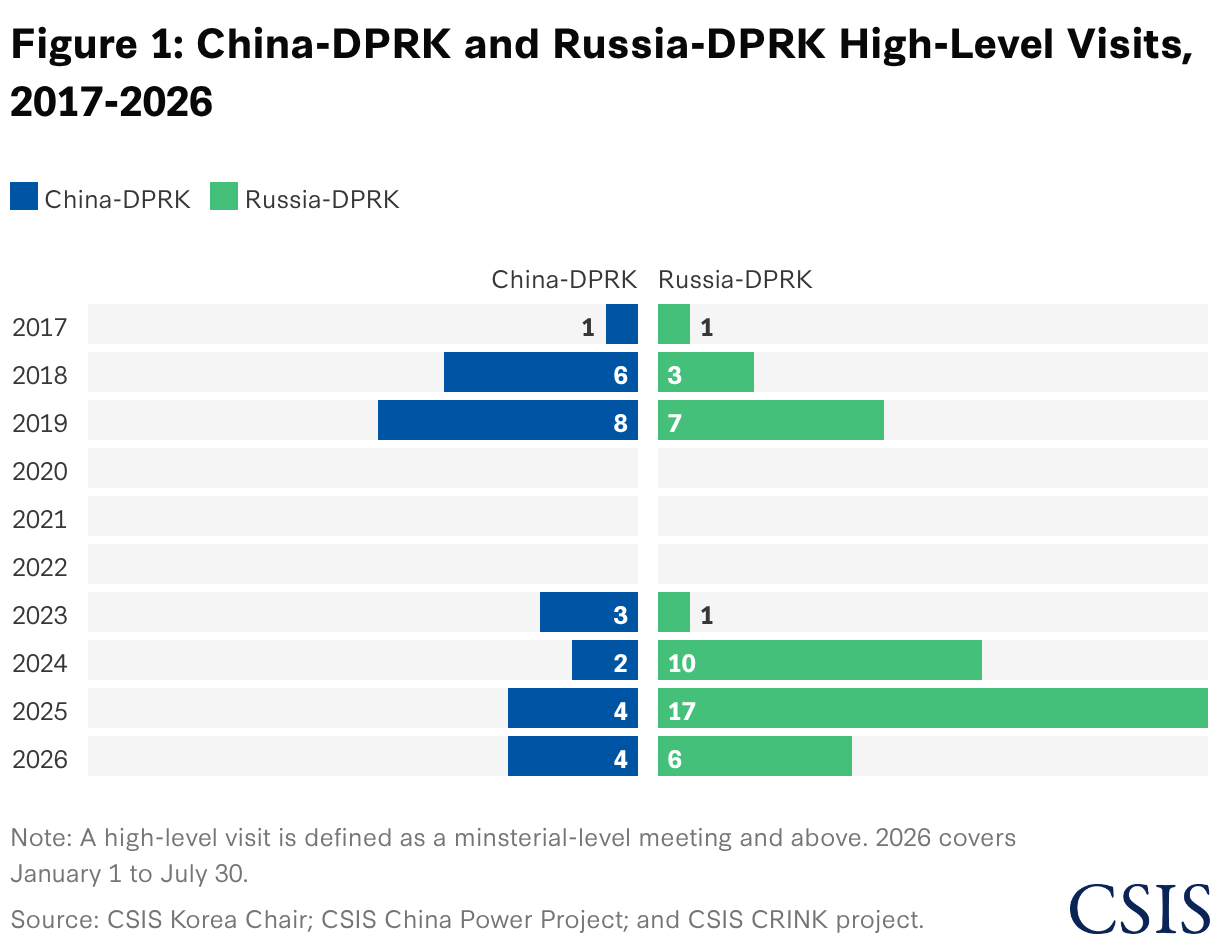
Chinese efforts to reset relations are clearly designed to dilute Russian influence over North Korea. Beijing always claims to the West that it has minimal influence over Pyongyang despite the regime’s economic dependence on it, but China guards jealously whatever influence it does have over its neighbor. However, Chinese actions may be a case of too little, too late. Quantitively, since the start of the Ukraine war, Russia-DPRK high-level exchanges have significantly dwarfed those between North Korea and China—a historically unprecedented fact.

Expanded cooperation in the economy, trade, and infrastructure was emphasized by both China and North Korea during the June meeting and will in many ways provide a key foundation for strengthening the relationship. Efforts to do so were already underway prior to the summit. In March, the two countries revived the Beijing-Pyongyang passenger trains that had been suspended since the start of the Covid-19 pandemic and resumed direct flights between Beijing and Pyongyang. In June, Chinese travel agencies began selling North Korea tourism packages amid speculation that Xi’s visit will revitalize cross-border tourism, though as of this writing, North Korea has not resumed tourist visa issuance for Chinese nationals. In a change that reflects the new state of affairs among the trilateral relations, most tourists in North Korea are Russian, not Chinese, and the passenger trains are for specific groups, such as business visa holders. Xi clearly wants to change the situation, calling on “both sides [to] leverage the opportunity of the full reopening of border crossings and the resumption of civil aviation flights and international passenger trains to increase people-to-people exchanges and foster mutual interaction.”
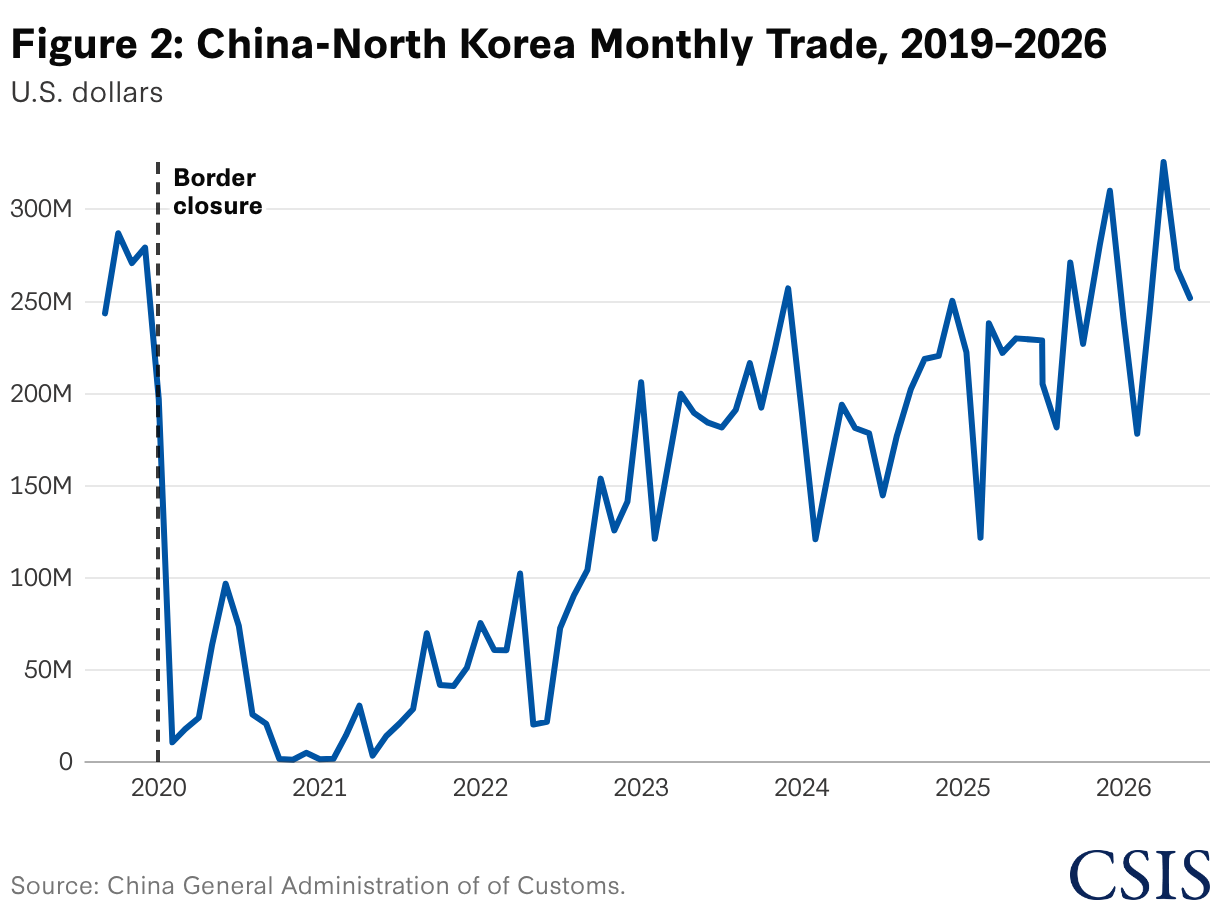
There has been a clear effort by the two sides to revive trade since the Covid lockdown. Two-way goods trade reached $2.7 billion in 2025, the highest total since the border closure in January 2020, and the first six months of 2026 are 19 percent ahead of the same period last year, according to Chinese customs data (see Figure 2). Total bilateral trade is still about half the level it was prior to UN sectoral sanctions in 2017—no longer enforced by China today—but the full border reopening Xi emphasized during his visit will further increase trade.

The reset of relations provides a window into what North Korea hopes to get out of revived relations with China. Pak’s July visit to China included site visits to the Beijing Rail Transit Command Center, the Port of Tianjin, China Resources Recycling Group’s Green Low-Carbon Circular Economy Demonstration Base, and a motor plant in Tianjin. Pak also toured Tianjin’s Haihe River, a popular tourist location. These site visits are unusual for senior officials from North Korea and were likely carefully selected to align with North Korea’s economic development priorities.
The most unexpected development of the summit was the prospect of military cooperation, which has seen very little activity over the past decade in contrast to the ramped-up cooperation between Russia and North Korea. As noted, Xi listed military affairs as an area of “enhanced exchange” at the June meeting. That same month, Chinese Defense Minister Dong Jun accompanied Xi and met with his North Korean counterpart, No Kwang-chol, the first such meeting since 1992. Xia Zhihe, political commissar of the People’s Liberation Army (PLA) National Defense University, also led a group to Pyongyang in October 2025, reportedly the first PLA delegation to visit North Korea in six years.
The recent activity is noteworthy given China’s historical ambivalence to military cooperation with North Korea. Aside from China’s intervention in the Korean War and some basic arms transfers into the early 1980s, China has stayed cool to cooperation. For example, when Kim Il-sung asked in 1975 for missiles that could strike all of South Korea, China declined to sell, leaving North Korea to build its rocket force based on Soviet Scud technology instead. China’s normalization of relations with South Korea in August 1992, which North Korea took as betrayal, froze military ties for a generation. What remained was largely ceremonial: friendship delegations, wreath-laying at war cemeteries and during anniversaries, and a lone 2011 port call at Wonsan by two Chinese naval ships.
Recent signals of China’s interest in greater military coordination with North Korea have not yet led to bilateral military exercises. The closest the two militaries have come to this was indirect and with Russia. North Korea observed Russia’s “Ocean-2024” naval drills, in which China also participated. And at China’s September 2025 military parade, Xi was flanked by Putin and Kim Jong-un as the PLA showcased several key military capabilities. However, the competition for North Korea’s influence could press the two larger patrons further in this direction. Russia, for example, has expressed support for North Korea to join China-Russia military exercises to enable trilateral activities. Even if Beijing were lukewarm to the idea, it may feel obligated to support it to avoid disaffection with Pyongyang.
It is unclear what Xi Jinping may have in mind for deepening military cooperation. It could mean involving North Korea in China-led or China-Russia joint military exercises or greater Chinese support as North Korea develops various military capabilities. This could include modern air defenses, drones, and dual-use components such as microelectronics and machine tools to modernize North Korea’s arms industrial base. If the relationship further deepens, China could consider providing fighter jets and other advanced assets.
While the North Korea readout did not mention Xi’s suggestion of military exchanges, Kim, in his banquet speech to Xi, said the two sides are united on the basis of a “common ideology and militant friendship.” And when Wang was in Pyongyang, Jo Yong-won, deputy chief of the Central Committee of the Workers’ Party of Korea, noted that the two sides needed to “further strengthen militant unity, support and solidarity and steadily intensify and develop the friendly and cooperative relations.”
North Korea may be willing to coordinate military activities with China if it occurs in the context of a China-Russia military exercise and Russia is on board too. On July 3, just days before China and Russia’s 2026 joint maritime exercises off the coast of the Chinese city Qingdao, North Korea showed off its advancing naval capability with Kim personally observing North Korea’s new 5,000-ton destroyer, the Kang Kon, launch 12 cruise missiles from its vertical launch system. The timing of the test is interesting and could be viewed as all three countries displaying naval capabilities at approximately the same time. A critical signpost will be when North Korea begins observing or joining more China-Russia military exercises.
Another security issue to watch is North Korea’s stance on giving China access to the Tumen River, a strategic waterway that runs through the border between China, Russia, and North Korea. Russia and North Korea control the last 15 kilometers of the river, which empties into the Sea of Japan. If North Korea grants China access to the Tumen River, this would not only provide China’s northeastern provinces access to an important maritime shipping route, but it could also provide the Chinese military with direct access to the Sea of Japan. China has been vying for access to this stretch of the river for decades without success. The joint statement from Putin and Xi’s most recent summit in May highlighted the issue of Chinese access, with both sides reaffirming “their commitment to continuing trilateral consultations with North Korea” on the issue. However, it appears there has been no further movement on the issue since the summit besides unconfirmed reporting that China may have discussed it with Kim during their bilateral meeting in June.
Four factors likely drive China’s desire to deepen alignment and relations with North Korea. First, Beijing wants to offset growing Russian influence over Pyongyang and ensure that its own influence is dominant. The potential military exchanges provide a channel into the Korean People’s Army that China has lacked since 2019 and provides a window into what Russia may be transferring. At the same time, Beijing is not naïve and recognizes that the two countries still harbor substantial mutual mistrust and need to rebuild relations through more exchanges as well as practical cooperation in less-sensitive areas.
A second potential motive is signaling to Washington ahead of a possible Trump-Kim summit. By deepening ties in public, Beijing reminds Washington that no deal with Pyongyang gets far without Chinese intervention. Rumors that Xi may have brought a message from Trump to Kim during his visit adds to that perception. At the same time, China has likely not forgotten President Trump’s threats of “fire and fury” against North Korea during the first Trump administration and likely wants to also remind the United States that President Trump’s use of military force against Iran’s nuclear program is not appropriate for North Korea.
The third is pressure on what Beijing views to be a more problematic and “militarist” Tokyo. China is wary of not only Japan’s greater investment in military capabilities, but also deeper U.S.-Japan defense cooperation. China could be looking to strengthen strategic and military ties with North Korea to offset perceived strengthened U.S.-Japan ties. Since January, China and North Korea have begun criticizing Japan using the same terms, such as “neo-militarism.” China could be looking to leverage its growing military partnership with North Korea to increase pressure on Japan and other U.S. allies in the region. It remains to be seen what more support North Korea could provide China in terms of its anti-Japan campaign.
Fourth, Xi’s push for deeper security ties may also reflect a bid for greater support from North Korea on Taiwan. If U.S. forces are tied up in a contingency on the Korean Peninsula, a distracted United States may give China an advantage toward its goals of taking over Taiwan. With this scenario in mind, it’s possible China may be planning to help North Korea build up its forces to become a greater threat to the United States, and to increase the success of a dual contingency.
Victor Cha is president of the Geopolitics and Foreign Policy Department and Korea chair at the Center for Strategic and International Studies (CSIS) in Washington, D.C. Bonny Lin is director of the China Power Project and senior adviser at CSIS. Truly Tinsley is the associate director of the China Power Project at CSIS. Andy Lim is deputy director and fellow with the Korea Chair at CSIS.

Podcast Episode by Bonny Lin and Victor Cha — June 18, 2026

Commentary by Bonny Lin and Kristi Govella — December 5, 2025

Commentary by Victor Cha and Yesun Kim — June 5, 2026


