Capital, Consolidation, and Leadership in the New Minerals Era
October 7, 2026 • 10:00 – 10:30 am EDT
Hosted by Critical Minerals Security Program

Photo: Abdel Hameed Al Nasier/ILO via Flickr
Over the past 15 years, international donors have provided tens of billions of dollars in aid to Syrian refugees and host communities in the Middle East. However, they have failed to create meaningful pathways to autonomy, with host governments refusing to grant refugees full economic inclusion. This installment of Charting the Middle East spotlights how Western aid cuts have rendered the current international response to Syrian refugees obsolete. It is drawn from a recently published CSIS report “The Self-Reliance Dividend: The Imperative of Syrian Refugees’ Economic Inclusion.”
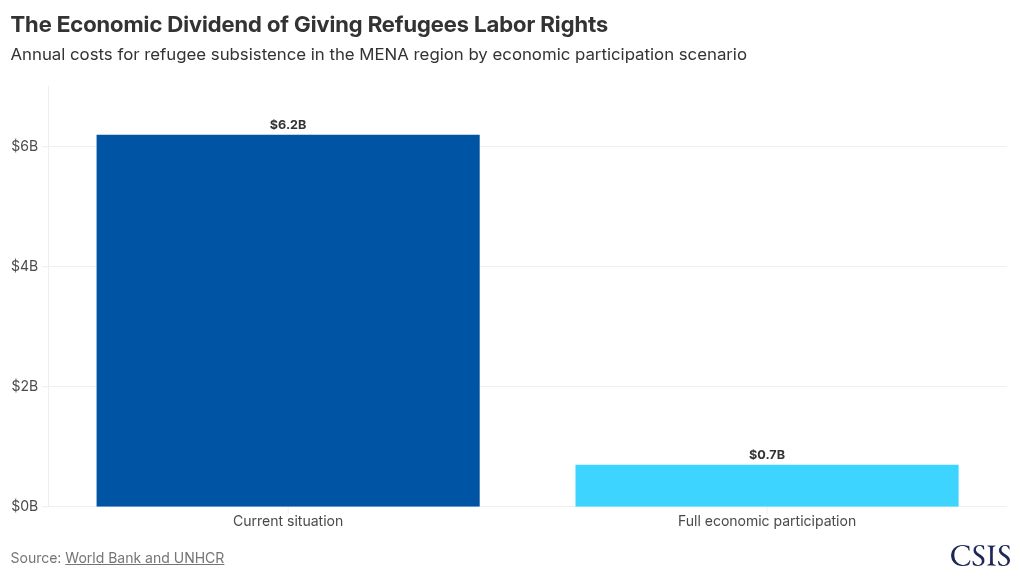
This approach has kept the more than 3.8 million Syrian refugees in neighboring countries dependent on aid, excluded from formal economies, burdened with debt, and ill-prepared to rebuild their lives in a post-Assad Syria. Beyond limiting refugees’ autonomy, this aid-dependence model has also been extremely expensive. A joint study by the World Bank and UNHCR estimated that $6.2 billion a year in aid is currently needed to secure refugees’ subsistence in the Middle East and North Africa. However, if host countries granted refugees the right of economic participation, refugees would be able to meet 90 percent of their needs themselves, reducing the annual amount of international aid needed to just $700 million.
Now, a geopolitical and geoeconomic opening exists for international actors to make a renewed push for Syrians’ economic participation and financial inclusion. Western and Gulf donors should collaborate to wield their financial and political leverage to connect refugees to private sector opportunities through labor mobility, skills development, and job creation. In doing so, they could turn refugee self-reliance into part of the broader regional connectivity agenda. An investment-recovery-resilience nexus approach would enable displaced Syrians to contribute to the economic and political transformations reshaping the region.
