The Implications of the Hormuz Energy Crisis on South Asia
September 21, 2026 • 8:30 – 9:30 am EDT
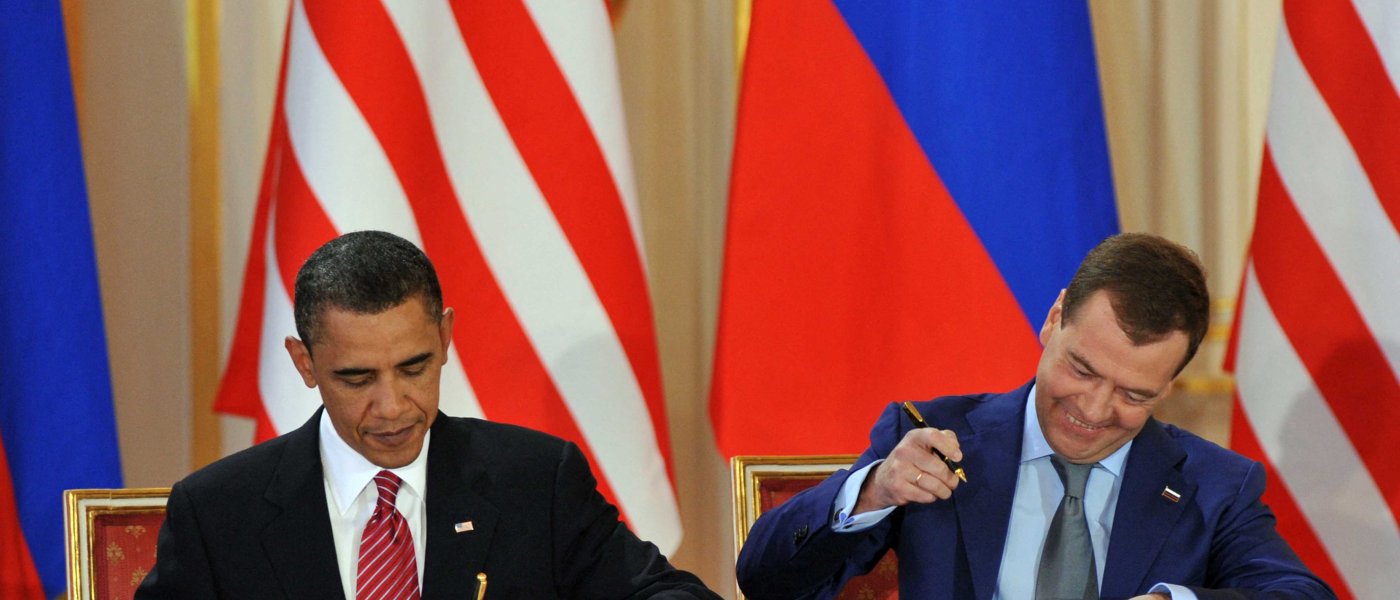
Photo: YURI KADOBNOV/AFP/Getty Images
The 2010 New Strategic Arms Reduction Treaty (New START), the last remaining bilateral nuclear arms control agreement between the United States and Russia, expires February 5. Russian President Vladimir Putin has repeated an offer to informally continue to observe the treaty limits for an additional year. Barring a last-minute reprieve from President Donald Trump, the end of New START will be the end of an era for nuclear arms control.
Here’s what the end of New START does and does not mean for strategic competition: The end of New START does not augur the start of an arms race. The end of New START does not mean the United States will automatically and massively build up its nuclear arsenal. And the end of New START does not equal the end of arms control; rather, this may be the beginning of a new era of arms control. Arms control must adapt to the moment. And this moment calls for diversifying and expanding the U.S. nuclear arsenal, paired with a new approach to arms control.
The end of New START has prompted fears of a new arms race. Senator Ed Markey warned, “If the U.S. exceeds New START limits by uploading warheads, Russia will do the same, and China will use it as another excuse to build up their nuclear arsenal.” The United States has shown exceptional restraint over the past decade in not expanding its arsenal and remaining committed to a modernization program since 2012. In a 2024 interview, the head of the New START delegation, Rose Gottemoeller, explained ongoing U.S. nuclear modernization as, “it’s not about a buildup or a nuclear arms race—the modernization that we are undertaking. But it is about a replacement of obsolescent systems that are no longer safe to operate.” But without the constraints of New START, these fears of an arms race have become more acute if the United States decides to build up, and Russia or China responds.
Arms racing is an action-reaction cycle, typically defined by an automaticity whereby one party builds up in direct response to an adversary’s actions. During the Cold War, Hedley Bull described arms races as sustaining or exacerbating conflicts, as well as expressing them; however, “the idea that arms races obey a logic of their own and can only result in war, is false; and perhaps also dangerous.” Some of the historic concerns about arms racing are that it can increase risks of misperception and accident, along with the financial costs. In the mid-1980s, for example, the Soviet Union was spending 15–17 percent of its GDP on defense. Whether or not we are in an arms race and whether or not arms races are “good” or “bad” remain hotly debated topics. Some experts argue that the arms race is already underway and point to Russian and Chinese nuclear buildups.
New data from both the Council on Strategic Risks and Federation of American Scientists provide insights about the quantitative and qualitative expansion of Russian and Chinese arsenals and can provide some insights into whether or not this is an arms race moment. Since New START was concluded in 2010, Russia has expanded its number of nuclear-capable systems by 22 percent on average, to include a 20 percent increase in the number of nuclear-armed submarines and submarine-launched ballistic missiles (SLBMs). China has engaged in an even more rapid buildup, such as by increasing the number of intermediate-range ballistic missiles by 635 percent and adding new types of strategic and nonstrategic delivery vehicles.
Conversely, as shown in Figure 1, the United States has not expanded anywhere near the scale of Russia and China since New START was concluded in 2010. Instead, U.S. nuclear capabilities have either stayed constant or gone down.

This asymmetry can be seen across the board in nuclear platforms. There has been a 33 percent decrease in nonstrategic nuclear weapons platforms.
Russia has increased its SLBMs by over 20 percent, while the United States decreased by 17 percent decrease in SLBMs since New START was finalized.
One of the most striking changes has been the 88 percent increase in China’s intercontinental ballistic missile (ICBM) force, while the United States ICBM force actually decreased by 11 percent under New START.
What these figures show is that Russia and China have been significantly expanding their strategic arsenals despite restraint on the part of the United States. If this is a nuclear arms race, the United States is losing; and if it is not yet an arms race but turns into one, the United States is starting from behind.
Arms control is a product of its time. The New START agreement was concluded in 2010, following the 2009 U.S.-Russia “reset,” President Obama’s 2009 Prague speech calling for the “peace and security of a world without nuclear weapons,” and an ambitious action plan for the 190 states in the Nuclear Non-Proliferation Treaty (NPT), to include additional arms control and risk reduction measures. At the time, a bilateral, verifiable arms control agreement was in the interests of both the United States and Russia. New START limits the United States and Russia to 1,550 deployed warheads on 700 deployed ICBMs, SLBMs, and heavy bombers. The treaty’s verification measures include on-site inspections, data and telemetric information exchanges, and a semiannual Bilateral Consultative Commission.
Historically, arms control has been a tool for managing strategic competition, and it is essentially a bargain between the parties involved that, though they may continue to compete and seek strategic advantage, they will limit themselves in this specific, discrete domain. Bilateral strategic arms control is neither a political nor a legal requirement for the United States. As described by former Department of State official Tom Countryman, “Arms control agreements are not a concession made by the United States, nor a favor done for another nation; they are an essential component of, and contributor to, our national security.” Arms control comes with strategic benefits of transparency and predictability into adversary arsenals, especially through on-site inspections, and also contributes to obligations under the 1968 NPT.
Since 2010, Russia has violated, suspended, or withdrawn from numerous important arms control agreements. A 2014 Department of State compliance report raised concerns about Russia’s compliance with the 1987 Intermediate-Range Nuclear Forces (INF) Treaty. In 2022, Russia suspended inspection activities under New START, and in 2023, it suspended participation in New START and withdrew ratification of the Comprehensive Test Ban Treaty. Putin’s offer to continue to observe New START limits did not include an offer to return to inspections or other transparency measures associated with the treaty. Despite its abysmal record with arms control and recent buildup in nonstrategic nuclear weapons, Russia faces practical challenges that mean it is unlikely to massively expand its strategic delivery vehicles.
What these trends all point toward is an increasing reliance on nuclear weapons by the United States’ adversaries, particularly for regional ambitions to intimidate U.S. allies and partners and try to drive a wedge between them and Washington. In congressional testimony in March 2022, then-Commander of U.S. Strategic Command Charles Richard pointed to this specific concern: “It is not all strategic. There is a significant class of theater threats that we are going to have to rethink, potentially, how we deter that.” Richard’s successor, General Anthony Cotton emphasized that in Russia’s case, nonstrategic weapons are not included under New START limits. Facing growing competition from nuclear-armed adversaries, the 2026 National Defense Strategy reasserts that the United States will “modernize and adapt our nuclear forces accordingly with focused attention on deterrence and escalation management amid the changing global nuclear landscape.”
Until today, New START has restrained the United States’ ability to adapt its strategic forces, but even with the treaty’s end, the United States does not need a massive nuclear buildup. In his testimony, Richard said, “We do not necessarily have to match weapon for weapon.... But it is clear what we have today is the absolute minimum, and we are going to have to ask ourselves what additional capability, capacity, and posture we need to do, based on where the threat is going.” What the United States needs now is a nuclear force posture that is more diverse and flexible to deter an increasing range of threats across multiple theaters, which may require expanding the U.S. nuclear arsenal, albeit “not radically, not monumentally.”
With the end of New START, the United States can consider at least four options for how it might change its nuclear force posture to align with Richard’s recommendations and develop a nuclear force that is more flexible. The first option would be to upload warheads to existing ICBM and SLBM platforms, which could “roughly double” the number of deployed warheads from New START numbers, according to former Deputy Assistant Secretary of Defense Kingston Reif. In the Project Atom 2025 study, Matthew Costlow makes the case for the second option: the United States should expand its procurement of systems that are “resilient, survivable, and forward-deployed (or deployable) in theater,” such as a new stand-off weapon or dual-capable intermediate-range systems. A third option would be expanding existing plans for nuclear modernization, such as additional B-21s or Columbia-class submarines. A final option, of course, is to make no changes to plans for U.S. nuclear force posture and instead invest in conventional capabilities, although this would come with a significant risk of undermining assurance and allied proliferation.
This is not the end of arms control. In an interview for the CSIS Project on Nuclear Issues arms control oral history project, Gottemoeller pointed to this as a moment of opportunity for arms control: “It’s very important the next treaty must be very much a Donald J. Trump treaty and Vladimir V. Putin treaty. It has to step into this new era that we are experiencing now with Trump in the lead.” Bull described arms control as “spasmodic.” It happens in waves, as evidenced throughout the history of the Cold War. Although this moment might signal a downturn in arms control as we know it, President Trump has repeatedly expressed an interest in a “denuclearization” agreement with Russia and China, which suggests a window of opportunity for new approaches to arms control.
What is to be done in this new era of arms control? As it considers how to respond to the pressures of the security environment and Russian and Chinese nuclear buildups, the Trump administration can pursue three simultaneous arms control priorities, some of them ambitious. First, Trump himself should play a role in leading future arms control initiatives. This could include a head-of-state-level trilateral meeting with Presidents Vladimir Putin and Xi Jinping, committing to a series of measures reducing the risks of nuclear use, such as hotlines, keeping a human in the loop in nuclear decisionmaking, and recommitting to the NPT. China has historically avoided any dialogue that hints at “arms control,” but a head-of-state-level dialogue may tempt Xi. Trump’s interest in new multilateral institutions, such as the Board of Peace, could be well-suited to nuclear diplomacy, such as establishing a Nuclear Risk Reduction Summit.
Second, while leaving the door open for dialogue with Moscow and Beijing, the Trump administration should also work with the international community to hold Russia and China accountable for their risky nuclear activities. Russia and China have expanded their nuclear arsenals with impunity. Both are suspected of conducting low-yield nuclear tests in violation of a testing moratorium. And Russia has consistently relied on nuclear threats throughout the war in Ukraine, with no accountability on the international stage. Key actors that claim to champion nuclear disarmament have refused to call out Russian behavior in the United Nations. South Africa, for example, abstained from four key resolutions on Ukraine, including one on the safety of the Zaporizhzhia Nuclear Power Plant.
Reducing the risks of nuclear weapons use is not only the responsibility of the United States, but of all nuclear possessors, and it is the responsibility of the wider international community to hold bad actors responsible. Until now, Russia and China have gotten a free pass. The United States can contribute to this accountability effort by sharing more data about Russian and Chinese nuclear buildups and behavior, combating disinformation about the U.S. nuclear posture, and actively participating in international forums such as the NPT.
And finally, the future of arms control requires the people and knowledge to seize opportunities when they arise. This new era of arms control requires new thinking, new ideas, and the creativity that the next generation of arms control leaders can bring. At the same time, the lessons learned from treaties like New START, particularly tacit knowledge, should not be lost. To be sure, the end of New START is a moment for reflection on all the treaty achieved and how the strategic landscape has changed since 2010; but it should also be a cue for new thinking on arms control and how it can work in tandem with deterrence in this era of strategic competition.
Heather Williams is the director of the Project on Nuclear Issues and a senior fellow in the Defense and Security Department at the Center for Strategic and International Studies in Washington, D.C.
