The Strategic Value of China to Korea
May 13, 2026 • 9:00 am – 1:30 pm EDT
Hosted by Korea Chair

Photo: AFP/Getty Images
As the war with Iran nears its one-month mark on March 28, complex escalation dynamics continue to drive the conflict. Iran’s escalation strategy centers on unrestrained retaliation in response to U.S. and Israeli strikes. This strategy reflects a distinct departure from Tehran’s previous practices of a more measured reaction to U.S. and Israeli military operations.

Commentary by Mona Yacoubian — March 16, 2026
Instead, Iran’s provocative and wide-ranging retaliation aims to impose enormous costs on the United States, the region, and the world and thereby dissuade the United States and Israel from undertaking future attacks. For the Islamic Republic, this is meant to be its final war with the United States and Israel—concluding a spiraling series of conflicts that began with Iran’s first direct attack on Israel in April 2024—and cement its position in the region.
As a result, Iran is engaged in a dangerous escalatory cycle with the United States and Israel. In a relatively short period, the conflict has intensified dramatically, including through strikes and counterstrikes on energy production infrastructure that could take years to repair, significantly deepening the war’s longer-term impacts. Most notably, President Trump’s ultimatum to Iran that it open the Strait of Hormuz or face attacks on all its power stations has further raised the stakes. Iran responded with counterthreats to “irreversibly destroy” critical infrastructure and energy facilities across the region. With President Trump’s April 6 extension of his deadline on Iran and amid murky efforts at diplomacy, the conflict’s trajectory hangs in the balance. Further escalation will be imminent if efforts to reach a ceasefire fail.
Part of the answer to how the conflict escalated so quickly lies in understanding Iran’s escalation strategy. As soon as it was attacked, Iran opted to escalate both horizontally—expanding the war’s geography by drawing in an increasing number of countries—and vertically—hitting an expanding array of targets, escalating from military targets to civilian targets and critical infrastructure. Pursuing horizontal escalation, Tehran targeted 14 countries in the first six days of the conflict, dramatically expanding the arena of conflict in a relatively short time. The United Arab Emirates has been targeted more than any other country, including Israel, intercepting at least 2,100 drone and missile strikes from Iran since the beginning of the conflict. Iran is now threatening to expand the conflict yet further to the Red Sea and the Bab al-Mandeb, the region’s other key maritime chokepoint, compounding global market disruptions. It could leverage the Houthis, its Yemeni proxy, to once again wage attacks on the strategic waterway, depriving Saudi Arabia of its key workaround for oil shipments given the blockage of the Strait of Hormuz.
Iran’s vertical escalation strategy seeks to inflict economic and psychological pain on its Gulf and regional neighbors, as well as provoke widespread disruption across global markets. International Energy Agency chief Fatih Birol warned that the current disruption is already worse than any previous energy market shock, superseding oil market crises in 1973 and 1979 as well as gas market disruption following Russia’s invasion of Ukraine.
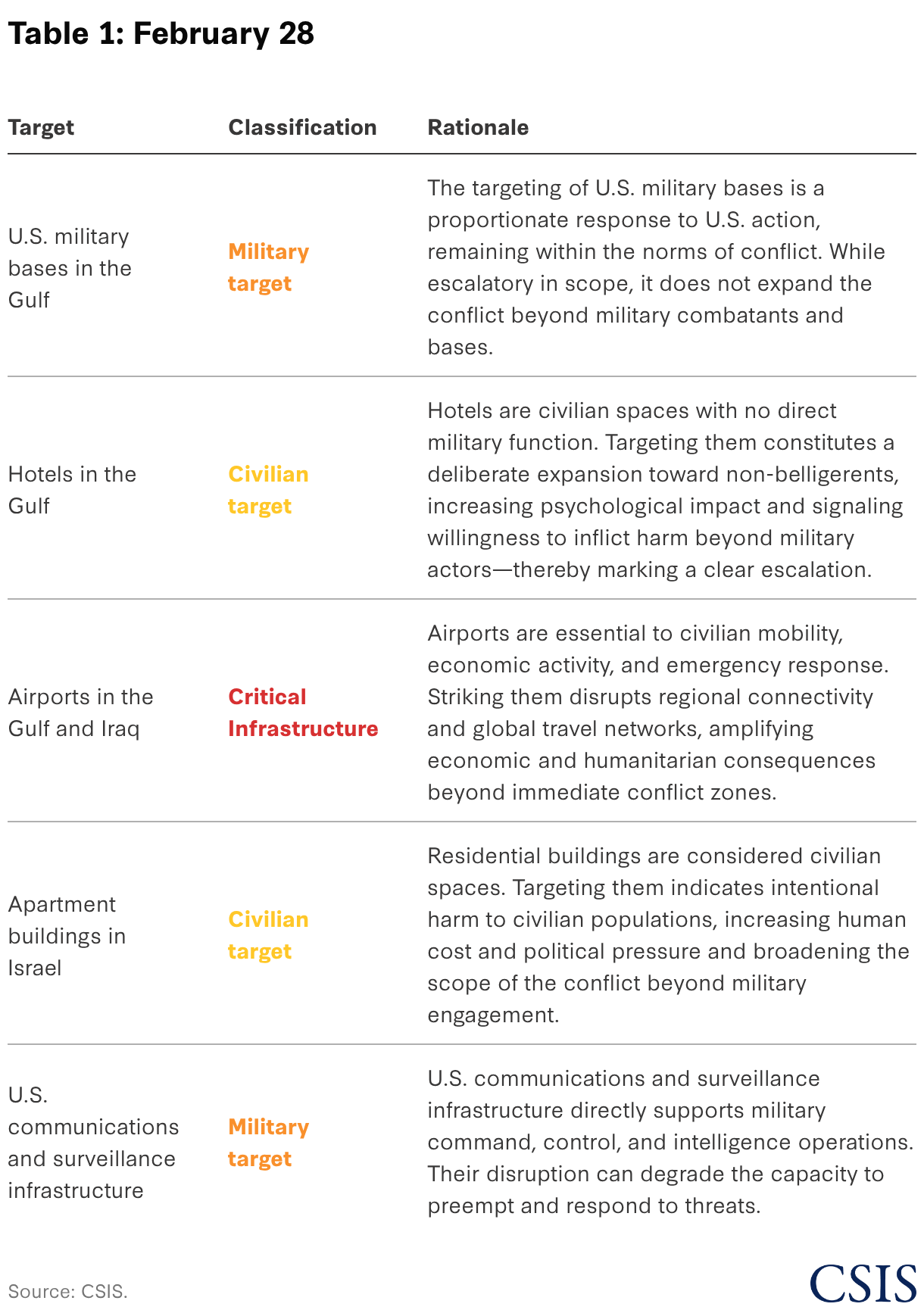
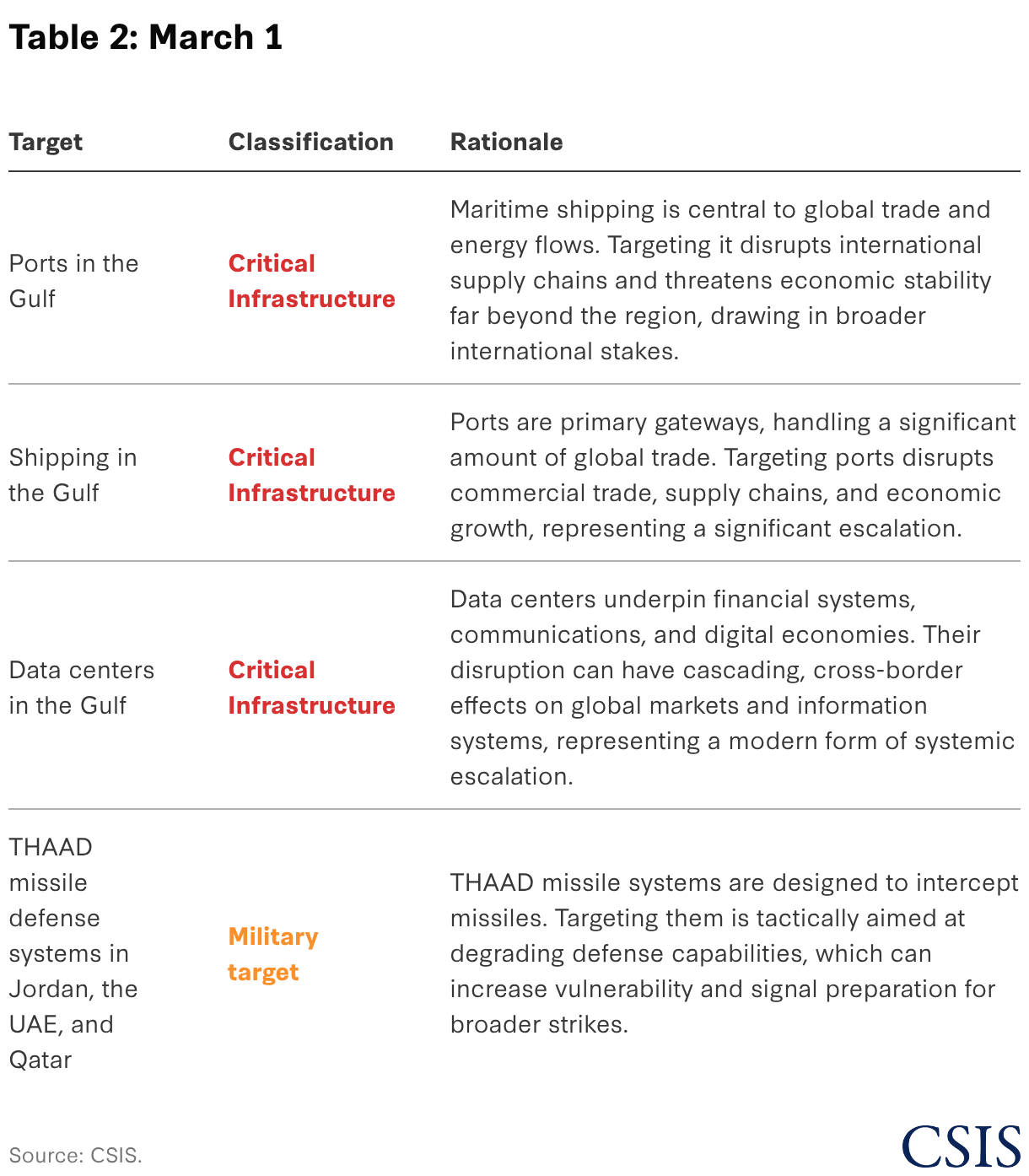
Within the first 24 hours of the conflict, Iran escalated to hit not only combatant country military targets—within the norms of conflict—but also targeted civilian targets and critical infrastructure in non-combatant countries in the Gulf. In these neighboring countries over just the first three days of conflict, Iran hit civilian targets such as apartment buildings and hotels as well as critical infrastructure targets such as airports, ports, data centers, and energy-related infrastructure. Its widening array of targets—from purely military targets to civilian targets and critical infrastructure—intensified the conflict, provoking greater levels of disruption and imposing higher costs.
Beyond its escalatory tactics, Iran’s “eye for an eye” response when its key targets are attacked has ensured that the escalation cycle continues. For example, in response to strikes on its critical infrastructure, Iran targeted other countries’ critical infrastructure in return, including desalination plants and even a failed attempt to hit Israel’s Dimona nuclear research site in response to an attack on Iran’s Natanz nuclear facility. Going forward, should President Trump’s deadline expire and the president make good on his threat to hit Iranian power stations, a new cycle of vertical escalation can be anticipated, with Iran potentially following suit on its threat to retaliate in kind, hitting power stations and other critical infrastructure in various Gulf countries.
What Is Vertical Escalation?
Vertical escalation is defined as “increasing the intensity, scope, or severity of a conflict or attack.” In the context of the war with Iran, Tehran has opted to undertake strikes against a widening array of targets as part of its vertical escalation strategy. By hitting an expanding set of targets—moving from strictly military targets to civilian targets and critical infrastructure—Iran seeks to impose mounting costs by expanding the scope of disruption at the local, regional, or global levels.
Definitions of Targets

Mona Yacoubian is director and senior adviser of the Middle East Program at the Center for Strategic and International Studies in Washington, D.C.
Commentary by Mona Yacoubian — March 16, 2026

Commentary by Mark F. Cancian and Chris H. Park — March 25, 2026

Commentary by Emily Harding — March 19, 2026

