Taking Stock of the U.S.-Korea Alliance | The Capital Cable #146
November 13, 2026 • 9:30 – 10:15 am EST
Hosted by Korea Chair

Photo: maho/Adobe Stock
The rise of AI and data centers; the electrification of commercial, industrial, and transportation sectors; and reindustrialization have produced a new era of electricity demand growth characterized by concentrated large loads. While these large loads are making a demonstrated impact on economic growth, they present unprecedented strains on the bulk power system.
Today’s large loads have certain traits that make planning and preparing for their grid impacts more complex. Large loads cluster geographically, are much larger than typical loads, and are driven by commercial timelines that move much faster than those of utility-scale planning. Often, grid planning entities receive more interconnection requests than will actually be built, as developers attempt to secure power as quickly as possible.
A potential concern is that as national demand growth materializes, aggregate figures and estimates can obscure local realities. Because of the inherent unpredictability of large-load growth, the location, sizing, and timing of these loads at a subnational level may be unclear, increasing the risk of resource misallocation. Mitigating that risk is imperative for policymakers, regulators, and utilities. However, the obligation to protect the interests of voters, ratepayers, and customers can conflict with the need for faster speed-to-power.
Interregional transmission is especially capable of addressing this emerging demand issue by helping offset the risk of over- and underinvestment in local generation and transmission while also speeding large-load interconnection.
On September 8, 2026, in response to the request from the Department of Energy (DOE) for public comments on the draft National Transmission Needs Study 2026, the Center for Strategic and International Studies (CSIS) submitted a set of recommendations outlining how the unique characteristics of large loads warrant greater scrutiny, and how interregional transmission can be assessed as a prospective tool to address the emerging grid planning concerns driven by large loads. The following takes the insight of the submitted comments and outlines how the DOE should analyze, characterize, and evaluate scenarios for large-load growth and the resulting value of interregional transmission.
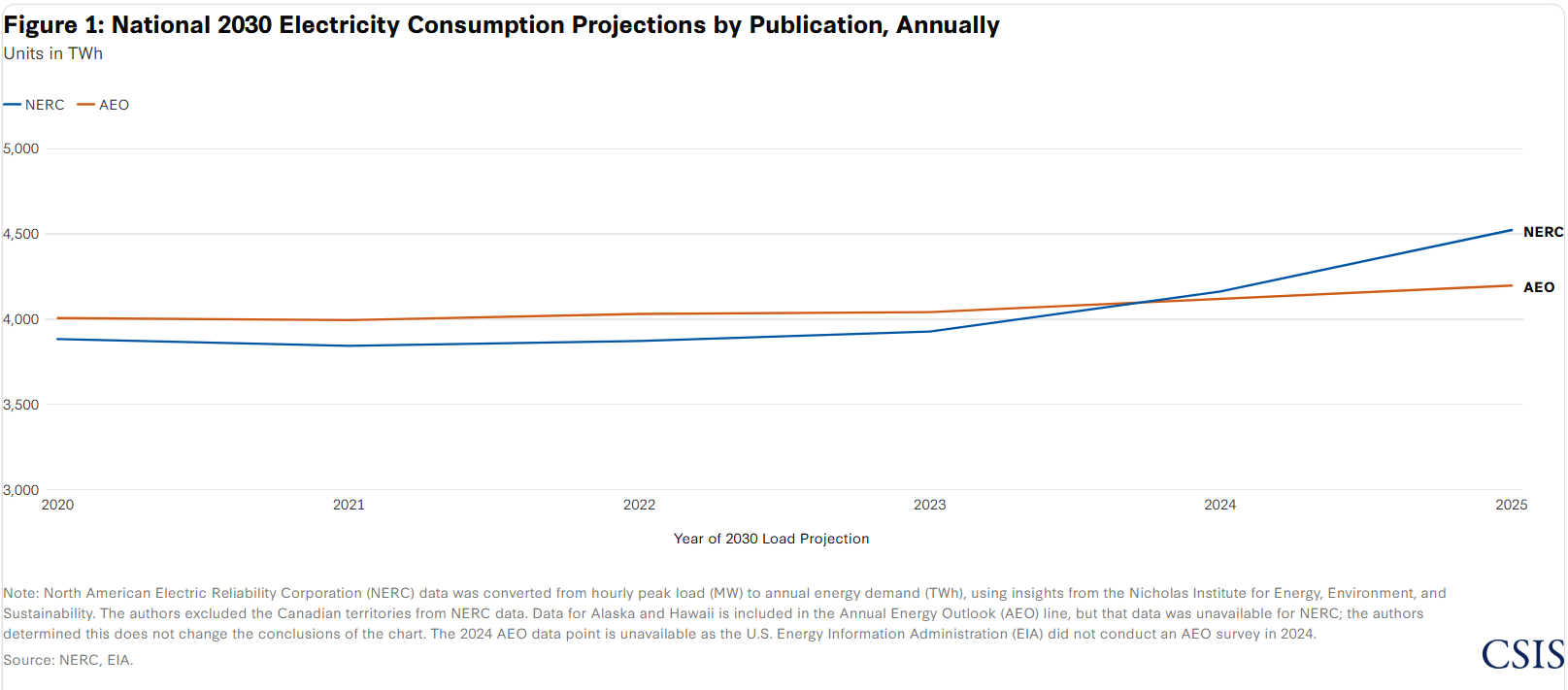
The above chart compares two estimates for national load projection in 2030: the AEO report from the U.S. EIA, in orange, and the aggregation of regional load projections from the Long-Term Reliability Assessment from NERC, in blue.
After 2023, NERC estimates surpass those of the AEO, at roughly the same time that large loads become a consideration in bulk system planning. This may be due to several reasons:
The disparity reflects the possibility of regional projections overcompensating for, or double-counting, large-load expectations, presenting a cross-regional risk of misallocating energy resources. Grid planning must account for this uncertainty, and interregional transmission has the potential to retain value regardless of where large loads land or how much was invested in local infrastructure.
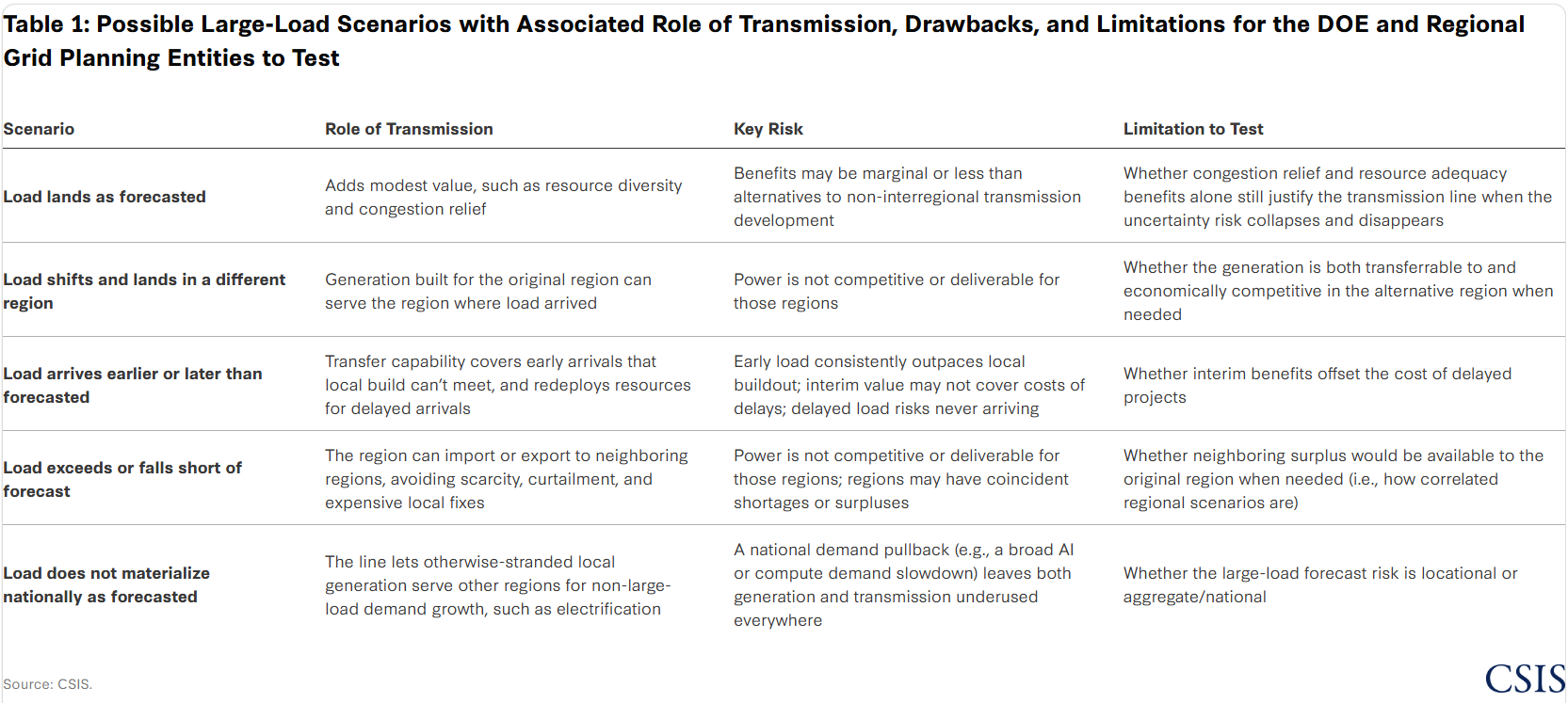
As outlined in Table 1, interregional transmission has the capacity to retain value across a number of potential large-load scenarios. Interregional transmission lets resources committed under one forecast serve demand that suddenly emerges under another. At the same time, it is important to evaluate the constraints and risks of interregional transmission, as outlined in the final two columns of the table. The specific questions are designed for regional grid planning entities to keep in mind as they explore the additional value interregional transmission can offer.
The following is a summary of CSIS’s comments to the DOE for the National Transmission Needs Study 2026.
Commission a study to distinguish and quantify regional demand uncertainty. The authors of the public comment response recommend that the DOE commission a study to build load growth scenarios by region, considering large-load-specific characteristics such as magnitude, location, and timeline of large-load realization. This study should also model the cost of forecasting error, or the cost a region incurs if it builds local infrastructure against a load that does not arrive, against costly stopgaps and congestion when a load appears and the region is not prepared.
The output is a set of regional load growth scenarios paired with realization probabilities quantifying the misallocation exposed when actual load diverges from forecast.
Guidance from the DOE should support regions in conducting collaborative interregional transmission planning studies across links and seams where the potential hedging value is greatest. If interregional transmission planning is properly understood and appropriately valued, it can durably address the distinct challenges that large-load growth presents.
Abhinav Subramaniam is a research associate in the Energy Security and Climate Change Program at the Center for Strategic and International Studies (CSIS) in Washington, D.C. Chelsey Gilchrist is a research intern with the Energy Security and Climate Change Program at CSIS. Joseph Majkut is director of the Energy Security and Climate Change Program at CSIS.


Commentary by Joseph Majkut and Cy McGeady — May 25, 2023

