Ensuring Economic and Energy Security: Opportunities for U.S.-Japan Leadership
September 24, 2026 • 9:00 am – 12:00 pm EDT
Hosted by Japan Chair

Photo: Pixels Hunter/Adobe Stock
When Americans think about China and intellectual property (IP), they typically think about theft. And for good reason. For decades, China relied on foreign technology to fuel its economic rise, employing a range of legal and illegal means to acquire IP from abroad. Allegations of cyber espionage, forced technology transfer, counterfeiting, and trade secret theft became regular features of the U.S.-China relationship. Even today, estimates suggest that Chinese IP theft costs the United States hundreds of billions of dollars each year.
But while IP theft remains an important challenge, it is an insufficient framework for understanding modern China’s relationship with IP. The image of China as simply a thief with disregard for IP rights reflects an earlier stage of its technological development. Over the last two decades, China has become a world-leading innovator in a range of industries and a major IP producer. It now understands IP rights as an instrument that can serve its broader technological objectives, and it has strengthened its IP institutions accordingly. In other terms, China has become serious about IP because IP can now advance China’s national interests.
This shift has important implications for the United States. An exclusive focus on Chinese IP theft risks obscuring the nature of the challenge the United States now faces: a competition between two innovation powers at the technological frontier. Success will depend not simply on slowing China’s progress, but on accelerating the United States’ own. Protecting U.S. innovators from IP theft and misappropriation remains essential. But the United States must respond to the competitor it faces today, not the one it faced yesterday.
In a 2020 speech, FBI Director Christopher Wray described Chinese IP theft as “one of the largest transfers of wealth in human history.” Likewise, a 2017 report from the Commission on the Theft of American Intellectual Property estimated that IP theft—including trade secret theft, software piracy, and counterfeit goods—costs the U.S. economy between $225 billion and $600 billion annually, with China identified as the principal offender. While the precise cost is difficult to calculate, it is safe to conclude that Chinese theft and misappropriation of IP is substantial.
Understanding how this dynamic emerged requires understanding China’s economic development. When China enacted its first patent law in 1984, it was only beginning its transition toward a more market-based economy. Nearly four-fifths of its population lived in rural areas. Its GDP per capita was roughly 1/70th that of the United States. Chinese firms produced relatively little proprietary technology, giving the country comparatively weak incentives to prioritize strong IP rights. Instead, China’s leadership focused on acquiring foreign technology through a combination of legitimate channels—including licensing, joint ventures, and foreign investment—as well as more coercive or illicit means.
Although often unlawful and inconsistent with international commitments, this approach reflected incentives common to countries attempting to move up the technological ladder. Strong IP rights tend to have a more limited effect on innovation in developing economies, where firms can often generate gains by adapting and improving existing technologies. The United States itself was not entirely immune to similar incentives: Early U.S. leaders encouraged the illicit acquisition of British manufacturing knowledge.
These dynamics shaped U.S. concerns about China for decades. Throughout the 1990s, weak legal protections and widespread infringement remained persistent points of friction. During China’s accession to the World Trade Organization (WTO) in the early 2000s, policymakers raised concerns that foreign firms were being pressured to transfer technology as a condition of market access. Following accession, China’s uneven enforcement of IP rights contributed to a major WTO dispute, and the limited success of that case discouraged similar challenges. In the early 2010s, cyber espionage became an increasingly prominent concern, culminating in a 2015 understanding between Presidents Barack Obama and Xi Jinping that neither government would knowingly support cyber-enabled theft of IP for commercial advantage—an understanding the United States subsequently accused China of violating.
These developments produced a well-earned and enduring image of China as an IP thief. That image remains grounded in reality today. Allegations of Chinese IP theft continue to evolve alongside technology itself, from semiconductor designs to concerns surrounding the distillation of advanced AI models. Protecting U.S. innovators from IP theft, misappropriation, and counterfeiting remains an important national priority.
But because this image was formed largely during China’s period of technological catch-up, it increasingly captures only one dimension of China’s relationship with IP. As countries become more innovative, their incentives change. Today, there is another half to China’s IP story.
When China enacted its first patent law in 1984, it remained a largely agrarian economy just beginning its transition toward market reforms. Its leading exports were textiles, agricultural products, and hydrocarbons. Today, China is a global leader in industries such as advanced electronics, telecommunications equipment, electric vehicles, and batteries. In many sectors, it produces valuable innovations of its own.
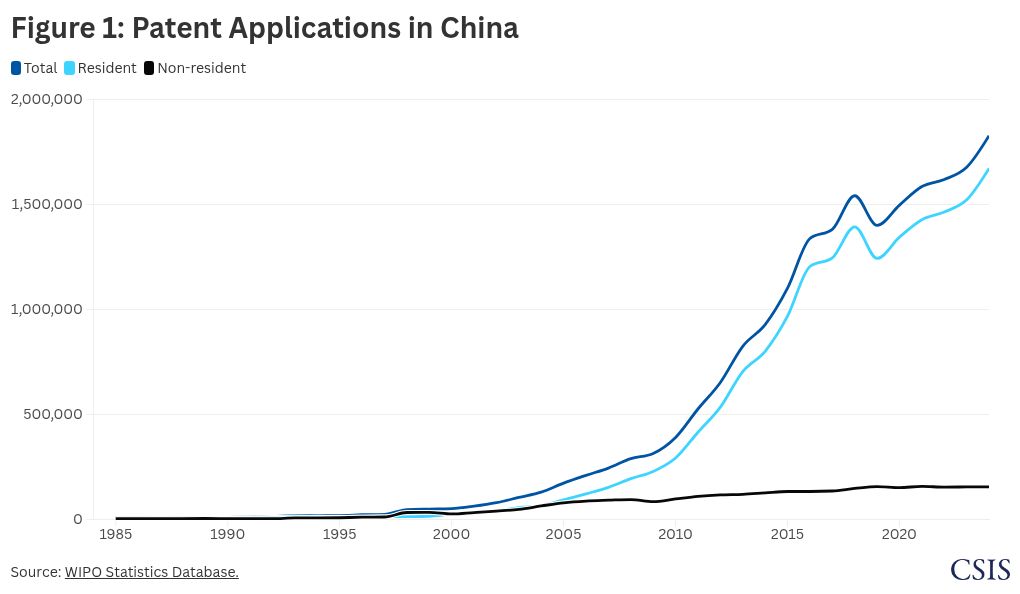
This transformation is reflected in China’s growing production of IP. In 1985, the first full year of China’s patent system, the China National Intellectual Property Administration received fewer than 9,000 patent applications. Less than half of these came from Chinese residents. By 2024, that number had grown to more than 1.8 million patent applications, with roughly 91 percent filed by domestic applicants. Patent data should be interpreted cautiously, particularly given the role government incentives have historically played in encouraging patenting in China. Nevertheless, the scale and sustained growth of patenting activity reflect a country that is producing far more IP than it did only a generation ago.
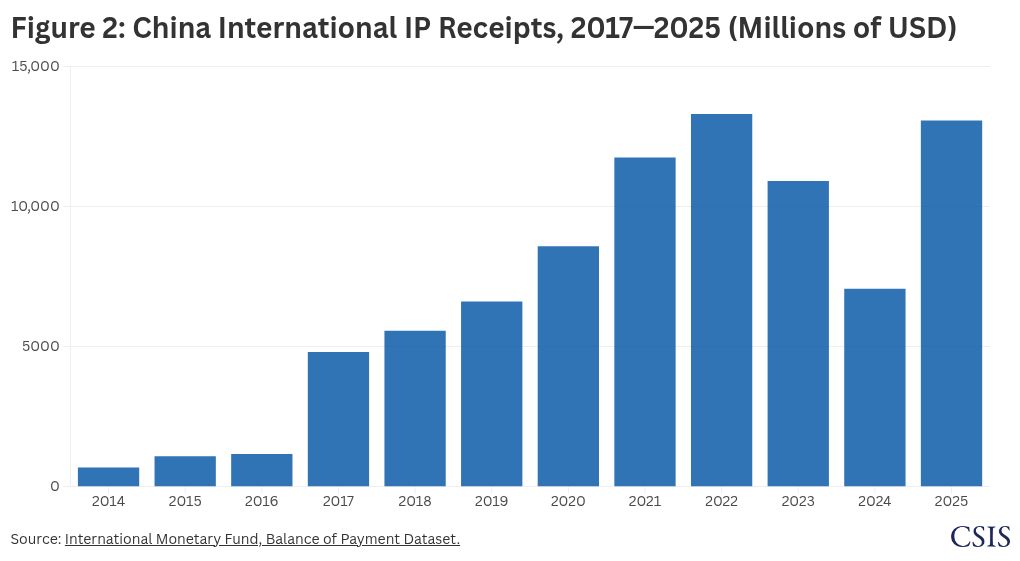
The shift is also evident in the value of China’s IP. For decades, China was primarily an IP importer, paying substantial licensing fees to foreign firms as it industrialized and integrated into global supply chains. Today, Chinese companies are growing IP exporters. Although annual receipts have fluctuated in recent years, China’s income from international IP licensing has increased substantially over the past decade, reflecting the growing commercial value of Chinese technology and innovation.
As Chinese firms create more IP, they have stronger incentives to protect it, enforce it, and maximize its returns in global markets. These changing incentives have fostered growing support for stronger IP institutions among Chinese firms, legal experts, and other stakeholders whose success increasingly depends on effective IP rights. And, most importantly, they have made stronger IP institutions a matter of state interest. China has made IP policy an explicit component of its national innovation strategy, embedding it in successive Five-Year Plans and coordinating it alongside its industrial, science, technology, education, labor, and foreign policy objectives.
To support those objectives, China has systematically strengthened its legal and administrative framework for IP. It has revised its IP laws extensively to better align with international standards and developed a specialized system of IP adjudication, including a network of technology-oriented courts; it also regularly updates its patent law and examination guidelines to account for emerging technologies. These reforms are intended to promote innovation by incentivizing investment in research and development, creating markets to commercialize intellectual assets, and providing Chinese innovators with greater legal certainty, paving the way for Chinese leadership in critical technologies.
Importantly, however, this does not mean China has adopted the same philosophy of IP as the United States. Both nations must balance the interests of innovators, competition, and broader public policy objectives. But whereas the U.S. IP system is fundamentally rooted in protecting private property rights as a means of encouraging innovation, China’s system is better understood as an instrument of national development: IP rights are enforced because they serve broader industrial, technological, and geopolitical objectives.
A key way this difference in purpose manifests is through China’s treatment of foreign firms. China’s IP system can disadvantage foreign companies when it believes doing so will advance state priorities, reflecting that its commitment to IP remains subordinate to broader national goals. Despite this, foreign companies continue to file large numbers of patent applications in China. China’s IP system has become substantially more credible and commercially significant than it was a generation ago. For many firms, the commercial benefits of securing Chinese IP rights, such as access to China’s massive internal market, outweigh the downsides.
China’s maturing relationship with IP is also reshaping its approach to the international IP system. As Chinese firms accumulate valuable intellectual assets, Beijing has become increasingly interested in ensuring that global IP rules and institutions serve China’s commercial and strategic interests. One example is the growing role of Chinese courts in global patent disputes, which have asserted extraterritorial jurisdiction in certain cases while also taking a more active role in determining licensing terms for key technologies. They have also discouraged disputes involving Chinese companies from being litigated abroad while limiting transparency around important rulings.
Taken together, these developments reveal a China whose relationship with IP has fundamentally shifted. Theft and misappropriation remain important parts of China’s IP story, but China is now also an IP creator, enforcer, and increasingly a global rule maker. Any strategy for competing with China must account for all of these roles.
How policymakers understand China’s relationship with IP matters because diagnosis shapes strategy. If China is viewed primarily as a country that succeeds through theft and misappropriation, the natural policy response is to stop the theft. Export controls, investment restrictions, and other defensive measures can become the primary focus of policy. Yet an effective strategy cannot rely exclusively on defensive tools. Competition with China is a contest over who can create the next generation of technologies, not simply protect existing ones.
An incomplete understanding of China’s relationship with IP may lead policymakers to devote insufficient attention to strengthening the competitiveness of the U.S. IP system. As China has been systematically strengthening its IP institutions, the U.S. IP system has become less predictable and less supportive of innovation. Changes to patent eligibility doctrine, injunctive relief, post-grant review, and recurring policy proposals such as march-in rights have collectively weakened confidence in the U.S. IP system as a platform for long-term investment. More broadly, the United States has gradually retreated from the international IP leadership it spent decades building, while other nations have become more active in shaping global IP norms and institutions. These trends are contributing to a shift in where and how companies choose to protect and enforce their IP, and they may reduce the advantages U.S. firms have historically enjoyed in global IP markets.
Another consequence may be policies that inadvertently weaken the institutions that have historically advantaged the United States. The recently proposed Prohibiting Adversarial Patents Act (PAPA) illustrates this risk. Motivated by legitimate concerns about national security and Chinese misconduct, proposals such as PAPA seek to impose costs on Chinese firms by restricting their participation in the U.S. IP system. Yet weakening the openness, predictability, or neutrality of that system carries broader costs for U.S. innovators as well.
Ultimately, the danger of the “China IP theft” narrative is not that it is wrong, but that it encourages policymakers to define success primarily in terms of limiting China’s progress rather than expanding the United States’ own innovative capacity and role within the global IP system.
Protecting U.S. innovators from theft should remain a priority, but defensive measures are, at best, half of a competitive strategy. In addition to pressing China to comply with its international IP commitments and ensure more even-handed treatment of foreign firms, the United States should strengthen its own IP system through clear and predictable rights, a well-resourced U.S. Patent and Trademark Office, and stable commercialization pathways. It should reassert its leadership role in the international IP system to counter China’s growing influence, championing the openness, predictability, and respect for IP that has historically advantaged U.S. firms. Just as China has deliberately integrated IP into its broader innovation strategy, the United States should view a strong IP system as a strategic asset that supports economic growth, technological leadership, and national security.
The challenge posed by China presents an opportunity to reaffirm one of the United States’ oldest and most enduring competitive advantages. The Constitution empowered Congress to secure exclusive rights for inventors because the nation’s founders recognized that protecting innovation would strengthen the republic itself. That insight remains just as relevant today. The competition with China will not be won solely by slowing China’s technological progress. It will be won by ensuring that the United States remains the world’s premier nation to invest, commercialize, scale, and innovate.
Chris Borges is a fellow and senior program manager in the Economic Security and Technology Department at the Center for Strategic and International Studies in Washington, D.C.