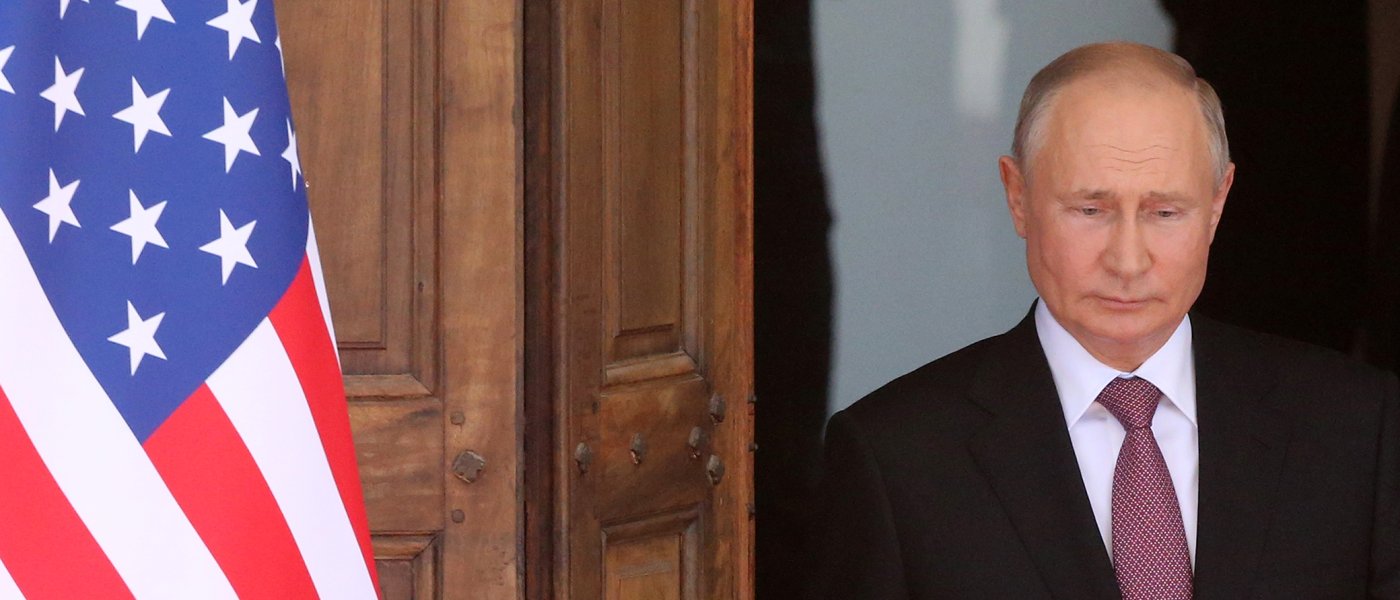
As U.S. President Donald Trump and Russian President Vladimir Putin prepare to meet this Friday at a summit in Alaska, questions arise over the potential agenda and implications for the war in Ukraine. With Ukrainian President Volodymyr Zelensky currently expected to be absent from the talks, concerns have emerged about the scope of any possible agreements, the role of Ukraine’s allies, and the durability of any negotiated settlement. CSIS experts weigh in on the political, military, and diplomatic stakes surrounding the meeting.
Seth G. Jones, President, Defense and Security Department; Harold Brown Chair
Peace agreements rarely end wars, making it important to set expectations for Ukraine peace negotiations. Only 16 percent of interstate wars after World War II ended in a peace settlement. Roughly 21 percent ended with a decisive military victory by one side, while another 30 percent ended with a ceasefire as the warring sides faced a military stalemate but failed to reach a formal settlement.
In addition, peace agreements routinely fall apart. Over a third of peace agreements between 1975 and 2018 collapsed for a range of reasons: Domestic support for the deal fell apart, one or more of the sides violated the terms of the agreement, or policymakers changed their minds for strategic or other reasons.
For peace agreements to end wars and endure, the warring sides generally need to view their prospect for military success as low; there needs to be significant external pressure for a deal, including positive inducements, third-party security guarantees, and penalties for reneging on a deal; and there needs to be internal support for a deal from critical domestic constituencies.
A better understanding of how wars end has several implications for the prospects of a peace deal in Ukraine.
First, Ukraine needs to be armed to the teeth from Europe—and ideally the United States—to convince Russian leaders that their prospect for military success is low and deter a future Russian invasion. Ukraine needs air and missile defense capabilities, medium- and long-range munitions, advanced fighter aircraft, intelligence, components for drones, and other materiel that can be used to attrit advancing Russian forces if Moscow shirks on a deal.
Second, there needs to be credible penalties—especially from the United States—if Russia walks away from a deal and positive inducements if Russia keeps its word. For example, increased sanctions against Russia’s energy sector would likely cause substantial pain. Energy sanctions could be combined with sanctions against other Russian exports, such as minerals, metals, agricultural goods, and fertilizers. After all, Russia is struggling with high inflation, labor shortages, and limited paths to economic growth.
Talking about peace is important. But talk is cheap. As history shows, reaching an enduring peace deal is a whole different matter.
Image
Too Much Uncertainty to Make a Final Judgement on the Trump–Putin Meeting
Eliot A. Cohen, Arleigh A. Burke Chair in Strategy
It’s definitely a bad look—meeting Putin, apparently without Zelensky or European allies present, inviting him onto U.S. soil, and potentially talking about swaps of territory that aren’t the United States’ to give. That said, I will reserve any final judgments until we see what comes of this.
Trump faces three big problems here: (1) Putin wants to take all of Ukraine, and he will probably push for conditions that are unacceptable even to Trump; (2) it seems as though U.S. Special Envoy Steve Witkoff made a cardinal diplomatic error—he failed to capture exactly what Russia was offering (a ceasefire freezing the front lines, or one contingent on Ukraine surrendering territory?); (3) above all, Ukraine’s allies and Ukraine itself retain agency. Trump is no doubt hungry for a deal because he fancies himself a peacemaker and believes he deserves, or will deserve, a Nobel Peace Prize. That doesn’t mean others will or should play along.
Ultimately, the central question for Trump, Ukraine, and Putin is the same: the theory of victory. For Trump, why assume that any deal would be anything other than a pause between two Russian invasions? For Zelensky, if unwilling to cede territory—even temporarily—how do you sustain the war toward something resembling a victory? For Putin, how can marginal territorial gains—bought with over a million casualties, NATO expansion, a dangerously violent group of returning veterans, and a badly damaged economy—look like a win?
There are no clear answers to any of these questions.
Image
Trump–Putin Meeting Highlights Diplomatic Gains for Russia Despite Unresolved Ukraine Issues
Maria Snegovaya, Senior Fellow, Europe, Russia, and Eurasia Program
It appears that Trump’s August 8 sanctions ultimatum may have prompted Putin to soften some of his earlier demands on Ukraine. Allegedly (though accounts differ), Putin signaled he would now limit his territorial demands to the Donetsk region, rather than seeking concessions from four Ukrainian regions as before. There are also signs he may be more flexible on Ukraine’s demilitarization issues.
The details remain murky, particularly as Steve Witkoff has walked back parts of his earlier account of his meeting with Putin. Still, the absence of President Zelensky from the alleged talks between President Trump and President Putin is troubling. Ukraine currently controls about 25 percent of the Donetsk region; ceding such a large portion of its own unoccupied territory (even in exchange for other areas) would be unprecedented.
Meanwhile, Putin gains valuable diplomatic recognition by meeting the U.S. president for the first time since his June 2021 summit with then—President Joe Biden in Geneva—without offering significant concessions on Ukraine or even agreeing to a ceasefire. His ability to shape his interlocutors’ perceptions in person, a hallmark of his KGB background, remains a potent tool. At this stage, optics suggest a potential diplomatic win for Putin. In the days leading up to the Trump–Putin meeting, the EU and European capitals will work to present a united front, hoping to persuade the White House to take their concerns into account.
Image
Ukraine’s Perilous Military Condition
Mark F. Cancian, Senior Adviser, Defense and Security Department
As Presidents Trump and Putin prepare to meet in Alaska, the war goes badly for Ukraine. Russia continues to chew away in half a dozen spots along the front line: Kupyansk, Pokrovsk, Chasiv Yar, Lyman, Sumy, and Toretsk. Since the beginning of its offensive in late 2023, Russia has gained about 6,000 km2, equivalent to the size of Delaware. The successful Ukrainian counterattacks at Kharkiv and Kherson are distant memories. Ukraine’s bold strike towards Kursk in August 2024 pushed 30 km into Russia, but the gain was untenable. Russia, helped by North Korean troops, pushed Ukraine back to its start line. All this has come at an immense cost to Russia, its total casualties having reached 1 million. However, Russia gives no sign of giving up.
Ukraine has had some major recent victories. It is striking deep into Russia, attacking air bases and oil facilities with remarkable resourcefulness. It has swept the Russian fleet from the Black Sea, even though it lacks a navy. Its development of battlefield drones has rewritten the book on warfare. However, Ukraine has not shown how it will turn these successes into victory.
The Ukrainian deep attacks, the continuing attrition of Russia’s forces, and civilian hardship from sanctions might cause Russian morale to crack. It happened in 1905, it happened again in 1917, and it might happen in 2025. On the other hand, it didn’t happen in 1941, when Russia had taken 4 million casualties and was losing, nor at the equivalent time of that war, November 1944, when Russia had taken 7 million casualties but still pushed forward.
Putin thinks he’s winning, and he is. He thinks time is on his side, and he’s probably right. The only way for the United States to change Putin’s mind is to do something dramatic. Secondary sanctions are helpful, but they will take time to have an effect, and so far, Russia has shrugged sanctions off. President Trump could reinforce the sanctions’ effect by announcing a dramatic military aid package, for example, a billion dollars plus more from European allies. The administration appears unwilling to do that. So, going into the summit, Ukraine’s weak battlefield position leaves it vulnerable to an intransigent Russia and a U.S. president eager for an agreement.
Image
More than a Map: Why Territory Swaps Are Insufficient to End the War
Benjamin Jensen, Director, Futures Lab and Senior Fellow, Defense and Security Department
Ceasefire negotiations are the start, not the end, of negotiations. Territory swaps alone will be insufficient to end the war. As Trump and Putin plan to meet in Alaska, there are larger issues concerning the future security status of Ukraine, including technical aspects of monitoring any ceasefire, frozen Russian assets, and questions over who pays for reconstruction, and the return of thousands of kidnapped Ukrainian children. Ukraine cannot just give up territory to negotiate with Putin, who has violated multiple ceasefires since 2014. There are domestic, political, and constitutional limitations on what Zelensky can accept, a prospect made starker by his absence at the Alaska talks.
Over the past six months, CSIS Futures Lab has pioneered analyzing peace talks in general, and Ukraine specifically, using a mix of data science and AI. This project—Strategic Headwinds—uses surveys of expert opinions and news outlets to run negotiation simulations using AI models. This process is further reinforced by training a large-language model on over 300 historical peace negotiations and treaties to add historical context. The findings reinforce that there is no simple solution to end the war, and any exit will involve a combination of land, money, and security, likely to take months to negotiate and years to monitor and enforce.
During this process, Putin is likely to continue using a punishment strategy largely reliant on mass salvos of one-way attack drones (Shaheds) as part of his larger negotiation strategy. He will attack Ukrainian cities daily, a phenomenon the Futures Lab documents through our firepower strike series, while also telling Washington that Moscow only seeks peace and security guarantees. Putin will also try and use economic offers to Washington directly as part of this process to isolate Ukraine and Europe. The resulting process is a portrait of twenty-first-century strategy and statecraft in which mercantilist tendencies erode the remnants of the liberal international order.
Image
Trump Needs to Get Tough to Strike a Deal
Max Bergmann, Director, Europe, Russia, and Eurasia Program and Stuart Center
Throughout 2025, Russia and Ukraine have been engaged in an elaborate dance to pin blame on the other for the failure of Trump’s peace efforts. That dance continues in Alaska, where Putin will likely demand significant territorial concessions from Ukraine knowing that Kyiv will say no. Hence, Putin hopes to turn the tables on Ukraine, such that in Trump’s eyes it is once again Ukraine that is seen as the obstacle to peace and him receiving the Nobel Peace Prize. By that logic, it is Ukraine that needs to be squeezed, just as it was after the Oval Office meeting with Zelensky when aid and intelligence sharing was cut off.
The key question is whether President Trump will actually get tough with Putin. For this war to end, Russia has to believe it can no longer win, and that, unfortunately, is not currently the case. Trump has recently threatened a harsher economic response and has agreed to sell U.S. aid to Europe for Ukraine. But inviting Putin, a man wanted by the Hague, to U.S. soil already gives him a win by weakening the global taboo against engaging with Russia. The only way such a concession is worth it is if Trump tells Putin directly that the United States will not let Russia win the war and that the United States is preparing an oil embargo that would be economically ruinous to Russia.