Who's Paying for the Iran War? | The High Top
August 25, 2026 • 10:00 – 10:15 am EDT

Photo: Allen J. Schaben/Los Angeles Times/Getty Images
Recent analyses have identified the causes and consequences of shrinking munitions stockpiles. Policymakers and industry should now turn their efforts to not only rebuilding the munitions industrial base but also recasting it for the demands of modern high-intensity wars of precision and attrition. Doing so calls for both increasing the size and changing the composition of the U.S. munitions arsenal, embracing magazine breadth as well as magazine depth through equipping the joint force with a “high-low mix” of exquisite and affordable missiles and interceptors. The emergence of multiyear “framework agreements” between the Department of Defense (DOD) and contractors is important, but they need to be followed by appropriations from Congress, increased capital expenditures (CapEx) by industry, and contracts between the Pentagon and companies.
What is a realistic timeline for this rebuilding and recasting of the munitions industrial base? Looking at the president’s fiscal year 2027 budget request, subsequent initiatives, quarterly company reporting, and recent contract announcements provides a clearer picture of the planned future as well as the obstacles that need to be overcome to achieve those objectives.
Based upon the DOD’s FY 2027 budget requests and subsequent policy announcements, the Pentagon plans to significantly grow stocks of the nation’s proven and capable missiles and interceptors. For example, requests for Patriot PAC-3 Missile Segment Enhanced (MSE) interceptors have grown 839 percent, from 341 in FY 2026 (by the U.S. Army and Navy) to 3,203 in FY 2027 (by the Army and Navy); asks for Terminal High Altitude Area Defense (THAAD) interceptors have climbed 2,216 percent, from 37 in FY 2026 (by the Missile Defense Agency) to 857 in FY 2027 (by the Army); and requests for Tomahawk missiles have surged 1,740 percent, from 57 in FY 2026 (by the Navy) to 1,049 in FY 2027 (by the Navy and Army). While expensive, these exquisite munitions are intricately designed, high-performance systems optimized to undertake the most difficult missions. Multiyear agreements, combined with coproduction efforts under consideration as well as direct-to-supplier agreements, could potentially help to reduce the 25-to-51-month manufacturing lead time for these systems. But unfortunately, these and other exquisite legacy systems were fundamentally built for performance and not designed or funded for production at scale.
Those limitations, plus the need for a broader portfolio of munitions to better address threats such as swarms of Russian and Iranian Shahed unmanned autonomous systems, have helped lead to an increased focus on lower-cost and more producible systems. Low-cost, expendable munitions have long been included in the United States’ stockpiles, ranging from the Joint Direct Attack Munition guidance kit developed in the 1990s to the Coyote counter-unmanned aircraft system pioneered the following decade. Yet the amount of attention and capital devoted to expanding affordable options within the U.S. arsenal is dramatically growing. The Pentagon launched the Drone Dominance Program in December 2025, for example, a $1.1 billion initiative to scale domestic small drone production, remove acquisition barriers, and rapidly field some 340,000 units by the end of 2027.
Since May 2026, the Pentagon and munitions manufacturers have signed several multi-year framework agreements to rapidly field substantial inventories of low-cost cruise missiles. These efforts include the Air Force’s Family of Affordable Mass Missile (FAMM) program for over 27,000 air-launched cruise missiles requested over the next five years and the Low-Cost Containerized Missiles (LCCM) program for some 10,000 ground-launched cruise missiles delivered by the beginning of 2030. Through the Multi-Mission Affordable Capacity Effector program, the Navy plans to request roughly 4,500 hypersonic air-launched cruise missiles through FY 2031. The Army seeks to equip its air and missile defense systems with modular interceptors costing under $1,000,000 per unit under its low-cost interceptor (LCI) initiative. The Missile Defense Agency, meanwhile, aims to counter ballistic and hypersonic threats at less than $750,000 per interceptor through an effort of the same name. To accelerate acquisition and production timelines for these new capabilities, the DOD is holding competitions for contracts between emerging defense companies in programs such as Drone Dominance and the Army LCI and signing framework production agreements with newer firms such as Anduril, CoAspire, and Zone 5 Technologies for LCCM and FAMM. These new munitions will be welcome additions to the DOD portfolio, but government and industry need to work closely to develop, rigorously test, deliver, and effectively incorporate these low-cost systems into the joint force.
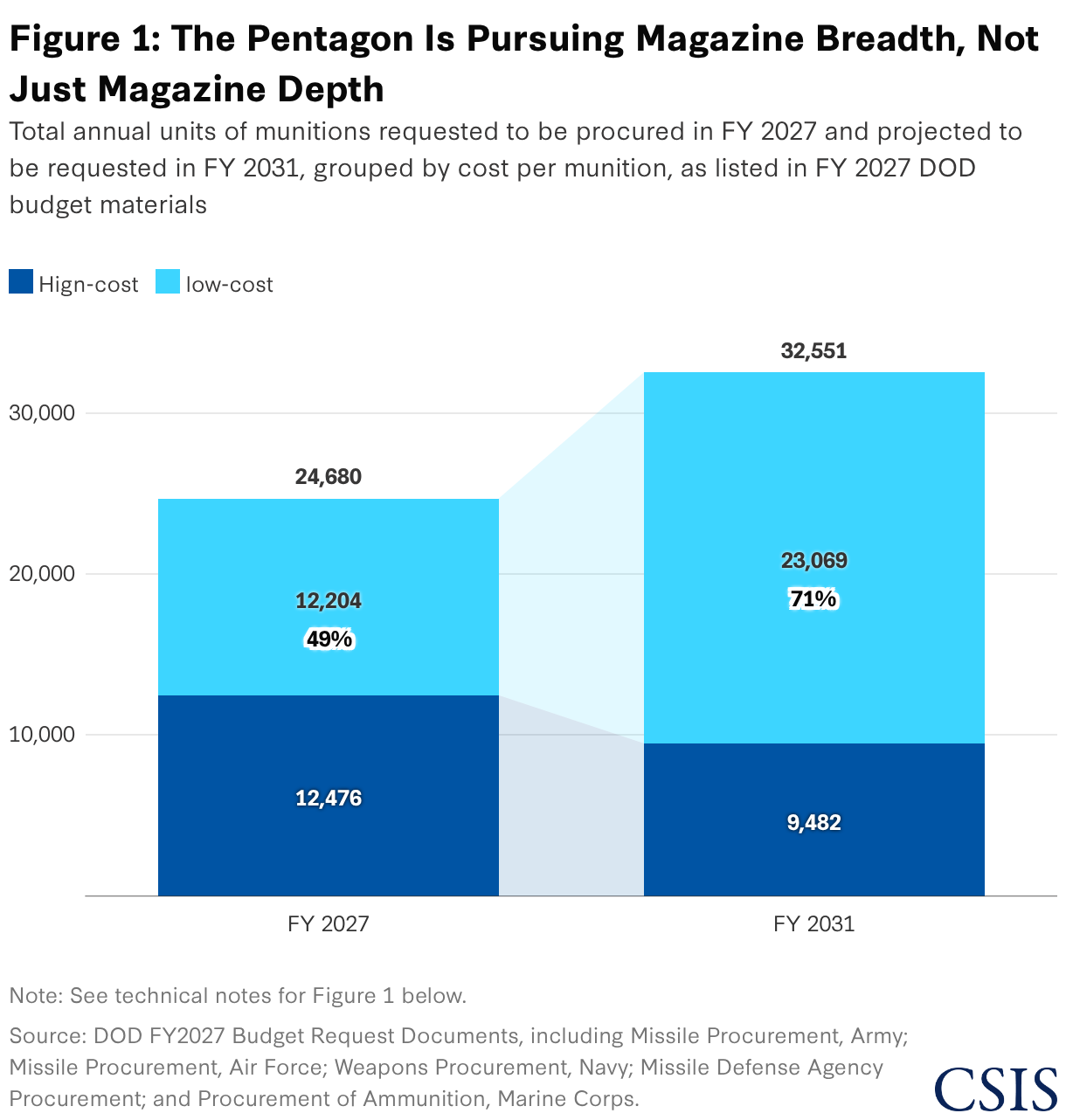
The Pentagon’s FY 2027 budget request and subsequent initiatives reinforce the shifting DOD priorities within its munitions portfolio toward more affordable weapons. As Figure 1 shows, roughly 49 percent of munitions units the DOD requested for FY 2027 cost less than $600,000 per unit, which increases to over 70 percent in FY 2031 based upon projected munitions budget requests.



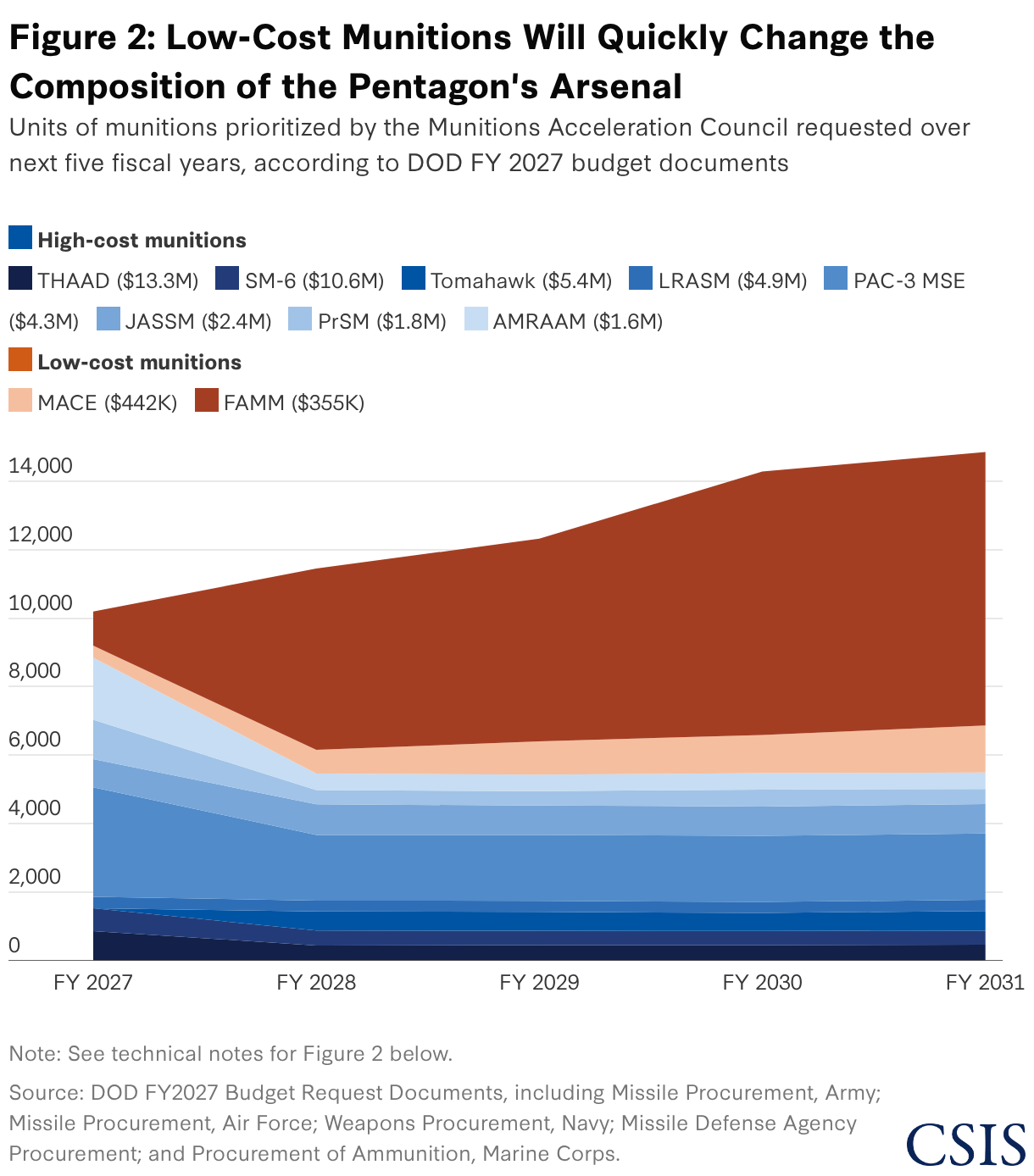
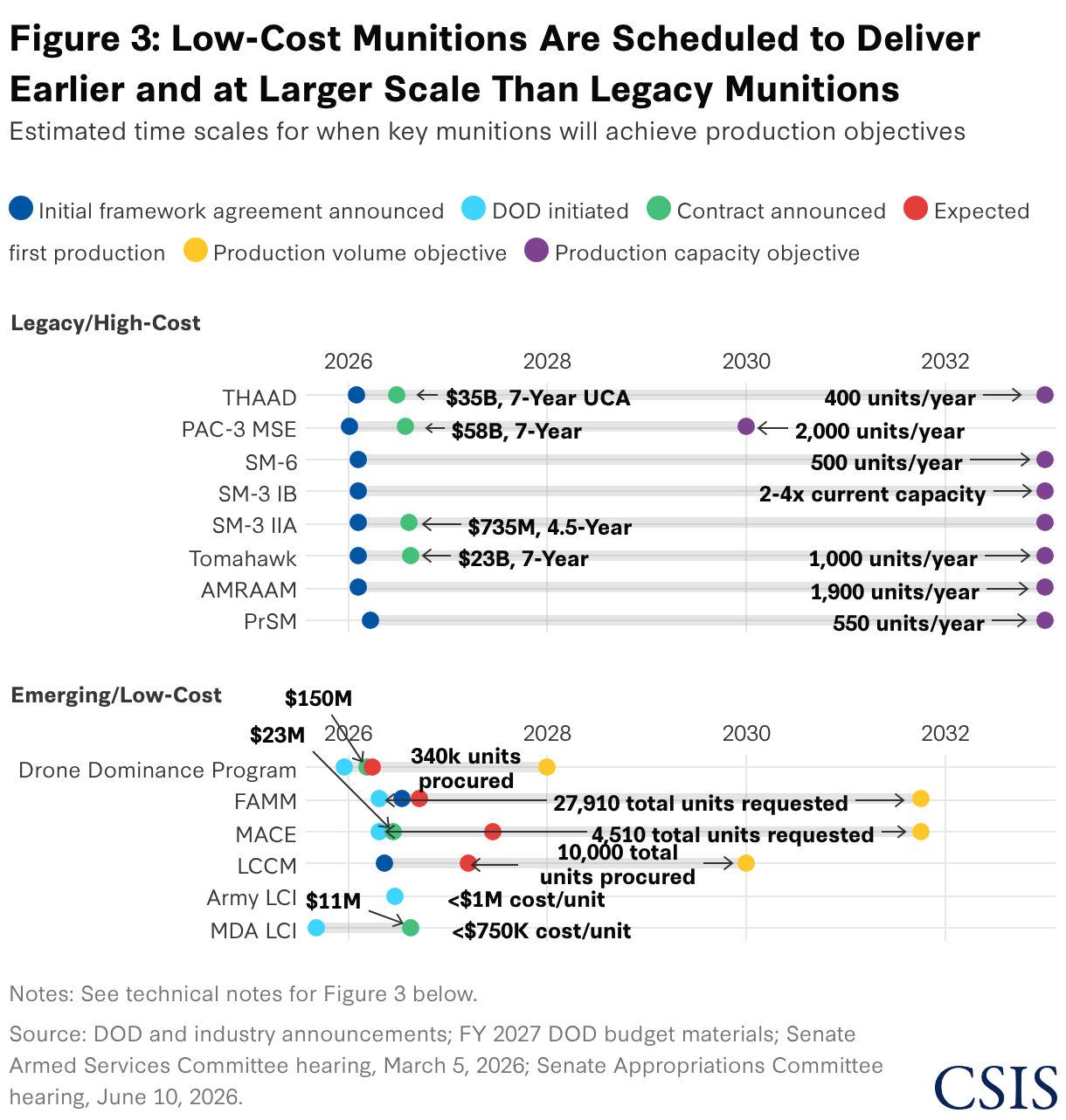
As the Pentagon presses industry to rebuild weapons inventories drawn down by the ongoing conflict against Iran, DOD budget documents confirm that low-cost systems will arrive at scale before most exquisite systems, as illustrated in Figure 2. Across framework agreements with Lockheed Martin of up to seven years, the DOD anticipates growing the production capacity of PAC-3 MSE interceptors by 233 percent, from roughly 600 to 2,000 interceptors per year by 2030; THAAD interceptor output capacity by 317 percent, from 96 to 400 units annually; and annual Precision Strike Missile production capacity fourfold to roughly 550 missiles. Backed by a DOD procurement commitment of up to seven years, RTX also plans to raise annual production of the Tomahawk missile to more than 1,000, the Advanced Medium-Range Air-to-Air Missile to over 1,900, and the Standard Missile 6 (SM-6) to over 500.
Compared to the multiyear lead times that these exquisite munitions producers need to ramp production capacity, however, agreements for low-cost munitions such as LCCM and FAMM are designed to move more at the speed of commercial industry and deliver rapid and repeatable production volume. For LCCM, for example, the gap between the framework agreement’s signature in May 2026 to the expected delivery of the first 1,000 units of Anduril’s surface-launched Barracuda-500M systems in 2027 is much less than the 34 months between contract award and first delivery of Tomahawk missiles projected in the FY 2027 budget documents. FAMM is on a similarly accelerated timeline, with 1,000 units requested in 2027 and more than 5,000 units requested for delivery in 2028.
Because of the immense number of the units planned for delivery in 2026 and 2027, Drone Dominance numbers are not included in Figure 2. While the drones are obviously much smaller and have different capabilities than legacy or low-cost missiles, they show the changing nature of munitions becoming available to the joint force. Although not a part of Drone Dominance, the Low-Cost Uncrewed Combat Attack System (LUCAS), for example, is a reverse-engineered Iranian Shahed-136 one-way attack drone that the United States deployed in combat for the first time in Operation Epic Fury. Though complete assessments of LUCAS’s initial performance remain undisclosed, the system’s $55,000 cost per unit, 18-month concept-to-development timeline, and 500-mile range position the system as a credible low-cost complement to legacy strike systems. In his testimony before the Senate Armed Services Committee in May 2026, Admiral Brad Cooper credited LUCAS with having “flipped the cost curve” against Iran by making Tehran use its own higher-end weapons. U.S. Army Secretary Dan Driscoll also informed the U.S. House Appropriations Defense Subcommittee in April 2026 that the service purchased 13,000 Merops interceptor drones—designed by United States-owned Perennial Autonomy, battle-tested in Ukraine, and costing less than $10,000 per unit—to counter Shahed drones in Iran. The Army is explicitly running a “compressed” timeline for its LCI program, meanwhile, placing the initial Request for Information in May 2026 and targeting the first live-fire demonstrations for fall of 2026. It is also splitting the interceptor into subsegments and acquiring their intellectual property rights to accelerate acquisition and reduce the risk of bottlenecked production in the future.
As Figure 3 illustrates, the pace of replenishment and agreements translating into deliveries varies sharply across the munitions industrial base.

While these framework agreements and announcements suggest the munitions industrial base will significantly evolve in a short time frame, there remain large obstacles to converting plans into production. Framework agreements are not appropriations; rather, they deliver demand signals intended to instill industry with confidence in future government purchases to justify large CapEx investments in facilities, workforces, and supply chains. Whether signals translate into additional industrial capacity depends on Congress appropriating funds, the Pentagon signing contracts, and industry delivering effective systems.
Congress took a meaningful first step in the FY 2026 appropriations bill, approving multiyear procurement authority for eight critical munitions—PAC-3 MSE, THAAD, Tomahawk, AMRAAM, SM-6, SM-3 IB, JASSM-ER, and LRASM—and establishing the legal basis for the framework agreements that have followed. But the state of FY 2027 funding for these prioritized munitions remains uncertain. A sizable portion of the funding for the Munitions Acceleration Council’s initial 14 prioritized munitions is mandatory spending tied to a reconciliation bill navigating an unclear passage through Congress. For example, of the PAC-3 MSE interceptors requested for FY 2027, 2,936 of 3,203 total units, or 92 percent, require mandatory funding to pass. While the president’s FY 2027 budget request called for a 188 percent increase in missile orders, it is uncertain how much will ultimately be procured.
Once funds are appropriated, the DOD can then award contracts to effectuate the framework agreements, most of which were signed earlier this year. Some contracts, utilizing funds in the FY 2026 appropriations and reconciliation acts, are being announced. In July 2026, for example, the Pentagon awarded Lockheed Martin a contract worth up to $58.6 billion to triple production of PAC-3 MSE interceptors by 2030, supporting a 50 percent increase in jobs at Lockheed’s Camden, Arkansas, facility. A month prior, the DOD awarded Lockheed Martin a seven-year undefinitized contract action for up to $35 billion to implement their framework agreement and quadruple production of THAAD interceptors. On August 10, 2026, the Missile Defense Agency awarded RTX a $745 million contract for production and sustainment of SM-3 Block IIA interceptors, as well. The following week, the DOD announced a $22.9 billion contract signed with RTX to scale production of Tomahawk missiles “at unprecedented speed.”
A key component of the framework agreements was the commitment by companies to increase their deployment of internally funded investments and CapEx in physical assets such as factories, machinery, and equipment to support the expanded production capacity needed to execute these longer-term deals. Lockheed Martin, for example, has committed more than $9 billion to expand capacity. This includes construction of a new Munitions Acceleration Center in Camden, Arkansas, that features advanced manufacturing techniques, tooling, and production methods to accelerate output. RTX’s support has also fueled broader capacity investments, such as a $115 million expansion of its Alabama missile integration facility to accelerate output of the Standard Missile family. The Pentagon’s initial framework agreements also target munitions suppliers, including L3Harris, Boeing, and Honeywell Aerospace. L3Harris, which manufactures solid rocket motors (SRMs), has pledged more than $1 billion to expand and modernize its site in Orange County, Virginia.
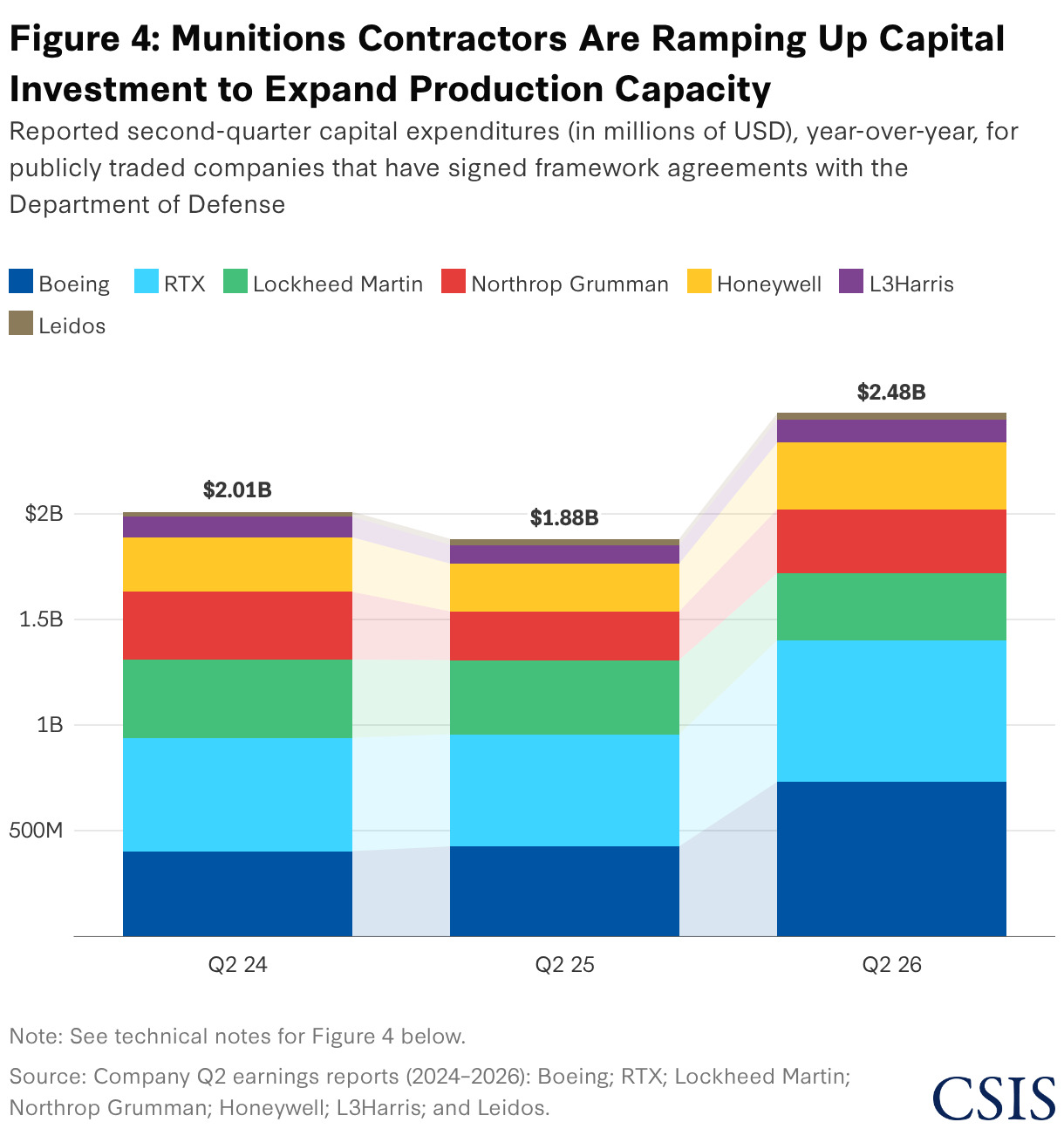
Figure 4 illustrates how these broad commitments are turning into investments. Publicly traded companies that have signed framework agreements have collectively reported a 31 percent increase in their year-over-year CapEx for the second quarter.

Whether greater investments can be translated into increased inventory, however, remains uncertain. New entrants tasked with building thousands of low-cost cruise missiles and hundreds of thousands of small drones will require expanded industrial capacity, reduced supply bottlenecks, and consistent funding to execute on their production goals. The DOD must rigorously assess which affordable weapons work and produce, acquire, and field them with commercial-like speed. It remains to be seen whether competition from more munitions manufacturers will drive down unit costs and shorten production lead times for traditional contractors, as well. Lockheed Martin, for example, recently announced the Patriot PAC-3 Adapted Capability Effector, an air defense interceptor that is projected to cost less than half the standard PAC-3 MSE per unit and that Lockheed intends to build “in record time.”
For the munitions industrial base to result in increased combat power, U.S. and allied weapons production should also be integrated into concepts of operations, determining which sets of capabilities are needed to deter and defeat adversaries. Joint force commanders should not only possess a broad, deep arsenal of weapons, but must also know how, when, and to what end specific systems should be wielded for a particular security challenge. Trust is important here. Commanders know the systems they have used and need to develop similar confidence in new capabilities as they come online. As recent Iranian strikes across the Middle East have illustrated, a broader, more diverse munitions industrial base should be equipped to provide not only “area defense” but also “point defense,” protecting critical U.S. and allied infrastructure and assets against higher volumes of lower-cost enemy missiles and drones.
The wars in Iran and Ukraine have shown how the growing importance of air and missile defense, the accelerating pace of combat, and the risk of simultaneous, protracted conflicts across multiple regions can each strain the munitions industrial base. To address these challenges, the United States needs a broad portfolio of munitions, from exquisite systems to lower-cost missiles and drones. In short, the munitions industrial base needs to be rebuilt and recast to restore deterrence and to counter the fast-evolving technologies and threats defining the character of war today. The broad trajectory outlined above is directionally on point, but requires a sustained and concerted effort by Congress, the Pentagon, and industry to send and receive long-term demand signals and invest in the underlying production capacity capable of building and sustaining inventories. There is near-term risk, but low-cost systems delivering over the next 18–24 months and ramping production of exquisite systems can get the United States on the right path. The keys to achieving the overall objectives are adequate appropriations from Congress, continued CapEx and other investment from industry, timely and flexible contracts between DOD and companies, and execution on all fronts.
This technical note provides additional details on the methodology, scope conditions, and sourcing for the calculations and information shown in the figures above.
Figure 1:
Figure 2:
Figure 3:
Figure 4:
Jerry McGinn is director of the Center for the Industrial Base and senior fellow in the Defense and Security Department at the Center for Strategic and International Studies (CSIS) in Washington, D.C. A.J. Dilts is senior program manager in the Defense and Security Department at CSIS.
The authors are grateful for the expeditious work by Lauren Adler, Hunter Macdonald, and Kharle Wu in editing and formatting this article.

Commentary by Mark F. Cancian and Chris H. Park — May 27, 2026

Report by Jerry McGinn and A.J. Dilts — July 6, 2026

Commentary by Jerry McGinn and Cynthia R. Cook — December 5, 2025