Without Parallel: North Korean Human Rights and the Russia Axis
October 14, 2026 • 9:15 – 11:00 am EDT
Hosted by Korea Chair

Photo: U.S. Central Command Public Affairs/DVIDS
The 39-day bombing and air defense campaign against Iran depleted inventories of key U.S. munitions stockpiles, as a previous CSIS analysis detailed. The United States has enough munitions for any plausible scenario in the Iran war, but the depleted inventories have created a window of vulnerability for a potential Western Pacific conflict. The time needed to rebuild those inventories has thus become a major concern.
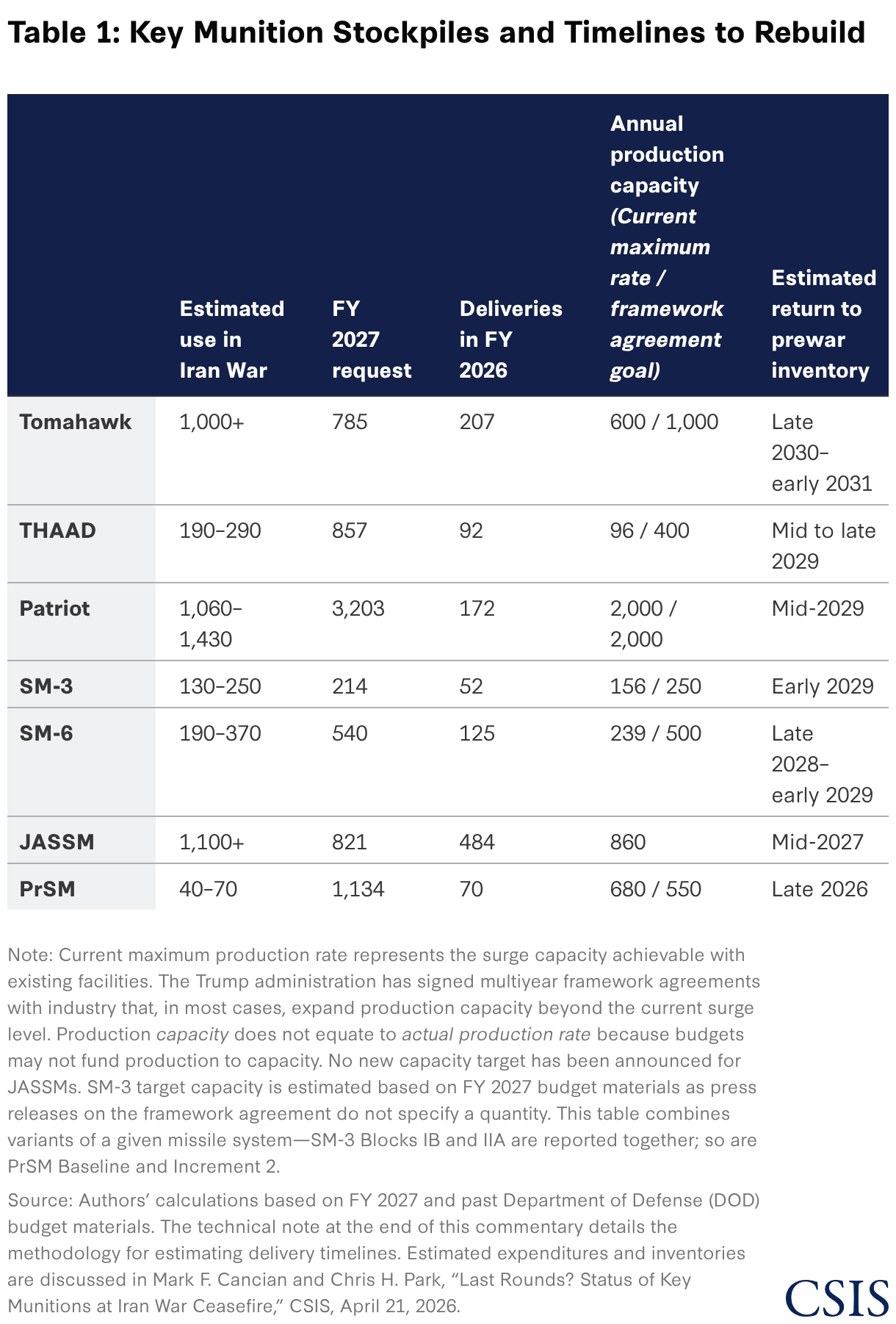
Defense Secretary Pete Hegseth stated that it will take “months and years . . . depending on the weapon system” to replenish U.S. inventories. CSIS analysis supports the secretary’s assessment. Table 1 shows replacement times for seven key munitions heavily used during the Iran War that would also be needed for a Western Pacific war. Under the current delivery projections:
Campaigns against Iran and its proxies—and, for Patriot interceptors, aid to Ukraine—have made the problem more acute. Alongside replenishing its own stocks, the United States also has to fulfill orders from allies and partners. Decisions on how to allocate new production have already created bilateral friction, and this friction will continue for the next few years as demand outpaces supply.
The Trump administration understands the urgency. Large munitions procurement in the president’s $1.5 trillion FY 2027 defense budget reflects these magazine depth concerns. A war supplemental for additional munitions funds is expected as the DOD seeks to replace what was expended in Operation Epic Fury and then build inventories above the prewar levels. The administration has also signed a series of framework agreements with industry to expand munitions production capacity, which could expedite future deliveries.
The figures in this article illustrate the deliveries of the seven key munitions to U.S. stockpiles in the coming years.
Tomahawk
Tomahawk procurement averaged 86 missiles in the past 10 fiscal years (FY 15–FY 26), with most orders coming from the Navy. While Raytheon’s goal is to have the capacity to make more than 1,000 Tomahawks per year, the recent annual production rate is less than 200 because of small past orders. Existing orders will begin replacing the 1,000+ Tomahawks expended during the Iran War, but will not be enough to fully restore inventories to prewar levels.
The Navy requested 785 Tomahawks in the FY 2027 budget—a huge increase from prior years. Based on current DOD delivery projections, these missiles will start arriving in U.S. inventories in March 2030, after 34 months of production lead time. U.S. inventory will replace TLAMs fired against Iran by late 2030.
Allied orders also need to be fulfilled. The 400 missiles due to Japan reportedly may be delayed as the DOD prioritizes refilling U.S. stockpiles, even as a Japanese destroyer recently completed the requisite modifications. Australia also purchased more than 200, and the Netherlands, 175.
THAAD
The large procurement request in the FY 2027 budget reflects the urgency of rebuilding the THAAD inventory after high operational use in Operations Epic Fury and Midnight Hammer.
Previous years’ budget documents projected zero deliveries to the United States between August 2023 and April 2027, after which missiles purchased in FY 2021 would begin to arrive. Updated schedules in the FY 2027 materials show earlier orders already being delivered, with FY 2025 procurement scheduled for delivery throughout 2026. To cope with the near-term shortfall, deliveries were apparently re-sequenced to prioritize U.S. needs over those of allies and partners.
The Army has requested 857 THAAD interceptors in FY 2027. Their deliveries, projected to start in mid-2029, will complete the replacement of Iran War usage by the end of calendar year 2029.
The delivery timelines in the budget documents imply that THAAD production is at the current surge rate of 96 interceptors a year. With additional facilities and tooling, Lockheed Martin plans to expand production capacity to 400 a year, a needed increase to fulfill large U.S. procurement orders and those of allies. The allied backlog includes a Saudi order of 360 interceptors in 2017, which has been partially fulfilled, and a 2022 Emirati purchase of 96 missiles. Additional orders can be expected because Saudi Arabia and the United Arab Emirates expended a large portion of their inventories defending themselves against Iranian missiles in the initial campaign.
Patriot
Patriot deliveries pose a dilemma for the United States because of the need to replenish its own inventories, help Ukraine defend against Russian missile attacks, and meet the needs of 17 other countries that use the interceptor. Current production of the latest variant—PAC-3 Missile Segment Enhancement (MSE)—is around the baseline rate of 650 interceptors per year, with half the deliveries going to the United States and the rest to allies and partners. The surge annual production rate with existing tooling and facilities is 2,000. Lockheed intends to scale up to this level.
Because U.S. procurement in the last decade has averaged 225 missiles per year, deliveries from prior years will not be enough to fully replace expenditures. For that, the United States will need to wait for the 3,203 Patriot missiles requested in the Army’s FY 2027 budget. These are projected to start delivery in May 2029.
The United States continues to send Ukraine Patriot missiles, among other weapons and munitions. Missiles contracted under the Ukraine Security Assistance Initiative during the Biden administration are beingdelivered to Ukraine as they are manufactured. The Prioritized Ukraine Requirements List (PURL), a new mechanism under which NATO states pay for weapons in U.S. inventories, has provided a near-term bump in Patriot deliveries to Ukraine. Both delivery mechanisms may be affected by the Trump administration’s efforts to prioritize U.S. needs with future deliveries to Ukraine being pushed back in the queue.
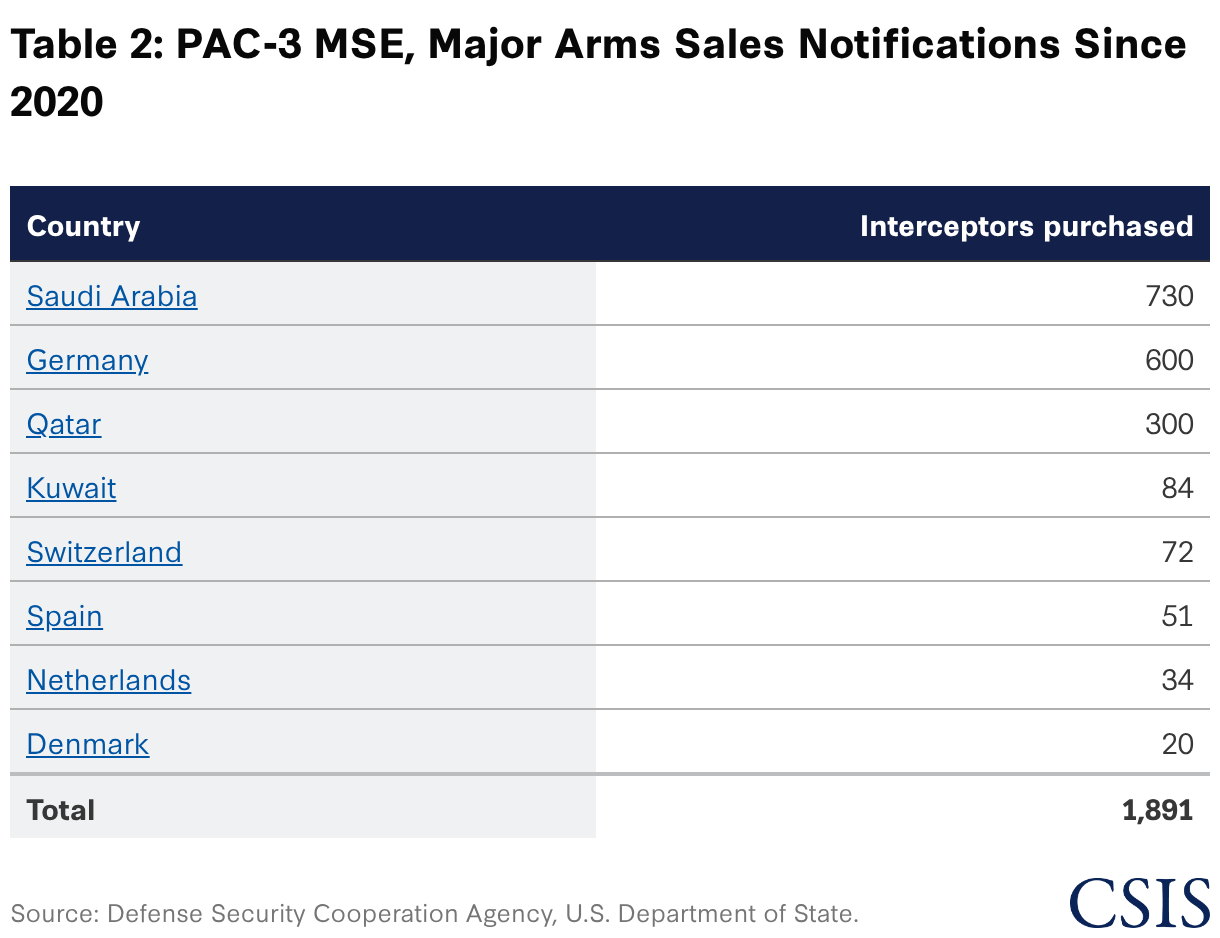
Other allies also await Patriot deliveries. Since 2020, U.S. allies and partners have purchased nearly 1,900 MSE interceptors and more than 700 of earlier variants such as the PAC-2 and Guidance Enhanced Missile-Tactical (GEM-T).
SM-3 and SM-6
Ship-launched interceptors, SM-3 and SM-6, have seen less use than ground-launch systems. A CNN report citing DOD sources indicated that actual Standard Missile usage in Operation Epic Fury was closer to the lower-bound estimates in the CSIS munitions inventory study. This lower use reflects the more distant location of U.S. naval assets—out in the Arabian Sea and Eastern Mediterranean—and the short range of Iranian fire, with the bulk of it against Gulf States. No warship capable of firing these air defense interceptors operated inside the Persian Gulf before the ceasefire.
Both missiles have lengthy production lead times. The Missile Defense Agency and the Navy requested large quantities in the FY 2027 budget: 78 SM-3 Block IBs, 136 SM-3 Block IIAs, and 540 SM-6s. These orders will take between 36 and 39 months to begin deliveries once Congress provides appropriations. Because of the small size of past orders, inventories will not return to prewar levels until early 2029 despite the relatively low usage in the campaign.
JASSM
U.S. forces began this campaign with a sizable JASSM inventory. The Air Force has procured large quantities of these long-range cruise missiles since the 2000s—on average, nearly 500 a year for the past decade. To deliver these orders, current production appears to be already at the surge rate unlike the other munitions discussed in this article. Further, the missile was not used in operations until 2018. Thus, while over 1,100 JASSMs were expended, U.S. inventories will recover fairly quickly as past orders are delivered.
In the past five years, U.S. allies have ordered nearly 1,200 JASSMs, including 821 missiles by Poland and 120 by the Netherlands.
Precision Strike Missile
The PrSM inventory was small at the beginning of this campaign because the Army received approval for full production and deployment only last July. Accordingly, use has been limited—though highly effective—and replacing expenditures will take only a few months.
The large procurement orders in the last few years—and the anticipated FY 2027 buy—keep production at the projected surge capacity. All deliveries will go to the U.S. inventory for now. While the baseline PrSM has been approved for export to Australia and the United Kingdom, no foreign sales announcement has yet been made.
Munitions inventories are classified, and some delivery timelines are unavailable. Sufficient public information exists, however, to make estimates with requisite fidelity to inform the policy debate.
CSIS estimates on when procured missiles enter U.S. inventories relied primarily on two data points: rate of production and procurement lead time. The DOD provides three different rates of production in its annual budget materials:
Even if existing facilities are used, achieving surge capacity is expensive and time consuming as it requires hiring additional personnel and resolving supply chain bottlenecks. The production schedule in DOD’s P-21 budget exhibits provides a sense of where current production rates fall between the MSR and the surge rate for individual systems. Reporting inconsistencies across weapon systems complicate the analysis. The justification books also generally omit delivery timelines for missiles procured through reconciliation. This adds further uncertainty to assessing FY 2027 procurements since the bulk of missile funding is in the reconciliation request. Where data was unavailable, delivery schedules were estimated using the latest procurement lead times, cross-referenced against production capacity limits.
The framework agreements between the Trump administration and industry have set ambitious production capacity goals that could significantly increase deliveries over the next five to seven years as new facilities come online. Capacity, however, does not equate to actual production. To illustrate the potential production increase, the “maximum potential inventory, with framework surge” curve in this analysis—depicted in green—is modeled as an annual linear increase from current capacity to stated industry goals.
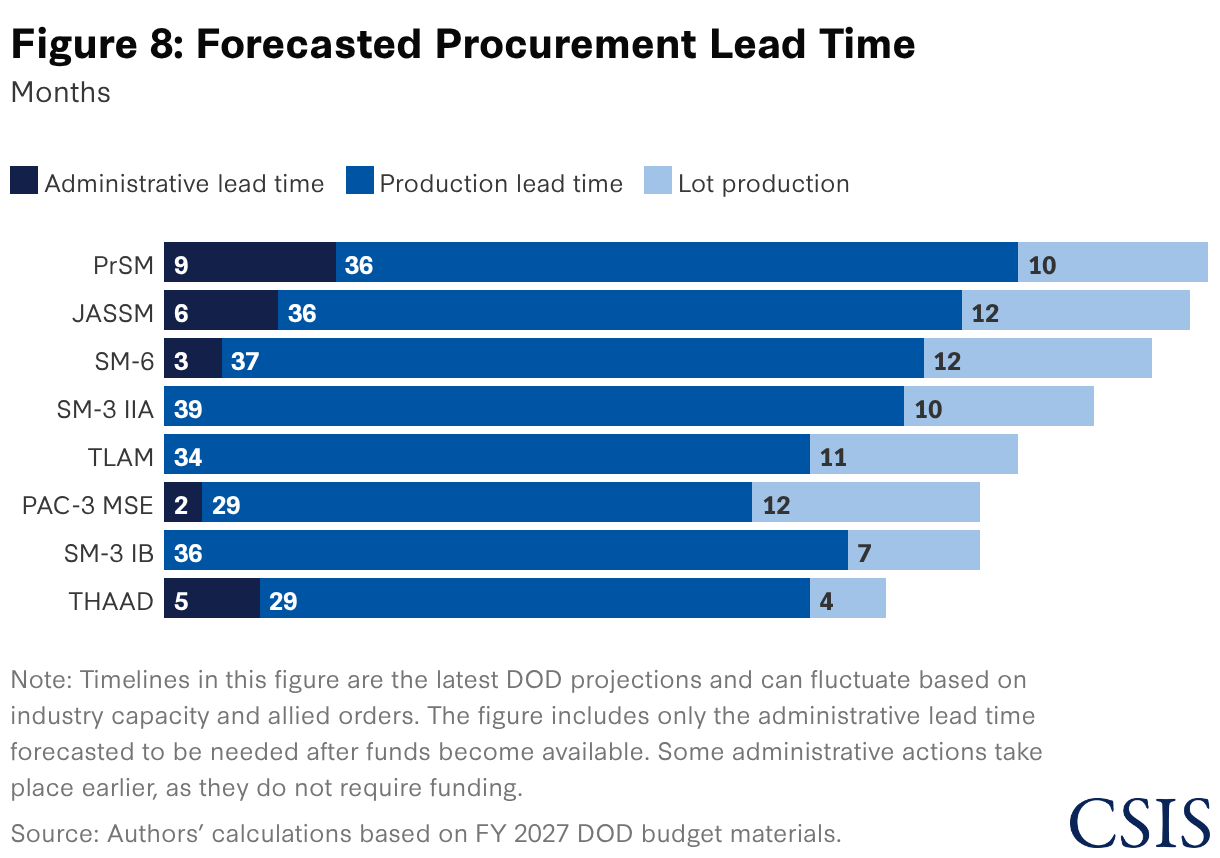
Procurement lead time refers to the number of months needed between Congress appropriating the funds and missile delivery. As Figure 8 shows, this time can be divided into three pieces:
As an example, the JASSMs procured in the FY 2027 budget are forecasted to be put on contract six months into the fiscal year (administrative lead time). The first missile in this lot is expected to be delivered 36 months after the contract is signed (production lead time). It will take another 11 months until all missiles are delivered (lot production).
Funding for additional munitions began in the Biden administration and has accelerated under the Trump administration. Congress has supported this funding reflecting bipartisan agreement on the issue. As a result, the problem today isn’t money; it’s time. It takes time to expand production capacity and to build these complex systems.
Thus, there will be a window of vulnerability for several years until inventories return to their previous levels and another several years before they get to the levels that war planners desire. The DOD will need to make plans for dealing with this gap. Some munitions could be substituted, but these carry tradeoffs. Alternative ground attack munitions, for example, are short- or medium-range and increase vulnerability of the launch platforms. Alternative counter-drone systems are expensive.
The situation in the Western Pacific is not all bleak, however. The world has seen the great skill of U.S. military forces not just in the conflict with Iran but in operations against Venezuela and the Houthis. China is deeply aware that it has no recent combat experience and that it performed poorly in its last war—against Vietnam in 1979. That difference in experience may preserve deterrence until munitions inventories are restored.
Our Defense and Security Department colleagues Seamus Daniels and Wes Rumbaugh provided helpful comments to an earlier version of this article. We also thank Hunter Macdonald and Sabina Hung for the expeditious review and formatting.
This Commentary was written in support of a project funded by the Smith Richardson Foundation.
Mark F. Cancian (Colonel, U.S. Marine Corps Reserve, ret.) is a senior adviser with the Defense and Security Department at the Center for Strategic and International Studies (CSIS) in Washington, D.C. Chris H. Park is a research associate for the Arleigh A. Burke Chair in Strategy at CSIS.

Report by Mark F. Cancian and Chris H. Park — April 21, 2026

Commentary by Mark F. Cancian and Chris H. Park — February 20, 2026


