What Did Trump and Xi Agree to at the White House? | State of Play
September 25, 2026 • 9:00 – 10:00 am EDT
Hosted by Geopolitics and Foreign Policy
Photo: Stocktrek Images/Getty Images
Despite recent progress, the U.S. military would struggle to fight a protracted war with China because of a lack of long-range munitions, air defense systems and interceptors, and unmanned air, undersea, and surface systems. Deterring or fighting a war on two fronts—in the Indo-Pacific and Europe—would be even more difficult. There are no quick fixes since production timelines are between three and four years for some critical munitions, such as SM-6, SM-3 IB, JASSM, and Tomahawk. The Pentagon’s recent ramp-up has been helpful. But Congress and the Pentagon urgently need a sustained commitment for multiyear contracts to fund base infrastructure, aircraft and ship readiness and sustainment, and the rapid production of a high-low mix of capabilities for a Hellscape concept of operations in the Indo-Pacific. The United States also needs to significantly increase the delivery of military aid to Taiwan, especially with a U.S. backlog of roughly $32 billion.
The United States fired thousands of missiles and drones as part of Operation Epic Fury, which precisely hit such Iranian targets as military bases, command centers, missiles, drones, and defense production facilities.1 The United States also fired thousands of interceptors from such air defense systems as Patriot and Terminal High-Altitude Aerial Defense (THAAD), which performed remarkably well in shooting down Iranian cruise missiles, ballistic missiles, and drones. Yet there is a debate about the implications of the Iran war for other regions, including for the Indo-Pacific and China. According to some assessments, the Iran war seriously undermined the availability of U.S. munitions for a war with China. As one article concluded, “The U.S. has burned through so many munitions in Iran that some administration officials increasingly assess that America couldn’t fully execute contingency plans to defend Taiwan from a Chinese invasion if it occurred in the near term.”2
But other U.S. officials responded that the U.S. military had plenty of munitions left in its arsenal for a war with China or other adversaries. As one U.S. defense official noted, “We’ve got no shortage of munitions . . . our munitions status only increases as our advantage increases.”3 Another U.S. official noted, “The United States of America has the most powerful military in the world, fully loaded with more than enough weapons and munitions, in stockpiles here at home and all around the globe, to effectively defend the homeland and achieve any military operation directed by the commander in chief.”4
To better understand the implications for China, this analysis asks two questions: What military capabilities does the U.S. military need to counter China? How did the war in Iran impact U.S. needs to counter China? To answer these questions, this analysis compiles data on the capabilities necessary for deterrence and warfighting against China, as well as information from wargames and other sources. It makes two main arguments.
The U.S. military has lacked sufficient munitions for a protracted conflict against China for years—including well before Operation Epic Fury.
First, the U.S. military has lacked sufficient munitions for a protracted conflict against China for years—including well before Operation Epic Fury. This lack of munitions is even more pronounced to deter or fight on two or more fronts, such as simultaneous conflicts in the Indo-Pacific and Europe. Despite these deficiencies, U.S. operations against Iran created additional risk for U.S. requirements for China and other countries because of the significant use of some long-range missiles, such as Tomahawks and Joint Air-to-Surface Standoff Missiles (JASSMs), and air defense interceptors, such as those for Patriot and THAAD systems. China’s defense industrial base is on a wartime footing, and the People’s Liberation Army (PLA) is building weapons systems at mass and scale in all the major domains of warfare: land, air, maritime, space, cyber, and nuclear. While U.S. deterrence starts from a foundation of “peace through strength,” the U.S. industrial base is far from ready—though there has been progress over the past year.5
Second, a focus solely on U.S. munitions to counter China or other countries misses several larger issues. One is base defense. Iranian missile and drone strikes against U.S. bases and civilian infrastructure in the Middle East are a stark reminder that China and other adversaries could similarly conduct strikes against military and civilian targets in the Indo-Pacific. But U.S. bases and infrastructure in Japan, the Philippines, Guam, and other locations are highly vulnerable to Chinese missile and drone attacks. The U.S. military also faces significant readiness and sustainment challenges for many of its aircraft and ships used extensively in the Iran war—and even in Venezuela during Operation Absolute Resolve.
In addition, U.S. capabilities in the Indo-Pacific should be nested under a concept of operations that builds off the U.S. Indo-Pacific Command’s Hellscape initiative to help identify which types of capabilities are necessary (and which are not essential). Several capabilities are important for contending with China: a high-low mix of undersea platforms, such as attack submarines and cheap unmanned underwater vehicles (UUVs); a high-low mix of air platforms, such as cheap unmanned aircraft systems (UASs) and stealthy fifth- and sixth-generation aircraft and bombers; long-range precision strike missiles; air defense systems; and a suite of space, counterspace, and cyber capabilities.
Yet, as this analysis concludes, the United States lacks sufficient numbers in many of these areas for a protracted war, including UUVs, UASs, long-range precision strike missiles, and air defense systems and munitions. Based in part on UAS usage in the Ukraine war, this analysis calculates that the United States and Taiwan need to produce hundreds of thousands of small, attritable platforms to achieve “precise mass”—the use of large quantities of precision-guided offensive and defense munitions.6 The United States also has a massive backlog of arms deliveries to Taiwan of approximately $32 billion, which are part of Foreign Military Sales. The backlog includes such systems as Harpoon coastal defense systems, National Advanced Surface-to-Air Missile Systems, PAC-3 MSE interceptors, and Altius drones.7
The rest of this analysis is divided into five sections. The first provides an overview of lessons from Operation Epic Fury. The second section examines the China challenge, including munitions, readiness, and base defense. The third describes a concept of operations to counter China that builds off Hellscape—U.S. Indo-Pacific Command’s concept for defense of Taiwan that relies on making the Taiwan Strait impassable for enemy forces. The fourth section outlines capabilities necessary to deter China and—if deterrence fails—to fight and win a protracted war. The fifth summarizes the main steps necessary to close today’s gap in the Pacific.
The good news from the Iran war is that many U.S. weapons systems performed remarkably well. One example is the Tomahawk land-attack cruise missile, which the United States used to destroy Iranian radar installations, command centers, missile sites, and other targets. Aided by GPS guidance, Tomahawks hit Iranian targets with precision and packed a big punch with 1,000-pound warheads. The U.S. military also used a wide range of other weapons systems for precision strikes, such as the Army Tactical Missile System (ATACMS), Guided Multiple Launch Rocket System (GMLRS), and Precision Strike Missile (PrSM). “In just the first 13 days of this operation, our artillery forces have made history,” said General Dan Caine, chairman of the Joint Chiefs of Staff. “They fired the first precision strike missiles ever used in combat, reaching deep into enemy territory. They’ve used Army ATACMS to sink multiple ships, including a submarine.”8
During the war with Iran, the U.S. military significantly depleted its stockpile of some long-range missiles . . . creating significant risk for a possible conflict with China or other contingences.
But the bad news is that U.S. stockpiles of long-range offensive munitions were low even before the Iran war. As outlined later in this analysis, the U.S. military will likely need a large number of long-range munitions for offensive operations in a protracted conflict, including in the Indo-Pacific. During the war with Iran, the U.S. military significantly depleted its stockpile of some long-range missiles—such as Tomahawks and JASSMs—creating significant risk for a possible conflict with China or other contingences.9
Stockpiles of U.S. air defense munitions were also low before the war, and the Iran conflict made the situation even more challenging. In 2025, the U.S. military fired over a quarter of its THAAD interceptors in a few days of operations against Iran.10 In the 2026 war with Iran, the United States further depleted its air defense stockpiles for some systems, including potentially over 50 percent of the prewar inventory of THAAD, Standard Missile-3 (SM-3), and Patriot interceptors.11 To make matters worse, Iran struck and damaged one or more AN/TPY-2 radars used for the THAAD system. A THAAD battery cannot operate effectively without this radar, which serves as the system’s “eyes” to detect, track, and provide targeting data for interceptors. The U.S. Army only has eight THAAD batteries, which are dispersed between the Middle East and Indo-Pacific.12
There are no quick fixes to refill empty bins. It takes over four years to produce some munitions, such as the SM-3 IIA; around three years to produce others, such as THAAD interceptors, SM-6, SM-3 IB, PrSM, Tomahawks, and JASSM; and over two years to produce the PAC-3 MSE. It can also take between 18 and 24 months to make additional capital investments in factories to meet surging demands.13 In addition, expanding weapons factories can involve purchasing more land, buying additional insurance, and abiding by other regulations—all of which take time.

The Iran war has highlighted other industrial base challenges. One is aircraft and ship readiness and maintenance, which were also impacted by the U.S. operations in Iran in 2025 and the Western Hemisphere in 2025 and 2026. The United States sent over a quarter of the Navy’s deployed surface fleet to the Western Hemisphere for its Venezuela operation, and then it used over 40 percent of deployed Navy ships for Iran operations in 2026. This operational tempo created significant wear and tear.14 It should not be a surprise that the U.S. aircraft carrier Gerald R. Ford suffered numerous maintenance problems in 2025, including a massive fire in the main laundry room that caused the U.S. Navy to quickly relocate the carrier to a base in Crete for emergency repairs.
Another challenge is base and infrastructure defense. Iran struck U.S. military bases in the Middle East and civilian infrastructure, such as oil and gas infrastructure, hotels, airports, electricity grids, cargo ships, and commercial companies. Iran also targeted maritime shipping lanes, such as the Strait of Hormuz. Many of these areas, especially civilian targets, were poorly defended. The United States and other countries faced particular challenges with point defense, especially protecting specific bases and infrastructure from Iranian drones that were maneuverable and could fly low to the ground.
China presents a much more significant threat to the United States, as the Trump administration’s own National Defense Strategy and National Security Strategy conclude. Beijing is focused on rapid military modernization in all the major domains of warfare and presents a particularly serious threat to the U.S. military in the first and increasingly the second island chains, where the PLA can bring significant mass and volume to a fight. China’s defense industrial base is producing substantial numbers of ships, aircraft, tanks, and other military systems at an alarming rate, and China is devoting significant resources to AI, quantum, and other technologies with defense applications. U.S. and allied bases, surface vessels, and aircraft operating in the first and increasingly second island chains—which extend from Japan south through Guam to New Guinea—are highly vulnerable to Chinese missile and drone attacks.
In multiple wargames conducted by CSIS, the U.S. military exhausted its inventory of some types of long-range missiles within the first week of a Taiwan conflict. Taiwan used up its entire inventory of antiship cruise missiles after a week as well.15 It would be impossible to sustain a fight without long-range weapons. Chinese defenses are formidable—especially in the early stages of a war—and would make it difficult for U.S. aircraft or ships to maneuver close enough to fire short-range munitions. The U.S. military’s heavy use of Tomahawks, JASSMs, and other munitions against Iran suggests that the stockpile of available munitions for a protracted war against China is low. The same is true for requirements for other U.S. war plans, including operational plans (OPLANS), such as for Russia and North Korea. It is hard to believe that China or other adversaries will be deterred by empty bins.
U.S. bases and other infrastructure are also at risk of attack by Chinese missiles and unmanned aircraft, underwater, and surface systems. The United States maintains a substantial forward-deployed posture in the Indo-Pacific, anchored in Japan, South Korea, the Philippines, and Guam. The United States has roughly 20,000 U.S. Army personnel in South Korea centered on the Eighth Army and Second Infantry Division at Camp Humphreys.16 Nearly 20,000 marines from the III Marine Expeditionary Force are based on Okinawa, Japan, as well as 9,000 personnel in Guam and rotational marine deployments to Darwin, Australia.17 The U.S. Seventh Fleet, based in Yokosuka, Japan, is the U.S. Navy’s largest forward-deployed fleet and typically fields 50 to 70 surface ships and submarines.18 U.S. air posture includes four fighter squadrons in Japan at Kadena Air Base in Okinawa and at Misawa Air Base, along with other aircraft in South Korea, Japan, and additional locations.19
These forces are highly exposed to Chinese drones and cruise, ballistic, and hypersonic missiles. The U.S. Air Force has developed agile combat employment (ACE), a concept that emphasizes operating fighters and other aircraft from austere, rapidly established locations using small mobile support packages.20 Yet U.S. forces are still not sufficiently dispersed throughout the Indo-Pacific and lack hardened fuel bladders, munitions storage bunkers, aircraft shelters, expeditionary aircraft shelters, and active defenses from Chinese attacks.
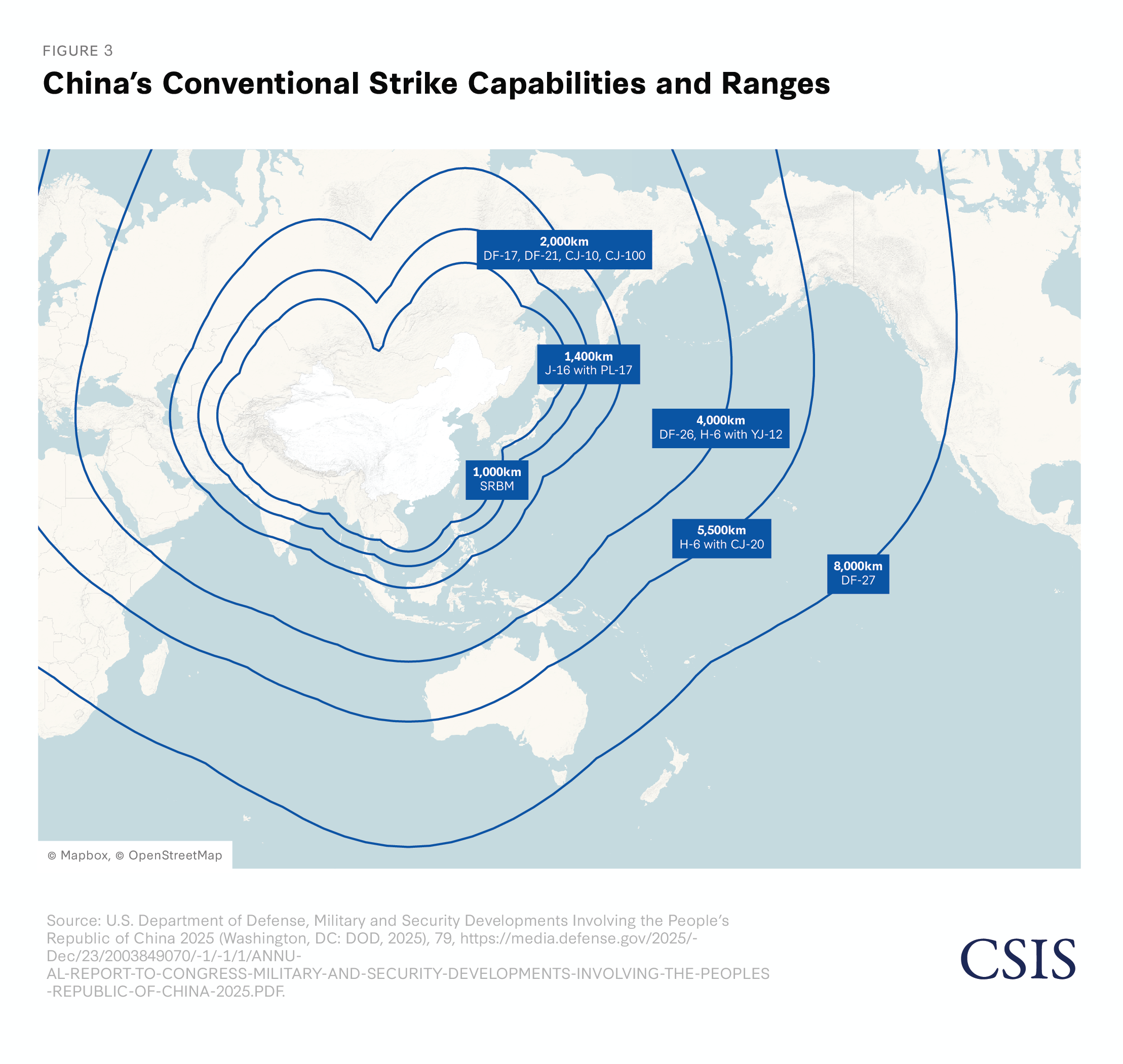
Based on China’s capabilities, the United States and Taiwan need to significantly revitalize their industrial bases to deter—and, if necessary, fight and win—a protracted war. Successful efforts to improve deterrence and war fighting have typically required a combination of technology and operational concepts. Technology alone has never been sufficient. As Andrew Marshall, head of the Pentagon’s Office of Net Assessment, argued:
The most important competition is not the technological competition, although one would clearly want to have superior technology if one can have it. The most important goal is to be the first, to be the best in the intellectual task of finding the most appropriate innovations in concepts of operation and making organizational changes to fully exploit the technologies already available and those that will be available in the course of the next decade or so.21
During the Cold War, the United States succeeded in several major efforts to counter—or offset—Soviet advantages. The first offset was the Eisenhower administration’s New Look concept, which involved offsetting the Soviet Union’s conventional advantage in Central Europe by developing a concept to inflict massive retaliatory damage using nuclear weapons.22 Beginning in the late 1970s, officials from the Carter and Reagan administrations developed and implemented Air-Land Battle and Assault Breaker—a second offset—to defeat Soviet forces attempting to invade Western Europe. The second offset led to a focus on stealth, precision weapons, and other advanced technology.23 The combination of an effective operational concept and capabilities deterred the Soviet Union in Central Europe. As Soviet Minister of Defense Dmitry Ustinov remarked at a meeting of the Warsaw Pact Committee of Defense Ministers, the military balance between NATO and the Warsaw Pact was “at the moment not in our favor.”24 The second offset strategy provided the U.S. military and its allies with an operational advantage and strengthened deterrence.25
A U.S. offset today needs to deter or defeat China in a war by focusing on defense by denial—and then link the operational concept to necessary capabilities.
With China’s defense build-up today, the United States needs an effective operational concept and capabilities. The Pentagon has developed some efforts, such as Hellscape, Assault Breaker II, and the various Joint Warfighting Concepts. But these either are too broad or lack sufficient detail to guide procurement and technological development. A U.S. offset today needs to deter or defeat China in a war by focusing on defense by denial—and then link the operational concept to necessary capabilities. This involves an emphasis on Air-Sea Battle for the Indo-Pacific. Still, the concept of Hellscape is a useful place to begin for a joint concept of operations. As Admiral Samuel Paparo, commander of U.S. Indo-Pacific Command, remarked, “I want to turn the Taiwan Strait into an unmanned hellscape using a number of classified capabilities so I can make their lives utterly miserable for a month, which buys me the time for the rest of everything.”26 A Taiwan Strait scenario is also relevant for other types of conflicts in the region, such as in the East or South China Seas.
The broad goal of Hellscape is to slow down a Chinese invasion of Taiwan using drones and other capabilities, ideally launched from Taiwan, though the Hellscape concept could be useful in defense of Japan, the Philippines, or other locations.27 Hellscape envisions using massive numbers of UASs, UUVs, unmanned surface vehicles (USVs), and other capabilities to collect intelligence, conduct target acquisition, use electronic countermeasures, lay mines, and strike PLA surface vessels, aircraft, subsea vessels, air defenses, missile silos, and other capabilities. Hellscape necessitates a high-low mix of cheap (or “attritable”) and more expensive unmanned systems, such as high-altitude, long-endurance UAVs and one-way attack and loitering drones that can be launched from surface ships, submarines, aircraft, and land.
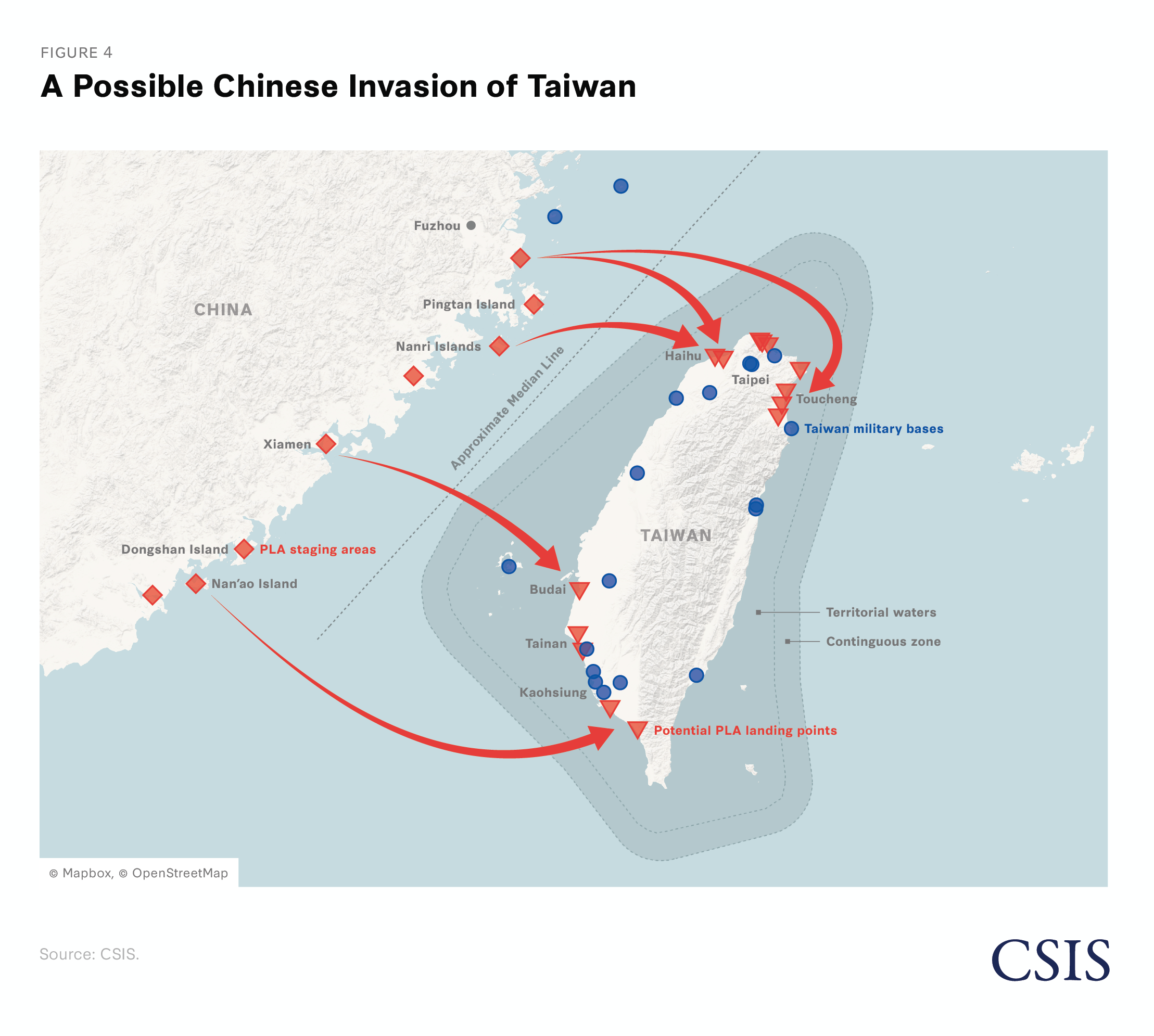
In a Hellscape scenario, the PLA would likely attempt to move troops, weapons, and matériel onto Taiwan or another territory through an amphibious landing, an air assault, airborne landings, or a combination of these means (Figure 4). PLA surface ships, submarines, aircraft, missiles, long-range fires, and other weapons systems would likely play important roles in the invasion, supported by cyber, space, and air defense capabilities. Consequently, a U.S. joint operational concept needs to include several components.
The first is moving with speed and maximizing maneuver, which requires pre-positioning platforms and stockpiling munitions. If the United States were to directly intervene, it would likely need to act within hours or days to prevent a territorial fait accompli. There might not be sufficient time for a slow and steady buildup of forces, much as the United States accomplished before Operation Desert Storm in 1991. Consequently, the United States would need to posture its forces now in the Indo-Pacific for rapid engagement, such as deploying sufficient bombers to Australia and Alaska, hardening shelters for aircraft, establishing active defenses for missiles, and stockpiling sufficient quantities of fuel, spare parts, munitions, and other matériel that can be used for a fight. Whether or not the U.S. president chooses to intervene, Taiwan would still need to stockpile and preposition as much as possible.
Second, U.S., Taiwan, or other forces would need to rapidly strike at the center of gravity of the invasion force and cripple its offensive. For a China scenario, this would require identifying high-value targets, including PLA ships and aircraft carrying PLA soldiers, weapons systems, and equipment; rapidly moving information from sensor platforms to shooters; and precisely hitting and destroying PLA targets to deny China’s attempts to conduct a successful invasion. Key targets include PLA ships, transport helicopters, and fixed-wing aircraft necessary for an invasion, as well as PLA air defenses, artillery, and operational command and control centers supporting the invasion force. To strike these targets, forces would need to generate combat power that can operate both inside and outside the reach of China’s strike systems. As U.S. General Ulysses S. Grant argued, “The art of war is simple enough. Find out where your enemy is. Get at him as soon as you can. Strike at him as hard as you can and as often as you can, and keep moving on.”28
In the short term, U.S., Taiwan, or other forces would need to withstand initial PLA attacks, degrade the performance of PLA battle networks and command and control systems, execute a suppression campaign against PLA long-range intelligence and strike capabilities, and target the PLA’s air defense systems. In the long term, the United States would need to be prepared for a protracted campaign, maintain operational logistics, and increase defense industrial production for critical munitions and weapons systems, including air defense and long-range strike systems. The United States would also need to exploit PLA weaknesses, such as undersea. Assistance from allies such as Japan, Australia, South Korea, and the Philippines would be helpful, though not necessarily assured.
Several types of systems and technologies are important based on this concept. The near-term goal should be to leverage capabilities that are effective and available now—or very soon. There should be five main priorities:
High-Low Mix of Undersea Capabilities: The first priority includes capabilities that allow the United States to maintain an undersea advantage against China. Of particular value is a high-low mix of attack submarines, such as Virginia-class nuclear-powered submarines, and relatively cheap UUVs and USVs. PLA capabilities are still relatively weak in antisubmarine warfare, and the PLA has serious difficulties finding U.S. submarines.29 In multiple iterations of CSIS wargames, for example, U.S. submarines wreak havoc against Chinese ships, including large amphibious vessels, escorts, and logistics vessels.30
U.S. submarines can hunt PLA targets, transit back to Yokosuka and other ports, reload, and return to hunting targets. Submarines are also needed to screen against Chinese submarines exiting the first island chain. The implication is straightforward: Attack submarines remain essential for deterrence and war fighting against China, though the U.S. military and industrial base have been slow to award contracts and build submarines.31 The Navy should prioritize increasing the production of Virginia-class attack submarines from the current target rate of two boats per year (it currently only produces 1.2 per year) to three per year, given the asymmetric advantage the increase provides over competitors’ capabilities.
The United States should also prioritize UUVs and USVs that can withstand communications and GPS jamming. There will be U.S. submarine attrition in a fight against China, such as in the relatively shallow waters of the Taiwan Strait. Each loss would be tough, since a Virginia-class submarine has a crew of roughly 132 sailors and costs approximately $4.5 billion.32 While UUVs are not as capable as attack submarines, they can be programmed to fulfill some critical missions, such as mine laying, intelligence collection, electronic warfare, and strike against PLA submarines and surface vessels. The Navy needs to step up its procurement of relatively cheap UUVs with longer ranges that can carry higher payloads and lay mines. U.S. partners and allies in the region, including Taiwan, also need these capabilities—including indigenous production.33
High-Low Mix of Air Capabilities: Second is a high-low mix of manned and unmanned aircraft. Large numbers of relatively cheap UASs, or drones, are critical, particularly drones that do not need runways to launch. They can be used en masse and perform valuable missions in a war—such as intelligence, surveillance, and reconnaissance (ISR), battle damage assessment, logistics, electronic warfare, and strike—within range of adversary missiles and drones. They are also expendable since they are cheaper than fourth-, fifth-, and sixth-generation aircraft and do not risk casualties. Overall, they provide the United States with the ability to achieve precise mass.34 In the Iran war, the U.S. military used FLM-136 LUCAS one-way attack drones, which cost about $35,000 each.35
The United States and Taiwan will need to produce substantial numbers of unmanned vehicles, including hundreds of thousands or more of relatively cheap tactical drones, decoys, and long-range one-way attack drones.
Table 1 provides an indication of the volume of drones that could be required in a protracted war in the Indo-Pacific. It shows that Ukraine and Russia used hundreds of thousands of drones per month on the battlefield, as well as produced hundreds of thousands more per month in their respective industrial bases. The United States and Taiwan will need to produce substantial numbers of unmanned vehicles, including hundreds of thousands or more of relatively cheap tactical drones, decoys, and long-range one-way attack drones. The United States also needs to prepare the industrial base to surge production, which will require sufficient industrial infrastructure (e.g., capital expenditures) and components (e.g., supply chains) for unmanned production. In addition, AI-enabled autonomous platforms will likely be useful for individual systems, as well as swarms of drones operating in tandem and capable of withstanding heavy electronic interference.
Yet drones are not sufficient. As wargames and other analyses suggest, the United States and its allies still need manned bombers and fighters to deter and win wars.36 The range and high ordnance capacity of stealth bombers like the B-21 Raider (along with the B-2 Spirit, B-1B Lancer, and B-52H Stratofortress) would likely present China with a serious challenge. They may be based beyond the range of most of the adversary’s conventional strike systems—including in the U.S. homeland and Australia—and may carry substantial payloads to attrit Chinese forces.
Manned fighter aircraft are also still important, especially stealthy fifth-generation fighters such as the F-35, since most unmanned systems do not yet have the strike capacity, speed, sensor packages, and battlefield management capabilities of advanced fighters. Sixth-generation fighters, such as the F-47, are important but are not a short-term solution. The dependence of manned aircraft on land bases and surface ships within range of thousands of enemy missiles remains problematic, particularly in a conflict against China. Fighter aircraft will likely have greater utility in a conflict with China after munition inventories have been depleted. In addition, the United States needs to speed up the development and fielding of capabilities for manned-unmanned teaming, such as the YFQ-42A and YFQ-44A collaborative combat aircraft for high-speed, stealthy air-to-air combat.


Long-Range Precision Strike: Third is a major increase in precision-guided munitions, especially for long-range strike. As Table 2 shows, an overview of wargame results suggests that the United States could use hundreds of some types of missiles, such as the Long-Range Anti-Ship Missile (LRASM), and thousands of others, such as the Joint Air-to-Surface Standoff Missile–Extended Range (JASSM-ER), in just the first week of a Taiwan conflict. These are estimates based on wargames, and they would likely increase dramatically over subsequent weeks and months. Specific numbers would depend on how the war evolved, geography, and other factors. While the Pentagon keeps exact inventories of munitions classified, open-source assessments suggest that the Pentagon does not have anywhere near the number necessary for a protracted conflict against China.39
While the Pentagon keeps exact inventories of munitions classified, open-source assessments suggest that the Pentagon does not have anywhere near the number necessary for a protracted conflict against China.
Munition usage is likely to be high in a protracted conflict. LRASMs, for example, are likely to be effective against PLA targets. But they are expensive, at roughly $3 million per missile, and the United States does not have enough of them.40 The JASSM is also effective, but is expensive at a price of roughly $2.5 million per missile.41 Consequently, the United States needs to ramp up the research, development, and production of cheaper long-range munitions. There has been some progress, including development of the Extended Range Attack Munition (ERAM), which costs roughly $250,000 per missile.42
It would be difficult to sustain a fight without a sufficient quantity of long-range weapons. Chinese defenses are formidable—especially in the early stages of a war—and would prevent most aircraft from flying close enough to drop short-range munitions. U.S. bombers, including the new B-21 bomber, would generally employ long-range munitions because they can fire them outside the range of Chinese missiles.
Air Defense: Fourth are air defense systems, including those to counter unmanned threats. U.S. bases, forces, and other infrastructure abroad and at home could be at risk attack by large numbers of unmanned aircraft; underwater, surface, and land systems; and cruise, ballistic, and hypersonic missiles. The United States and its allies need to devote significant resources to defenses against these threats or risk the kinds of losses that Ukraine and Russia have suffered.
There should be several priorities. One is developing new affordable types of technologies for defense, such as high-powered microwaves, directed energy systems, low-cost interceptors (including drones), AI-enabled processing, and long-range, high-resolution active and passive sensors. These capabilities can complement current mobile surface-to-air missiles, loitering surface-to-air missiles, drone interceptors, decoys, passive defenses, and gun-based drone defenses.43 A second priority is stockpiling sufficient quantities of munitions for many of these systems, which are low. Examples include high-end interceptors, such as Patriot and THAAD. But they also include cheaper systems that can be useful against unmanned systems. In 2026, the U.S. Army announced the purchase of 13,000 counter-drone systems known as Merops, which are roughly $15,000 per unit.44 U.S. companies have also produced other counter-drone systems, such as the Coyote and Roadrunner-M.
Additional Capabilities: Other capabilities are also important, such as all-domain command and control systems and software that leverages AI. So are space, counterspace, cyber, and electronic warfare capabilities. But others are not likely to be critical for an evolved Hellscape concept. For example, surface ships are less likely to be useful in a war in such areas as the first and second island chains because of their vulnerability to strikes from the People’s Liberation Army Rocket Force. Destroyers and aircraft carriers are highly exposed in a war despite their defensive systems.
In his book The Rise and Fall of the Great Powers, historian Paul Kennedy concludes that in “a long-drawn-out Great Power (and usually coalition) war, victory has repeatedly gone to the side with the more flourishing productive base.”45 This is certainly true for a protracted war with China—and even more if the United States has to deter or fight on two fronts. The United States should have learned this lesson in its response to the Ukraine war, which exposed serious deficiencies in the U.S. defense industrial base. U.S. assistance to Ukraine depleted U.S. stocks of several types of weapons systems and munitions, such as Stinger surface-to-air missiles, 155 mm howitzers and ammunition, and Javelin antitank missile systems. Both the Pentagon and the defense industry have furiously worked to ramp up production lines.
The Trump administration has started to address some of these problems. The Pentagon has committed to rebuilding what it calls the “arsenal of freedom” and called for placing the U.S. defense industrial base on a wartime footing. Deputy Secretary Steve Feinberg has been particularly helpful in driving change, establishing a Munitions Acceleration Council in 2025 to increase production of a dozen munitions—from Patriot interceptors to LRASMs. He has also spearheaded efforts to reform a woefully slow acquisition system, minimize stifling regulations, and leverage an innovative private sector. In addition, the Trump administration has ramped up efforts to decrease U.S. reliance on China for critical minerals that are important for the defense industrial base. The administration has begun to stockpile critical minerals as part of Project Vault, taken direct equity stakes in strategic minerals assets, and negotiated arrangement with such countries as the Democratic Republic of Congo to acquire stakes in mines.46
But these efforts are not sufficient for the Indo-Pacific or a two-front war, as the war in Iran shows. More needs to be done—and fast. An urgent focus for the Pentagon should be fully funding multiyear contracts for several critical munitions that Congress has already authorized. Multiyear contracts allow defense primes to provide a long-term commitment and assured funding to their suppliers, and there is limited production and too few suppliers for solid rocket motors, castings, forgings and seekers for munitions.
Another priority is maintaining aircraft and ship readiness. F-35s stealth fighters, B-2 bombers, C-17 transport aircraft, and other aircraft have been heavily used against Iran and are vital in other theaters, including the Indo-Pacific. So are aircraft carriers, destroyers, and other ships. The Pentagon and Congress likewise need to work together to authorize and fund multiyear contracts to maintain aircraft and ship readiness and sustainment.
In addition, Iranian missile and drone strikes against U.S. bases and critical infrastructure in the Middle East are a stark reminder that China and other adversaries could execute similar strikes. U.S. bases and installations throughout the Indo-Pacific—such as in Japan, the Philippines, and Guam—are in desperate need of hardened shelters (including underground shelters), air defenses, and sufficient stockpiles of fuel, munitions, and spare parts. The Pentagon and Congress should plus up the department’s facilities sustainment, restoration, and modernization funds to address these gaps.
Finally, the United States desperately needs a presidential-led initiative to focus on national industrialization. During World War II and the Cold War, U.S. presidents such as Franklin D. Roosevelt and Dwight D. Eisenhower created organizations to revitalize the U.S. defense industrial base to strengthen deterrence. An effective initiative—such as a modern-day Defense Production Board—should have several components. It should be created by, and report to, the president of the United States. This would ensure that the organization has the full weight of the president, which is necessary to break bureaucratic logjams and provide strategic guidance from the Oval Office. It should also exercise general direction over U.S. defense procurement and production; help determine the policies, plans, and procedures of federal departments regarding procurement and production; and establish priorities in the distribution of materials and services. The organization should include individuals with production experience from the private sector—people who have the understanding and experience to manufacture and produce hardware and software.
The Iran war has once again highlighted deficiencies in the U.S. defense industrial base. If the United States does not move quickly this time, it may have to learn this lesson—the hard way—against China in the Indo-Pacific.
Seth G. Jones is president of the Defense and Security Department at the Center for Strategic and International Studies in Washington, D.C., and author, most recently, of The American Edge: The Military Tech Nexus and the Sources of Great Power Dominance (Oxford University Press).
Thanks to Chris Park and Alexis Day for research help.
This brief was made possible through general support to CSIS. No direct sponsorship contributed to this brief.
Please consult the PDF for references.

Report by Mark F. Cancian and Chris H. Park — April 21, 2026

Report by Seth G. Jones and Alexander Palmer — March 6, 2024

Report by Seth G. Jones — January 23, 2023