From Partners to Producers: U.S.-Australia Defense Cooperation
October 5, 2026 • 9:00 – 9:30 am EDT
Hosted by All About the Base
Photo: Sgt. JaDarius Duncan/DVIDS
The Pentagon first outlined the goal of putting the United States industrial base on a “wartime footing”—the condition of being prepared to deter and, if necessary, prevail in a protracted conflict—in November 2025. What steps have government and industry taken since then to make this ambition a reality?
By initiating and incentivizing large-scale public and private investments, deploying novel industrial policy tools, and undertaking significant defense acquisition reforms, the Department of Defense (DOD) has made meaningful progress toward fostering an industrial base for wartime readiness. Roughly 10,000 new firms have entered the market in the past two years and nontraditional companies received over $120 billion in contract obligations in FY 2025, adding competition and innovation to the sector. Munitions contract obligations have risen 330 percent since FY 2010. Spurred by this increased demand and depleted inventories, the Pentagon is signing multiyear agreements with munitions producers and suppliers on a historic scale.
In addition to developing magazine depth, the DOD is prioritizing magazine breadth, placing an increased emphasis on equipping the Joint Force with a “high-low mix” of both exquisite and affordable missiles and interceptors. Based on the Pentagon’s FY 2027 budget request, the DOD plans to grow its demand for low-cost munitions from 49 percent of total munitions requested in FY 2027 to 70 percent in FY 2031. Stockpiles require resilient supplies of subcomponents, and new firms and forms of government-industry collaboration are reshaping the solid rocket motor (SRM) sub-sector. At the bedrock of defense supply chains, unprecedented commitments of public and private capital are focused on establishing a secure mine-to-magnet rare earth supply chain outside Chinese control. According to author analysis of announcements from several federal agencies, the scale of U.S. government investment in rare earth projects in the past sixteen months has increased by 321 percent from the previous four years. Finally, industrial collaboration between the United States and its allies and partners greatly facilitates overall industrial capacity, and a 347 percent growth in U.S. foreign military sales (FMS) from FY 2015 to FY 2025 points to potential closer allied industrial integration.
Yet industrial plans are not the same as results, and isolated bursts of investment are not the same as institutionalized industrial power. The time scales needed to deliver several critical munitions, for example, depleted after the war in Iran, continue to stretch more than three years. Though investment announcements have risen following China’s export controls in April and October 2025, U.S. and allied efforts to rebuild a secure rare earth ecosystem are in their early stages. While new entrants to the industrial base promise advanced technologies at low cost and high volume, moving defense innovations from concept to contract takes a sustained government demand signal and continued cooperation with private firms.
In short, getting on a wartime footing takes time. It must be built and maintained through strong and consistent budgetary demand signals, enduring coordination within supplier networks, effective coordination mechanisms and incentive structures between government and industry, and strong U.S. collaboration with allies and partners. The following analysis assesses where progress is being made and identifies areas for additional focus.


While U.S. defense spending has increased in dollar terms over time (Figure 1), its recent share as a percentage of GDP has remained relatively stable and well below Cold War levels (Figure 2). The increase in real spending reflects rising investment in defense, but the flat GDP percentage suggests the U.S. remains below funding levels consistent with a wartime footing. At an estimated 4.6 percent of GDP, however, the president’s budget request of $1.5 trillion in total discretionary and mandatory budget authority for FY 2027 would mark a notable break in this trend.

The authors examined nine countries representing U.S. strategic competitors, close allies, and countries in active conflict to assess how they prioritized defense spending over the past decade, drawing on the Stockholm International Peace Research Institute’s annual index. As Figure 3 illustrates, Ukraine, Israel, and Russia spent the most at 39.6 percent, 7.8 percent, and 7.5 percent, respectively. This puts them in the category of wartime economies, as defined in previous CSIS analysis, in which production is mobilized for sustained military conflict and defense spending is elevated above traditional levels. Russia’s figures are likely underreported, as Moscow funds a significant share of its war efforts through state-directed bank loans to defense contractors outside the defense budget and it has kept a growing portion of that defense spending classified since invading Ukraine in 2022.
Poland’s defense spending trends demonstrate how a country’s industrial base may build toward a wartime footing: The country’s said spending has doubled in the last 10 years in response to Russia’s aggression against Ukraine. The United States dedicated 3.1 percent of its GDP to defense spending in 2025, but it would be closer to a wartime footing if spending reached the 4.6 percent level outlined in the FY 2027 budget request.
While taking significant steps to build and modernize their militaries, other key U.S. allies continue exemplifying peacetime economies, where military expenditures are held at predictable levels and are a marginal segment of the economy. These countries trail the United States in defense spending figures, including the United Kingdom at 2.4 percent, Australia at 1.9 percent, and Japan at 1.4 percent. China, which features a military-civilian fusion that complicates calculating total defense spending, spent roughly 1.7 percent of its GDP on defense. This is widely recognized as significantly understating Chinese defense spending levels, which are likely at the upper boundaries of a wartime footing.
Reaching a state of wartime footing includes more than simply spending more on defense, however. It also demands an ecosystem of competitive, innovative firms that can quickly field and sustain military systems in large quantities.


The recent increase of new entrants in the industrial base and the growth in nontraditional firms receiving defense contracts from the Pentagon both point to rising commercial sector participation and innovation. According to the FPDS, the U.S. government’s central database that records federal contract actions, the number of new entrants has risen after several years of decline, adding roughly 5,000 new firms to the defense industrial base in both FY 2024 and FY 2025 (Figure 4). The dollar amount of nontraditional defense obligations, meanwhile, has more than doubled from $60.9 billion in FY 2015 to $122.6 billion in FY 2025 (Figure 5).
Indeed, DOD leadership has pushed for “commercial first” solutions from new industry players across the new Acquisition Transformation Strategy published in November 2025. As Assistant Secretary of Defense for Industrial Base Policy Michael Cadenazzi described in December, the Pentagon seeks to reshape the defense acquisition ecosystem “to a commercially oriented dynamic vendor space.” In late 2025 and early 2026, for example, Space Systems Command issued 20 Other Transaction Authority contracts to 12 firms, including GITAI, a space robotics startup, and Quindar, a cloud-based satellite software firm founded in 2022, as part of a broader effort to prototype space-based interceptor concepts for the Golden Dome missile defense architecture.
To streamline how government agencies buy from and contract with the private sector, the current administration has also taken significant executive actions targeting the federal acquisition framework as part of the ongoing Revolutionary Federal Acquisition Regulation Overhaul.
While faster, agile procurement is a clear priority of this administration, how policymakers translate innovations into production and long-term inventories will be crucial to addressing rapidly changing national security challenges.

Driven mainly by increases in missile production, the total obligated amount of defense spending for munitions has risen by 330 percent since FY 2010 according to FPDS data illustrated in Figure 6. Yet CSIS analysis of the consumption rates across seven key munitions used in the war in Iran illustrated in Figure 7 suggest that remaining U.S. stockpiles will be insufficient for future conflicts, particularly the stocks of interceptors for air and missile defense systems such as Terminal High Altitude Area Defense (THAAD) and Patriot.

The recent conflict in the Middle East has also revealed the lengthy time horizons that prime defense contractors and their suppliers currently need to build and deliver critical munitions. Reflected in the service branches’ budget justification books, the manufacturing lead time for these weapons ranges from 25 to 51 months.
To reduce manufacturing lead times and replenish U.S. stockpiles, the Pentagon has signed several novel, multiyear framework agreements with leading munitions contractors since January 2026, which catalyze and create a demand signal for the expansion of underlying industrial capacity and output across critical munitions.
Through a series of deals with various primes, the DOD anticipates growing the production capacity of PAC-3 MSE interceptors used in Patriot batteries from roughly 600 to 2,000 interceptors per year by 2030, THAAD interceptor output capacity from 96 to 400 units annually, and annual Precision Strike Missile (PrSM) production capacity fourfold to roughly 550 missiles. To meet this demand, companies are making private capital investments to increase capacity. For example, Lockheed has begun construction of a new Munitions Acceleration Center in Camden, Arkansas, that features advanced manufacturing techniques, tooling, and production methods to accelerate output. Backed by a DOD procurement commitment of up to seven years, RTX also plans to raise annual production of the Tomahawk missile to more than 1,000, the Advanced Medium-Range Air-to-Air Missile (AMRAAM) to over 1,900, and the Standard Missile 6 (SM-6) to over 500.
The Pentagon’s initial framework agreements also target munitions suppliers, including L3Harris, Boeing, and Honeywell Aerospace. L3Harris, which manufactures SRMs, has pledged more than $1 billion to expand and modernize its site in Orange County, Virginia. Reinforcing the long-term government demand signal behind these recent agreements, Congress approved multiyear procurement authority for eight critical munitions in the FY 2026 appropriations bill, and the president’s FY 2027 budget request called for a 188 percent increase in missile orders.
A resilient industrial base, however, requires more than a deep inventory of large precision missiles and interceptors. It also demands industrial agility and the ability to quickly field a breadth of munitions that can be built at low cost, high speed, and large volume. As Senator Roger Wicker (R-MS), chair of the Senate Armed Services Committee, explained in a hearing on low-cost munitions in March 2026, affordable systems that can be quickly built and rebuilt are increasingly important on the modern battlefield. To this end, the Air Force has established the Family of Affordable Mass Missile program, aiming to procure nearly 27,000 cruise missiles costing $218,000 per unit over the next five years. Air Force Brig. Gen. Robert P. Lyons III, portfolio acquisition executive for weapons, stated that the program represented “a new speed of acquisition,” going from contract to prototype in a matter of months. The Navy has requested high volumes of the Multi-Mission Affordable Capacity Effector, an air-launched hypersonic cruise missile that, at a goal price of $300,000 per unit, presents a more cost-effective complement to the Navy’s Long Range Anti-Ship Missile, which costs nearly $4.5 million per missile. Complementing this push for cheap, attritable weapons, the DOD launched the Drone Dominance Program in December 2025, a $1.1 billion initiative to scale domestic drone production, remove acquisition barriers, and rapidly field some 300,000 units by the end of 2027.

An assessment of the Pentagon’s FY 2027 budget request materials reinforces that it is shifting priorities and production within its munitions portfolio toward lower-cost weapons. As Figure 8 shows, while roughly 49 percent of units of munitions the DOD requested in FY 2027 cost less than $600,000 per unit, this figure increases to over 70 percent in FY 2031 based upon projected munitions budget requests. These budget totals do not include the Low-Cost Containerized Missiles program, a Pentagon initiative announced in May 2026 to deliver 10,000 cruise missiles between 2027 and 2029 through framework agreements with four manufacturers: Anduril, CoAspire, Zone 5 Technologies, and Leidos. The DOD is also planning to purchase some 12,000 low-cost hypersonic strike missiles from Castelion over the next five years, a long-term signal that has supported Castelion’s self-funded facility expansion to meet the increased demand.
Through accelerated investments in missile and drone procurement, testing, and the underlying ecosystem of component parts and software, the Pentagon is pursuing mass and affordability to counter adversaries who deliberately field large numbers of cheap systems to outlast the United States’ expensive, limited-inventory arsenal.
The industry-wide imperative to increase munitions production has also led to significant changes within the overall supply chain, particularly in the SRM sector. While the industry remains dominated by two traditional prime contractors—Northrop Grumman, which acquired Orbital ATK in 2018, and L3Harris, which acquired Aerojet Rocketdyne in 2023—a wave of new entrants, including Anduril, Ursa Major, and X-Bow, has emerged with the aim of reducing supply bottlenecks and increasing production rates (Figure 9). In August 2025, Anduril announced that it had become the Pentagon’s “third supplier” after opening an SRM manufacturing facility in McHenry, Mississippi, and that the firm expects to grow production to up to 6,000 tactical motors annually by the end of 2026.
As the CSIS Missile Defense Project’s recent report demonstrates, overcoming long-standing production constraints has led these firms and policymakers to adopt new approaches, including multiyear procurement agreements, direct-to-supplier investments, and leaner acquisition pathways. In January 2026, for example, the DOD announced it would commit $1 billion in convertible preferred equity investment in L3Harris’ Missile Solutions business, positioning both government and industry to negotiate a multiyear procurement framework agreement pending congressional authorization and appropriation. Such public capital investments send a powerful demand signal and will generate additional SRM capacity. Yet this government equity stake also complicates competitive dynamics within the industry as new entrants and established suppliers alike seek to meet rapidly growing demand for munitions at scale.


As Figure 11 illustrates, announced non-equity U.S. government investment in rare earth projects has reached $7.6 billion from the start of 2025 through June 2026, a 321 percent increase from the $1.8 billion announced from 2020 to 2024. At the lowest levels of the supply chain, the Pentagon and federal agencies are leveraging long-term demand commitments and strategic capital investments to shape investment incentives, crowd in private funding, and secure the raw resources required for increased defense production.
Among these inputs are 17 rare earth elements, a valuable subset of critical minerals, and the high-performance magnets made from rare earths that are essential for guidance systems on precision-guided missiles, radar on fighter aircraft, electric motors on unmanned aircraft systems, and applications across virtually all major defense systems. As Figure 10 shows, the United States led global rare earth mine production until the mid-1990s, when China’s long-term, state-led industrial strategy, abundant rare earth reserves, permissive environmental standards, and lower labor costs enabled it to flood world markets at reduced prices and emerge as the world’s dominant supplier. Beijing has maintained this position for three decades, accounting for 69 percent of production, nearly 90 percent of processing and refining capacity, and over 90 percent of rare earth magnet manufacturing across the globe today. From 2021 to 2024, the United States sourced 71 percent of its rare earth imports from China, leverage which China wielded through export control regimes in April and October 2025. While Beijing agreed to suspend the restrictions for one year in November 2025 as part of a broader economic and trade truce with Washington, erratic export patterns, continued licensing requirements, and strategic competition in the following months have reinforced that the United States cannot depend upon its most significant rival for its most essential resources.
To address this acute vulnerability, the Trump administration has built upon efforts under the Biden administration that mobilize domestic industrial policy tools and coordinate with partner countries to construct a predictable, secure rare earth “mine-to-magnet” supply chain. According to analysis by the CSIS Critical Minerals Security Program and recent industry announcements, the federal government has announced roughly $7.6 billion in non-equity capital support, including a mix of loans, grants, and nonbinding letters of interest, to accelerate rare earth production and processing projects since January 2025. The Pentagon’s Office of Strategic Capital, the Export-Import Bank of the United States (EXIM), and the U.S. Development Finance Corporation have led a diverse set of government agencies that fund these efforts, each injecting public dollars and signaling federal support to catalyze the longer-term, larger private investment needed for large-scale rare earth mining and processing projects. To build more resilient stocks and sources for critical minerals inputs as a whole, the Trump administration has also launched Project Vault, a $12 billion public-private partnership backed by EXIM to establish a U.S. Strategic Critical Minerals Reserve of 60 essential minerals, the Forum on Resource Geostrategic Engagement initiative, a plurilateral preferential trade and investment zone that protects allied mining projects using tools like coordinated price floors, and Pax Silica, a U.S. State Department–led coalition of over a dozen partner nations to coordinate minerals production, processing, and distribution.
Through these novel forms and levels of government and industry coordination, the United States and its allies have built a robust foundation for recovering a rare earth industry over the last year. Indeed, the United States produced 8,900 tons of rare earth compounds and metals in 2025, tremendous growth from the 95 tons produced in 2022.
The erosion of domestic rare earth manufacturing capacity and the rise of Chinese control took decades to unfold, however, and it will take several years of enduring effort for the United States and its allies to build, scale, and sustain the production capacity of these key defense inputs. For the U.S. to possess the raw materials that wartime footing demands, policymakers and firms must coordinate to unlock private capital, educate engineers and a skilled workforce, and scale innovative recycling, recovery, and substitute technologies that offer alternatives to dependence on China.
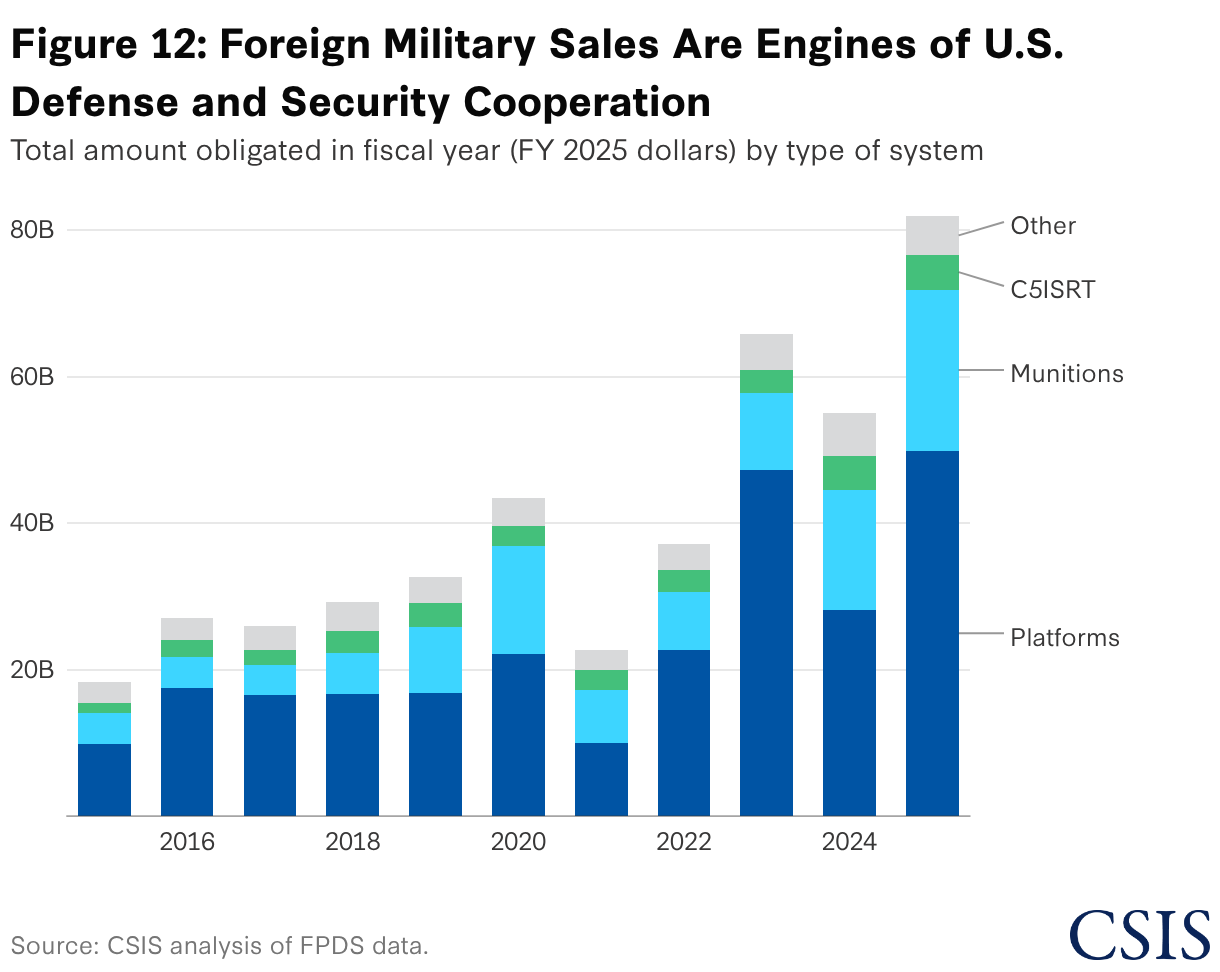
Drawing from FPDS records, U.S. FMS obligations have increased by over 347 percent from FY 2015 to FY 2025 (Figure 12), reflecting an expanding global demand for U.S. defense systems, particularly munitions and manned aircraft, and deeper security cooperation with allies and partners.
To capitalize on this market and lock in partner integration across defense systems, the Pentagon has taken several steps to streamline the FMS process and position arms cooperation as an engine driving demand across the broader industrial base. After issuing the first presidential executive order specifically focused on the FMS process in April 2025, the Trump administration announced an “America First Arms Transfer Strategy” in an executive order signed in February 2026. Together, these measures accelerate the FMS approval process and prioritize deliveries to those countries with higher defense spending and strategic importance. The FY 2026 NDAA included a provision to create an assistant secretary of defense for international armaments cooperation, further institutionalizing the Pentagon’s engagement with allied and partner industrial bases.
As the United States works to put its industrial base on a wartime footing, allied and partner defense markets are experiencing parallel expansions that create new opportunities to fuel domestic industry. In 2025, military spending by European NATO members rose faster than at any time since 1953, while military expenditures in Asia and Oceania saw the largest annual rise since 2009. Yet a resource-constrained industrial base supporting U.S. and allied forces in multiple theaters raises questions over whether industry can meet simultaneous demand at scale.
In addition to increased arms deliveries, shared security challenges and scarcity of critical inputs have led to significant codevelopment, coproduction, and co-sustainment efforts between the United States and its closest allies and partners. Canada and Finland, for example, signed a trilateral memorandum of understanding with the United States in November 2024—the Icebreaker Collaboration Effort, or “ICE Pact”—to jointly design, build, and maintain Arctic and polar icebreakers by pooling shipyard capacity, supply chains, and workforce development across the three nations. The pact has since shifted from framework to implementation, as officials met in Helsinki in May 2026 to identify concrete actions over the following year that will expand production capacity, train skilled workers, and reduce supply bottlenecks. South Korean shipbuilding giant Hanwha Ocean, as well, has notably moved forward in 2026 with its agreements in 2025 to invest $5 billion in transforming its U.S. subsidiary, Hanwha Philly Shipyard, into a warship-building facility and to perform maintenance on U.S. naval vessels at its yards in South Korea.
The United States has made meaningful progress toward placing the industrial base on a wartime footing. Defense spending is rising, munitions production agreements are being signed at historic scale, and novel public-private investment structures are taking shape.
Yet according to several measures—manufacturing lead times, critical munitions and materials stockpiles, and supply chain security—the U.S. industrial base has a long way to go to achieve resilience. Munitions depleted in the war in Iran will take years to replace and lower-cost versions are not yet in production. Commercial-first acquisition reforms, however promising, have yet to demonstrate that technologies at the prototype stage can be reliably converted into throughput at scale.
Wartime footing is not a destination that can be declared but a condition that must be continuously built, tested, and sustained. Translating investment into inventory and building the physical capacity and human capability needed for enduring industrial strength will demand continued effective coordination between government and industry, within supplier networks, and across allies and partners. The goal of a wartime footing is ultimately to deter conflict, an effort that will increasingly depend not only on exquisite military systems and technological superiority but also on whether the United States and its allies can generate, field, and reconstitute military capability faster than adversaries can exhaust it. Institutionalizing this industrial power remains an essential task for policymakers seeking to transform wartime footing into a foundation for sustaining the United States’ national security and strategic commitments.
Jerry McGinn is the director of the Center for the Industrial Base and a senior fellow with the Defense and Security Department at the Center for Strategic and International Studies (CSIS) in Washington, D.C. A.J. Dilts is a research assistant with the Center for the Industrial Base at CSIS.



Commentary by Jerry McGinn and Cynthia R. Cook — December 5, 2025