Capturing National Security Benefits from Offshore Wind
October 20, 2026 • 9:30 – 10:30 am EDT

Photo: HUGE PERALTA/AFP/Getty Images
Five months have passed since U.S. forces stormed into Caracas to capture Venezuelan dictator Nicolás Maduro, and tensions are again rising in the Caribbean—this time with Cuba. Almost immediately after the Maduro operation, President Trump halted Venezuelan oil deliveries to Cuba, telling the island’s leaders to “make a deal” or face the consequences. Mexico, which since 2023 has been a key supplier of fuel to the island nation, also shut off its deliveries under U.S. pressure, leaving Cuba in dire straits and strangling its tourism industry.
Against this backdrop, the United States has engaged in touch-and-go negotiations with various figures within the Cuban communist regime, while at the same time issuing an executive order to further increase economic pressure on the island. Statements from U.S. officials have not offered much strategic clarity, oscillating between maximalist comments by President Trump, who mused that he “will have the honor of taking Cuba,” to more conciliatory moves by the State Department, which announced it would be prepared to authorize a $100 million aid package in exchange for “meaningful reforms.”
More recently, the United States has been settling into a pattern similar to that which presaged Operation Absolute Resolve against Maduro. The recent unsealing of an indictment against Raúl Castro and other regime figures over the 1996 shootdown of U.S. civilian planes creates a rationale for characterizing his capture as a law enforcement operation. A similar justification was used by the Department of Justice to argue that Maduro’s capture on drug and arms trafficking charges represented an extraterritorial application of domestic law, not a foreign military intervention.
Along with rhetorical measures, the United States has stepped up military surveillance overflights of Cuba, gathering intelligence on the capabilities and dispositions of the country’s Revolutionary Armed Forces (FAR). In late May, CIA Director John Ratcliffe met with Cuban leaders, bringing along a paramilitary officer who was involved in capturing Maduro and killing the Cuban military personnel who were guarding the Venezuelan leader. It was a sign of what could come if negotiations are unsuccessful. Although the crisis in the Persian Gulf continues to smolder, threatening to reignite at any moment, the United States has enough military assets to operate simultaneously in the Western Hemisphere. The USS Nimitz carrier strike group entered the Caribbean in May, and the 1,300 Marines of the 24th Marine Expeditionary Unit (MEU) will replace the 22d MEU, which has been in the Caribbean since January.
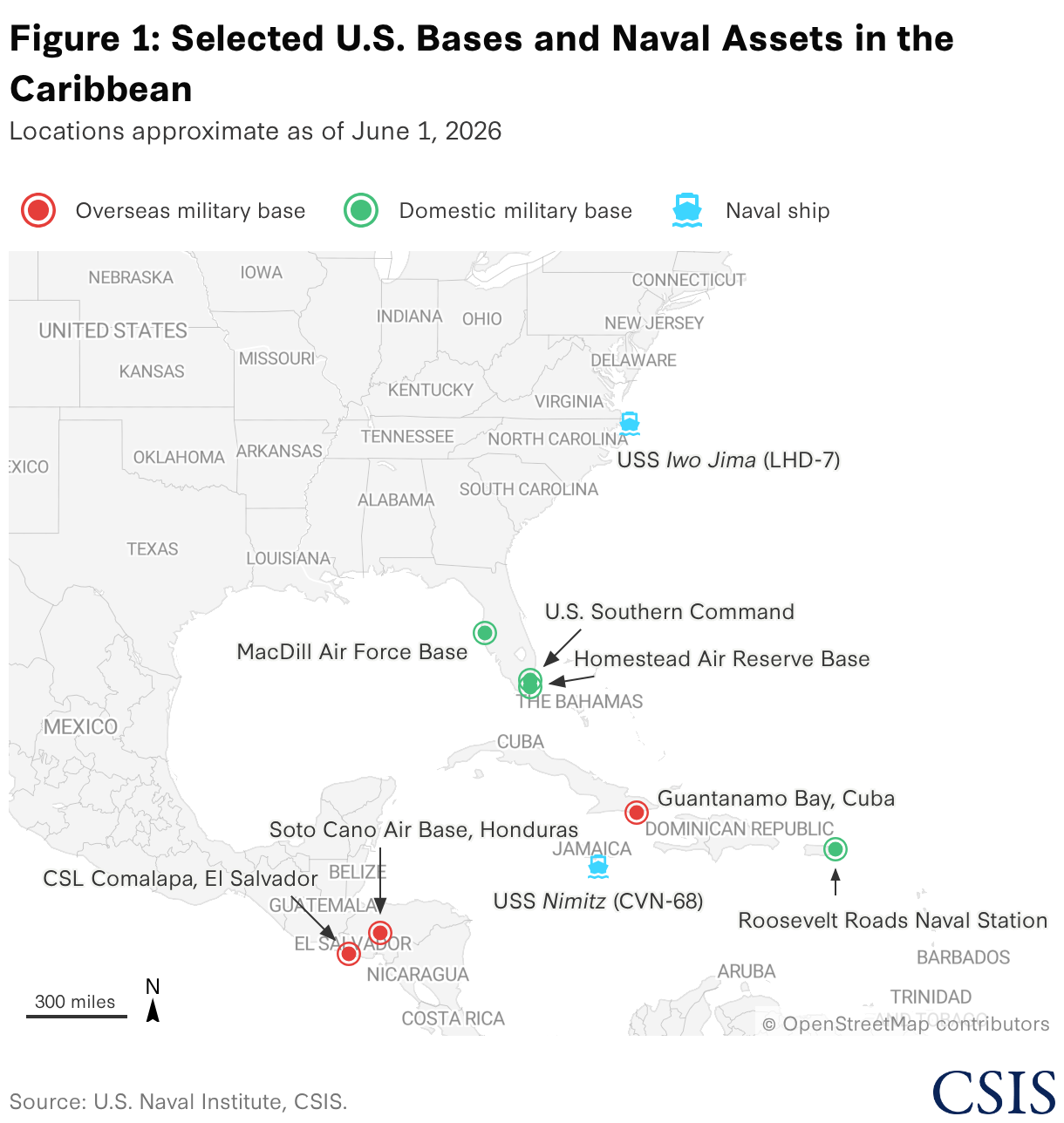
While the ultimate objective of U.S. Cuba policy remains unclear, the possibility of military action is present. Therefore, it is worthwhile to examine a range of possible scenarios involving the use of force against Cuba. The following sections examine five such scenarios, their relative likelihoods, and the risks involved.
The first scenario involves the continuation of the U.S. policy toward Cuba adopted in January 2026, which uses restrictions on oil imports as leverage to induce the regime to accept major changes. This is fundamentally an attritional strategy for the United States, relying on pressure from Cuba’s deteriorating economic position over time.
Militarily, this would be easy to execute. Cuba has essentially no navy and its few friends—Russia, Iran, and China—are not in a position to intervene. Tankers, the likely targets of a blockade, are easily tracked and intercepted. Military forces may not even be required if the United States convinces other countries not to send oil. There would likely be some low-level blockade running, but quantities would not be significant enough to affect the outcome. Blockades don’t need to stop every ship to be effective. The political challenge to a blockade is twofold: The first challenge occurs if a nation or NGO decides to run the blockade, forcing a public confrontation. The second challenge is that the suffering in Cuba makes the United States look like a bully. Both of these dynamics are already at play to an extent. In particular, Russia has proven willing, to some degree, to challenge the de facto U.S. blockade, delivering an oil shipment to Cuba in March, a move that likely reflected U.S. desire not to enter into a showdown with the war in Iran still raging, as well as a calculated strategy to keep some fuel headed to the island to stave off total collapse. However, recent reports that a second shipment of Cuba-bound Russian oil has now turned back could suggest that the economic pressure campaign may be ramping up.
The second scenario involves an internal collapse in Cuba that results in a humanitarian crisis and power vacuum, prompting the United States to intervene to restore order. The Cuban regime has persevered through periods of immense deprivation, and even today seems firmly entrenched in the face of U.S. pressure. In addition, recent protests have largely been spontaneous responses to economic deprivation, lacking a cohesive political program capable of challenging the regime’s dominance. Nevertheless, a sudden deterioration cannot be ruled out. This scenario would likely be difficult to predict, involving a rapid and simultaneous unraveling of various parts of the Cuban state, as well as mass protests and civil unrest.
General Colin Powell once described these situations as embodying the Pottery Barn rule: “You break it; you own it.” If there were a collapse but without disorder, U.S. military intervention might be limited to a few ports and airfields to facilitate the flow of humanitarian supplies and ensure their proper distribution. A complete breakdown of law and order and a decision to impose stability by occupying the island would require large ground forces.
A rule of thumb from the stability operations literature is that one member of the security forces is needed for every 50 citizens if there is no active insurgency. If half of those forces come from indigenous organizations like the police, then half would come from the United States and any coalition that the United States might put together. With a Cuban population of 10 million, that implies an external force of 100,000. The Trump administration is unlikely to pursue such an option, while a regional coalition would be equally reticent to step up. In nearby Haiti, even with U.S. prodding and financing, the international community was unable to deploy 2,500 troops for the now-defunct Multinational Security Support Mission, and it has more recently committed 5,500 troops to a UN-backed Gang Suppression Force, a fraction of what would be needed in Cuba.
The third scenario most closely resembles Operation Absolute Resolve, with a special forces operation or a kinetic strike aimed at capturing or killing senior Cuban leadership. Potential targets would include the recently indicted Raúl Castro, President Díaz-Canel, or both, as a means of signaling U.S. resolve and capabilities to the remaining Cuban leadership.
Leadership decapitation is hard to do despite recent operations that make it look easy. The U.S. seizure of Maduro required extensive preparations, a weak and unprepared adversary, and inside information. U.S. and Israeli decapitation of the Iranian government required exquisite intelligence, including with sources on the ground.
Putting boots on the ground for a seizure operation is extremely risky because of the possibility of casualties and capture. A kinetic strike would, therefore, be more likely. It still requires superb intelligence to know where the targets will be at a particular moment and to avoid collateral damage. The United States does have the military assets in theater to execute such a strike.
The first U.S. action in any kinetic operation would likely be the reinforcement of the U.S. base at Guantanamo Bay, which is currently essentially undefended. In the 1960s, the base was heavily defended with mines and infantry, but over the decades, those defenses have dissipated as the threat of Cuban attack has diminished.
If a decapitation attack were contemplated, it should be borne in mind that Cuba is not Venezuela. The Cuban Communist Party is far better institutionalized than Venezuela’s kleptocratic regime. While internal divisions are undoubtedly present, the edifice is unlikely to collapse with the removal of a single high-level figure. Furthermore, Cuba lacks an organized domestic opposition capable of putting pressure on the regime from within.
Even if a decapitation strike were successful, there is the problem of what happens next. Like Iran, the Cuban government has been fortifying itself for decades against possible kinetic strikes from the United States. As occurred in Iran, the most likely immediate outcome would not be quick regime collapse but instead a hardline response led by the Communist Party, the Revolutionary Armed Forces, intelligence services, and the military-economic mega-conglomerate Grupo de Administración Empresarial S.A., or GAESA.
In this scenario, the United States would carry out airstrikes against a number of military and intelligence targets in Cuba to pressure the regime into accepting major changes and to degrade Cuba’s ability to oppose future U.S. military action.
With the Nimitz in the Caribbean, the United States has the capability to launch several days of punitive strikes. While the size of the military force in the Caribbean remains well below the heights it reached in December 2025 and early January 2026, Cuba is close enough to several air bases within the continental United States that could supplement naval aviation. Airstrikes would likely focus on drone and intelligence facilities, consistent with U.S. concerns about Cuban behavior. The U.S. military would likely also strike Cuban air defenses, especially in a longer campaign.
Cuban air defenses are weak, having been neglected for decades, but reducing them to impotence would allow the United States to fly over Cuban territory and use more plentiful and less expensive munitions rather than scarce and expensive long-range missiles. This dynamic has been present in the Iran war, where the coalition eliminated the remnants of Iranian air defenses in the first four or five days and was then able to overfly Iran with near impunity.
The political problem remains the same as in the previous scenario: What if the Cuban government continues to resist? Assuming no large-scale nationwide uprising that threatens the regime (there are further parallels to Iran here), airstrikes alone are unlikely to topple the regime.
The final scenario involves an unforeseen event—such as an accident where the cause was not immediately apparent or an attack, authorized or not, on U.S. forces in the Caribbean by Cuba—that would lead to U.S. military retaliation. Like the second scenario, it would be difficult to anticipate this prior to the triggering incident.
A risk inherent to the U.S. strategy of saber-rattling rhetoric and increased military deployments around Cuba is the potential for miscalculation on either side and the outbreak of hostilities that neither party truly wants. In October 1962, U.S. pilot Rudolf Anderson was killed when his U-2 surveillance plane was shot down conducting reconnaissance over Cuba. At the time, diplomacy between Washington, Havana, and Moscow prevailed, but the incident could have triggered a darker trajectory, driven by tensions that were running white-hot. Sixty-four years earlier, the USS Maine had been sent to Havana to protect U.S. interests as the Cuban independence movement from Spain gained strength. The ship’s explosion, the cause of which is still debated today, led directly to the Spanish-American War. An incident between U.S. and Cuban forces, especially if there were U.S. casualties, might spark escalation. The United States might respond with leadership decapitation or limited air strikes, as described above.
The least likely outcome is a U.S. invasion. Cuba is unable to impose costs upon the United States militarily and economically in the same way as Iran. The Cuban armed forces are weak, their equipment is woefully out of date, and their long-range strike capabilities are severely limited. While reports that the country has acquired hundreds of Russian military drones suggest that Cuba may be seeking to acquire an asymmetric capability against the United States, the 300 units allegedly received are orders of magnitude less than what would be needed to credibly close the Straits of Florida or threaten U.S. critical infrastructure on the mainland; Guantanamo, however, could be vulnerable. The FAR maintains around 50,000 active soldiers, about 39,000 reservists, and nearly 90,000 paramilitary personnel, and could also threaten combat in urban areas and insurgency in rural areas, both of which would be politically difficult for the United States. As in the second scenario, achieving the overwhelming force favored by U.S. planners would likely require an invasion force of at least 100,000 personnel, with air and naval support. That would take months to put in place and be visible long before operations began.
To deny the United States a quick victory either on the battlefield or at the negotiating table, Cuba could seek to delay negotiations at least until the U.S. midterm elections, when a potential change in Congress could create more favorable conditions for the country. Cuba has long recognized that the vast disparity in military and economic might necessitates an asymmetric strategy to resist its northern neighbor, and it hopes that U.S. willingness to fight runs out before the regime collapses. Such a strategy is not without risks, though, chief among them the second scenario described above, involving a spontaneous collapse and subsequent humanitarian crisis.
The United States has real strategic interests at play in Cuba: unwinding the island’s authoritarian partnerships that allow it to serve as an outpost for Chinese intelligence; preventing Cuba from supporting Russia’s war in Ukraine with mercenaries; opening the Cuban economy; and creating a political opening to offer a path to return for many Cubans who have fled the island for U.S. shores.
However, the United States will struggle to achieve any of these objectives without a coherent theory of change, which has often been lacking in U.S. messaging around Cuba. In a worst-case scenario, the United States could find itself drawn into a military confrontation that could stretch U.S. forces and endanger the lives of both U.S. personnel and ordinary Cubans, with no clear path to democratization or economic recovery.
Christopher Hernández-Roy is a senior fellow and acting director of the Americas Program at the Center for Strategic and International Studies (CSIS). Mark F. Cancian is a retired Marine colonel and senior adviser with the CSIS Defense and Security Department. Henry Ziemer is a fellow with the CSIS Americas Program.

Critical Questions by CSIS Scholars — April 9, 2026


