From Shahed to Geran: How Russia Continues to Reinvent the One-Way Attack Drone
September 29, 2026 • 8:00 – 9:00 am EDT
Hosted by Wadhwani AI Center

Photo: JUAN BARRETO/AFP/Getty Images
A geologist estimated in 2018 that the global price of oil would need to be above $200 per barrel for commercial resource extraction of oil in Antarctica to be feasible. That is a remarkably high number considering the highest price ever was $150 per barrel in June 2008. The armed conflict in Iran as well as recent U.S. statements and actions related to Alaska, Venezuela, and Denmark (Greenland) have made clear the importance the United States places on commercial resource extraction, or mining, of energy and critical minerals. In this period of geopolitical upheaval, it is potentially useful to review the political, legal, and natural challenges unique to Antarctica that make commercial mining, whether for energy or for critical minerals, in the region unlikely in the coming decades.
Antarctica is a continent roughly the size of the United States and Mexico combined, surrounded by the Southern Ocean. There has never been an indigenous human population, and it remains inhospitable for all but the most intrepid staff and scientists supported by their national governments. There is no private, commercial infrastructure in the region, such as airports, naval ports, hotels, grocery stores, or hospitals. Everything south of 60°S latitude, whether land, ice, or water, is governed by the Antarctic Treaty system, which is based on international cooperation rather than on sovereign territories.
Although located far from them now, Antarctica was once connected with Africa, Australia, India, and South America millions of years ago, and scientists presume it should have resources similar to those of those continents and their adjoining waters. The United States and other countries active in Antarctica have repeatedly reported petroleum finds, with the U.S. Geological Survey publishing reviews in 1974, 1983, and 1991. The U.S. reports were done during successive energy crises and while countries were negotiating a convention to govern potential mineral extraction in Antarctica, a convention that was ultimately discarded in favor of protecting Antarctica’s environment and prohibiting commercial mining. More recently, a Russian firm announced in February 2020 that it had found over 500 billion barrels of potential hydrocarbon resources in the Southern Ocean. The UK Parliament discussed this finding during a series of public hearings in 2024 regarding its national interests in Antarctica. There are reports of other mineral finds in the region, albeit none of that reported size and the chairman of the U.S. Senate Foreign Relations Committee referenced this Russian action in a hearing in February.
However, the United States, Russia, and all other countries active in the region have never taken any action to undertake commercial mineral extraction in the region.
It is therefore not a question of whether there exist potentially valuable mineral resources in Antarctica, but whether those resources could be found, extracted, and moved safely and profitably. Since 1991, the private sector and countries have concluded that there are two reasons the answer is no. First, there are significant, longstanding political and legal disincentives to initiating commercial mining activities in the region that include an outright ban on any nonscientific mining activity, the absence of property rights and business confidentiality, and reputational and financial risks that are particularly significant in the case of an environmental disaster. Second and much more importantly, the unique and extreme natural conditions significantly restrict when and where mining operations could occur and significantly increase the operational costs.
The most significant political and legal challenge to potential commercial mining operations in Antarctica is that such activities have long been prohibited by international law. Article 7 of the Protocol on Environmental Protection, which was agreed to in 1991 and went into force in 1998, prohibits “any activity relating to mineral resources, other than scientific research.” The provision does not expire and does not need to be renewed. Parties to the Protocol regularly reaffirm their adherence to the provision, including most recently in 2023. Article 25 of the Protocol establishes a procedure to modify the mining ban that changes after 2048, but requires the entry into force of a binding legal regime on mining that had been agreed to by consensus before removing or amending Article 7.
Beyond prohibiting nonscientific mining, the Protocol and its annexes establish stringent rules related to conducting activities in the region, including requiring environmental impact assessments, protecting flora and fauna, establishing waste management norms, regulating marine waste, and creating protected areas. In short, since 1991, all countries active in the region, including the United States, Russia, and China, have prioritized environmental protection over mineral exploitation in Antarctica.
This is consistent with U.S. policy first established during the Nixon administration, when the United States decided to oppose commercial mining in favor of preventing discord or competition in the remote region. The United States further reinforced this position during the George H.W. Bush administration when it signed into law the Antarctica Protection Act of 1990, which made it “unlawful to engage in, finance, directly or indirectly, or knowingly provide assistance to any Antarctic minerals resource activity.” This statute remains in force.
Additionally, Antarctic Treaty Article IV, which freezes competing overlapping claims of sovereignty, and Article VII, which allows unannounced inspections anywhere in the region, have the effect of eliminating property rights and business confidentiality in the region. Although the purpose of the inspection regime is for arms control, it has already expanded to cover environmental issues and could easily be used to investigate business operations. The result is that a company operating in Antarctica should have no expectation that it could prevent others from accessing the same resource it found and is attempting to extract from, and should not expect to have business confidentiality from competitors learning about its operations.
Although climate change policy and energy policy diverge in the United States, many countries are taking action to reduce their use of hydrocarbons by diversifying their energy portfolio. Antarctica is well-known as a place of unique beauty that has had limited human impact, so it would be reasonable to expect a concerted effort by committed and skilled environmentalists, such as the Antarctic and Southern Ocean Coalition, which led the fight that established the Environmental Protocol and mining ban, to restrict the importation or dampen demand for energy or other products using Antarctic minerals.
While the human-made political and legal challenges to conducting nonscientific mining for energy and other products in Antarctica are substantial, they could be reversed. However, those challenges are insignificant compared to the natural constraints on conducting operations in the region, which are not reversible by decree. Antarctica is the driest, coldest, and windiest continent in the world. Over 98 percent of its land is covered by ice sheets up to 3 miles thick. A company desiring to even find mineral deposits on the continent would therefore need to overcome the greatest quantity of ice anywhere in the world just to reach what we would consider the ground surface.
The Southern Ocean that rings the continent is well-known for its miserable surface conditions. Katabatic winds can quickly turn a calm day into a challenge with speeds over 100 mph, which would be the equivalent of a Category Two hurricane but without the preceding warning of its arrival. In addition to katabatic winds, cyclonic low-pressure storm systems constantly circulate Antarctica, impacting any location in the Southern Ocean for days at a time, with a new storm system arriving almost weekly.
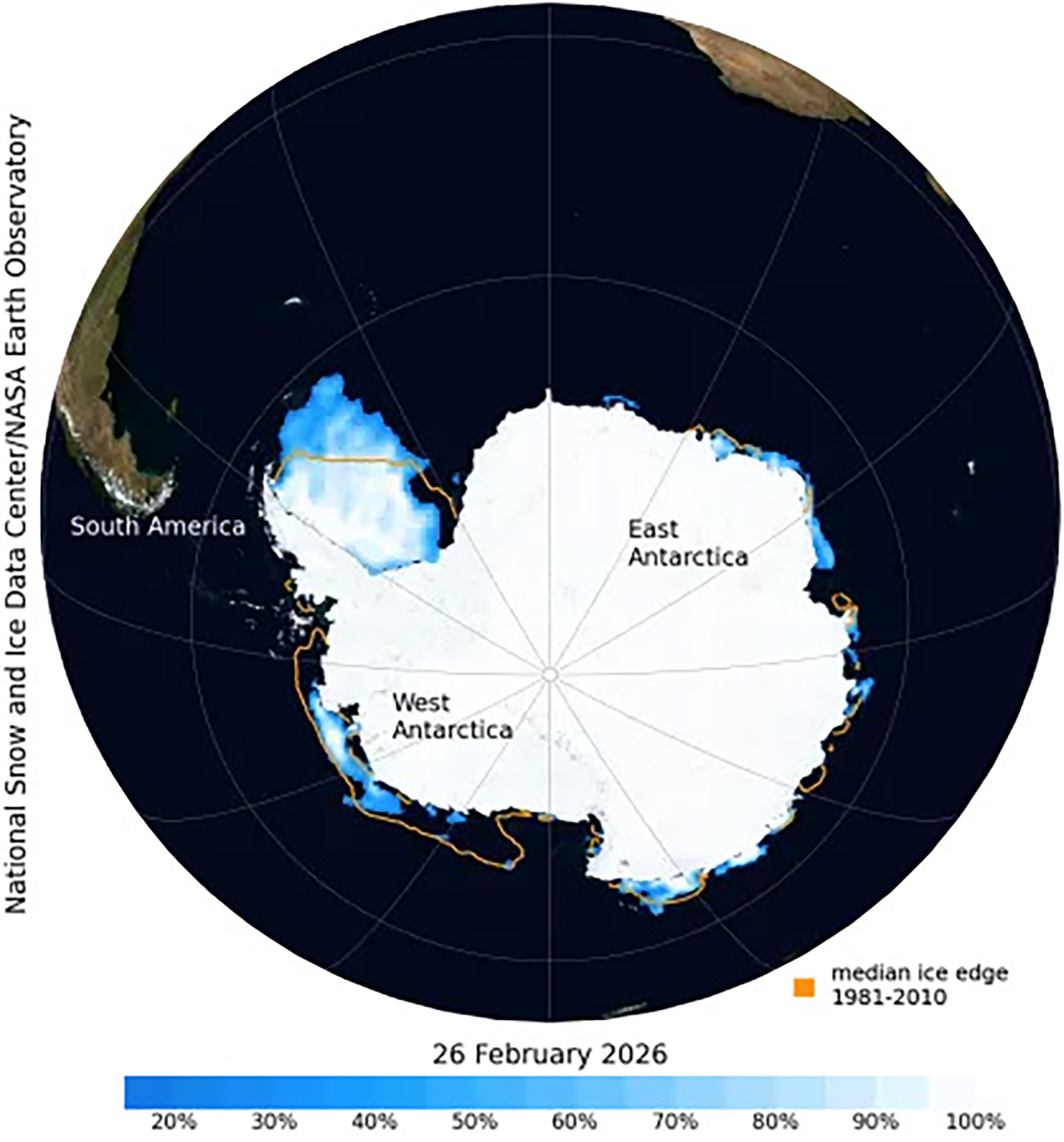
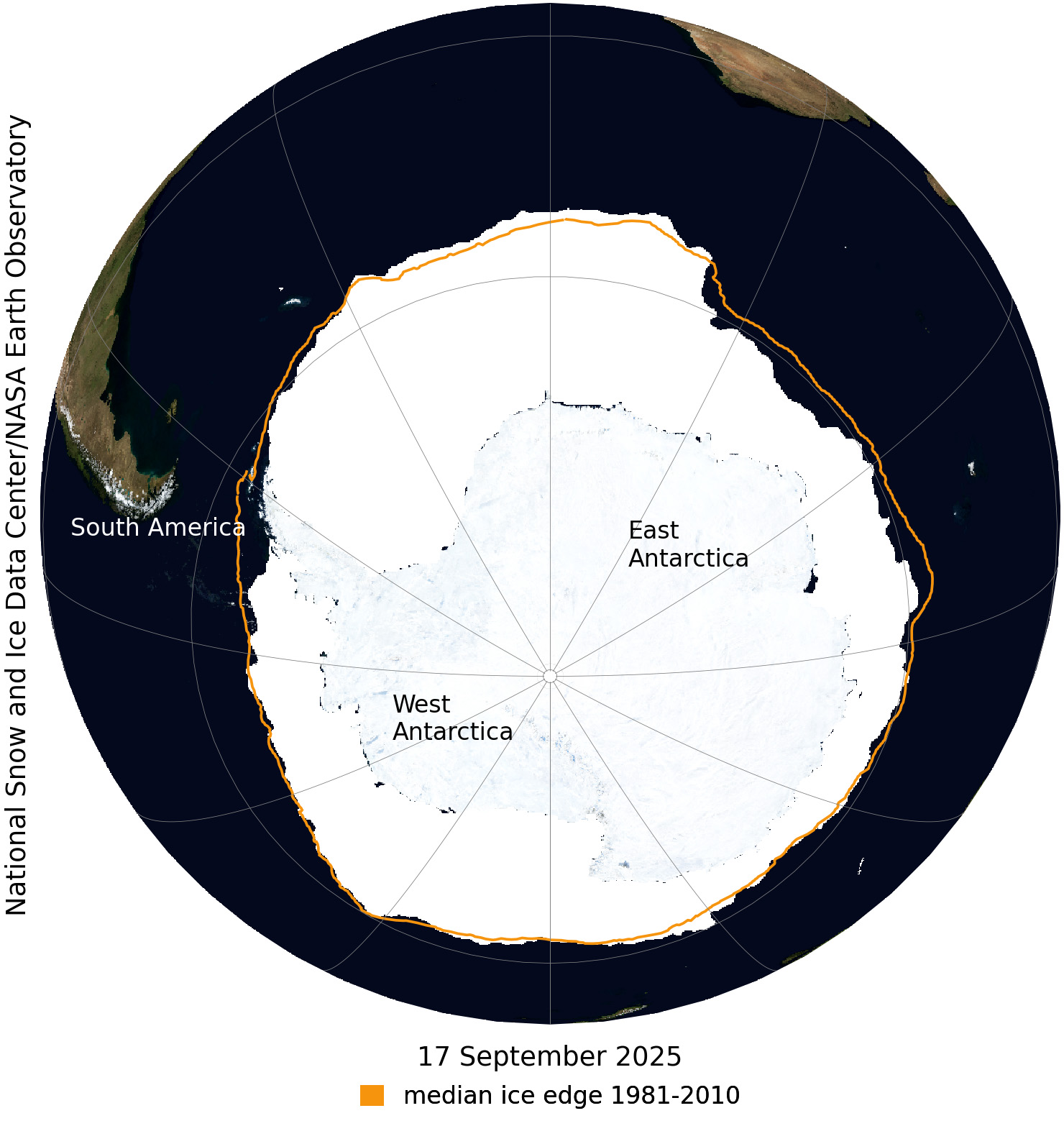
Antarctica has a significant annual seasonal variation of sea ice, ranging from 996,000 square miles in February 2026 to 6.88 million square miles in September 2025 (see Figure 1). The sea ice is thick enough to prevent even heavy icebreaker operations in the region for much of the year. Operations throughout the year, but particularly active during the austral summer, would face a different challenge from ice, namely the movement of icebergs, and could be impossible due to the presence of sea ice. The frequency and size of icebergs in the Southern Ocean also create significant risks to anything in the water, be they boats, platforms, or islands. A recent large iceberg, A23 (about twice the size of Greater London), is large but would have been dwarfed by the largest Antarctic iceberg recorded, B15 (nearly as large as the state of Connecticut or the country of Jamaica), when it calved in 2000.
Figure 1: Antarctic Sea Ice Hits Sixteenth-Lowest Minimum
Source: NSIDC/NASA Earth Observatory.
Figure 2: Antarctic Sea Ice Peaks at Third-Lowest Level
Source: NSIDC/NASA Earth Observatory.
Logistics would be a considerable challenge, whether the desired operations were on land or offshore. The habitable continents Africa (3,800 km), Australia (2,500 km), and South America (1,000 km) are distant from Antarctica and do not rely on the Southern Ocean for maritime connections with the rest of the world. There are no indigenous inhabitants of Antarctica and no population centers on the Southern Ocean, meaning there are no easy locations to base operations, refine the output, or sell the resulting product.
In this challenging location, an operator would need to establish multiple logistics networks related to the mining operation, whether it is on a platform in the Southern Ocean or on the continent. That operator would need to construct key infrastructure — such as an airport, ocean port, hotel or dormitory, hospital, or grocery store — since none exist in the region to address the various needs of moving personnel, supplies, and products for commercial purposes. It would be particularly complex to manage the human labor needed for such an operation. Currently, only 5,000 people live in the Antarctic region during the peak summer months and around 1,500 during the long winter.
As described above, there are significant legal, political, and natural reasons that make it difficult to envision commercial mining in Antarctica in the coming decades. That is not to say that it is impossible. There could be significant changes in technology that make commercial operations in the Antarctic Ocean more feasible, and there could be countries that would advocate for policies that lower the risk or costs of nonscientific mining in Antarctica in the hope or expectation that mining could be feasible in the future. Additionally, a state-owned company from a country that does not give significant weight to reputational risk or environmental harm might undertake challenging operations.
As it has done since 1974, the United States should prioritize peace, science, and environmental protection over the hopes of finding and exploiting a mythical El Dorado of energy or mineral resources in Antarctica and the Southern Ocean. One cost-free action would be to place a permanent ban on nonscientific mining to further dissuade governments and companies from looking to the south for resources. Another would be to collaborate with like-minded countries to continue to monitor and strongly dissuade potential non-scientific mining in the region. A third action would be for countries to act globally to protect Antarctica’s environment from all threats, including mining. Taking these steps would be consistent with the U.S. National Security Strategy released in November, which emphasized that the United States needs to prioritize where it spends its time and capital to advance its national interests, while reserving Antarctica as a natural reserve, devoted to peace and science.
William Muntean is a senior associate (non-resident) of the Americas Program at the Center for Strategic and International Studies in Washington, D.C.

Commentary by William "Bill" Muntean III — December 5, 2024