Proportional to the Mischief: International Law and U.S. Grand Strategy
October 26, 2026 • 3:30 – 4:30 pm EDT
Hosted by Defense and Security

Photo: NicoElNino/Adobe Stock
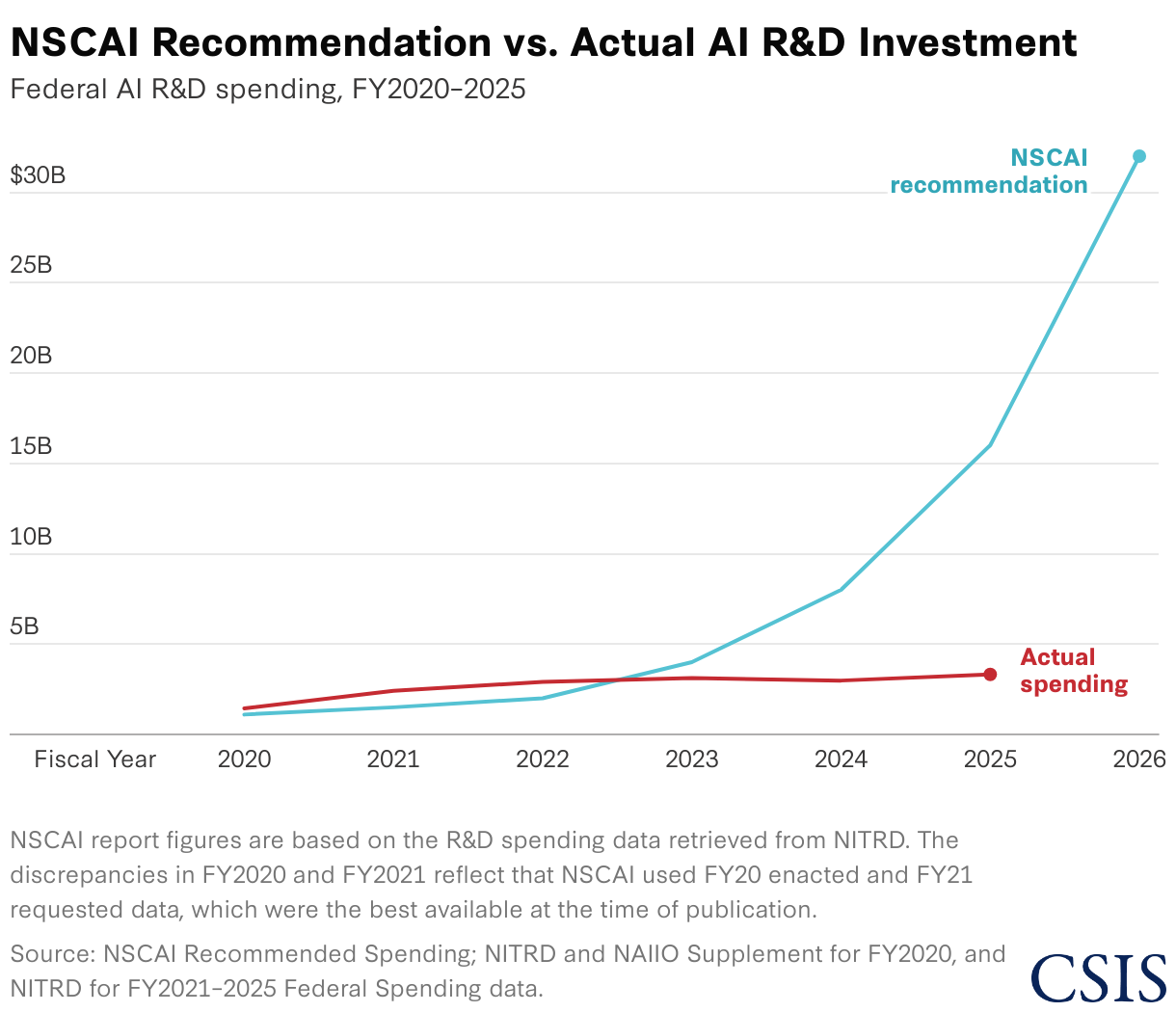
In 2021, the National Security Commission on Artificial Intelligence (NSCAI) released its final report, calling for bold action to advance U.S. leadership in AI. One of its key recommendations was to dramatically increase federal investment in AI research and development (R&D)—doubling non-defense funding annually to reach $16 billion by FY25 and $32 billion by FY26.
Nearly five years later, the United States has fallen far short of this goal. In FY25, the federal government invested roughly $3.3 billion in non-defense AI R&D.
At the same time, U.S. private sector investment in AI has surged, exceeding $109 billion in 2024. That’s a good thing: industry brings the scale required to train the largest frontier models and the capacity for commercialization. But federal funding plays a different and equally essential role.
Federal R&D funding matters for U.S. AI leadership because in AI, as in other fields, public and private R&D are complements, not substitutes. Government funding typically seeds early-stage ideas, expands access to tools and knowledge, and promotes innovation that serves the public interest. Private funding, in contrast, focuses primarily on late-stage research and commercialization, transforming new knowledge into tangible products and services. In other terms, public R&D frequently generates new knowledge that private R&D then builds upon. In this way, investment in public R&D promotes investment in private R&D, rather than crowding it out.
History provides clear examples of this dynamic. Although recent breakthroughs in AI have largely been funded by the private sector, the foundations of modern AI were built through decades of federally funded research. Following World War Two, government agencies like the National Science Foundation (NSF) and the National Institutes of Health (NIH) invested in early AI experiments, such as the first AI program in the 1950s, the first chatbot in the 1960s, and rules-based systems for medical diagnosis in the 1970s. Indeed, public funding advanced many core capabilities like machine learning, neural networks, computer vision, and natural-language processing, which the private sector then developed into the AI systems we use today. In 2024, the House Task Force on Artificial Intelligence released a report of its own, acknowledging that the United States “has maintained its AI leadership largely due to continued and consistent federal investments in AI R&D over decades.”
The case for federal investment in AI R&D is also grounded in economic literature. R&D generates positive spillovers—benefits to society that extend beyond the organization that conducted the R&D. As a result, even when firms invest heavily in AI, they still tend to underinvest relative to what is optimal for societal welfare. Put differently, the public returns to early-stage AI research—such as expanding the scientific frontier or enabling entirely new applications—are often far greater than the private incentives to fund it. Public R&D funding helps fill this gap, supporting research that drives long-term growth but offers limited short-term returns to any one company, such as AI interpretability, cybersecurity, and privacy.
In today’s environment of shrinking federal R&D budgets, meeting the NSCAI’s original target may no longer be feasible. But the need for public investment remains urgent. As stated in the White House’s AI Action Plan, “whoever has the largest AI ecosystem will set global AI standards and reap broad economic and military benefits.” China recognizes this and is deploying industrial policy tools across the full technology stack to accelerate its progress in AI, including investments in R&D.
In the United States, private capital alone cannot deliver the foundational breakthroughs and safeguards that will define U.S. AI leadership for decades to come. To stay ahead, the United States must expand its commitment to federal R&D, ensuring that innovation in AI advances both economic competitiveness and national security.
Data visualization by Sabina Hung