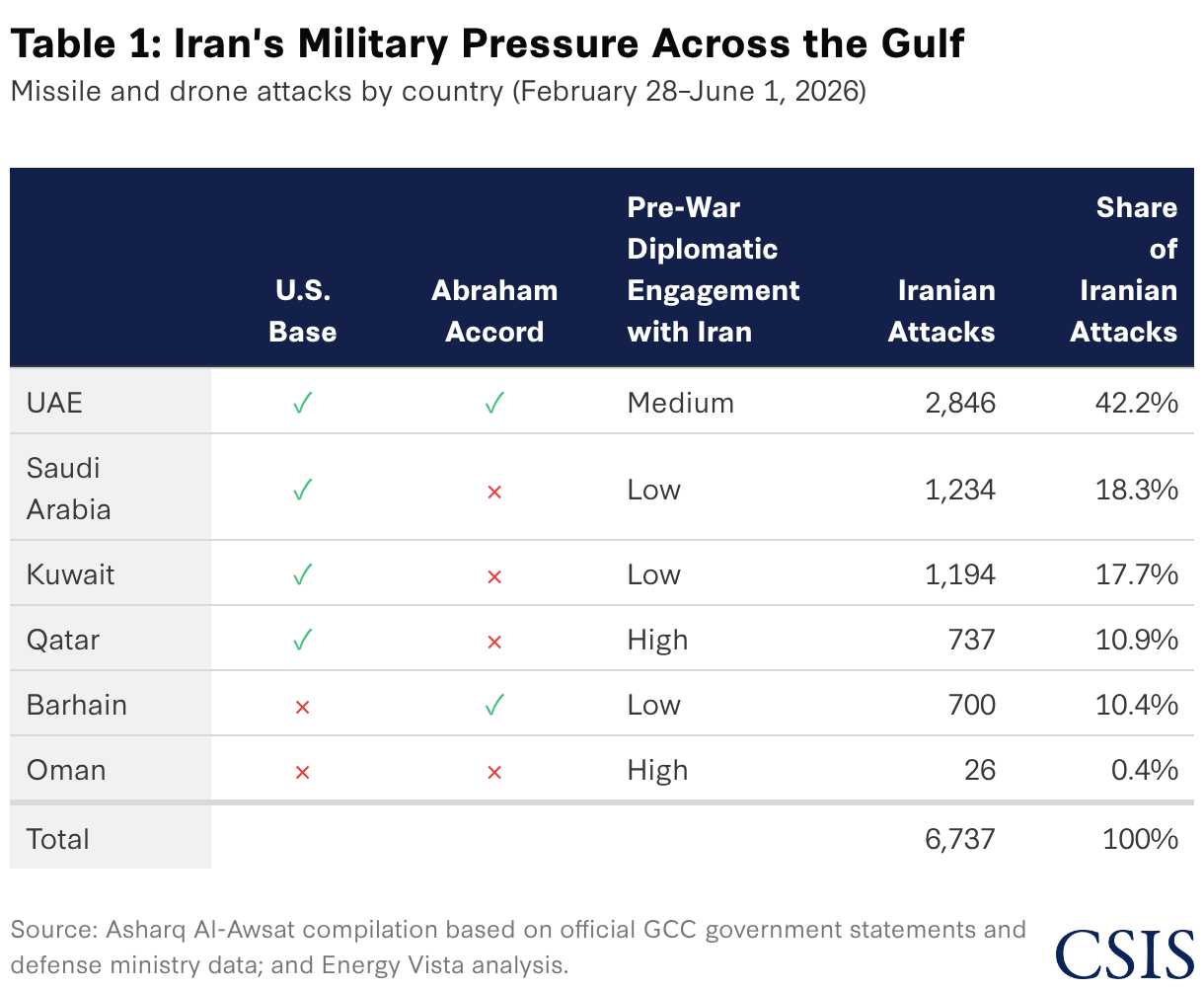
Since the outbreak of the conflict, Iran has targeted LNG facilities, oil export terminals, refineries, pipelines, storage tanks, and power infrastructure across Saudi Arabia, Qatar, the UAE, Kuwait, and Oman. More than 25 energy companies operating in the GCC have declared force majeure since the conflict began, underscoring the scale of the disruption. Commercial planning and investment decisions are increasingly put on hold because of the current lack of forward visibility. Instead, energy companies operating in the Gulf must prepare for tail risks, develop mitigation strategies, anticipate potential write-offs, and manage the potential loss of clients and revenues.
There may be short windows during which petroleum tankers can transit the Strait of Hormuz. Gulf producers will attempt to maximize those openings, as seen in June when Qatar was able to export approximately 40 loaded LNG tankers through the strait, equivalent to roughly 2.8 million tons, according to ship-tracking data. But renewed attacks, even if limited and targeted, could close the route again within hours. At the time of writing, Strait of Hormuz crossings had fallen by 70 percent compared with the “truce” period (June 7–July 7), according to Kpler.
Return to Full-Scale War
The second scenario is a return to full-scale war, which would carry non-negligible destruction risks to energy and civilian infrastructure but could also break the stalemate and bring the IRGC back to the negotiating table on terms more favorable to the United States. This scenario could also give the United States, Israel, or both an opportunity to “finish the job” once and for all and even decimate the IRGC, an outcome that some Gulf states have supported since the beginning of the war.
Initially, the U.S. electoral calendar appeared likely to constrain such an escalation, as high fuel prices remain politically sensitive ahead of the November midterm elections. Gasoline prices were rising again the week of July 20 in the United States, topping $4 per gallon, while voters remain worried about rising inflation. Iran’s recent behavior and its targeting of Gulf countries, however, have made the timing of any full-scale war less predictable.
A renewed military campaign could also become more likely if Washington succeeds in assembling a broader coalition that includes Gulf partners and European allies. Those countries have a direct interest in ensuring that the Strait of Hormuz remains permanently open and that energy flows from the Gulf are no longer subject to repeated disruption. Such a coalition would allow the United States to share the military and financial burden of the campaign while making sustained military engagement more politically acceptable at home.
The central question would be the campaign’s objective. Would it be limited to restoring freedom of navigation through the Strait of Hormuz, the Red Sea, or both? Would it seek to permanently degrade Iran’s missile and drone capabilities? Would it aim to dismantle Iran’s nuclear program? Or would it ultimately extend to regime change?
From the perspective of Gulf exporters, significantly reducing Iran’s ability to threaten energy infrastructure and maritime trade could restore confidence among investors, insurers, shipowners, and energy consumers. Gulf economies cannot operate indefinitely under recurring cycles of conflict and uncertainty. As a result, some policymakers may conclude that a more decisive military outcome offers the only durable path to regional stability and secure commodity flows. However, the Gulf states are also wary of the cost of infrastructure damage and the uncertainty surrounding the outcome. Israel would likely join the United States in seeking to deal a decisive blow to the IRGC, further widening both the geographic scope and the intensity of the conflict.
Comprehensive Peace
The third scenario is a comprehensive peace agreement. For now, it remains the least likely and most remote outcome, given the extent to which the parties remain at odds over multiple fundamental issues. However, both sides have shown interest in keeping diplomatic channels open. Over time, such negotiations could eventually lead to the release of frozen assets and a gradual lifting of sanctions on Iran. If that happens, Iran could return much more fully to international energy markets.
It would become a major global competitor in both oil and natural gas. Iran possesses one of the world’s largest hydrocarbon resource bases and enormous long-term production potential. This transformation would not occur overnight. It would require technology, capital, and investor confidence. China, of course, never really left Iran’s energy sector. Other international companies would likely follow if sanctions were lifted.
For global gas markets, this scenario would reinforce expectations of abundant supply for decades to come. It is certainly something that Qatar and every major LNG exporter is already thinking about.
Qatar’s Immediate LNG Priorities
Qatar is among the countries most exposed to prolonged disruption in the Strait of Hormuz. Its vast LNG expansion program to nearly double its existing export capacity of ~77 million metric tons per annum (mtpa) was intended to reinforce its position as the world’s second-largest supplier and would have contributed to bringing global LNG prices down by 2027 by tipping the market into oversupply, an outcome that LNG consumers were eagerly anticipating. The conflict now raises a broader question: Is the anticipated LNG glut merely delayed, or has the future supply outlook been fundamentally altered?
Qatar’s first priority will be to restore its undamaged export capacity (64 mtpa) as quickly and as fully as possible. Two liquefaction trains, co-owned by QatarEnergy and ExxonMobil, were attacked by Iran on March 18 at the giant Ras Laffan LNG complex. QatarEnergy indicated that repairs could require three to five years, leaving the country with a 17 percent loss of its total export capacity. Although there has been little subsequent public clarity on the damage assessment, those repairs are unlikely to be Qatar’s immediate focus.
The other commercial priority will be accelerating the construction of the North Field East liquefaction plants, which were well underway before the conflict, and the project could become operational in 2028. However, a full return to capacity and adding new volumes will require greater visibility regarding transit through the strait. A producer the size of Qatar cannot simply operate every liquefaction train unless it is confident that multiple cargoes can safely transit the Strait of Hormuz every single day.
The second priority will be restoring customer confidence. Qatar has long been perceived as a highly reliable supplier. It has built strong relationships with buyers and has often shown flexibility on delivery timing. Force majeure declarations now threaten that reputation. Before the latest round of strikes, market participants expected QatarEnergy might lift force majeure by August or September. That timetable is now much less certain, and some news outlets are already reporting that the new target is October.
Qatar could still export slightly less than 30 million metric tons (mt) of LNG this year, according to Energy Vista, but the result will ultimately depend on how much LNG can transit the strait. Under conditions of partial access, as was the case in June, QatarEnergy might be able to export approximately 2 mt every month through the strait.
As a third priority, Qatar could also pursue a bilateral arrangement with Tehran to allow some exports without a fully reopened waterway, a move that could strain Doha’s relations with Washington unless it was framed as an energy security measure to supply buyers facing acute shortages, such as Pakistan. Oman and Qatar have emerged as the most conciliatory toward Iran and the most eager to pursue dialogue, including potentially accepting a fee, if necessary. Doha had appeared open to negotiating a “temporary” toll, which could also open the door to recurring negotiations in the future.
One possible outcome is the emergence of two competing shipping systems within the Strait of Hormuz. On one side would be an Iran-approved corridor, reserved for vessels authorized by Tehran or operated by countries aligned with its strategic interests. Such a system could increasingly serve Iran, Russia, China, and other states friendly to Tehran, though always subject to Iranian good will and coercion. On the other side would be the U.S.-backed and internationally protected corridor, relying on the Omani route and supported by Western naval forces and their partners.
This would resemble the situation that developed in the Red Sea, where the Houthis, from early 2024 to May 2025, selectively accommodated vessels linked to countries with which they maintained implicit or explicit arrangements. Numerous reports suggested that Chinese, Russian, and Iranian-linked shipping was able to transit without security risk by securing backdoor arrangements. These de facto arrangements contributed to the emergence of a differentiated maritime security environment that favored non-Western interests.
Meanwhile, Iran continues to deal bilaterally with Oman, and possibly other Gulf countries, to impose its vision of a new mechanism ruling the strait. Tehran keeps proposing managing one-way traffic on its side of the strait, while Oman would oversee vessels transiting in the opposite direction, with “service fees” going to the IRGC.
Could Qatar Still Come Out of the Crisis as a “Winner?”
Regaining market share will be another high-ranking priority. The longer the disruption lasts, the more other suppliers will capture Qatari market share, both through existing trade flows and through new final investment decisions in more stable jurisdictions.
Qatar should not be written off as a long-term LNG winner, but only if transit via the Strait of Hormuz once more becomes predictable and normalized. The country remains the world’s lowest-cost LNG supplier and therefore retains unmatched pricing competitiveness. If construction at North Field East (33 mtpa) and North Field South (16 mtpa) resume at full speed after a delay of 12–18 months, Qatar could aggressively pursue buyers through competitive spot cargoes and discounted long-term contracts with lower oil-linked slopes that other suppliers may find difficult to match.
Qatar also possesses a powerful commercial-diplomatic model. QatarEnergy is not simply a company; it is an instrument of the Qatari state. Commercial decisions can be aligned with foreign policy, government-to-government agreements, financing, and long-term strategic relationships. This model may allow Qatar to regain market share, notably with Asian countries, even after a major disruption.
The country is also transforming itself into a global portfolio player. The recent start-up of the Golden Pass LNG export project in the United States, 70 percent owned by QatarEnergy and 30 percent owned by ExxonMobil, is central to that effort. QatarEnergy’s merchant LNG share from Golden Pass (12.6 mtpa) is approximately equivalent to the volume lost from the two damaged Ras Laffan trains, which are also joint ventures between QatarEnergy and ExxonMobil. The symmetry raises questions about whether Doha and Tehran may have had a quiet understanding regarding which facilities would be targeted and how much supply would be removed from the market.
Qatar is also about to control a much larger LNG shipping fleet. Before the war, it aimed to own or manage approximately 200 LNG carriers by the early 2030s. Some newbuilding deliveries and vessel orders now appear to have been delayed, but QatarEnergy’s strategic decision of owning and controlling a large fleet remains central to its pursuit of market dominance.
Pipeline alternatives to export Qatari gas may be discussed in the future, including an expansion of the existing Dolphin Pipeline, a larger connection to Oman through the UAE, or routes through Saudi Arabia toward Turkey or the Eastern Mediterranean. A deep-sea pipeline from Oman toward India could also be studied. But these options would require large amounts of capital, time, and geopolitical coordination. Qatar, the UAE, and Oman are themselves LNG competitors, and Doha is unlikely to welcome dependence on another state for its exports. Unlike oil producers, Qatar has few realistic options for bypassing Hormuz.
Tail Risk: Indefinite Loss of Qatari LNG
The possibility that a large share of Qatari LNG remains unavailable for an extended period should not be dismissed. The Strait of Hormuz could remain unreliable. Ras Laffan could be struck again. A political transition in Iran could also create new uncertainties over the long-standing tacit understanding that has governed the world’s largest gas field, North Field–South Pars reservoir, shared between Doha and Tehran. A more nationalistic Iranian government, or a post-sanctions Iran seeking to become a major gas exporter, might demand a renegotiation of existing arrangements.
A prolonged disruption would fundamentally reshape the global LNG market. But the market also adapts. The global energy system adjusted to the loss of Libyan LNG, Yemeni LNG, and, more recently, Russian pipeline gas in Europe. The Russian gas disruptions triggered severe price spikes, led to persistent volatility, and eroded buyers’ confidence in natural gas as a reliable energy source. Yet, new supply emerged and markets gradually rebalanced. U.S. LNG played a particularly important rescuer role following Russia’s invasion of Ukraine and is doing so again amid the current Middle East disruptions.
The critical question is therefore whether the world will still miss lost Qatari LNG three to five years from now, once new liquefaction capacity in the United States, Canada, and elsewhere comes online. U.S. LNG is undergoing an unprecedented expansion. Projects currently under construction will add more than 120 mtpa of liquefaction capacity based on Energy Vista analysis, more than doubling the country’s current LNG export capacity over the next five years. In 2027 alone, approximately 52 mtpa of new U.S. capacity is expected to enter the market, with Plaquemines LNG Phase 2, Calcasieu Pass 2, Rio Grande LNG, and Port Arthur LNG all likely to ship their first cargoes. Canada is also emerging as a significant LNG exporter. By the end of the decade, it is expected to have roughly 20 mtpa of export capacity and could rise to more than 45 mtpa if the proposed Ksi Lisims LNG project and a second phase of LNG Canada proceed.