AI Agent Containment Failures: Technical Realities and Policy Responses
August 24, 2026 • 2:00 – 4:00 pm EDT
Hosted by Wadhwani AI Center

Photo: JM LOPEZ/JM LOPEZ/AFP via Getty Images
On August 21, 2013, Syrian president Bashar al-Assad’s army killed an estimated 1,400 people in Eastern Ghouta with sarin gas. It was the first use of chemical weapons in the Middle East in 25 years, but not the last. As he battled a dogged insurgency, Assad used sarin in another mass casualty event; he has used chlorine gas nearly 350 times.[1]
Following the 2013 Ghouta attack, international outrage prompted efforts to eliminate Syria’s chemical arsenal with Russia’s cooperation. Yet, accountability for war crimes has faded from the international spotlight, as has Russian cooperation to investigate and attribute chemical weapons attacks in Syria. Assad won back most of his territory and has reentered the Arab League. He transgressed international norms and survived. Assad’s success may push adversaries and allies of the United States alike to consider using chemical weapons as he did.
Assad’s success may push adversaries and allies of the United States alike to consider using chemical weapons as he did.
If such a thing happened, it would have a precedent. During the Cold War, four Arab states embarked on chemical weapons programs, with Egypt taking a pioneering role in both development and usage in the 1960s. The Egyptian military used chemical weapons on Yemeni royalists sheltering in caves in Yemen as early as June 1963, and it eventually launched around 40 separate chemical weapons attacks in the country.[2] Libya, Syria, and Iraq subsequently began chemical weapons programs, Iraq with Egyptian assistance. Saddam Hussein’s regime would eventually use such weapons extensively in the Iran-Iraq war of the 1980s.[3] Muammar Gaddafi decided to pursue a similar capability in the 1970s and eventually used the chemical weapons developed in Chad. Syria also began developing chemical weapons in the 1970s, and with Egypt’s and, later, North Korea’s help, grew one of the most advanced chemical weapons arsenals in the world.[4]
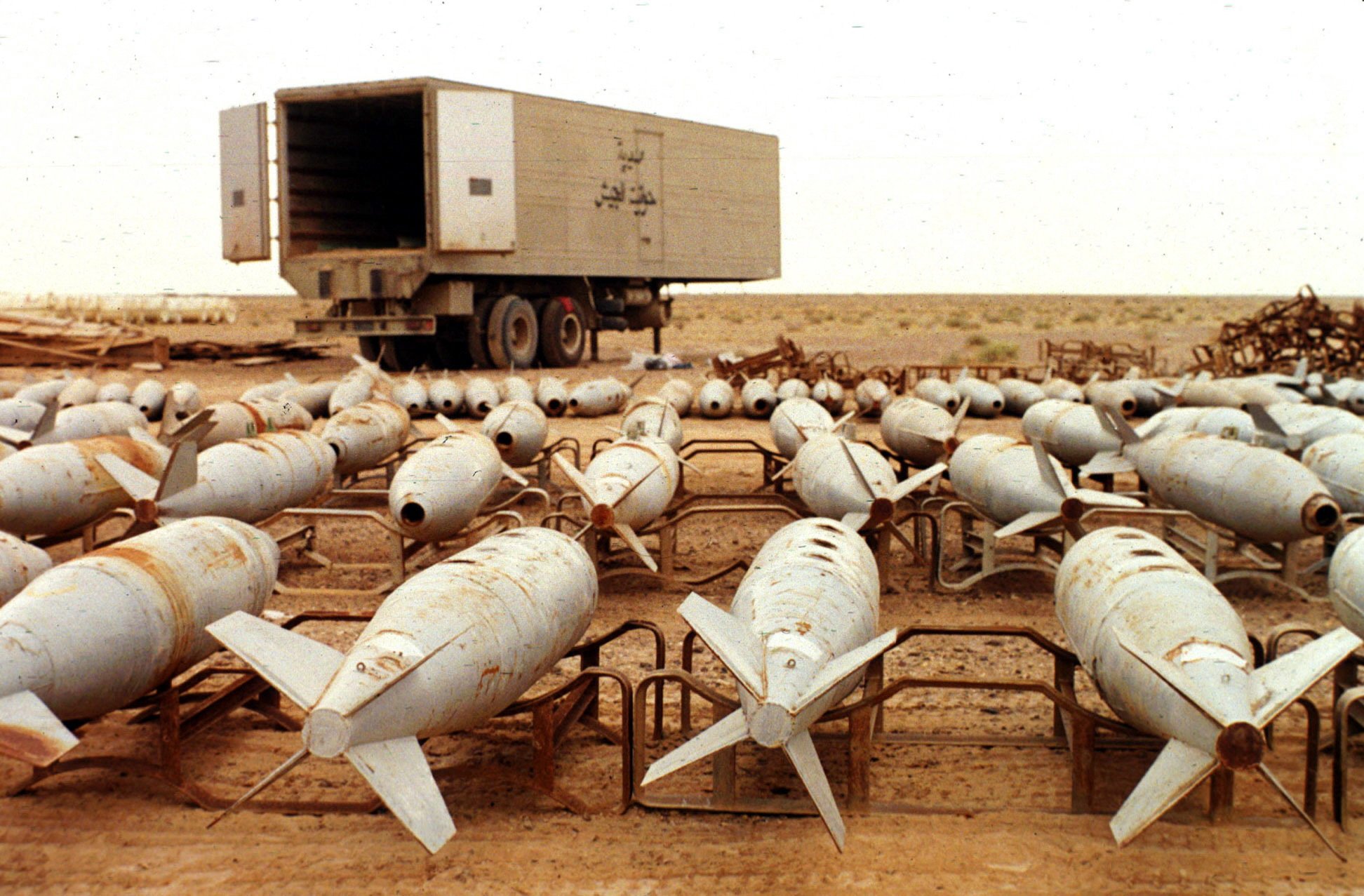
Chemical 500-pound aerial bombs filled with chemical warfare agents await destruction by UNSCOM inspectors in Iraq.
Photo: UNSCOM/UNSCOM/AFP via Getty Images
The environment radically changed after the Cold War ended. The Chemical Weapons Convention (CWC) prohibiting the development and use of these weapons became nearly universal, with 193 State Parties in 1997 (although Syria, Egypt, and Israel did not ratify the CWC due to persistent regional tensions and unresolved arms control concerns). Still, chemical weapons use halted in the region for 25 years—until it reemerged in Syria under Assad. With the Syrian regime’s use of chemical weapons and rising global competition breaking the consensus around shared norms like the CWC, the circumstances may once again be ripe for renewed chemical weapons proliferation and usage in the Middle East and beyond.
To evaluate this prospect, the Center for Strategic and International Studies (CSIS) Middle East Program undertook an investigation to assess the potential return of chemical weapons threats to the Middle East and what the United States could do about it. The project was supported by the Defense Threat Reduction Agency (DTRA), but the findings should in no way be interpreted to reflect the views of DTRA, the U.S. Department of Defense, or the U.S. government.
The project’s methodology is based on desk research, 43 interviews, and a tabletop exercise (TTX). CSIS interviewed current and former U.S. and allied government officials, Organisation for the Prohibition of Chemical Weapons (OPCW) and International Criminal Court (ICC) officials, chemical weapons and arms control experts, prosecutors and investigators, survivors, and Syrian regime defectors. The interviews and the TTX assessed the potential for a second wave of chemical weapons proliferation in the Middle East and identified ways that the United States could curb the threat.
The TTX evaluated potential chemical weapons users’ calculations when deciding whether and what kind of chemical weapons to use and the U.S. government’s response to chemical weapons usage in another country. The 23 participants in the TTX included current and former U.S. State Department, Defense Department, National Security Council, military, and OPCW officials, as well as chemical weapons and country experts. The CSIS-created scenarios centered on Syrian president Bashar al-Assad, Egyptian president Abdel Fattah al-Sisi, and Iranian supreme leader Ali Khamenei as potential chemical weapons users when faced with a significant challenge to their respective regimes. These governments were chosen to reflect states with different alliances, political systems, and histories with chemical weapons, including as developers, proliferators, users, and victims. In the second part of the TTX, teams predicted what a U.S. response to chemical weapons attacks might be and how it could be improved.
CSIS analysis revealed several alarming trends. First, most experts believe that the taboo against chemical weapons use in the Middle East is in danger and has probably already eroded. Interviews and the TTX both reinforced this point. Experts underscored the utility of these weapons’ psychological impacts, instilling terror even when used without great precision. The sobering reality is that weaponized toxic industrial chemicals (TICs) such as chlorine can have many of the same impacts as agents the CWC specifically bars, such as sarin. Consequently, virtually any actor can wield chemical weapons with chilling effectiveness.
CSIS also found that U.S. allies and adversaries are likely learning from Syria’s use of chemical weapons. The Syrian government’s use of Schedule 1 agents such as sarin provoked swift international condemnation, but it used TICs such as chlorine repeatedly with relative impunity. Syria’s experience, combined with ambiguity in the CWC regarding TICs, riot-control agents (RCAs), and pharmaceutical-based agents (PBAs), could tempt some states to escalate attacks with these substances gradually, testing the limits of international accountability.

A girl holds an oxygen mask over the face of an infant following a reported gas attack on the outskirts of Damascus, Syria, on January 22, 2018.
Photo: HASAN MOHAMED/AFP via Getty Images
In addition, approaches can be blended. Assad demonstrated a successful strategy for using Schedule 1 agents sparingly for internal and external deterrence, interspersed with chlorine gas attacks for more tactical military operations. U.S. adversaries may believe that they could survive economic sanctions and other forms of international condemnation just as the Syrian regime did. Experts with whom CSIS consulted assessed that U.S. partners are likely to believe they could use their political leverage for protection against international retribution.
This latter issue points to a larger concern. A more multipolar world makes deterrence and accountability more challenging, if not impossible. With increased great power competition, the experts that CSIS consulted concluded that it will become easier for chemical weapons users to find an international patron that can protect them from accountability. The TTX and expert interviews underscored other tactics that potential users might employ to evade accountability, such as deflecting blame or disseminating disinformation. The support of powerful allies like Russia and China on the world stage would make such strategies more effective.
A more multipolar world makes deterrence and accountability more challenging, if not impossible.
Finally, despite the ease of using TICs as weapons, experts assessed that nonstate actors appear to be a lesser threat to the chemical weapons taboo than state actors. Though governments may blame nonstate actors in “false flag” attacks, nonstate actors’ lack of technical expertise and the widescale availability of conventional weapons limit the likelihood of their usage of chemical weapons. The United States and others may also find it easier and more politically palatable to punish nonstate actors.
Experts noted that the United States could work with its allies, the OPCW, and other international bodies, including the UN General Assembly (UNGA) and the UN Secretary-General’s Mechanism for Investigation of Alleged Use of Chemical and Biological Weapons (UNSGM), to reestablish consensus on the chemical weapons taboo and pursue alternative pathways toward accountability (e.g., courts with international jurisdiction, including the ICC). Given U.S. reluctance to use military means to punish chemical weapons users, the TTX and expert interviews highlighted that prevention was key to discouraging chemical weapons use. The United States should enhance intelligence efforts to detect chemical weapons activity. Then, it should discuss alternatives with allies and backchannel robust threats and incentives to deter adversaries from using chemical weapons and inciting a mass casualty event.
Findings and Recommendations
1) Finding: The taboo against chemical weapons use has been degraded since Syria began using chemical weapons in 2013. As a result, Middle Eastern governments, including U.S. partners and allies, may be willing to use chemical weapons if there is a significant challenge to their regimes.
Middle Eastern governments, including U.S. partners and allies, may be willing to use chemical weapons if there is a significant challenge to their regimes.
1a) Recommendation: The U.S. Department of Defense and the White House, in coordination with high-ranking officials in the Middle East, should further develop a regional security architecture or regional fora similar to the Association of Southeast Asian Nations (ASEAN) to improve lines of communication and reduce the potential for misunderstanding, surprises, and unplanned escalation. This could allow the United States to prevent some actors, especially partners, from using chemical weapons.
1b) Recommendation: The United States should use backchannels to communicate significant threats for using chemical weapons and, potentially, incentives for not using them (e.g., the United States offering to help the Egyptian military quell an insurgency using conventional means). To preempt chemical weapons attacks in this way, the United States will need to develop deeper intelligence capabilities on chemical weapons stockpiles. In Syria, having this capability prior to a major attack gave Washington a window to change Assad’s calculus.
2) Finding: Mediating powers and middle powers may be essential in channeling communications during a potential escalation, making incentives and warnings more effective. For example, both Syria and Egypt’s main concern in the near term is the loss of Gulf support. If the United States can win the support of Gulf states to uphold the norm, threats will be more effective.
2a) Recommendation: U.S. diplomats and military officials should work with these mediating powers to reestablish red lines on arms control and chemical weapons usage and to deliver messages to potential chemical weapons users during times of increased threat. They could relay the message that there is widespread consensus on the need to pursue accountability if chemical weapons are used.
2b) Recommendation: In return for existing defense and diplomatic ties, U.S. diplomats should encourage these states to act as linkages and mediators to deescalate tensions when a neighbor is facing significant challenges.
3) Finding: States could likely act with impunity if they eased into chemical weapons use. Learning from the Syria example, actors could test the limits of international outrage and condemnation and gradually raise the threshold of objectionable behavior. For example, they could start using RCAs in lethal ways, and then graduate to using TICs or PBAs. These chemicals, in combination with sporadic usage of Schedule 1 and 2 chemicals, could inspire fear among opposition forces or in communities while limiting an international response due to the ambiguity on their usage in the CWC.
3a) Recommendation: U.S. diplomats should work with allies to condemn the Syrian government’s regularized use of chlorine gas and bar further normalization with the Syrian regime. U.S. diplomats in the United Nations should work with other states in UNGA to develop a consensus around prohibited uses for RCAs, TICs, and PBAs.

Ahmet Uzumcu, director general of the Organisation for the Prohibition of Chemical Weapons, speaks in Paris on January 23, 2018, during a meeting discussing sanctions and criminal charges against the perpetrators of chemical attacks in Syria.
Photo: JACQUES DEMARTHON/AFP via Getty Images
3b) Recommendation: U.S. diplomats in The Hague should work with other member states, the OPCW, and private companies, in tandem with experts at the Chemical and Biological Controls Division, the Office of Chemical and Biological Weapons Affairs, DTRA, and the Australia Group to better regulate the movement, storage, and usage of dual-use chemicals, TICs, RCAs, and PBAs.
4) Finding: Chemical weapons users are likely to spread disinformation and impede the collection of evidence to evade accountability. This limits the effectiveness of investigations and encourages usage, gradually deteriorating the CWC.
4a) Recommendation: The Department of Defense—including DTRA—should support the development of evidence collection technologies such as “drone sniffers” and lab materials that would make it easier to collect evidence and train trusted organizations or civil society members to gather evidence when needed.
4b) Recommendation: The U.S. State Department’s CBW and DTRA’s Information Resiliency Office should work together to strengthen the credibility of the OPCW, local evidence collectors, and chemical weapons experts. These efforts should focus not only on the gathering of evidence, but also on incorporating the help of communications experts. The U.S. government should also continue to support the OPCW ChemTech Centre.
4c) Recommendation: The Department of Defense should continue to seek support for, and even strengthen, DTRA’s Information Resiliency Office to protect the agency from disinformation. These efforts should be expanded to interagency efforts with the State Department and the UN mission to prevent the effectiveness of disinformation directed at other relevant U.S. government entities.
5) Finding: Chemical weapons do not stand alone. They are integrated into a broader warfighting toolkit. Governments use chemical weapons in conjunction with other military tactics, such as conventional explosive weapons and sieges, to amplify fear among armed adversaries and civilians alike. U.S. officials may underestimate the motivations for using chemical weapons because they judge the “success” of chemical weapons through direct casualty numbers rather than their broader military—and psychological—effects.
5a) Recommendation: DTRA should analyze the secondary effects of chemical weapons usage by collecting evidence and testimony on their usage when used alongside conventional weapons to assess their tactical benefits beyond direct casualty figures. With such information, the United States may better predict why an actor would use them, prevent proliferation and attacks, and strengthen accountability for these secondary uses.
6) Finding: Nonstate actors appear to be a lesser threat to the chemical weapons taboo than state actors.
6a) Recommendation: Scholars should conduct further research to determine if new delivery mechanisms and the accessibility of certain types of TICs could increase the threat of nonstate actors using chemical weapons.
7) Finding: Escalating tensions between the United States and Russia, coupled with fractures in the international community, challenge existing mechanisms for chemical weapons control and accountability.
7a) Recommendation: To reverse the normalization of chemical weapons usage and the breakdown of other norms, U.S. diplomats should launch a preemptive and aggressive multilateral campaign to hold chemical weapons users to account. For this multilateral approach to be effective, the United States needs to work more closely with members of the Global South and with China to ensure that such measures (e.g., investigations, sanctions, asset freezes, travel bans, etc.) are effective.
To reverse the normalization of chemical weapons usage and the breakdown of other norms, U.S. diplomats should launch a preemptive and aggressive multilateral campaign to hold chemical weapons users to account.
7b) Recommendation: To widen support of the CWC and accountability efforts, DTRA should assess the strategic reasons that actors—including adversaries such as China and allies and partners such as Egypt or India—would want to prevent the proliferation and usage of chemical weapons.
7c) Recommendation: The United States and its allies and partners should consider supporting an entity separate from the OPCW and UNSC that would attribute violations and hold violators criminally liable. They should ensure that any such entity embraces a diverse membership. The Working Group to Advance Proposals for International Criminal Accountability for Chemical Weapons Use established in September 2024 and composed of 12 states from around the world is one step toward such an effort.
7d) Recommendation: The Department of Justice, the United States Ambassador-at-Large for Global Criminal Justice, and diplomats with the OPCW and partners should enhance measures within and outside of the OPCW that would strengthen CWC prohibitions and ensure that those responsible for crimes involving chemical weapons will be brought to justice. For example, INTERPOL Washington, the U.S. National Central Bureau, should support specialized training projects for law enforcement officers, prosecutors, and judges. The United States and allies should also further develop the capacity of the OPCW’s Investigation and Identification Team to interface with national and international legal systems to prosecute those that have used chemical weapons.
7e) Recommendation: U.S. diplomats at the UN mission and partners should explore avenues for coalition-building around accountability and investigations within the United Nations. The United States should build coalitions with nonpermanent UNSC members and UNGA to enhance and broaden support for accountability for noncompliance with the CWC. The UNGA-created International, Impartial, and Independent Mechanism (IIIM) to assist in the investigation and prosecution of persons responsible for the most serious crimes committed since March 2011 is a good example of how effective such efforts can be. The IIIM helps to preserve evidence that states with universal jurisdiction could use for prosecution. The United States should also work to strengthen the UN Secretary-General’s Mechanism for Investigation of Alleged Use of Chemical and Biological Weapons (UNSGM) to investigate chemical weapons uses when CWC procedures do not apply or are not invoked by any State Party.
7f) Recommendation: U.S. diplomats should consider focusing on the elimination of chemical weapons in the Middle East as the first step in a broader effort to uphold the Conference on the Establishment of a Middle East Zone Free of Nuclear Weapons and Other Weapons of Mass Destruction.
Natasha Hall is a senior fellow with the Middle East Program at the Center for Strategic and International Studies (CSIS) in Washington, D.C.
The author would like to express her thanks to the many experts and practitioners who shared their knowledge and insights for extended interviews and tabletop exercises. Each brought many decades of research and experience, and their wisdom and support made this report possible.
She is grateful for support from CSIS colleagues Jon Alterman and Danny Sharp on conceptualizing the project. A special thanks goes to Martin Pimentel, who provided research and programmatic support, as well as others who assisted with the tabletop exercise, including CSIS colleagues Leah Hickert, and Gregory Dgheim and interns Joshua Phillips and Aiden Aronoff. The author would also like to express her gratitude to the team at the CSIS iDeas Lab for designing the final product.
The Defense Threat Reduction Agency (DTRA), as part of the Strategic Trends Research Initiative, sponsors strategic research projects under Broad Agency Announcement HDTRA1-22-S-0004. DTRA sponsored the Center for Strategic and International Studies to conduct this research examining the risks of chemical weapons usage in the Middle East. This report analyzes the growing willingness of states to develop and deploy chemical weapons and policy options for the U.S. government to deter chemical weapons usage. The views expressed herein are those of the authors and do not necessarily reflect the official policy or position of DTRA, the U.S. Department of Defense, or the U.S. government.
Please consult PDF for references.
